

This Policy Brief is based on Christian Buelens (2026), Gone, But Not Forgotten: Inflation Perceptions And Attention After The Post-Pandemic Inflation Surge, Quarterly Report on the Euro Area (QREA), vol. 25(2). The views expressed in this document are solely those of the author and do not necessarily express the views of the European Commission.
Abstract
Despite rapid disinflation following the post-pandemic inflation surge, euro area citizens have remained highly attentive to inflation, as well as concerned by it. One of the most evident post-pandemic scars is citizens’ perception that inflation significantly exceeds official figures. Given the magnitude of the post-pandemic price level shift and its adverse consequences for households, the persistence of elevated inflation perceptions and inflation attention can be seen as part of an understandable and likely “post-traumatic” reaction. This policy brief argues that this condition entails several risks, both macro-economic, and political and institutional. It notably creates a fertile ground for the de-anchoring of inflation expectations and weighs on economic activity by dragging down consumer sentiment. An open—yet timely—question is to what extent the experience of the post-pandemic inflation surge will condition consumer behaviour in reaction to future adverse supply shocks, which are expected to become more frequent.
Just as meteorologists distinguish between actual and apparent—or “feels like”—temperature, economists distinguish between actual and perceived inflation. In both cases, perceptions should broadly track their precisely measured counterparts. Yet general and personal factors can drive a wedge between the two, and the size of that wedge may vary over time. Perceptions matter because they shape behaviour. A person deciding whether to wear a coat responds to the temperature they perceive, not necessarily the one reported by the weather service. Similarly, households and firms form expectations and make consumption, saving, wage, and pricing decisions based, at least partly, on their perceptions of inflation, which need not coincide with official inflation measures.
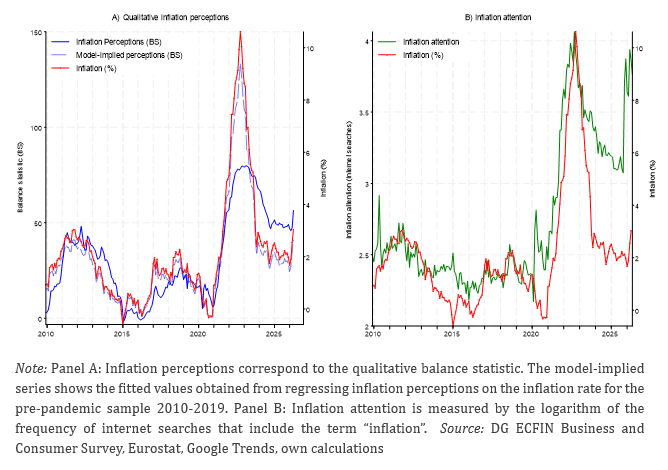
In the case of inflation, the post-pandemic inflation surge appears to have opened a substantial inflation perceptions gap (Graph 1). While euro area inflation fell relatively rapidly from its peak of 10.6% in October 2022 and returned to levels consistent with the inflation target by 2024, both perceived inflation and inflation attention declined only gradually and have remained persistently elevated. The remainder of this policy brief discusses some of the implications and risks associated with an inflation perception gap in an era in which adverse supply shocks are likely to become more frequent.
Graph 1. Qualitative inflation perceptions and inflation attention in the euro area
Previous research has shown that living through periods of high inflation leaves scars and has potentially lifelong consequences for the formation of inflation beliefs (Malmendier and Nagel, 2016). This is consistent with a wide-spread dislike of inflation, which is reported to trigger emotional reactions and stress (Stancheva, 2024), notably related to the ability of affording essentials or having to cut down on other expenses.
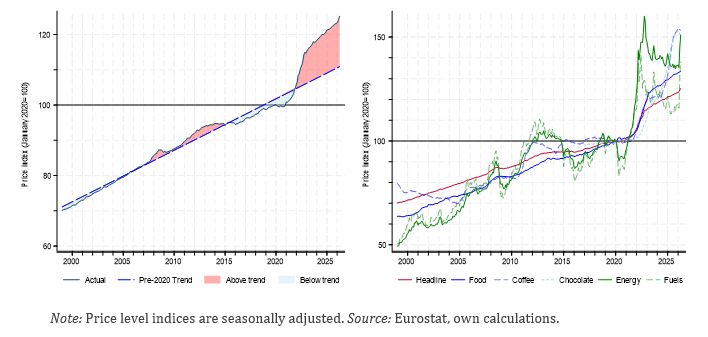
The post-pandemic inflation surge contained many of the necessary ingredients to persistently upset inflation beliefs. First, there is the sheer magnitude and exceptionality of the price level shock: while the general price level broadly followed the pre-pandemic linear inflation trend in the two decades running up to the pandemic, it jumped between end 2021 and early 2023 (Graph 2, left panel). In early 2026, the price level was almost 15% above that trend, a level that should only have been reached in 2031, if prices had continued to grow at their pre-pandemic speed. Another characteristic of the post-pandemic price surge was that it was concentrated in prices of salient items, such as energy and food (Graph 2, right panel), which consumers often use as gauges to infer changes in the general price level.
Since end 2023, inflation perceptions have clearly exceeded levels that would be consistent with actual inflation (Graph 1). Based on the pre-pandemic relationship between inflation and inflation perceptions, the inflation rate consistent with current (qualitative) inflation perceptions would be about 2 percentage points above the official rate.
Graph 2. Post-pandemic price level shock and salient prices
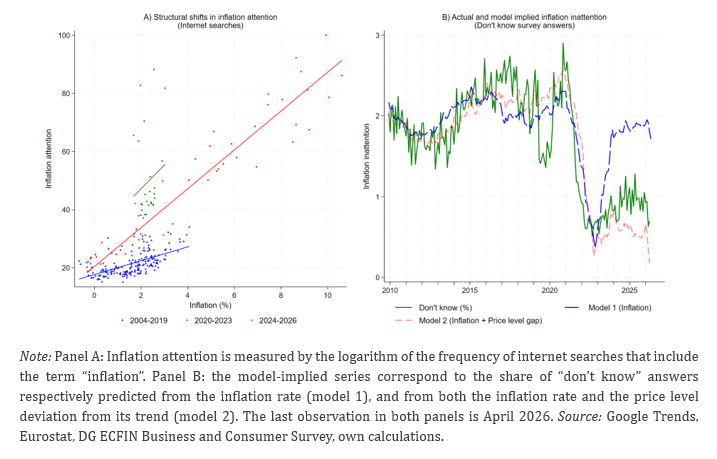
Likewise, the persistence of elevated inflation attention – which, broadly speaking, measures how frequently and how deeply individual think about inflation – also points to a structural shift. Households now devote more attention to inflation, at any given inflation rate, than they did before the pandemic. This is illustrated in Graph 3 (panel A), which shows that the relationship between inflation attention (as measured by the intensity of internet searches for the term “inflation”) and inflation has shifted up, and become steeper, since the pandemic. Recent estimates for the euro area indicate that the post-pandemic increase in inflation attention is equivalent to a 1.3 percentage point increase in the inflation rate (Buelens, 2025).
A similar structural shift can be observed in the share of “don’t know” responses to survey questions on perceived inflation, which provides another proxy for attention to inflation.1 The post-pandemic inflation episode appears to have affected inflation perceptions not only through the ‘intensive margin’, with survey participants reporting higher perceived inflation, but also through the ‘extensive margin’, as a larger share of individuals now hold a view on inflation in the first place (Buelens and Lindén, 2025). Prior to the inflation peak in 2022, most of the variation in the share of “don’t know” responses could be explained by the prevailing inflation rate alone (‘Model 1’ in the Graph). Since then, however, this simple relationship has broken down. A significantly better explanation of the low share of respondents who do not express a view on inflation is obtained by augmenting this model with the deviation of the price level from its pre-pandemic trend (‘Model 2’ in the Graph). This finding points to a lasting imprint of the post-pandemic price-level shock on households’ attention to inflation.
Beyond consumers’ direct experience of rising prices, the prominence of inflation in the public discourse has likely contributed to heightened inflation attention. Objectively, inflation-related media coverage has remained substantially higher than would have been expected, based on pre-pandemic relationships between inflation and media reporting (Aarab et al., 2025). More anecdotally, the emergence of numerous catchy neologisms built around the term “inflation” – such as “greedflation” or “shrinkflation” – echo the continued relevance of inflation in the public debate, while also creating negative connotations that allude to consumer harm. While the impact of extensive media coverage and public discussion of inflation is difficult to quantify, it may trigger expectancy confirmation-mechanisms (Traut-Mattausch et al., 2004), by which individuals’ inflation perceptions are not only shaped by observed price changes, but also prior beliefs about them.
Graph 3. Inflation attention
Given the magnitude and characteristics of the post-pandemic inflation surge, the persistence of elevated inflation perceptions and inflation attention should not be entirely surprising. Nevertheless, it may have several macro-relevant implications, running through different channels, and pose various risks.
Inflation expectations. The most immediate risk—and one of particular concern to central banks—is that elevated inflation perceptions, rather than actual inflation, may spill over into inflation expectations (Dräger, 2015). Expectations of persistently high inflation may contribute to second-round effects by leading workers to demand higher wages to preserve purchasing power and by inducing firms to raise prices to protect profit margins. Such responses can give rise to wage-price spirals and more persistent inflationary dynamics. Recent evidence shows that elevated inflation perceptions indeed increase the likelihood that households form their inflation expectations in a more adaptive manner and place greater weight on perceived recent price developments (De Fiore et al., 2025; Bussière et al., 2026). Consistent with this, Pfäuti (2025) shows that the frequency with which inflation expectations are updated is a positive function of the degree of inflation attention and thereby influences inflation dynamics. In a high-attention regime, the more frequent updating of inflation expectations can thus prolong the inflationary effects of adverse supply shocks.
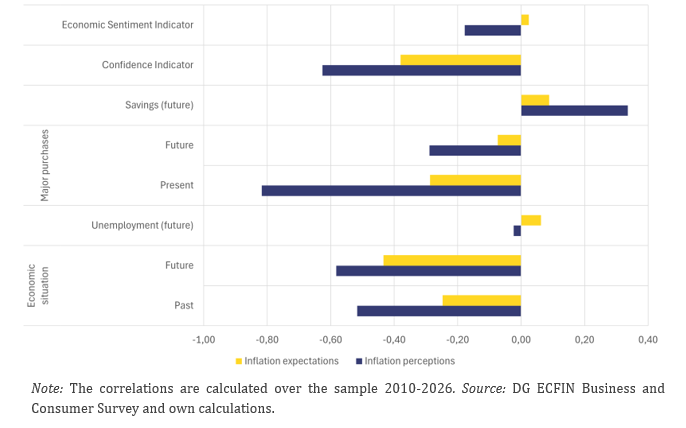
Macro-relevant behavioural shifts. Everything else equal, rising prices erode households’ real incomes and wealth, and increase the cost of living, which fosters greater caution and pessimism among consumers. Considering the association between inflation perceptions and expectations on the one hand, and various dimensions of consumer sentiment on the other is quite telling (Graph 4). Inflation perceptions are strongly negatively correlated with overall consumer confidence, insinuating that perceptions of high inflation are closely associated with a more pessimistic assessment of economic conditions. In other words, changes in inflation perceptions tend to coincide with broader shifts in households’ economic outlook. High perceived inflation, even if not reflected in official data, may thus have important behavioural consequences, as it is associated with a lower propensity to make major purchases, both in the present and in the future, as well as a stronger inclination to save, rather than spend. Such reactions would hold back private consumption and economic activity more generally. Consistent with this interpretation, elevated inflation perceptions are also associated with more negative expectations regarding households’ future economic situation.
Trust erosion and political consequences. High inflation can have far-reaching consequences extending well beyond its direct economic effects. This is for instance the case when it risks being perceived as a symptom of weak economic governance. The low degree of inflation attention observed during the pre-pandemic decades has at times been interpreted as a sign of success for inflation-targeting central banks (Coibion et al., 2020). By the same token, elevated inflation may be perceived as evidence of policy failure on the part of central banks, or government in the broader sense. This risk is particularly pronounced when households are unable to correctly identify the underlying drivers of inflation or to distinguish between endogenous shocks and supply shocks arising from external factors.
Rising inflation attention in a high inflation environment may erode trust in public institutions generally and weaken confidence in central banks’ ability to maintain price stability (Guillochon and ter Ellen, 2025; van der Cruijsen et al., 2025). The political consequences of high inflation may be significant (Aytaç et al., 2025). Federle, Mohr, and Schularick (2024) find that unexpected inflation increases support for populist parties, which in turn has substantial economic costs (Funke, Schularick, and Trebesch, 2023).
Graph 4. Correlations of inflation beliefs with other dimensions of consumer sentiment
Despite the rapid disinflation following the post-pandemic inflation surge, inflation has remained a widely publicised issue that continues to preoccupy euro area citizen and to which they remain extremely attentive. The most evident post-pandemic legacy is that citizen perceive inflation to be significantly higher than it is. The magnitude of the post-pandemic price level shift, the concentration of price rises in salient products, and many of the narratives around the inflation surge make it difficult to shrug off. The persistence of elevated inflation perceptions and inflation attention can thus be seen as an understandable and likely “post-traumatic” reaction. The persistence of these inflation perceptions and attention gaps creates several risks, both macro-economic, and political and institutional. It creates a fertile ground for the de-anchoring of inflation expectations but also weighs on economic activity by dragging down consumer sentiment. Additionally, high inflation perceptions and attention may weigh on institutional trust. An open question is to what extent the experience of the post-pandemic inflation surge will shape consumer behaviour in response to future inflationary shocks. Structural shifts related to climate change, geopolitical tensions, or disruptions to international trade could increase the frequency of adverse supply shocks in the future, potentially triggering ‘here we go again’ reflexes and increasing the risk of inflation expectations becoming de-anchored.
Aarab, I., Bańbura, M., Bobeica, E. and Leguay, E., 2025, Monitoring attention to inflation in the news. ECB Economic Bulletin, Issue 6/2025.
Aytaç, S.E., McDowell, D. and Steinberg, D.A., 2025, Inflation and Incumbent Support: Experimental Evidence from the 2024 US Presidential Election. British Journal of Political Science, 55, p.e127.
Buelens, C. 2025, Googling ‘inflation’: Household inflation attention across the euro area, European Journal of Political Economy, Volume 89.
Buelens, C. and S. Lindén, 2025, Self-Reported and Revealed Inflation Inattention, DG ECFIN Discussion Paper 225
Buelens, C. 2026, Gone, But Not Forgotten: Inflation Perceptions And Attention After The Post-Pandemic Inflation Surge, Quarterly Report on the Euro Area (QREA), vol. 25(2).
Bussière, M., J. Gilbert, and O. Grishchenko, 2026, “The Role of Inflation Perceptions in Consumer Inflation Expectations: Evidence from the Euro Area,” Finance and Economics Discussion Series 2026-038. Washington: Board of Governors of the Federal Reserve System.
Coibion, O., Gorodnichenko, Y., Kumar, S. and Pedemonte, M., 2020, Inflation expectations as a policy tool?. Journal of International Economics, 124, p.103297.
De Fiore, Sandri and Yetman, 2025, Household perceptions and expectations in the wake of the inflation surge: survey evidence, BIS Bulletin 104.
Dräger, L., 2015, Inflation perceptions and expectations in Sweden – Are media reports the missing link?. Oxf Bull Econ Stat, 77: 681-700.
Federle, J.J., Mohr, C. and Schularick, M., 2024, Inflation surprises and election outcomes (No. 2278). Kiel Working Paper.
Funke, M., Schularick, M. and Trebesch, C., 2023, Populist leaders and the economy. American Economic Review, 113(12), pp.3249-3288.
Guillochon, J. and ter Ellen, S., 2025, Inflation concern, attention and central bank trust. Journal of Economic Behavior & Organization, 239, p.107268.
Malmendier U., S. Nagel, Learning from Inflation Experiences, The Quarterly Journal of Economics, Volume 131, Issue 1, February 2016, Pages 53–87.
Pfäuti, O., 2025. Inflation—who cares? Monetary policy in times of low attention. Journal of Money, Credit and Banking, 57(5), pp.1211-1239.
Stantcheva S., 2024, Why Do We Dislike Inflation? (April 2024). NBER Working Paper No. w32300.
Traut‐Mattausch, E., Schulz‐Hardt, S., Greitemeyer, T. and Frey, D., 2004. Expectancy confirmation in spite of disconfirming evidence: The case of price increases due to the introduction of the Euro. European Journal of Social Psychology, 34(6), pp.739-760.
van der Cruijsen, C., de Haan, J. and van Rooij, M., 2025. The association of high perceived inflation with trust in national politics and central banks. Journal of Banking & Finance, 171, p.107368.
A lower share of “don’t know” responses indicates that a higher share of individuals holds a view on inflation.
