

This policy brief is based on Di Pace, Mangiante and Masolo (2026). The views expressed are those of the authors and do not necessarily represent those of the Banca d’Italia, the Eurosystem, or the authors’ institutions.
Abstract
Brexit illustrates how trade fragmentation can raise the cost of living even when inflation eventually subsides. Using synthetic no-Brexit counterfactual, we estimate that UK consumer prices were around 7% higher by the end of 2024, accounting for more than one-quarter of the increase in the price level since the referendum. The adjustment unfolded in two phases: an initial phase consistent with sterling depreciation after the vote, and a later phase consistent with higher trade costs after the Trade and Cooperation Agreement. Exchange-rate, output, financial-market, and item-level evidence support this interpretation. For policymakers the distinction matters: stabilising inflation need not reverse a persistent increase in the price level.
Trade fragmentation raises a question that matters to households and central banks alike: do new barriers to trade generate a temporary inflation episode or a lasting increase in the cost of living? Brexit provides a rare case study of economic disintegration in an advanced economy with deep trade and production links to its neighbours. It also unfolded in stages, combining news about future trade barriers with their later implementation, which allows us to separate the two.
The June 2016 referendum changed expectations about the future UK–EU relationship, but the form and timing of withdrawal remained uncertain during the negotiations. The Trade and Cooperation Agreement (TCA), applied from January 2021, then changed trading conditions. Although it preserved tariff-free trade for qualifying goods, it introduced new non-tariff barriers. The economic adjustment could therefore begin with news about future costs and continue as those costs materialized.
We construct a synthetic UK, or Doppelgänger: a weighted average of other economies chosen to reproduce UK consumer-price dynamics and macroeconomic characteristics before the referendum. Our quarterly sample runs from 1993 to the end of 2024. We then compare actual UK CPI with the path of this no-Brexit benchmark.
This comparison helps account for shocks shared with donor economies, such as the COVID-19 pandemic and the energy-price surge following Russia’s invasion of Ukraine. Its causal interpretation rests on the assumption that, absent Brexit, UK prices would have continued to follow the synthetic path. UK-specific developments unrelated to Brexit remain a potential source of divergence, a limitation we return to below.
Figure 1. UK consumer prices and the synthetic counterfactual
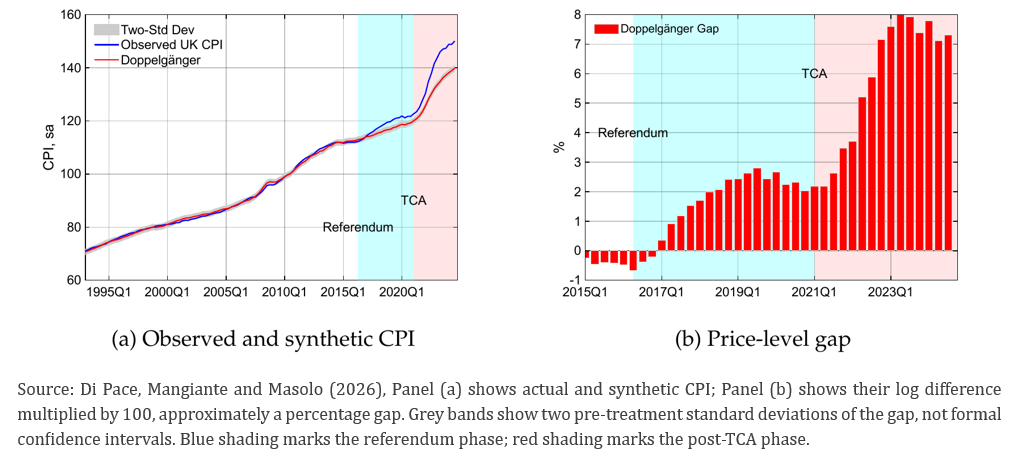
As shown in Figure 1, by 2024Q4, the estimated gap was around 7%, equivalent to about 0.8 percentage points of additional annual inflation on average since the referendum. It accounts for more than one-quarter of the overall increase in UK consumer prices over that period.
During the referendum phase, from July 2016 to December 2020, the gap opened gradually following the depreciation of sterling. The initial adjustment stabilized around mid-2019, with UK prices roughly 2.9% above the benchmark, consistent with the earlier consumer-price evidence in Breinlich et al. (2022).
In the post-TCA phase, from January 2021 onwards, the gap widened more sharply. Its quarterly change suggests that this second adjustment largely stabilized around 2023Q2. Our decomposition attributes most of the 2021–2024 inflation surge to the synthetic benchmark — that is, to shocks common across advanced economies — but still estimates a Brexit-related contribution of up to 3 percentage points to annual inflation in 2022 and early 2023.
We apply the same counterfactual approach to the broad nominal effective exchange rate (NEER) and real GDP. These exercises help assess whether the consumer-price result is consistent with an adverse trade shock. The results are reported in Figure 2.
Figure 2. Exchange rates and real activity
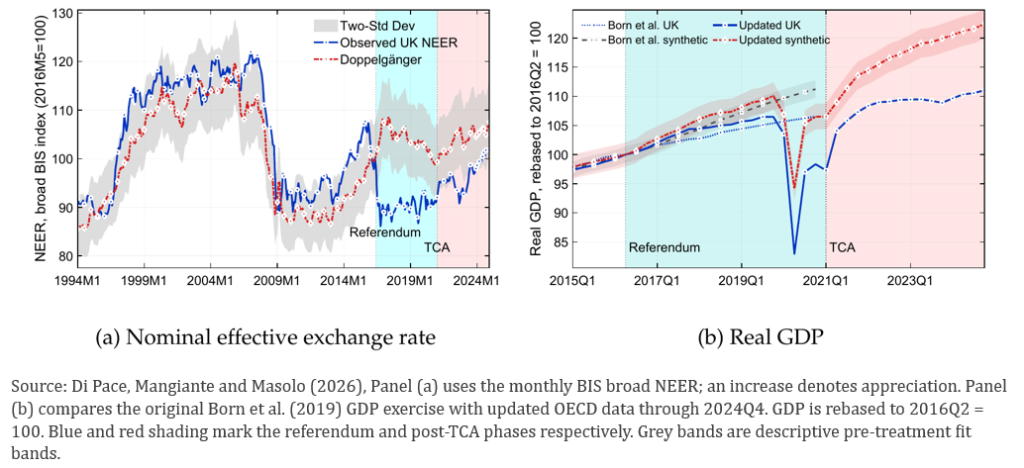
Sterling falls sharply relative to its synthetic counterpart after the referendum, whereas the CPI gap builds over roughly three years. This timing is consistent with gradual exchange-rate pass-through: contracts, inventories, and distribution margins can delay the effect of higher import costs on retail prices. It does not imply that a depreciation passes through one-for-one into consumer prices.
Around the TCA, sterling begins to recover towards its synthetic path even as the CPI gap widens again. The second price acceleration therefore coincides with a partial currency recovery rather than another discrete depreciation. Higher administrative costs and other trade frictions offer a plausible explanation for the continued pressure on import costs.
The GDP comparison updates Born et al. (2019) with revised data and a longer sample. UK activity underperforms its counterfactual, with a more visible gap after withdrawal—consistent with the weaker growth path documented by Bloom et al. (2026). We use this as supporting evidence on the nature of the shock: higher prices alongside weaker activity point to adverse supply effects, in line with the news-based interpretation of Brexit developed by Broadbent et al. (2024).
To examine transmission more directly, we extend the narrative Brexit-event chronology of Geiger and Güntner (2024) beyond 2020, adding legal, policy, and border-friction announcements such as the delay of UK import controls in April 2022 and the Windsor Framework in 2023.
On these event dates, we measure surprises using the relative share-price performance of large firms with greater versus less exposure to UK revenues. Daily regressions over 2016–2024 show that adverse Brexit surprises raised short- and medium-horizon inflation-linked swap rates, while the longer-horizon measure responded little. These results support an inflationary news channel, conditional on the assumption that the relative equity movements on the selected dates predominantly reflect Brexit news.
We also examine monthly CPI items covering goods and services, matched to annual import-penetration measures constructed from ONS Supply-Use Tables. After the referendum, a one-standard-deviation increase in lagged import exposure is associated with approximately 1.5 percentage points higher year-on-year item inflation. The pattern survives alternative exposure measures, including fixed 2010 exposure and EU-goods imports. Specifications that allow for exchange-rate effects over three annual windows also find additional post-TCA inflation in import-exposed categories, conditional on exchange-rate movements.
These results describe differences within the consumption basket, not the aggregate price effect. Month fixed effects absorb inflation movements common to all items, but they do not eliminate other shocks that affect import-exposed categories more strongly. The micro evidence therefore supports the proposed channels without uniquely isolating trade frictions from every competing explanation.
Inflation can subside while consumer prices remain persistently above their counterfactual path. In our estimates, UK and synthetic CPI eventually resume similar growth rates, but the accumulated price gap remains. Lower inflation therefore need not undo the increase in the cost of living associated with the earlier adjustment.
For monetary policy, the challenge is to distinguish temporary inflation from persistent changes in costs and productive capacity. A trade shock that raises prices while weakening activity creates a policy trade-off. The muted response of longer-horizon inflation compensation to Brexit news is consistent with anchored expectations, but it does not mean that households avoid a lasting price-level increase.
For trade policy, retaining low tariffs does not guarantee unchanged trading costs. Administrative requirements and other non-tariff barriers can raise prices, including those of goods and services that rely on imported inputs.
Assessments of trade fragmentation should track consumer prices and the timing of adjustment, not only trade flows and output. Brexit illustrates why the end of an inflation episode need not mark the end of the economic effects of a trade shock: the price-level increase can persist long after inflation returns to target.
Born, B., Müller, G. J., Schularick, M. and Sedláček, P. (2019). The costs of economic nationalism: Evidence from the Brexit experiment. The Economic Journal, 129(623), 2722-2744.
Breinlich, H., Leromain, E., Novy, D. and Sampson, T. (2022). The Brexit vote, inflation and UK living standards. International Economic Review, 63(1), 63-93.
Bloom, N., Bunn, P., Mizen, P, Smietanka P., Thwaites, G., Abrams, S. (2026). The Economic Impact of Brexit. NBER Working Paper 34459.
Broadbent, B. et al. (2024). The Brexit vote, productivity growth, and macroeconomic adjustments in the U.K. The Review of Economic Studies, 91(4), 2104-2134.
Di Pace, F., Mangiante, G. and Masolo, R. M. (2026). Brexit and the cost of living: A tale of two phases. Working paper, September.
Geiger, M. and Güntner, J. (2024). The chronology of Brexit and UK monetary policy. Journal of Monetary Economics, 142, 103516.