

This policy brief is based on OECD ARTIFICIAL INTELLIGENCE PAPERS March 2026 No. 57. The views expressed are those of the authors and not necessarily those of the institutions the authors are affiliated with.
Abstract
Productivity gains from AI are expected to be significant, but how international trade shapes the cross-country distribution of these gains remains an open question. In our new analysis, we argue that AI-driven productivity gains will vary widely across countries and are expected to raise per capita real income growth – our measure of welfare – by 0.1–0.95 percentage points annually over the next decade in our central scenario. A key insight is that while countries lagging in AI adoption can gain from cheaper imports of goods and services whose production benefits from AI, maintaining competitiveness in global markets – especially in highly AI-exposed sectors – ultimately requires strong domestic AI adoption.
Weak productivity growth has weighed on living standards across much of the OECD (Fernald, Inklaar and Ruzic, 2025; Goldin et al, 2024). Several recent assessments suggest AI could help revive productivity, although the debate about the size and timeline of the effect is ongoing (Acemoglu, 2025; Aghion and Bunel, 2025; Filippucci, Gal and Schief, 2024). Most estimates of AI’s macroeconomic gains, however, focus on domestic productivity effects, which is only part of the story in an integrated world economy. Indeed, countries can also benefit when AI lowers the cost of imported goods and services, but they can also lose ground if foreign competitors adopt faster and domestic firms struggle to keep pace with declining world market prices.
Our recent work (Filippucci et al, 2026) combines evidence on task-level productivity gains, sectoral AI exposure, and projected AI adoption with a global multi-country, multi-sector trade model. This makes it possible to trace how AI affects welfare – measured by per capita real income – over the next decade through imports, exports, and global value chains. Building on the micro-to-macro setup introduced by Acemoglu (2025) and on our earlier work (Filippucci, Gal and Schief, 2024; Filippucci et al., 2025), this paper features a global production network with trade in intermediate and final goods and services (Cakmakli et al, forthcoming). It covers 76 countries (all OECD and G20 economies) and 45 sectors, calibrated using OECD Inter-Country IO (ICIO) tables (Yamano et al, 2023) and augmented by international spillovers. It allows us to decompose how much of a country’s AI gains come from domestic and foreign sources.
The three key empirical components of the aggregation framework are micro-level gains, sectoral exposure to AI and projected future adoption rates. While we rely on previous evidence for micro-level gains, we extend exposure estimates based on the sectoral composition of different countries. Moreover, given that globally harmonised measures on systematic, regular AI adoption by firms are not readily available, we construct a novel dataset with harmonised AI use measures, including estimates for countries where the underlying statistics are not available. Our preferred measure captures AI use in core business functions, such as the production of goods and services. We compute it after a series of harmonisation and adjustment steps, extending our previous calculations for G7 economies (Filippucci et al, 2025). According to these estimates, high-intensity AI adoption in core business functions stands around 4% on average across OECD countries, ranging from about 0.2% in Mexico to about 7% in Ireland (Figure 1).
Figure 1. The expected increase in AI adoption varies a lot across countries
Current and future adoption (in 10 years) based on the S-shaped adoption paths of previous GPTs, % of businesses
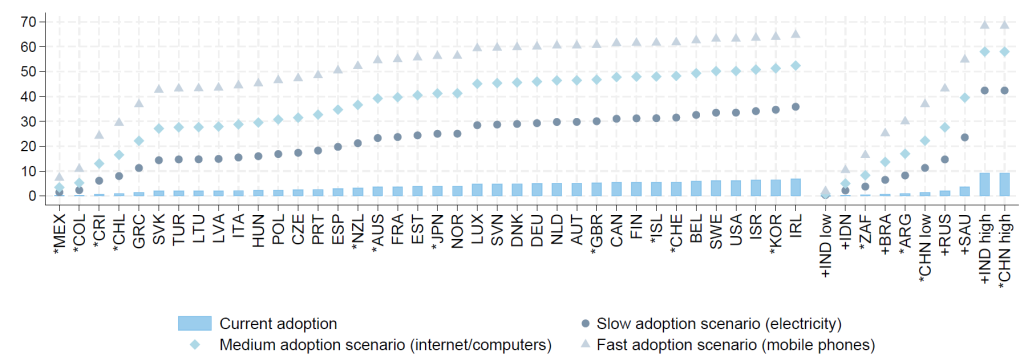
Note: Current adoption rates refer to estimates for 2024. They are built from official national statistics after harmonisation and adjustment steps. When data limitations do not allow for this (marked by “∗”), adoption rates are imputed based on predictions as a function of the digital infrastructure, skills, and innovation. For more details, see the source.
Source: Filippucci et al. (2026).
Each country’s future AI adoption trajectory is pinned down by its current adoption rate and assumptions about the speed of future adoption. For these speed parameters, we draw on empirical evidence from the adoption dynamics of earlier technologies, such as the historical adoption paths of electricity (slow), computers and the internet (medium), and more recently mobile phones (rapid). Figure 1 shows the resulting range of projected adoption rates across countries and scenarios. While recent adoption trends, falling access costs, and the user-friendly nature of language-based generative AI suggest faster uptake, deeper integration into core business functions will probably still require major investments in data, skills, and business process reorganization, in the spirit of the J-curve hypothesis (Brynjolfsson, Rock and Syverson, 2021).
We feed the country-sector level productivity gains into a global multi-sector general equilibrium model (Cakmakli et al, forthcoming) to obtain aggregate welfare effects. The results reveal large cross-country differences in the expected welfare gains over the next decade (Figure 2). In the medium-paced adoption scenario, AI contributes to per capita real income growth over the next decade by 0.1 to 0.95 percentage points in annual terms. Mexico and Colombia are near the lower end of the range, consistent with lower projected adoption and a smaller role for knowledge-intensive services. Luxembourg, Switzerland, and the United States sit near the top, reflecting both stronger AI adoption capacity and greater exposure through sectors such as finance and ICT. In the rapid adoption scenario, the gains reach just below 1.2 percentage points per year, comparable to the ICT-driven productivity boom of mid-1990s, which was estimated to contribute by 1 to 1.5 percentage points annually in the United States (Byrne, Oliner and Sichel, 2013; Bunel et al., 2024).
Figure 2. AI’s macroeconomic gains are expected to vary widely across countries
Predicted per capita real income gains from AI over the next 10 years (annualised percentage points)
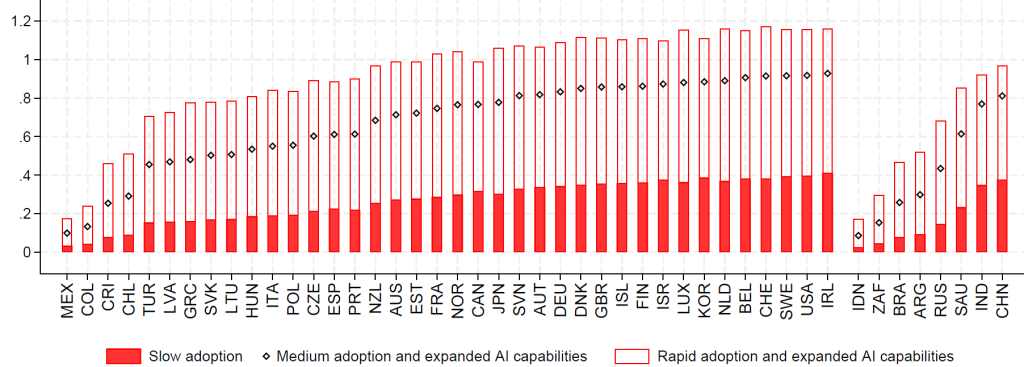
Note: This figure shows per capita real income gains from AI depending on the speed of AI adoption and on underlying AI capabilities.
Source: Filippucci et al. (2026).
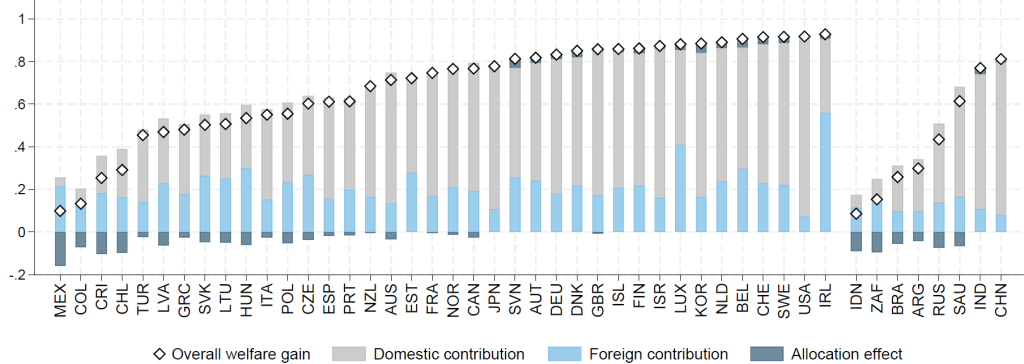
Trade shapes these gains through three channels. First, foreign AI adoption can lower the prices of imported intermediate and final goods and services. Second, it can alter a country’s competitiveness in global markets, regarding both export and domestic markets. Third, trade links can speed local AI adoption by helping firms learn from leading adopters. Figure 3 decomposes each country’s welfare gains into domestic and foreign contributions. Foreign AI adoption makes a sizable contribution to domestic living standards by lowering import prices. The gains vary widely across countries. Highly open economies with import baskets tilted toward AI-intensive services, such as Luxembourg and Ireland, benefit more. Lower-adoption economies in Europe and Latin America gain less in absolute terms, but foreign contributions can still account for up to half of their total gains. In short, trade helps spread AI gains beyond the frontier, especially when countries are closely linked to AI-intensive sectors and leading adopter economies.
Figure 3. Foreign productivity gains from AI benefit incomes through cheaper import prices
Predicted per capita real income gains from AI over the next 10 years (annualised percentage points)
Note: Average annual real business investment growth (2014–23). Panel B shows the US–OECD (ex-US) growth gap split by asset type; digital is split into ICT and non-ICT sectors. OECD aggregates are GDP-PPP weighted.
Source: Source: Filippucci et al. (2026)
That does not mean, however, that countries can “free ride” on foreign AI adoption, that is, benefitting from AI via trade even without domestic adoption. To illustrate this point, we run a series of country-by-country experiments. In each experiment, one country does not adopt AI while all others do, and we then estimate the gains for the non-adopting country (Figure 4). These experiments show that in most countries, the gains from foreign-only AI adoption are small. For the median OECD country, such gains are only about 0.03 percentage points a year in per capita real income growth. The reason is that while cheaper imports help consumers and downstream firms, the non-adopting country’s producers lose competitiveness at home and abroad as they cannot sufficiently keep up with price declines induced by AI. The competitiveness loss is especially large for small open economies such as Ireland and Luxembourg, for countries specialised in highly AI-exposed services such as the United Kingdom and Israel, and for commodity exporters facing strong price competition. For these countries, domestic adoption is a particularly important condition for remaining competitive.
Figure 4. Without domestic AI adoption there is a loss in competitiveness
Predicted per capita real income gains due to AI over the next 10 years in a series of experiments capturing “AI adoption only in foreign countries” scenarios; in percentage points (annualised)
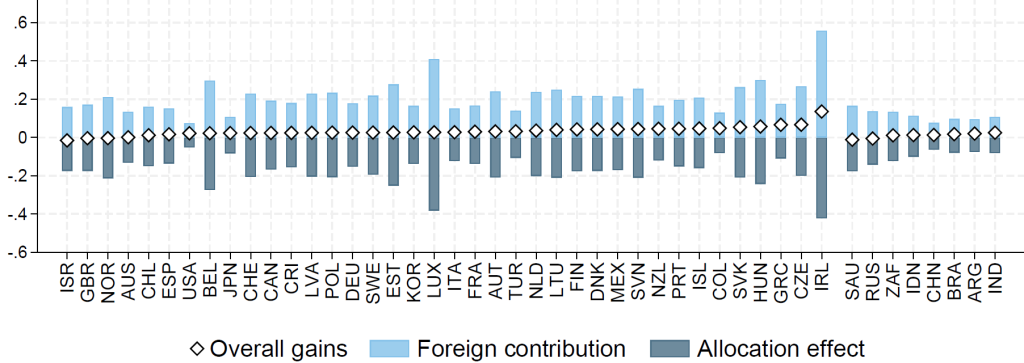
Note: This graph decomposes sources of the gains when a country does not adopt AI but other countries do. The “foreign contribution” is the same under global adoption (Figure 3) and foreign only adoption (this Figure). The “Allocation effect” captures the loss of global sales and lower export prices in case a country does not adopt AI domestically. For more details, see the source. Source: Filippucci et al. (2026)
Trade may also transmit benefits across borders through other channels than prices. Countries can learn about AI applications from their trading partners, a mechanism rooted in the broader literature on international knowledge spillovers (Grossman and Helpman, 1991). For instance, AI adoption rates may end up being larger, all else equal, in countries that source a large share of their intermediate inputs from leading AI adopters. We therefore present a separate exercise to quantify this channel. Figure 5 suggests that spillovers calibrated from earlier evidence based on patenting (Berkes, Manysheva and Mestieri, 2022) are modest. We also construct a stronger illustrative scenario, in which the strength of trade-related spillovers is calibrated so that Latin American economies with close trade links to the United States experience an AI adoption boost comparable to the projected adoption gains of the lowest-adopting European economies (bottom 10% of EU) over the next decade. We then use this calibrated – stronger – spillover to recompute the projected income gains from AI. Under this scenario, Mexico’s projected gains roughly triple, while gains in Chile, Costa Rica, and Colombia rise by 40% to 90%. Several Central and Eastern European economies as well as Greece receive an additional boost of around 30% to 40%. Even then, country rankings change only modestly. Learning from trading partners can help narrow gaps, but it does not fully erase them.
Figure 5. Knowledge spillovers can further boost real-income gains through faster AI adoption thanks to learning from trading partners
Predicted per capita real income gains from AI over the next 10 years (annualised percentage points)
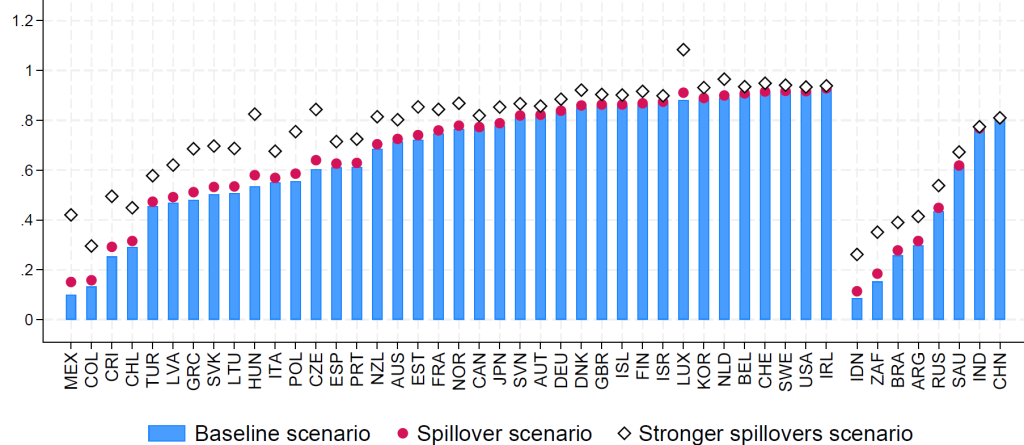
Note: The standard spillover scenario builds on previous literature on innovation (patents), and the stronger one uses an illustrative alternative which leads to about six times as strong spillovers.
Source: Filippucci et al. (2026)
International trade helps countries benefit from AI through cheaper imports and knowledge spillovers. However, without domestic adoption, competitiveness losses can offset much of the benefit. To maximise the gains from AI, policymakers should prioritise improving domestic adoption capacity, through strengthening digital infrastructure, data centres, skills, innovation capacity, and reliable energy supply. International openness remains important: low barriers to digital services trade allow firms to access leading AI models, a pre-requisite for realizing domestic productivity gains through adoption.
Acemoglu, D., (2025), “The simple macroeconomics of AI”, Economic Policy, 40(121), 13–58, https://doi.org/10.1093/epolic/eiae042.
Aghion, P., and Bunel, S., (2024), “AI and growth: where do we stand”, Technical report, Mimeo LSE.
Baqaee, D. R., and Farhi, E., (2024), “Networks, barriers, and trade”, Econometrica, 92(2), 505–541, https://doi.org/10.3982/ECTA17513.
Berkes, E., Manysheva, K., and Mestieri, M., (2022), “Global innovation spillovers and productivity: Evidence from 100 years of world patent data”, Discussion Paper DP17285, CEPR.
Brynjolfsson, E., Rock, D., and Syverson, C., (2021), “The productivity j-curve: How intangibles complement general purpose technologies”, American Economic Journal: Macroeconomics, 13(1), 333 372.
Bunel, S., Bijnens, G., Botelho, V., Falck, E., Labhard, V., Lamo, A., Rohe, O., Schroth, J., Sellner, R., Strobel, J., and Anghel, B., (2024), “Digitalisation and productivity”, Occasional Paper Series 339, European Central Bank.
Byrne, D., Oliner, S. D., and Sichel, D., (2013), “Is the information technology revolution over?”, International Productivity Monitor, 25, 20–36.
Cakmaklı, C., Demiralp, S., Kalemli-Ozcan, C., Yesiltas, S., and Yıldırım, M. A., (fortchoming), “The economic case for global vaccinations: An epidemiological model with international production networks”, Review of Economic Studies.
Fernald, J., Inklaar, R. and Ruzic, D. (2025), The Productivity Slowdown in Advanced Economies: Common Shocks or Common Trends?. Review of Income and Wealth, 71: e12690. https://doi.org/10.1111/roiw.12690
Filippucci, F., Gal, P., Laengle. K., Schief, M. and Yildirim, M.A. (2026) “AI meets trade: Global linkages and the cross-country distribution of the gains from AI”, OECD Artificial Intelligence Papers No. 57, https://doi.org/10.1787/13081644-en
Filippucci, F., Gal, P. and Schief, M. (2024), “Miracle or Myth? Assessing the macroeconomic productivity gains from Artificial Intelligence”, OECD Artificial Intelligence Papers, No. 29, https://doi.org/10.1787/b524a072-en.
Filippucci, F., Gal, P., Laengle, K., and Schief, M., (2025), “Macroeconomic productivity gains from Artificial Intelligence in G7 economies”, OECD Artificial Intelligence Papers, No. 41, https://doi.org/10.1787/a5319ab5-en.
Goldin, I., Koutroumpis P., Lafond, F. and Winkler, J. (2024), “Why is productivity slowing down?”, Journal of Economic Literature 62(1): 196–268.
Grossman, Gene M. & Helpman, E, 1991. “Trade, knowledge spillovers, and growth,” European Economic Review, Elsevier, vol. 35(2-3), pages 517-526, April.
Yamano, N., Alsamawi, A., Webb, C., Cimper, A., Zürcher, C., and Chiapin Pechansky, R., (2023), “Development of the OECD Inter Country Input-Output Database 2023”, OECD Science, Technology and Industry Working Papers, No. 2023/08, OECD Publishing, Paris, https://doi.org/10.1787/5a5d0665-en.