

This policy brief is based on BIS working paper no. 1295. The views expressed in this policy brief are those of the authors and do not necessarily reflect those of the Bank for International Settlements or the World Bank.
Abstract
Fast payments are transforming the global payments landscape by providing instant, secure and accessible payment solutions. The adoption of fast payments has surged globally, with over 120 jurisdictions implementing or planning fast payment systems (FPS). Around the world, fast payments are enhancing financial inclusion and reducing transaction costs. But the sustainability of FPS hinges on effective pricing strategies. This policy brief explores global practices in FPS pricing at the system, participant and end user levels. It highlights key trade-offs in balancing adoption and market incentives with the help of economic theory and outlines broader policy implications for pricing fast payments effectively.
Fast payments, also known as instant or real-time payments, are transforming the way that individuals and businesses transact. Fast payment systems (FPS) enable near-instant transfer of funds between accounts on a 24/7 basis, offering a secure and efficient alternative to cash and card payments. Over 120 jurisdictions have implemented FPS, with 266 billion fast payments made globally in 2023. Fast payments accounted for 19% of all digital payments in 2023 and are projected to reach 27% by 2028 (ACI Worldwide, 2024).
The benefits of fast payments extend beyond convenience. New evidence shows that they can enhance financial inclusion, reduce cash dependency and spur savings in formal financial institutions (Aurazo et al, 2025a; Sarkisyan, 2023). For small and medium-sized enterprises (SMEs), fast payments can reduce costs and improve cash flow. For households, they provide immediate access to funds and increase income (Dubey and Purnanandam, 2023; Alok et al, 2025). Additionally, fast payments generate valuable transaction data, which underbanked individuals and businesses can leverage to access other services like credit (Aurazo et al, 2024).
Notwithstanding the increasing popularity of fast payments around the world, there are open questions around the best ways to expand participation of payment service providers (PSPs) and end users in FPS. A central theme of discussions is the role of pricing in expanding the use of fast payments. This policy brief starts by describing different participants and their pricing relationships in an FPS. We then draw insights from global practices and economic theory to shed light on designing sustainable and inclusive FPS.
Fast payments are provided through FPS which operate in a collaborative ecosystem involving multiple stakeholders and layers. Key participants include the FPS owner (often a central bank or a private entity or consortium), payment service providers (PSPs) like banks or fintech companies, and end users (payers and payees). An FPS usually consists of five layers. First is the infrastructure or the technical backbone consisting of clearing and settlement systems. The next layer consists of the scheme rules, which are the operational guidelines and rules for all the participants in the FPS. The third layer consists of the types of payment instruments that the FPS can enable. The fourth layer comprises value-added services built on top of the FPS infrastructure. These can include enabling payments through quick response (QR) codes, or using aliases like phone numbers to make payments. The final layer consists of the use cases that the FPS enables, including person to person (P2P) payments, person to merchant (P2M) payments and government to person (G2P) payments.
There are three main pricing relationships in an FPS: (i) between the FPS owner and participants (system level); (ii) among participants themselves (participant level); and iii) between the participants and their customers / end users (end user level). Graph 1 illustrates these relationships. Pricing arrangements in FPS can vary with the ownership model (public, private or hybrid), funding from the public sector or alternate revenue streams of private sector participants. They can also reflect the intended role of an FPS in a jurisdiction’s broader payment ecosystem – for example, supporting public policy goals such as financial inclusion.
Graph 1. Fees involved in a simple FPS design
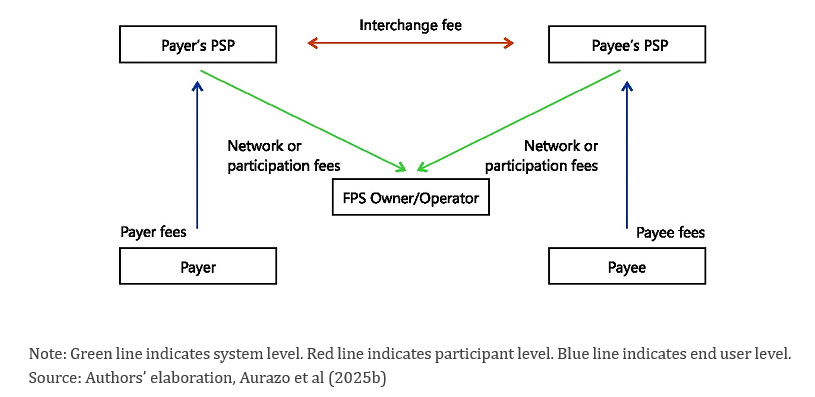
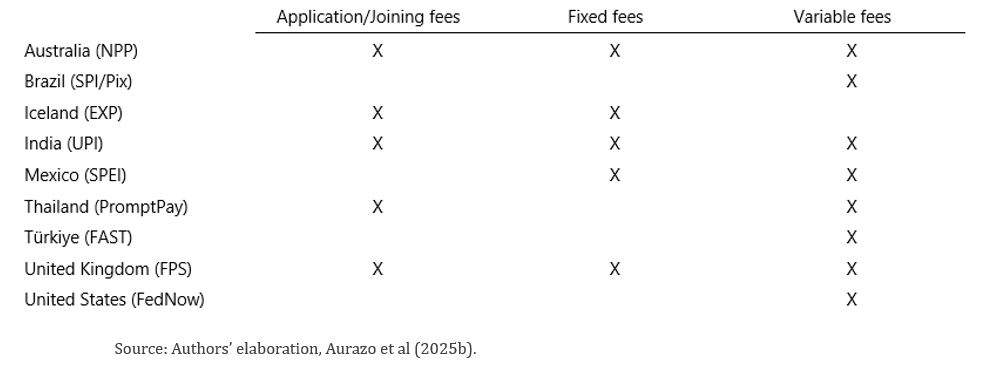
At the system level, the FPS owner can charge fees to the PSPs that are a part of the scheme. These can include joining/application fees, fixed fees to be paid on a monthly or annual basis or variable fees that are paid on a per-transaction basis. For example, in Thailand’s PromptPay system, participants pay a joining fee that depends on PSP size and transaction volume. In Brazil’s Pix, only the receiving PSP is charged, so as to incentivise adoption. Table 1 provides examples from other jurisdictions.
At the participant level, there can be interchange fees between different PSPs. For instance, merchant PSPs may pay interchange fees to individual PSPs to balance costs and incentivise adoption. In India, no fees are charged to merchants for P2M transactions to encourage usage. In Brazil, merchant fees for Pix are typically 0.3–0.35% of the transaction value.
Table 1. Examples of different categories of system-level fees introduced by FPS
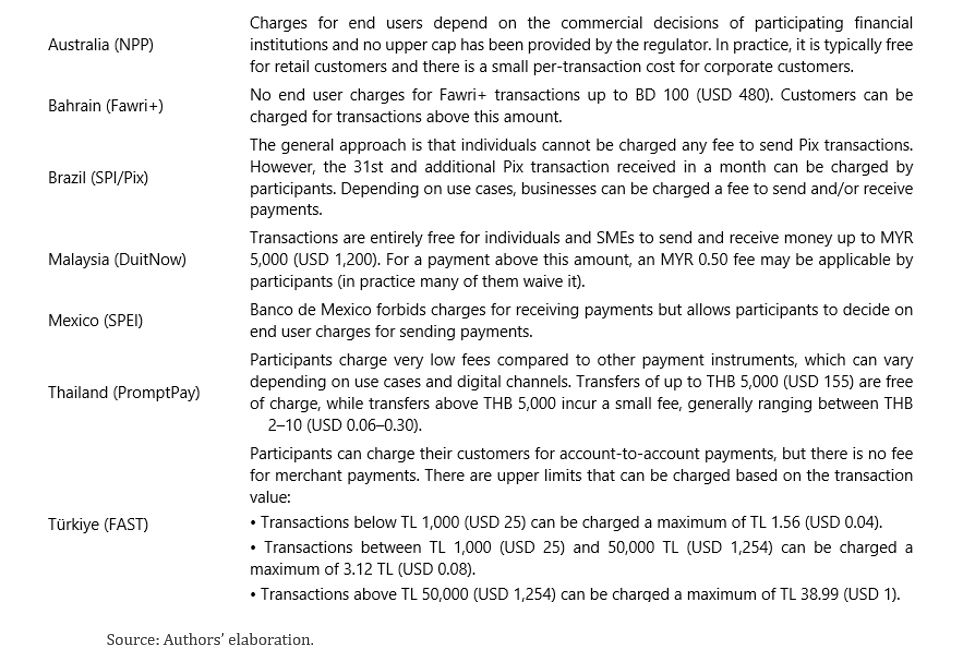
Finally, at the end user level, participating PSPs may charge fees to the ultimate users of fast payments (merchants, businesses or individuals). In general, most FPS offer free P2P transactions for both the payer and payee to incentivise adoption. For P2M transactions, the pricing strategies vary across jurisdictions. Some FPS, for instance in India and Mexico, waive off any fees for merchants. Other jurisdictions like Türkiye impose a maximum fee for merchants by regulation. In some jurisdictions, like Brazil, merchant fees are market determined by the PSPs. Other illustrative examples of end-user pricing schemes are presented in Table 2. The goal of pricing at all three levels is to balance cost recovery with expanding usage and in some cases, generating profits.
The existing theoretical literature on pricing in card payments can be instructive to understand pricing schemes for the P2M fast payments use case. The P2M transaction takes place in a two-sided market. On one side are individuals that wish to make a payment to purchase a product. On the other side are merchants that sell products and accept payments. The payment goes through the FPS network and the PSPs on each side of the market enable it. Our set-up includes five types of agents: a mass of heterogeneous individual consumers, homogeneous merchants, distinct PSPs on each side of the market and the FPS network owner. There are three key prices in this case: the fees charged to the individual, the fees charged to the merchant and the interchange fee charged by one PSP to the other.1
Through a simple expository model, we document four main findings. In the absence of external subsidies, data monetisation or cross-selling by PSPs, it is not viable to provide P2M fast payments if individual fees, merchant fees and interchange fees are all zero. Second, when the merchant’s benefit of accepting fast payments is higher than the per transaction cost of providing fast payments, even with a zero individual fee (and non-zero interchange fee), usage will be lower than is socially optimal. Third, usage is even lower than in the second case when the merchant fee is zero (while allowing for non-zero individual and interchange fees). Finally, if PSPs’ per transaction cost of providing fast payments is reduced, or set to zero, the demand for fast payments increases both in the socially optimal benchmark case and when the FPS network maximises the volume of fast payments.
Table 2. Examples of different end-user pricing in FPS
Pricing strategies for fast payments vary widely across countries and evolve with market maturity, policy goals and competition. Models range from zero-fee regimes (often regulated and aimed at public-good objectives like financial inclusion, as in India) to market-based pricing (as in the United States), with hybrids in between (for example, Brazil’s no-fee P2P and capped P2M). Many jurisdictions differentiate P2P and P2M fees to spur consumer adoption while enabling incentives and revenues for PSPs. Tiered pricing schemes (as in Nigeria or Costa Rica) keeps low-value transactions affordable while preserving viability for higher values. These strategies are tailored to local conditions, use cases, and the broader payments landscape.
Zero-fee policies can rapidly scale usage but require ongoing evaluation to avoid under-provision, competitive distortions and sustainability risks – particularly for P2M transactions and for specialised providers with limited cross-selling options. Zero-fee regimes can also favour larger participants with deep pockets. Alternative revenue streams and operational innovations are often essential to sustain fast payments with zero-fee policies, but bundling free fast payments with fee-generating instruments can raise competition concerns.
Regulators and central banks play a pivotal role in governing pricing policies, especially where FPS are publicly owned or cost-recovery-based. Approaches range from India’s and Mexico’s regulation mandated zero fee FPS and the Single European Payment Area’s (SEPA’s) rule against premium pricing for instant transfers. Ultimately, effective pricing is context-specific and evolves over time. Hybrid models, targeted support and differentiated fees, balanced with regular reassessment, can help sustain inclusion, innovation and the long-term viability of fast payment ecosystems – including in underserved areas where users may accept reasonable premiums for speed and reliability. Well-designed pricing schemes can thus contribute to better outcomes for all users and participants.
Alok S, P Ghosh, N Kulkarni and M Puri (2024): “Cross-Platform Digital Payments and Customer-Driven Data Sharing: Implications for Credit Access”, National Bureau of Economic Research (NBER) Working Paper, no 33259.
Aurazo, J, C Franco, J Frost, P Koo Wilkens, A Kosse, V Shreeti and C Velasquez (2024): “The design and adoption of fast payments”, Journal of Payments Strategy & Systems 18 (4), 366-380.
Aurazo, J, C Franco, J Frost and J McIntosh (2025a): “Fast payments and financial inclusion in Latin America and the Caribbean”, BIS Paper, no 153.
Aurazo, J, H Banka, G Galicia, N Ramteke, V Shreeti and K Tanaka (2025b): “Pricing in fast payments: a practical and theoretical overview”, BIS working papers no. 1295.
Dubey T S and A Purnanandam (2023): “Can cashless payments spur economic growth?”, online at https://dx.doi.org/10.2139/ssrn.4373602
Sarkisyan, S (2023), “Instant payment systems and competition for deposits”, November, online at https://papers.ssrn.com/abstract=4176990
Key assumptions in our expository model include: i) benefits from accepting fast payments are homogeneous across merchants, ii) there is perfect competition between PSPs on each side, iii) fees charged by FPS owner to PSPs are exogenously determined by regulation, and iv) pricing of other payment instruments does not impact pricing of fast payments. Relaxing these assumptions will be a key avenue for future research.