

This SUERF Policy Brief is based on ECB Working Paper Series No 3271, “Financial frictions across the production network and the transmission of monetary policy,” part of the research network “Challenges for Monetary Policy Transmission in a Changing World Network” (ChaMP). The paper is available here. The views expressed are those of the authors and do not necessarily reflect those of the European Central Bank or the Eurosystem.
Abstract
How monetary policy transmits to output and prices depends not only on a sector’s own financial health, but also on the financial conditions its suppliers and customers face. We show that these indirect, network-level financial frictions amplify the effects of monetary policy and empirically dominate the direct ones in a panel of euro area countries and sectors. The amplification arises from a downstream demand channel: customers buy fewer inputs when policy tightens. This is only partly offset by an upstream cost channel, whereby suppliers raise prices to protect margins. At its peak, the network-based amplification is roughly three times as large as the direct effect. These results show that financial conditions along the supply chain play a quantitatively important role in the transmission of monetary policy.
A large body of literature in monetary economics finds that financial frictions matter for how interest rate changes by the central bank transmit through the economy. For instance, firms and sectors with weaker financial positions may respond more strongly to a tightening because their access to external finance is more constrained.[1]
But firms do not operate in isolation. They buy inputs from suppliers and sell output to customers, embedding each sector in a web of production linkages. This raises a question that has received less attention so far: does a sector’s response to monetary policy depend only on its own balance sheet, or also on financial conditions of firms in other sectors it trades with?
Our research shows that the latter seems to be the case and, in fact, the network dimension appears quantitatively more important than the direct, own-sector effect.
To study this question, we construct novel measures of financial frictions that go beyond the individual sector. Combining firm-level balance sheet data with input-output tables for a broad panel of euro area countries and sectors, we build indicators of financial frictions not only for each sector itself, but also for its suppliers (upstream) and its customers (downstream).
We then use these measures to estimate how frictions located at different points along the supply chain shape the response of sectoral output and prices to monetary policy rate shocks. This allows us to separate three distinct forces:
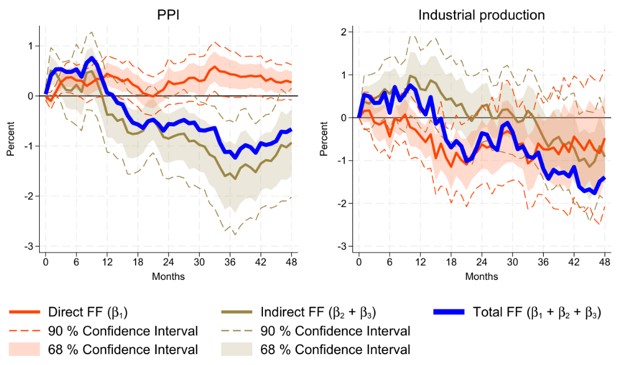
The results suggest that the network dimension of financial frictions is quantitatively more important than the direct effect of a sector’s own financial position (Figure 1). At its peak, the amplification effect on prices of monetary policy operating through financial frictions in the broader production network is estimated to be roughly three times as large as the direct effect.
This means that, if one wants to understand how strongly a given sector reacts to a change in interest rates, looking at its own balance sheet is not enough. What matters more is the financial position of the firms surrounding it in the production chain.
Figure 1. Impulse responses to monetary policy tightening shock
(direct vs. indirect financial frictions effects)
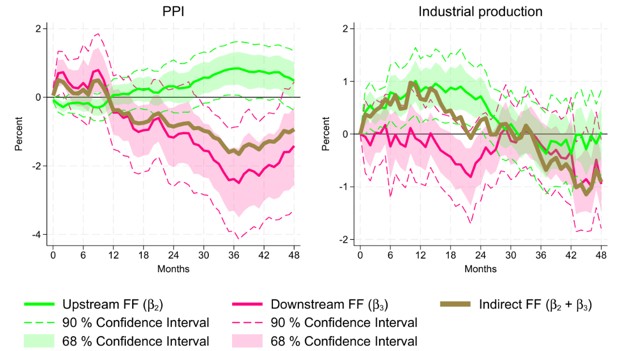
A central contribution of the paper is to show that the upstream and downstream frictions a specific sector faces operate through distinct and opposing channels (Figure 2).
The downstream demand channel. When downstream customers face more restrictive financial conditions following a monetary policy tightening, they cut back their purchases of intermediate inputs. This reduction in demand reinforces the contractionary impact of policy on both output and prices — pushing in the same direction as the intended effect of tightening.
The upstream cost channel. When upstream suppliers face tight financial conditions, they respond differently: they raise their prices to protect margins as financing costs rise. Higher input prices propagate down the chain, partially offsetting the disinflationary effect of the tightening.
These two forces pull in opposite directions but do not cancel out: the downstream demand channel dominates in the aggregate. As a result, network-level financial frictions amplify rather than dampen the transmission of monetary policy.
Figure 2. Impulse responses to monetary policy tightening shock
(upstream vs. downstream financial frictions effects)
To understand the economics behind these empirical patterns, we develop a multi-sector general equilibrium model featuring input-output linkages and sector-specific financial frictions in the form of working-capital constraints — that is, firms must finance part of their production costs before revenues are realised.
The model shows analytically how the two channels operate. On the one hand, tighter financing conditions raise suppliers’ effective marginal costs, which they pass on through higher prices (the upstream cost channel). On the other hand, financially constrained customers scale back their input demand (the downstream demand channel). The theoretical model reproduces also the empirical finding that the demand-side force dominates, so that frictions embedded in the production network magnify the output and price responses to policy.
The findings carry several messages for policymakers.
First, assessing the transmission of monetary policy requires a network perspective. Gauging how strongly a rate change will feed through to activity and inflation cannot rely on sector-by-sector balance-sheet indicators taken in isolation. The financial health of suppliers and customers is crucial.
Second, when financial frictions are larger, monetary policy will have a stronger impact. Conversely, when balance sheets across the production network are strong, transmission may be more muted.
Third, the upstream cost channel is a genuine but limited counterforce. Suppliers’ margin-protecting price increases can mitigate the disinflationary effect of tightening, a mechanism relevant for interpreting the transmission lags of monetary policy in periods in which price pressures and interest rate rises coincide. However, in the aggregate this force is outweighed by the demand-side contraction originated downstream.
Bernanke, B. S., & Gertler, M. (1995). Inside the black box: the credit channel of monetary policy transmission. Journal of Economic perspectives, 9(4), 27-48.
Bernanke, B. S., Gertler, M., & Gilchrist, S. (1999). The financial accelerator in a quantitative business cycle framework. Handbook of macroeconomics, 1, 1341-1393.
De Sanctis, A., Gebauer, S., Holm-Hadulla, F., & Sirani, M. (2026). Financial frictions across the production network and the transmission of monetary policy. ECB Working Paper Series, No 3271.
Ottonello, P., & Winberry, T. (2020). Financial heterogeneity and the investment channel of monetary policy. Econometrica, 88(6), 2473-2502.
While the amplifying role of financial frictions has long been central to monetary policy transmission (Bernanke and Gertler, 1995; Bernanke et al., 1999), recent evidence highlights substantial heterogeneity. Ottonello and Winberry (2020), for example, find that less financially constrained firms exhibit stronger investment responses to monetary policy shocks, as steeper marginal financing costs limit the response of constrained firms.