

This policy brief is based on S&P Global Ratings Economic Research April 2026. This policy brief does not constitute a rating action. S&P Global Ratings believes there is a high degree of unpredictability around the duration and scale of the Middle East war, and its potential effect on commodity prices, supply chains, economies, and credit conditions. As a result, the baseline forecasts carry a significant amount of uncertainty.
Key Takeaways
Europe is no stranger to energy supply shocks. Most recently, in 2022, the region was roiled by the sudden loss of Russian oil and gas imports following international sanctions responding to the Russia-Ukraine war. S&P Global Ratings considers that tensions in the Middle East, which are again disrupting Europe’s energy markets, are giving rise to risks to the broader economic landscape.
Energy shocks are rarely a single blow; instead, they tend to unfold in stages. The first phase is the direct hit, with higher oil and gas prices squeezing households and businesses and increasing costs across the economy–though oil prices and gas prices feed into European end markets at different speeds. These price increases then typically extend rapidly beyond energy markets, affecting Europe’s domestic supply chain within a few quarters. A third phase can follow if trade friction intensifies, with bottlenecks emerging as imports from affected regions are delayed or curtailed.
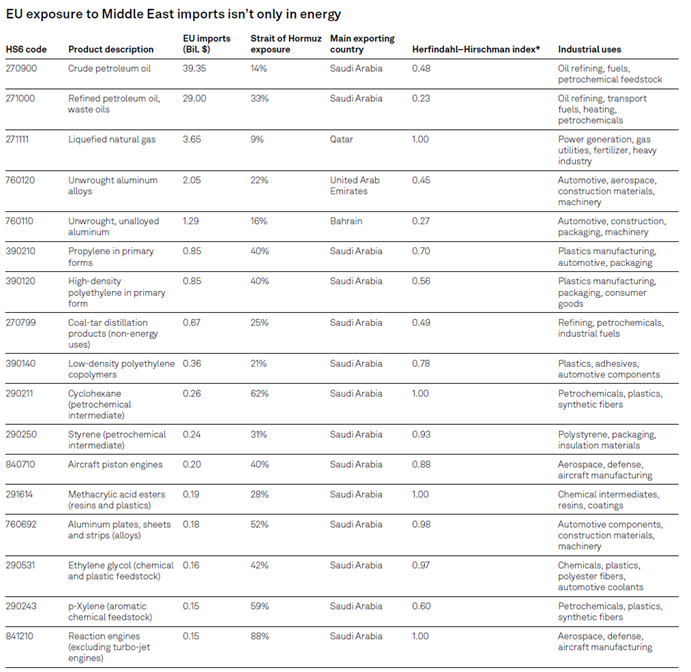
Europe’s exposure to Middle East exports is material. The EU imports about $110 billion of goods from the region each year (equating to about 4% of total EU goods imports), about half of which come from Saudi Arabia and Iraq. This exposure extends beyond energy, with about $40 billion of non-energy imports reliant on safe passage through the Strait of Hormuz.
Furthermore, continued higher inflation may pressure European central banks to raise policy rates, increasing borrowing costs and potentially weakening confidence. Deteriorating financing conditions could then accelerate the transmission of stresses to the real economy, broadening the impact of the energy shock.
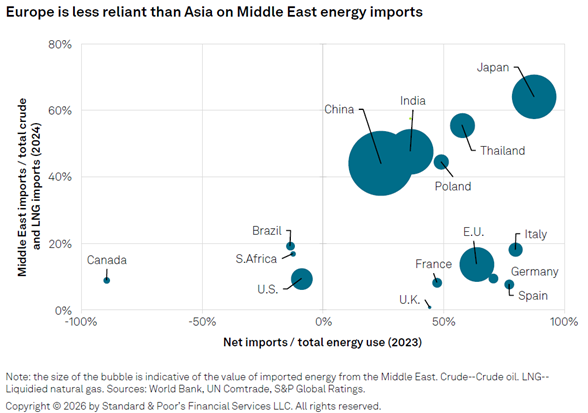
Europe benefits from significant savings and technical expertise but lacks sufficient oil and gas resources. The EU imports nearly two-thirds of its energy, with about 14% coming from the Middle East. Germany and Italy, industrial powerhouses with limited nuclear capacity, are particularly exposed to Middle East imports. France is less vulnerable due to its nuclear infrastructure, and the U.K. is relatively insulated, as the Middle East accounts for only a small share of the 44% of its energy that is imported.
Europe’s energy supply risk is lower now than in 2022, when Russia met 30%-35% of the region’s oil and gas needs. Furthermore, Europe is less affected by the current turmoil than major Asian economies, which import about three times more energy from the Middle East (see Chart 1).
Chart 1.
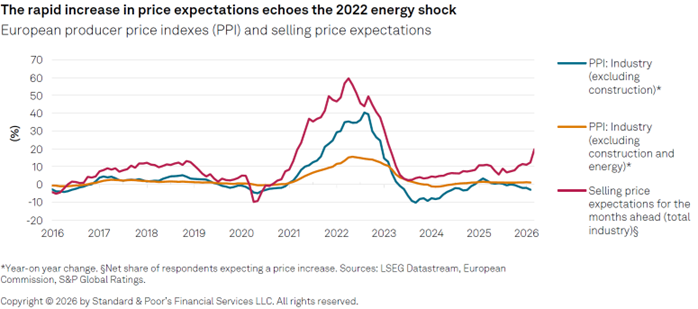
The initial phase of the shock is already unfolding. Higher energy prices significantly increased consumer costs in March, with further increases expected in April. Unlike the sweeping fiscal support of 2022, government responses are more limited and targeted–think temporary fuel-tax cuts rather than broad price caps. As a result, Eurozone inflation is expected to rise to 3%-3.5% in April, up from 2.6% in March.
The second phase–where indirect effects emerge–has also begun. March business surveys show European industries raising their selling price expectations in response to the conflict (see Chart 2). This extends beyond the energy sector, with transport providers, food, and metal producers also signaling price increases. Flash purchasing managers’ index (PMI) surveys available for April confirm the trend, albeit after input costs rose less than in March. These indirect effects could prompt a response from central banks.
Chart 2.
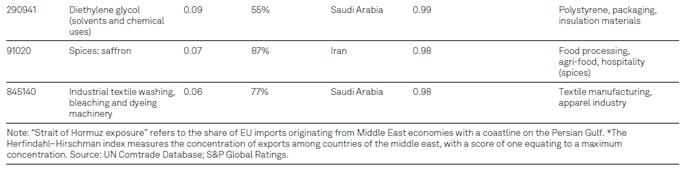
Tankers continue to arrive at major European ports like Rotterdam, Amsterdam, and Antwerp, but supply-chain concerns are lurking. While Europe doesn’t rely exclusively on the Strait of Hormuz for energy imports, other vulnerabilities exist. Our analysis of UN Comtrade data identifies 20 products where Europe has high dependency on Middle Eastern imports. We have sorted that exposure by value, reliance on the Strait of Hormuz, and concentration among Middle East suppliers (see Table 1).
Some import lines look particularly exposed. Although only 9% of Europe’s LNG imports transit the Strait of Hormuz–solely from Qatar–the strait is a critical chokepoint for cyclohexane, polypropylene, and polyethylene, which are key inputs for packaging, plastics, and petrochemicals. Aluminum (unwrought and plate) is another potential vulnerability, with possible consequences for the automotive and construction sectors. Our list also notes the exposure of aerospace and defense engine parts, and, on a very different note, saffron, which Europe imports almost entirely from Iran.
It is somewhat reassuring that Saudi Arabia is often Europe’s largest–and sometimes sole–Middle East supplier for several products, as it can also ship via the Red Sea. However, even if headline import values appear modest relative to Europe’s industrial scale, supply chains are only as resilient as their weakest link.
Table 1.
The Middle East war has not yet pushed Europe into a repeat of the 2022 energy crisis. That said, households and businesses are experiencing pressures, and the effects could be meaningful and lasting. As the direct hit from higher energy prices takes hold, indirect effects are beginning to ripple through the European economy. A broad-based supply-chain shock still looks remote at this stage, yet there are pockets of vulnerability. Additionally, indirect risks could emerge through Asian supply chains, which are more reliant than Europe on Middle Eastern imports and are closely linked to European production networks.