

This policy brief is based on “Digital banking and the evolving monetary policy transmission”, ECB Working Paper No. 3206, March 2026. The views expressed are those of the author and not necessarily those of the European Central Bank (ECB).
Abstract
Digitalisation is reshaping the way banking is done, also in the euro area. This policy brief takes a closer look at euro area digital banks — institutions operating predominantly online with minimal physical presence and at the frontier of digitalisation trends – and examines how differently these banks transmit monetary policy from traditional branch-based institutions. Using supervisory microdata on more than 170 euro-area digital banks between 2016 and 2025, the analysis focuses on the ECB’s tightening cycle that began in July 2022 and the initial easing phase starting in mid-2024. The evidence shows that digital banks reprice deposits more strongly and more rapidly during tightening. Lending rates do not increase proportionately, leading to margin compression and a relative slowdown in lending growth. During the early easing period, digital banks cut new deposit rates more decisively, while retail inflows soften. Digitalisation thus strengthens the funding cost leg of the lending channel of monetary policy. As digital banking expands, monetary authorities and supervisors may need to account for faster deposit repricing, higher retail funding elasticity and asymmetric transmission dynamics over the policy cycle.
Over the past decade, digital technologies have significantly altered the structure of retail banking. Internet banking adoption has increased rapidly, and customers can now compare deposit offers and shift funds across institutions in real time. The decline in switching costs and the weakening of relationship-based frictions have intensified competition in retail funding markets.
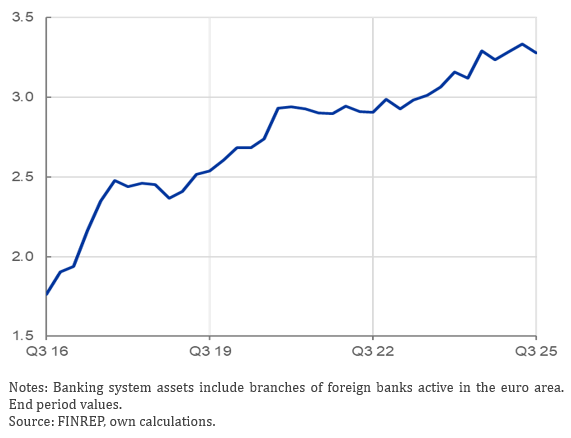
Within this environment, digital banks have emerged as a distinct business model. These institutions operate almost entirely online, rely on mobile interfaces and typically maintain little or no physical branch network. Although still small in aggregate, their presence has grown steadily in the euro are. Their assets expanded much faster than those of the banking system and their asset share in the euro area banking system rose from around 1.5 percent in 2016 to above 3 percent by the end of 2024.
Figure 1. Expansion of Digital Banks in the Euro Area
Digital bank assets as percentage of the euro area banking system assets
Digital banks differ structurally from traditional institutions. They rely more heavily on household deposits, particularly overnight deposits, and tend to hold larger liquidity buffers. Retail-focused digital banks dominate the segment, while service-oriented and wholesale digital institutions represent smaller shares.
These structural characteristics are directly relevant for monetary transmission. A funding model based heavily on retail deposits with low switching frictions may react more sensitively to changes in policy rates.
The ECB’s tightening cycle beginning in July 2022 provides a natural setting to study how digitalisation changes how monetary impulses propagate through banks’ balance sheets and pricing decisions. The Deposit Facility Rate rose from negative territory to 4 percent within just over a year. Such a rapid and substantial adjustment allows an assessment of how different banking models respond.
The evidence shows that digital banks increased household deposit rates significantly more than traditional banks during the tightening phase. On average, digital banks’ effective household deposit rates rose roughly 35 to 40 basis points more than those of brick-and-mortar peers. Their sensitivity to changes in the policy rate was also higher. This differential is particularly pronounced at overnight maturities, where funding spreads at digital banks compressed much less than at traditional institutions.
The difference is strongest among stand-alone digital banks, while digital subsidiaries embedded in larger groups exhibit more muted responses. This suggests that reputational capital, customer attachment and access to broader group funding structures may dampen immediate repricing pressure.
Importantly, these findings remain robust when controlling for the degree of digital adoption in national markets. While deposit repricing is generally stronger in countries with higher internet banking penetration, digital bank effects persist over and above these market characteristics.
Figure 2. Household Deposit Rate and Retail Funding Spreads Response to Monetary Tightening and Easing
(Digital vs. Benchmark Banks)
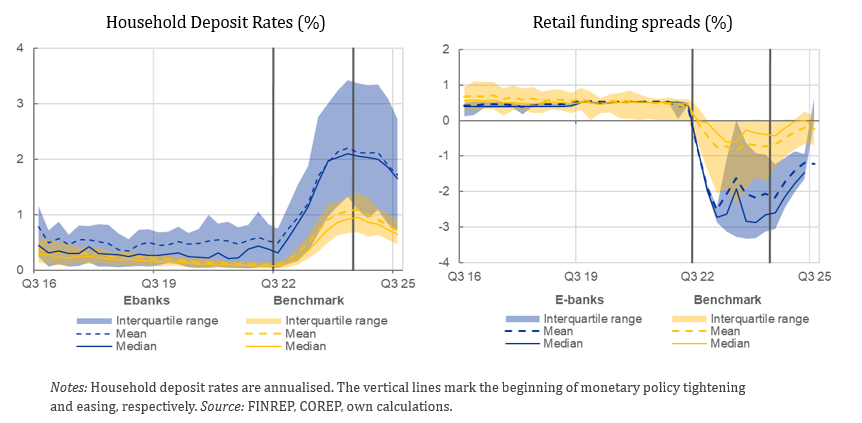
Stronger deposit repricing does not automatically imply stronger lending pass-through. In fact, lending rates at digital banks increased broadly in line with those at traditional institutions.
Cross-sectional analysis confirms that the mapping from deposit rate changes into lending rates is weaker for digital banks. While traditional banks exhibit substantial pass-through from funding costs to lending rates, digital banks show significantly lower sensitivity. As a result, interest margins compress.
This margin compression is visible in profitability indicators. Before tightening, digital banks’ returns were broadly comparable to those of peers. During and after the hiking phase, profitability declined relative to traditional institutions.
This asymmetry reflects competitive conditions on both sides of the balance sheet. Deposit markets are highly competitive in digital banking, with strong rate sensitivity. Lending markets, however, remain competitive across banking models, limiting the ability to pass higher funding costs on to borrowers.
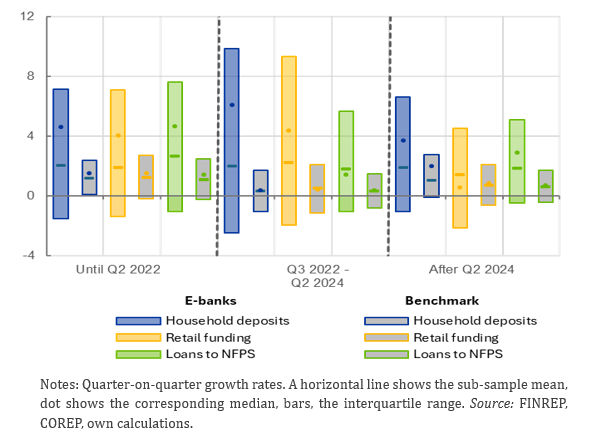
An important question is whether policy tightening translates into funding outflows. The evidence indicates that this is not the case. Digital banks maintained strong inflows of household deposits and retail funding And their growth rates did not slow relative to traditional banks. In fact, in level terms, digital banks accumulated more retail deposits over the tightening episode.
At the same time, deposit volumes at digital banks exhibit stronger interest rate sensitivity. Increases in deposit rates are associated with comparatively larger increases in household deposit volumes. This supports the interpretation that retail funding is more elastic in digital environments.
This suggests that this was aggressive deposit repricing by digital banks that preserved funding volumes. Adjustment occurred primarily through prices rather than quantities.
Corporate deposits and unsecured funding do not show similar patterns. The enhanced rate sensitivity appears concentrated in retail segments, consistent with lower switching frictions among household depositors.
Then, lending growth at digital banks decelerated more strongly. This pattern is consistent with compressed margins and higher funding costs gradually weighing on credit expansion.
Taken together, these findings indicate that digitalisation strengthens the funding leg of monetary transmission where digital banks absorb a larger part of the monetary shock through margin compression, that ultimately hampers lending expansion.
Figure 3. Deposit, funding, and loan growth in monetary policy windows
(digital vs. benchmark, in percent)
The easing phase that began in mid-2024 provides preliminary insight into whether these asymmetries reverse when policy rates decline. Initial evidence suggests that digital banks reduce new deposit rates more decisively than traditional banks. The digital deposit premium narrows, although effective deposit rates remain elevated, reflecting the stock nature of outstanding contracts.
Retail inflows soften relative to traditional institutions during the early easing period. This indicates that the competitive advantage in attracting deposits during tightening diminishes as interest rate differentials compress.
Loan rates at digital banks decline more gradually, allowing some repair of compressed margins. The lending channel does not appear to amplify easing disproportionately at digital institutions. Although the easing window remains short and conclusions must be cautious, the evidence points toward symmetric responsiveness of digital banks across the cycle: stronger repricing both when rates rise and when they fall.
The results carry important implications for monetary transmission in increasingly digital financial systems.
First, digitalisation strengthens the funding cost channel. Deposit rates respond faster and more strongly to policy changes. This may accelerate the initial impact of policy tightening on banks’ funding structures.
Second, lending rate pass-through is not proportionately amplified. Instead, higher funding costs compress margins, influencing lending.
Third, the responsiveness of retail funding implies that monetary transmission may become more sensitive to competitive conditions in deposit markets. Countries with higher digital penetration may experience faster funding repricing and potentially more pronounced short-term balance sheet adjustments.
As digital banking expands, central banks may observe changes in the timing and strength of transmission. Policy shocks may propagate more quickly through possibly asymmetrically through deposit markets.
Higher deposit elasticity does not automatically imply fragility, but it does imply sensitivity. Digital banks rely heavily on overnight retail funding and operate in environments with low switching frictions. Monitoring should therefore pay attention to the maturity composition of retail funding, the share of insured versus uninsured deposits and the degree of stand-alone exposure among digital institutions. Further, margin and franchise value compression during the tightening episodes can occasionally result in solvency challenges. Stress testing frameworks may need to incorporate stronger rate sensitivity of retail funding in digital banking models.
Digitalisation is reshaping the mechanics of monetary transmission in the euro area. New evidence from supervisory microdata covering more than 170 digital banks shows that these institutions reprice deposits more strongly and more quickly during tightening. Lending rates do not rise proportionately, leading to margin compression and a relative slowdown in lending growth late in the cycle. Retail funding at digital banks is markedly more interest-rate sensitive. During the early easing phase, digital banks reduce new deposit rates more decisively while retail inflows soften.
The overall effect is a strengthening of the funding cost channel of monetary policy. Digitalisation does not weaken transmission. Instead, it alters its structure, shifting adjustment toward deposit markets and margin dynamics.
As digital banking continues to expand, monetary authorities and supervisors may need to account for faster funding repricing, greater retail rate sensitivity and evolving asymmetries across the policy cycle. Understanding these dynamics will be increasingly important in an environment where technological change reshapes financial intermediation.