

The views expressed are those of the author and not necessarily those of the institutions the author is affiliated with.
Abstract
This paper examines how to design policies that, in the event of a severe demand shock, call for expansionary measures while remaining mindful that different policy choices can have harmful long-term consequences for growth and economic balance. The paper provides further evidence that excessive consumption growth can be particularly costly, whereas policies that boost investment and exports tend to support a more sustainable growth path. The longer the time horizon, the greater the emphasis that should be placed on exports. The analysis also shows that different ways of promoting consumption expansion are far from equally effective.
When negative economic shocks hit the economy, the standard response is to expand aggregate demand through government policies. Often, the specific composition of this demand expansion appears secondary, as political realities frequently dictate policy content. This need not be the case. In this paper, we discuss some basic results concerning the consequences of different policy choices and provide cross-country evidence on the advantages and drawbacks of alternative strategies. A fundamental issue is the time horizon of policy decisions: should we focus only on immediate developments, or also consider the long-run consequences? Different types of demand-management policies have markedly different implications for subsequent economic growth. In particular, consumption-led policies appear to generate significantly lower future output growth than policies that stimulate investment or exports (see, e.g., Kharroubi and Kohlscheen, 2017; Viren, 2022). It is generally easier to expand consumption than investment or exports, as the latter two components are largely determined by private firms. Investment and exports are also heavily influenced by monetary policy through interest rates and exchange rates. Although central banks officially focus on inflation, in bad times they face strong pressure to use policy tools to support growth and employment well beyond strict inflation targets. Investment and exports can, of course, be influenced by fiscal means such as taxes and subsidies, but these are often politically more difficult to implement. Public investment can be decided independently of the corporate sector, but infrastructure projects typically require considerable time to initiate.
Regarding consumption, a key distinction exists between private and public consumption. Public consumption consists largely of services, while private consumption is dominated by goods. The more difficult question is how to boost private consumption (setting aside monetary policy tools). Traditional Keynesian analysis suggests manipulating disposable income through taxes and transfers. When Keynesian multipliers played a larger role in policymaking, considerable attention was paid to the differing impacts of income categories on consumption. Today these issues are largely ignored — a pity, since the differences are far from trivial and can produce large variations in both short- and long-term effects. We must also remember the potential distinction between wage and non-wage income. Consequently, the choice of tax instrument is by no means straightforward.
In bad times, policymakers often overlook the possibility that households consider not only their own balance sheets but also the financial positions of firms and the government. This can be unfortunate, because households ultimately own both firms and the public sector. Households may therefore react to corporate and public saving (i.e., profits and government surpluses/deficits) in a manner consistent with debt neutrality or Ricardian equivalence (see David and Scadding, 1974; Koskela and Viren, 1986; Barro, 1988). The subsequent empirical analysis also leaves room for these effects.
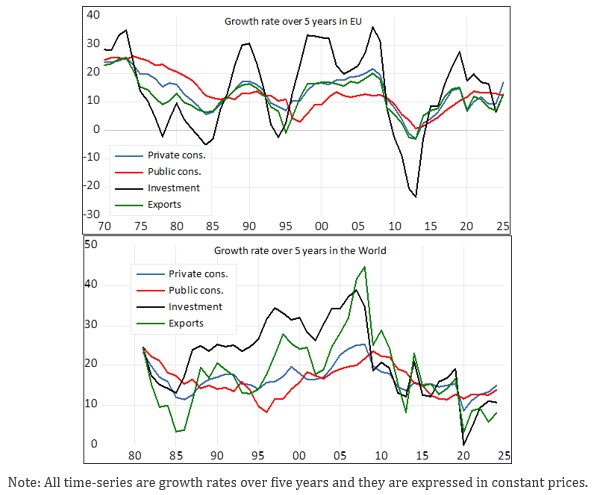
We first examine the choice between demand components from the perspective of possible harmful long-run effects of excessive consumption growth. We do not investigate here why these harmful effects arise, but potential mechanisms include crowding-out of resources, effects on the price level and inflation, negative tax effects in the case of public consumption (Barro and Redlick, 2011) and hysteresis-type phenomena. We begin by estimating a simple model in which output growth is explained by indicator variables that characterize the nature of growth in past periods. For instance, growth in period t−1 is classified as private-consumption-led if the growth rate of private consumption exceeds GDP growth. We first focus on growth in period t and growth patterns in preceding periods, then extend the analysis to growth patterns over the previous 3 or 5 periods and (average) future growth over the following 2 or 4 periods (in addition to the current period).The analysis uses World Bank WDI data for 157 countries (1970–2025) and European Commission AMECO data for 27 European countries for 1965-2025. Figure 1 shows 5-year growth rates for different demand components in both the EU and the full world sample. As expected, investment and exports are considerably more volatile, while public consumption is much smoother. A striking feature in the WDI data is that public consumption grew noticeably more slowly than other demand components until the 2008/9 financial crisis; thereafter, it expanded at rates comparable to the others. A similar (though less pronounced) pattern appears in the EU data.
Figure 1. Average growth rates of main demand components
The main results appear in Figure 2, which shows the evolution of economic growth following different past demand-growth patterns (based on WDI data, using one- and three-period leads and lags). A more extensive set of results is presented in Figure 3, covering both datasets and longer (5-period) horizons. These analyses use average values of the indicator variables for the 3- and 5-period windows. Qualitatively similar results emerge when we require the same demand pattern in all periods or only in a single period (see Viren, 2022).
Figure 2. An illustration of the effect of past demand structure on growth
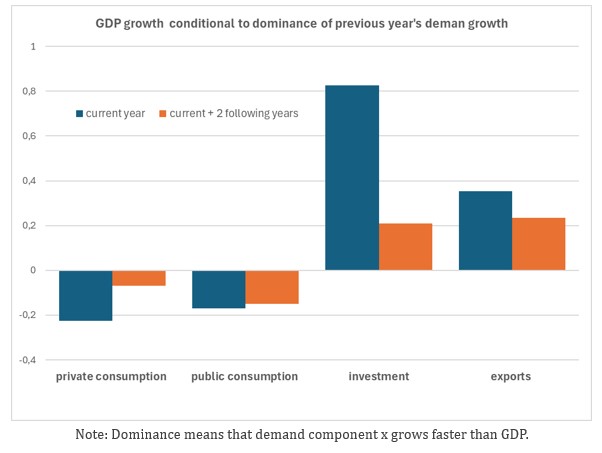
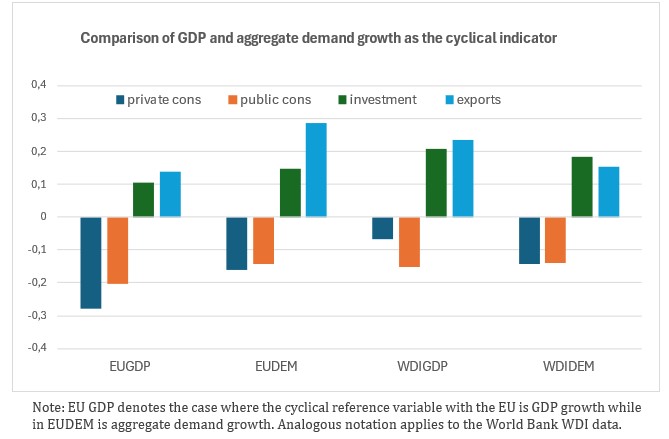
The outcome can be summarized succinctly: excessive consumption growth has a clear and statistically significant negative effect on future growth. This holds for both private and public consumption (and their sum). By contrast, investment- and export-led growth patterns support stronger future growth. Export-led growth appears to have more persistent positive effects than investment-led growth. Overall, the data strongly support the case for export-led growth (see also Haddad and Shepherd, 2011). We also repeated the exercises using aggregate demand growth (instead of GDP growth) as the benchmark. Results for the 3-year lead/lag specification are shown in Figure 4. Although some minor differences appear (e.g., in the role of exports), the overall findings remain robust.
Figure 3. Effect of previous years’ demand structure on future GDP growth
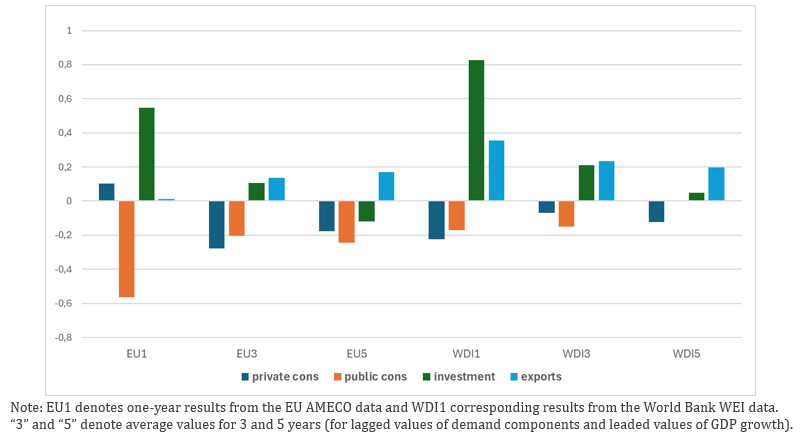
Figure 4. What matters: GDP growth or aggregate demand growth?
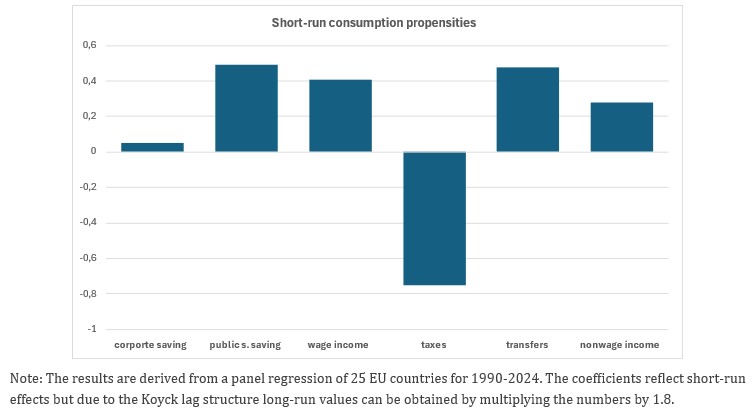
We next turn to the design of consumption stimulus measures. The analysis is based on a simple Keynesian consumption function that includes four disposable-income components — wage income, non-wage income, transfers, and (paid) taxes — as well as corporate and public saving. The model also includes lagged private consumption, the real interest rate, and the VIX uncertainty index (coefficients for the latter variables are omitted here but are highly significant and correctly signed).
The results (Figure 5) are clear: the source of income change matters greatly. Transfer income has the largest positive effect on consumption, while non-wage income has the smallest. Income taxes produce the largest absolute (negative) effect. Consequently, simultaneously increasing transfers and taxes tends to produce a clearly negative net effect. Interestingly, corporate profits and public-sector saving also appear relevant for households, consistent with the idea that households internalize these as affecting their permanent income. The coefficient on public-sector saving is large, but its practical impulse response on consumption is small because government balances are on average close to zero (cf. Viren 2024).
Figure 5. Consumption propensities out of different demand components
During the Covid-19 crisis, the prevailing attitude was to generate growth by any available means, with little regard for costs, benefits, or differences between short- and long-run effects. However, the technically easiest ways of increasing aggregate demand — typically through consumption — are generally not the most effective or durable. Governments also appear poorly prepared in advance for major economic shocks, which are too often viewed as belonging to the past. As a result, policy responses tend to be improvised. A better approach would be to prepare, in advance, contingency plans that list possible instruments, evaluate their relative efficacy, and ideally reach agreement on their use under different crisis scenarios and time horizons.
Barro, R. (1988) The Ricardian approach to public deficits. NBER Working Paper 2685.
Barro, R. and C. Redlick (2011) Macroeconomic Effects from Government Purchases and Taxes. The Quarterly Journal of Economics 126 (1), 51–102.
David, P and Scadding, J. (1974) Private savings: Ultrarationality, Aggregation and the Denison’s Law. Journal of Political Economy 82, 82, 225-249. https://www.journals.uchicago.edu/doi/epdf/10.1086/260189
Haddad, M. and B. Shepherd (2011) Export-led growth: Still a viable strategy after the crisis? Vox EU. https:// voxeu.org/article/export-led-growth-still-viable-strategy-after-crisis
Kharroubi. E. and E. Kohlscheen (2017) Consumption-led expansions. BIS Quarterly Review, March 2017, 25-37. https://www.bis.org/publ/qtrpdf/r_qt1703e.htm
Koskela, E. and M. Viren (1986) Testing the direct substitutability hypotheses of saving, Applied Economics 18, 143-155.
Viren, M. (2022) Consumption-led expansion lead to lower future output growth. Statistical Review, Statistics Poland 69, 44-59. https://ps.stat.gov.pl/Article/2022/3/044-059
Viren, M. (2024) Household saving and consumption in Europe continue to follow traditional patterns. SUERF Policy Brief 100. https://www.suerf.org/wp-content/uploads/2024/10/SUERF-Policy-Brief-1000_Viren.pdf