

This SUERF Policy Brief summarizes Fudulache and Castillo Lozoya (2025). The views expressed in this study reflect those of authors and are not necessarily those of Banco de España, the ECB or the Eurosystem.
Abstract
We exploit banks’ early repayments of targeted longer-term refinancing operations (TLTRO) following the program’s recalibration in October 2022 as a laboratory to uncover demand drivers of central bank liquidity. We formulate and estimate a discrete-time hazard model of early exit from TLTRO to identify which bank (country) characteristics drive a sticky, prolonged demand for long-term central bank operations as opposed to an early exit from such facilities. Our results identify operation design features (maturity, pricing and collateral), bank balance sheet constraints (leverage ratio and reserve requirements), and bank liquidity positions (measured by three composite indicators) as key demand factors, and link demand for reserves to fulfilment with liquidity regulation. We discuss the policy implications of our findings in the context of the recent review of the ECB’s operational framework.
As central banks unwind their balance sheets, establishing an optimal framework for supplying reserves has become one of their crucial tasks. Major institutions like the ECB and the Bank of England are transitioning from regimes of surplus reserves to demand-driven frameworks. In these systems, the steady-state size of the balance sheet is determined by banks’ actual demand for central bank reserves, primarily satisfied through a combination of short-term and long-term central bank facilities. While uncertainty regarding the aggregate volume of reserves is inherent to demand-driven frameworks, understanding bank-level demand is essential to ensure an effective design of the instruments used to supply reserves.
We use the October 2022 recalibration of the third series of targeted longer-term refinancing operations (TLTRO III) as a laboratory to exploit banks’ early exit behaviour from the program and understand what shapes a sticky, prolonged demand for long-term operations as opposed to early exits. Although TLTRO programs had a specific monetary policy easing purpose, which is not foreseen in demand-driven operational frameworks, the “targeted” features of the program were no longer applicable since 23 June 2022. Consequently, by decoupling the policy purpose of TLTRO from the banks’ exit behavior, this analysis sheds light on the broader demand drivers for long-term central bank liquidity and can thus inform the future design of structural longer-term credit operations foreseen under the ECB’s revised operational framework.1
Previously a major source of central bank liquidity-peaking at €2.2 trillion at the end of 2021-the TLTRO III program underwent a tightening of the program’s conditions, as announced on 27 October 2022, with the aim to increase the speed of the monetary policy normalisation process.2 The recalibration revealed substantial heterogeneity in bank behavior, with many banks accelerating their exit via sizable early repayments amounting to over EUR 1 trillion in total, while roughly half chose to retain funds until maturity.
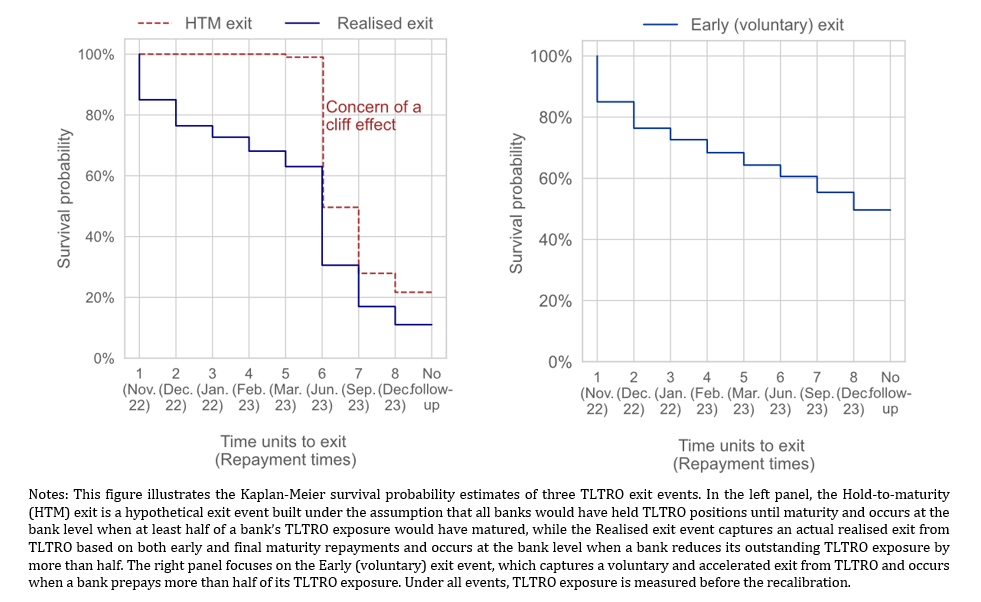
Figure 1 illustrates this variation in banks’ exit decisions, based on Kaplan-Meier survival estimates (Kaplan and Meier, 1959) for three TLTRO exit events for a sample of 820 TLTRO participating banks followed between recalibration and end-December 2023.3 The left panel illustrates that absent the recalibration, in a hold-to-maturity (HTM) scenario, there would have been a high concentration of banks exiting the program in June 2023, potentially generating a cliff effect in money and funding markets. By contrast, the realised situation depicts a more accelerated bank exit from TLTRO, with many banks choosing to exit before final maturity. The right panel takes a closer look at accelerated bank exits, namely early (voluntary) exits, and illustrates that roughly half of banks chose to not exit early and thus “survived” the recalibration.
Figure 1. Kaplan-Meier survival estimates of TLTRO exit events
To examine the factors influencing banks’ accelerated exits from TLTRO, or alternatively their delayed exit decisions, we apply a time-to-exit or survival analysis, accounting for both the occurrence and timing of these exit decisions. By applying a discrete-time extension of the Cox proportional-hazards model (Cox, 1972) and leveraging rich Eurosystem datasets, we estimate a discrete-time hazard model for TLTRO early exits. Within this framework, we explore which bank- and country-specific characteristics influence the timing of a bank’s early exit. Our empirical analysis yields the following main results.
Design features. First, we provide evidence that operations design features such as maturity, pricing and type of collateral securing the lending operation emerge as key demand drivers for (long-term) liquidity via refinancing operations. Specifically, when examining the maturity structure of TLTRO funds, we find that a high share of funds with less than six months weighted average residual maturity is associated with a higher exit hazard, while residual maturities exceeding six months, and especially one year, are linked to delayed exits. Our findings thus present evidence supporting an NSFR value of central bank facilities with maturities above the six-month and one-year thresholds, with the higher regulatory value for the latter threshold. We also find that a stronger tightening of TLTRO rate following the recalibration (according to DFR expected path at the recalibration announcement) is associated with a higher exit hazard. Finally, banks pledging more govies-like collateral were more likely to exit early, also suggesting a decrease in the relative attractiveness of TLTRO-injected reserves compared to safe assets collateral.
Balance sheet characteristics. Second, turning to balance sheet characteristics, we find that a bank’s SSM significance, balance sheet capacity (stemming from the leverage ratio requirement), as well as its share of minimum reserves requirements also play a significant role in shaping their demand for central bank liquidity. We document that a banks share of excess reserves or stable funding sources does not significantly explain banks’ early exit decisions. In turn, when recognising the influence of claims on liquidity encumbered on reserves, such as deposits and credit lines (Lopez-Salido and Vissing-Jorgensen, 2023; Acharya and Rajan, 2024; Acharya et al., 2023), or the influence of long-term lending positions which require stable funding, both “available” excess reserves and “required” stable sources of funding become statistically linked with a faster exit and thus emerge as demand drivers for (long-term) refinancing operations.
Bank liquidity positions. Third, building on these findings, we consolidate all relevant (on- and off-) balance sheet items into comprehensive indicators of bank liquidity. Drawing on the liquidity creation framework of Berger and Bouwman (2009) (the BB framework) and the composite liquidity risk exposure measure introduced by Acharya et al. (2023) (the ACRS framework), we propose three liquidity position indicators: a Liquid Assets ratio, a Stable Funding ratio, and an Inverse Liquidity Creation ratio. These indicators provide a holistic view of bank liquidity, with the first two distinguishing between banks’ short- and long-term liquidity requirements, while the third is a comprehensive measure capturing a bank’s overall liquidity position across both the short- and long-term sides of the balance sheet. Figure 2 explains the construction of these metrics and summarizes their evolution and cross-sectional dispersion from December 2019 to December 2024. Notably, when employed in the time-to-exit TLTRO, our results position these bank liquidity measures as being among the most influential demand drivers of prolonged central bank liquidity in terms of magnitude.
Figure 2. Bank liquidity positions measures: Summary of time series and cross-sectional dispersion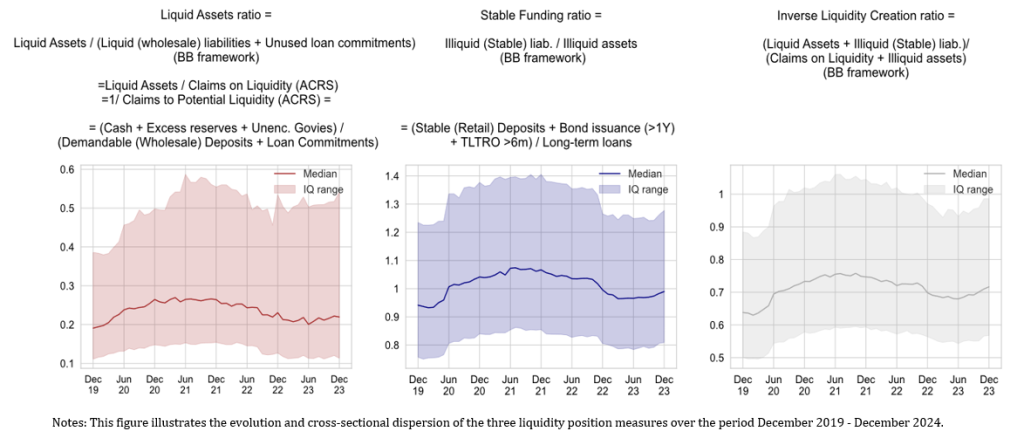
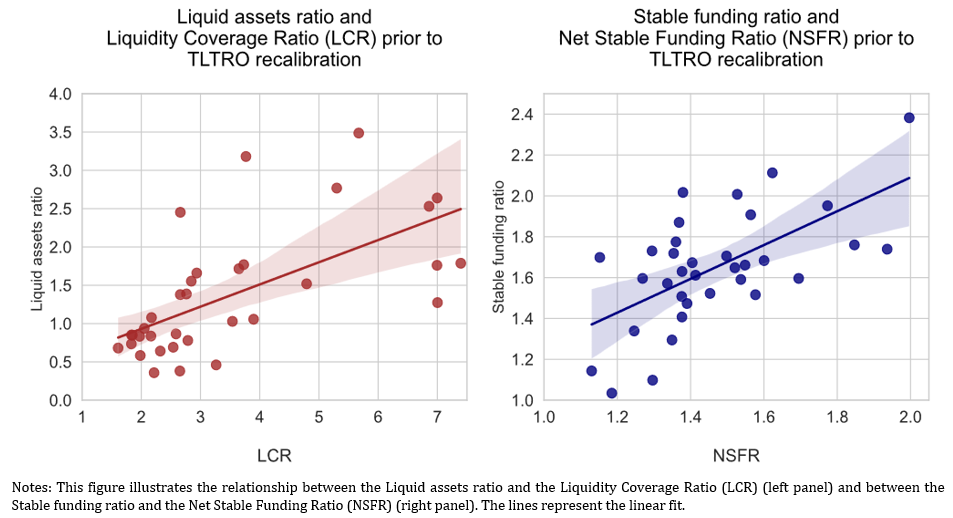
Regulatory interpretability. We further argue that our Liquid Assets ratio and Stable Funding ratio are conceptually aligned with the Basel III regulatory framework, specifically the Liquidity Coverage Ratio (LCR) and Net Stable Funding Ratio (NSFR). While the LCR measures high-quality liquid assets against net outflows under a 30-day stress scenario, our Liquid Assets ratio uses a more conservative denominator by including the full stock of claims on liquidity rather than net flows. Consequently, our ratio yields lower levels (often below 1), effectively serving as a “stressed” version of the LCR where all claims on liquidity are assumed to be fully called. Similarly, the Stable Funding ratio adopts a maturity-based classification for assets and a stability-based classification for liabilities inspired by the BB framework, albeit with simplified weights compared to the regulatory NSFR. We validate these conceptual links using quarterly regulatory data for Spanish banks. Figure 3 demonstrates a clear positive correlation between our metrics and their regulatory counterparts prior to the recalibration (Q3 2022). This strong association is further confirmed by panel regressions spanning the survival analysis period (Q3 2022–Q4 2023), even when controlling for bank fixed effects. Crucially, these cross-sectional associations provide empirical support for the link between banks’ regulatory incentives and their demand for central bank liquidity.
Figure 3. Liquidity position measures and liquidity regulatory ratios for the sub-sample of Spanish TLTRO participating banks
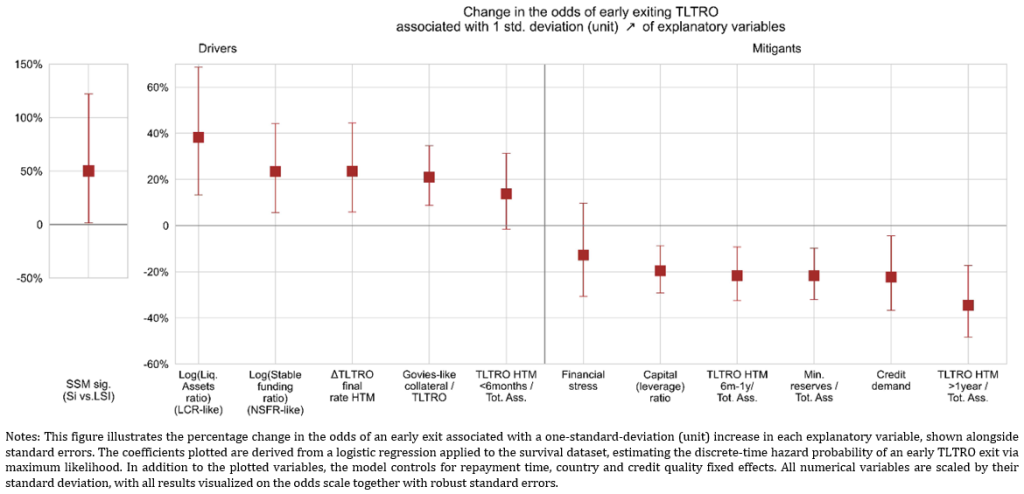
Relative importance. Having identified the drivers of TLTRO exits, we now assess their relative importance. The odds-proportionality assumption of our discrete-time framework allows us to compare the extent to which different variables shift the probability (odds) of an early exit. Figure 4 visualizes these estimated magnitudes on the odds scale, alongside their standard errors, using our preferred model specification which incorporates the Liquid Assets and Stable Funding ratios instead of individual balance sheet characteristics. The results are interpreted as the percentage change in the odds of an early exit associated with a one-standard-deviation or unit increase in each explanatory variable. Being a significant bank compared to a less significant one increases the odds of an early exit by 50%. Among the continuous variables, the estimates place the TLTRO HTM > 1y / Total assets (interpreted as TLTRO funding with maximum NSFR-value) and Liquid assets ratio (interpreted as an LCR-like ratio) as the primary drivers of central bank liquidity. These are followed by Stable funding ratio (interpreted as an NSFR-like ratio) and Δ TLTRO final rate HTM (capturing the actual bank-level impact of the recalibration on TLTRO rates). Other important factors of comparable magnitude albeit with different signs are Capital (leverage) ratio, TLTRO HTM 6m-1y / Total Assets (or TLTRO funding with lesser NSFR value), Minimum reserves / Total Assets and Govies-like collateral / TLTRO.
Figure 4. Drivers and mitigants of TLTRO early exit
Finally, motivated by Acharya et al. (2023), we also examine whether banks more exposed to liquidity risk during the TLTRO phasing-out period had a higher probability to become “liquidity dependent” on the ECB when exiting, by participating in SRO. Our findings indicate that higher liquidity risk exposure, measured as the inverse of our three liquidity position indicators, is linked to a greater likelihood of recourse to central bank liquidity during the phasing-out period. The observed associations are stronger for banks exiting the TLTRO program later. Since the phenomenon of “liquidity dependence”, understood as increased reliance on central bank liquidity as central banks reduce their balance sheets, is, in some sense, an intrinsic feature of demand-driven operational frameworks and considering that participation in SRO was limited after the phase-out of TLTRO, our motivation to test this hypothesis is to evaluate whether our liquidity position (risk) measures can serve as indicators of when reserves/stable funding scarcity may emerge at the bank level. Our findings offer supporting evidence that these measures can effectively signal such bank level scarcity points.
Motivated by the transition toward “steady-state” operational frameworks, this paper exploits the October 2022 TLTRO recalibration to provide novel evidence on the demand drivers of (long-term) central bank liquidity through a time-to-exit analysis. We identify that design features (such as maturity, pricing, and collateral), alongside balance sheet constraints like leverage ratios and minimum reserve requirements, significantly influence demand for reserves. A key contribution is the development of three bank liquidity position indicators which also emerge as key demand drivers. Our findings offer critical insights for the ECB’s new operational framework, particularly regarding the design of future Structural Long-Term Refinancing Operations. Crucially, the regulatory interpretability of our liquidity position ratios, coupled with the empirical evidence for a high NSFR-value of operations with maturities exceeding six months, provide supportive evidence of a link between the demand for (long-term) central bank funding and the fulfilment of regulatory liquidity ratios.
Acharya, V. V., R. S. Chauhan, R. Rajan, and S. Steffen (2023). “Liquidity Dependence and the Waxing and Waning of Central Bank Balance Sheets.” NBER Working Paper Series, No. 31050, National Bureau of Economic Research. https://doi.org/http://dx.doi.org/10.3386/w31050.
Acharya, V. V., and R. Rajan (2024). “Liquidity, Liquidity Everywhere, Not a Drop to Use: Why Flooding Banks with Central Bank Reserves May Not Expand Liquidity.” Journal of Finance, 79(5), pp. 2943–2991. https://doi.org/https://doi.org/10.1111/jofi.13370.
Berger, A. N., and C. H. S. Bouwman (2009). “Bank Liquidity Creation.” The Review of Financial Studies, 22(9), pp. 3779–3837. https://doi.org/https://doi.org/10.1093/rfs/hhn104.
Cox, D. R. (1972). “Regression Models and Life-Tables.” Journal of the Royal Statistical Society: Series B (Methodological), 34(2), pp. 187–220. https://doi.org/10.1111/j.2517-6161.1972.tb00899.x.
Fudulache, A. E., and M. C. Castillo Lozoya (2025). “Demand Drivers of Central Bank Liquidity: A Time-to-Exit TLTRO Analysis.” Working Papers, No. 2548, Banco de España. https://doi.org/10.53479/41885.
Kaplan, E. L., and P. Meier (1958). “Nonparametric Estimation from Incomplete Observations.” Journal of the American Statistical Association, 53(282), pp. 457–481. https://doi.org/https://doi.org/10.1080/01621459.1958.10501452.
Lopez-Salido, D., and A. Vissing-Jorgensen (2023). “Reserve Demand, Interest Rate Control, and Quantitative Tightening.” SSRN Working Paper. https://doi.org/http://dx.doi.org/10.2139/ssrn.4371999.
See European Central Bank, “ECB Announces Changes to the Operational Framework for Implementing Monetary Policy,” press release, March 13, 2024, https://www.ecb.europa.eu/press/pr/date/2024/html/ecb.pr240313~807e240020.en.html.
See European Central Bank, “ECB Recalibrates Targeted Lending Operations to Help Restore Price Stability over the Medium Term,” press release, October 27, 2022, https://www.ecb.europa.eu/press/pr/date/2022/html/ecb.pr221027_1~c8005660b0.en.html.
The survival probability is defined as the probability that the TLTRO exit has not yet occurred by a certain repayment time.