

This policy brief is based on DNB Working Paper No. 840 and DNB analysis: “Uncertainty and climate policy in the Netherlands: measure and economic effects”. The views expressed are those of the authors and do not necessarily reflect those of De Nederlandsche Bank or the ESCB.
Abstract
We introduce the CPU-Concern index – a media-based measure that captures both the prevalence of climate policy uncertainty and public concern. Using Dutch data, we show how policy announcements influence perceived uncertainty through signaling effects. The index rises during contested debates and declines after ratification, with responses varying according to policy ambition and credibility. Climate policy uncertainty primarily transmits through shifts in sentiment, affecting stock prices, investment, and real activity. Negative shocks have more persistent real effects than positive ones, whereas nominal variables show the opposite pattern. These findings underscore the importance of credible, transparent policy communication to reduce uncertainty and support the low-carbon transition.
Climate policy uncertainty (CPU) is increasingly recognized as a key factor influencing economic decision-making and investment in green technologies. As governments commit to ambitious emissions reduction targets and the transition to a low-carbon economy, the credibility and consistency of these commitments become critical in shaping expectations and behaviour. CPU arises from misalignments between announced climate goals and actual policy actions, leading agents to question the reliability of public commitments such as net-zero pledges. This scepticism is compounded by perceived transition risks—ranging from unemployment and energy price volatility to stranded assets — which may trigger political backlash and policy reversals. Ambiguities and inconsistencies in climate policy further complicate long-term investment decisions, as firms struggle to anticipate whether supportive frameworks will persist.
Despite its growing relevance, CPU remains relatively under-researched due to challenges in its definition and measurement. Existing text-based indices often fail to capture nuanced dimensions of CPU, such as credibility, alignment, and socio-economic costs. To address this gap, our recent working paper (Marotta, Pagliari & de Winter, 2025) develops a Dutch-specific CPU index based on media attention and the timing of actual policy announcements.1 This approach enables us to track CPU separately from general uncertainty and quantify its economic effects more precisely. The results highlight the importance of managing not just global or external sources of risk, but also the uncertainty that arises from domestic policy processes.
The CPU-Concern index is constructed using sentiment-weighted media coverage of climate policy announcements. This approach builds on the economic policy uncertainty literature by incorporating legislative timing and perceived credibility. The index tracks media responses to policy developments, capturing both the direction and intensity of public concern through a comprehensive text analysis of articles from Het Financieele Dagblad, the major Dutch economic newspaper.
Total uncertainty has risen over time, but the share attributable to climate policy has grown markedly since 2018 (Figure 1). This increase coincides with a period of intensified climate policymaking in the Netherlands, including the adoption of the Klimaatakkoord2, the introduction of a carbon levy, and contentious debates over policy implementation and sectoral targets. CPU has become a growing part of public and policy discourse in the Netherlands, particularly since 2019, with spikes around key climate announcements and crises. Importantly, the relative weight of CPU within total uncertainty has also increased, suggesting that climate policy is becoming a more prominent driver of economic expectations and perceived risk — not merely one of many policy topics, but a recurring source of public and investor concern.
The tone of climate-related uncertainty coverage has progressively become more negative over time, especially since 2015, suggesting that the debate on climate policy is increasingly framed in terms of risk rather than opportunity (Figure 2). While sentiment fluctuates, it remains mostly neutral to negative and turns consistently negative in the second half of the sample period (2015–2025). This cautious tone likely shapes firms’ and investors’ expectations, reinforcing the perception of climate policy as a source of downside risk. In turn, this may contribute to a more conservative investment behaviour, particularly in long-horizon, more capital-intensive projects.
Figure 1. Climate Policy Uncertainty as a Share of Total Uncertainty
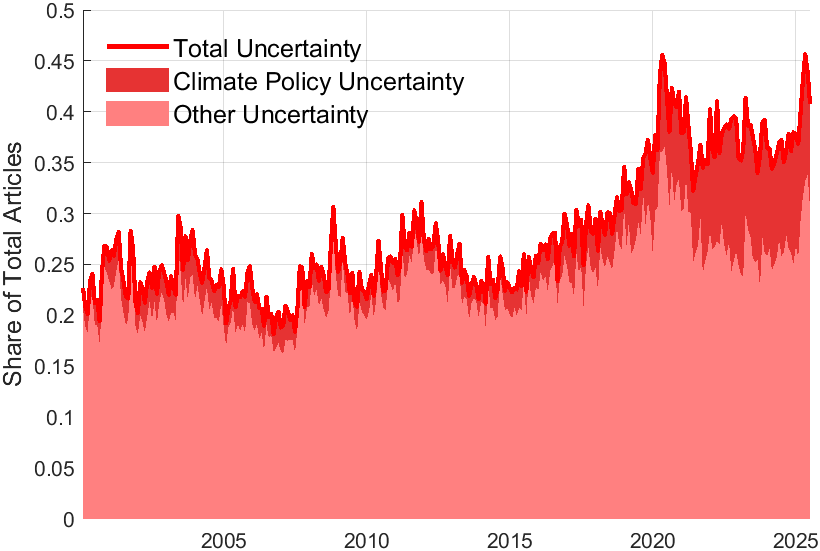
Figure 2. Sentiment in Climate Policy Uncertainty Coverage
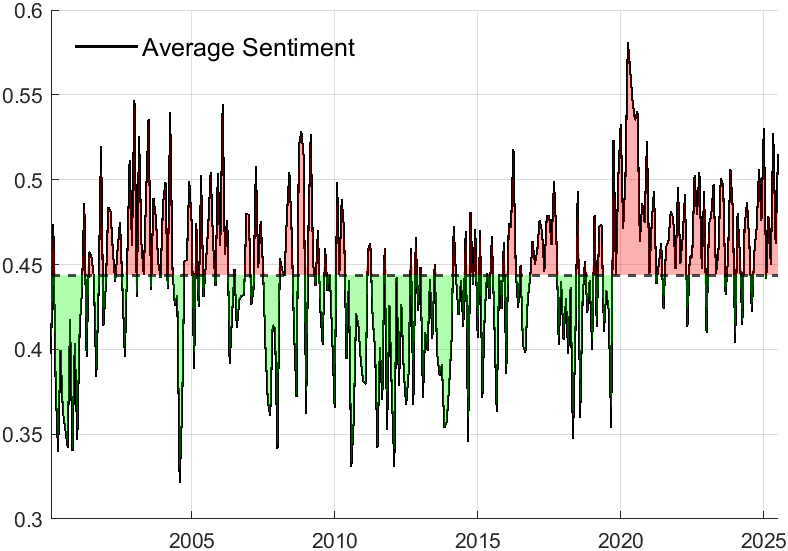
Note: Figure 1 decomposes total uncertainty into climate policy and other sources. Figure 2 reports the average sentiment score of CPU articles, scaled between 0 (positive) and 1 (negative). The data indicates an increasing share of climate policy-related uncertainty articles and a predominantly negative framing of CPU in Dutch media since 2015.
The level of CPU is not constant throughout the policy cycle, but depends on the stage of the legislative process and the clarity and credibility of communication. We analyse several major Dutch climate policy proposals to show that CPU tends to increase more strongly during the early legislative stages, particularly when policies are sent to parliament (Figure 3). This phase often coincides with public debate, media scrutiny, political negotiation, and uncertainty about the final form or timing of the law. Conversely, we observe a flattening or even a decline in CPU following formal approval by either chamber of parliament, and a stabilization or reduction after official ratification. This pattern is visible across multiple policies — e.g., the Climate Law, the Carbon Levy for Industry, and the Climate Fund — and holds in the average response across cases. These dynamics highlight the importance of institutional credibility: clear, predictable, and legally anchored policy signals reduce uncertainty, while vague or drawn-out legislative processes amplify it.
Figure 3. CPU dynamics around legislative events
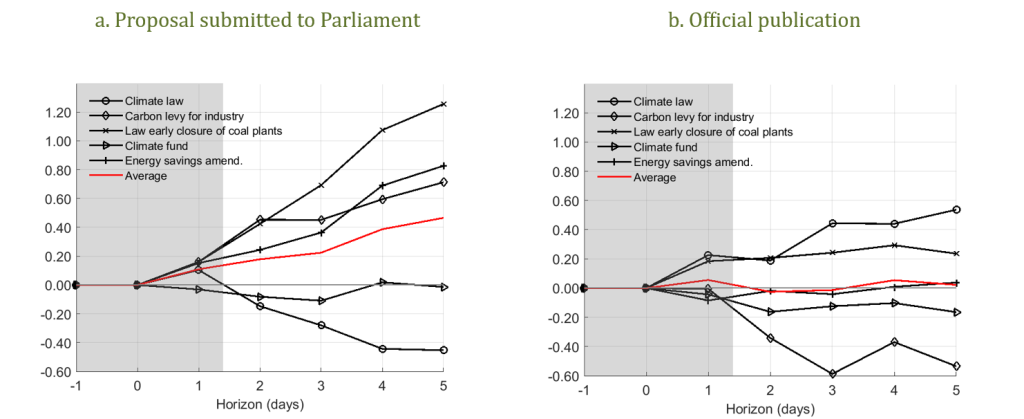
Notes: Cumulative change in CPU around four legislative milestones. The red line shows the average change across events. Individual lines correspond to specific policy laws.
Building on the evidence provided so far, we quantify the dynamic effects of CPU shocks on key macroeconomic and financial indicators. Notably, we set up a monthly Bayesian Vector Autoregression model estimated with Dutch data, where CPU shocks are identified using our CPU-Concern index. We find that a one-standard-deviation CPU shock significantly dampens forward-looking economic indicators like Economic Sentiment and Business Confidence (Figures 4a and 4b), highlighting the role of the expectation channels emphasized by the literature. CPU shocks also depress real economic outcomes, including private investments and industrial production (Figures 5a and 5b), as well as stock market valuations.
Figure 4. Impact of climate policy uncertainty shocks on expectations and real activity
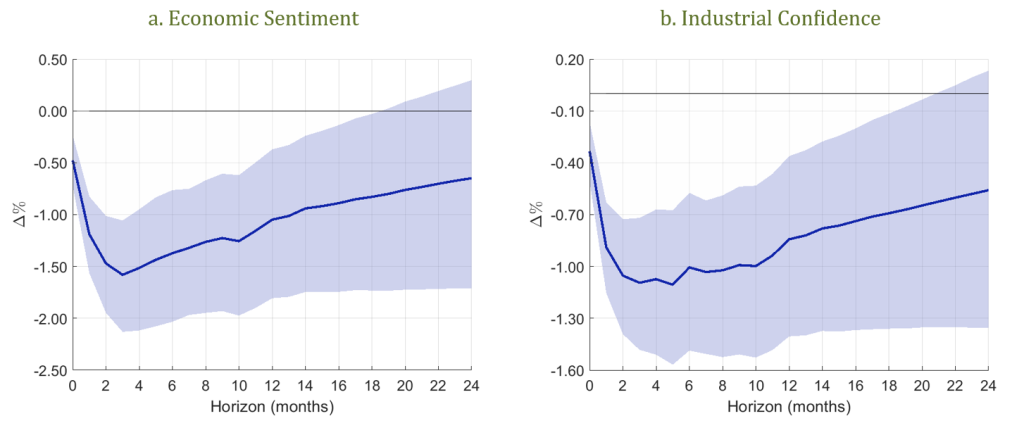
Note: Impulse response functions (IRFs) to a one-standard-deviation shock to climate policy uncertainty. Shaded areas represent 68% highest posterior density intervals. Variables are expressed in percentage change relative to baseline.
A counterfactual analysis3 shows that real economic effects stem primarily from shifts in sentiment and expectations (Figure 5). While we still find some negative effects on both industrial production and stock market valuations, the magnitude is, respectively, around 60% and 30% smaller at the peak compared to the baseline results.4
Figure 5. Impact of climate policy uncertainty shocks – counterfactual
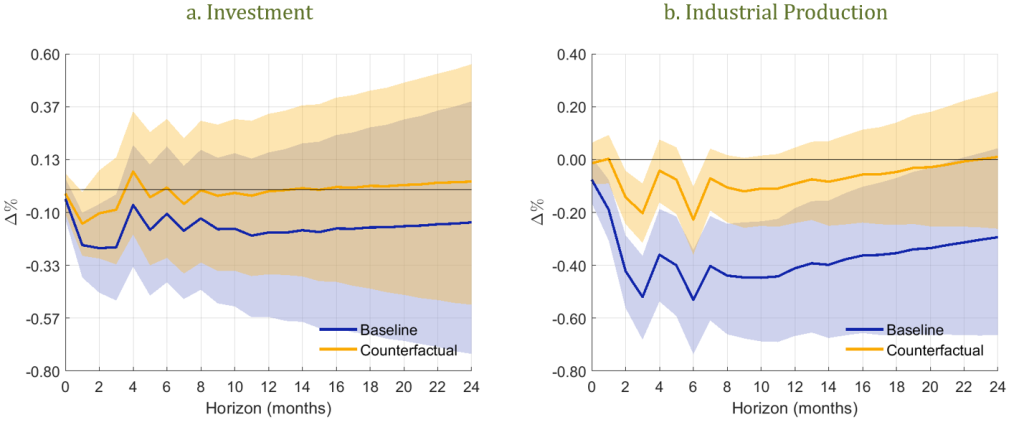
Notes: Impulse response functions (IRFs) to a one-standard-deviation shock to climate policy uncertainty. In the counterfactual simulations (yellow line), we shut down the response of Economic Sentiment and Industrial Confidence. Shaded areas represent 68% highest posterior density intervals. Variables are expressed in percentage change relative to baseline.
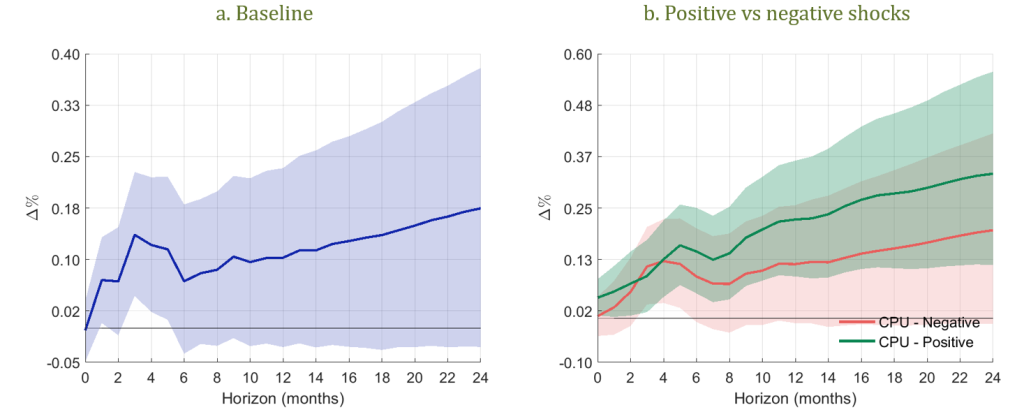
Additional analysis also unveils an asymmetry in the effect of negative versus positive CPU shocks, with the former typically more impactful than the latter, especially for forward-looking variables. Moreover, we provide evidence that these shocks can be different in nature. On the one hand, negative CPU shocks entail a temporary increase in prices accompanied by an economic contraction, making them more supply-driven. Conversely, positive CPU shocks lead to an economic expansion featuring a more persistent upward pressure on prices, making them more akin to demand-side shocks (Figure 6). This could call for a state-contingent monetary policy approach, whereby central banks should not uniformly “look through” CPU shocks but instead tailor their response depending on the underlying nature of the shock, in line with the so-called Brainard principle.
Figure 6. Impact of climate policy uncertainty shocks on prices
Our analysis highlights the significant economic impact of climate policy uncertainty (CPU), showing that it influences expectations, investment decisions, and financial markets by increasing macroeconomic volatility and delaying capital formation. CPU tends to spike during the early stages of policymaking due to unclear content and timing, and only subsides after formal ratification, underscoring the importance of credible and transparent policy frameworks. Different types of climate policies generate varying levels of uncertainty, with carbon pricing causing more persistent effects. While some uncertainty is inevitable and even necessary for policy flexibility, excessive ambiguity raises transition costs. To mitigate these effects, governments should enhance credibility through clear communication, stable legislative frameworks, and complementary instruments like forward guidance. The study also suggests that CPU should be integrated into economic assessments of climate transitions and calls for further research into its long-term effects on green investment and innovation.
Baker, S. R., Bloom, N., and Davis, S. J. “Measuring economic policy uncertainty”. The Quarterly Journal of Economics, 131(4):1593–1636, 2016.
Bernanke, B. S., Gertler, M., and Watson, M. “Systematic monetary policy and the effects of oil price shocks”. Brookings Papers on Economic Activity, 1997(1):91–157, 1997.
Loughran, T. and McDonald, B. “When is a liability not a liability? Textual analysis, dictionaries, and 10ks”. Journal of Finance, 66(1):35–65, 2011.
Marotta, F, Pagliari, M. S., de Winter, J. M., “Commitment vs Credibility: Macroeconomic Effects of Climate Policy Uncertainty”. DNB Working Paper No. 840, 2025.
Mumtaz, H. and Theodoridis, K. “Monetary policy and macroeconomic uncertainty: Evidence from the euro area”. Journal of Monetary Economics, 114:237–255, 2020.
Sims, C. A. “Interpreting the macroeconomic time series facts: The effects of monetary policy”. European Economic Review, 36(5):975–1011, 1992.
Sims, C. A. “Computational methods for the study of dynamic economies”. Handbook of Computational Economics, 1:1171–1230, 1995.
The climate policy uncertainty (CPU) index is built following the approach of Loughran & McDonald (2011) and Backer et al. (2016), and is based on articles containing at least one keyword from each of three categories: climate (e.g. “emissions”, “renewable s”), policy (e.g. “regulation”, “subsidies”), and uncertainty (e.g. “unclear”, “debate”). It is calculated as the share of uncertain articles among all climate policy-related articles, normalized for overall media volume. A sentiment-weighted version captures whether coverage is framed positively, negatively, or neutrally.
The Klimaatakkoord (Climate Agreement) is the Netherlands’ national climate policy framework, finalized in 2019.
Our counterfactual analysis draws from Sims (1992, 1995) and Bernanke et al. (1997), and aligns with the methodology used in studies like Mumtaz and Theodoridis (2020).
However, such difference is statistically significant only in the case of industrial production.