

This Policy Brief is based on D’Orazio, P. (2026), ‘The political economy of climate-related financial policies: creating new paradigms or reinforcing old ones?’, Socio-Economic Review. The views expressed are those of the author and not necessarily those of the institutions the author is affiliated with.
Abstract
This brief classifies climate-related financial policies in 118 countries (2000–2024) using Peter Hall’s orders of change. It examines policy dynamics around five international milestones: the Kyoto Protocol, the Copenhagen Accord, the Paris Agreement, the joint TCFD and NGFS launch, and the EU Sustainable Finance Action Plan. Adoption accelerates after 2015, but first-order (incremental) instruments dominate while voluntary tools remain prevalent. Ambition gains are modest and concentrated in advanced and high-emission economies and among central banks and supervisors. The evidence points to institutional layering and technical convergence rather than paradigm change, and suggests sequencing reforms via supervisory expectations, scenario analysis, and prudential calibration where mandates allow.
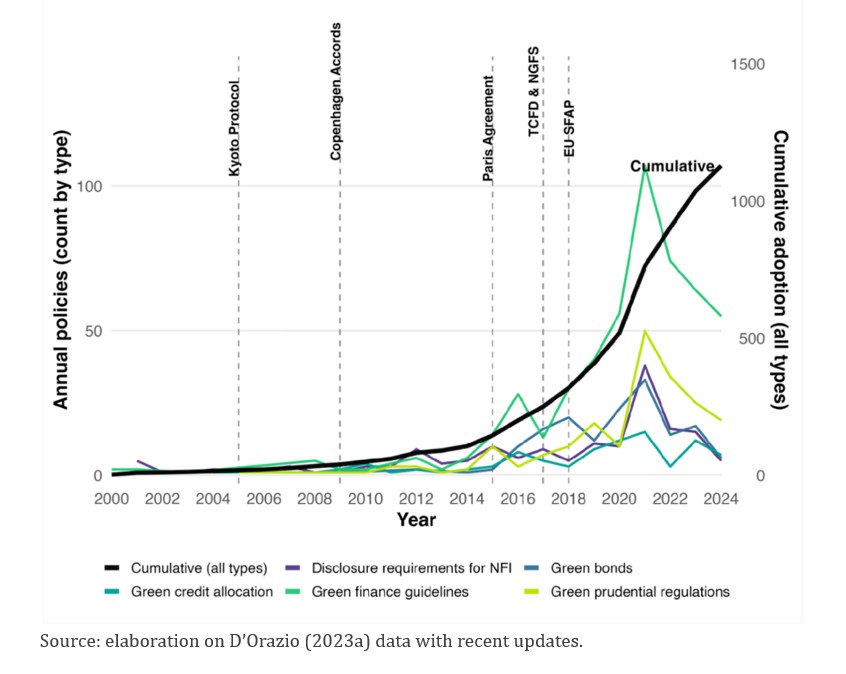
The recognition of climate change as a source of systemic financial risk (Carney, 2015) has driven a wave of climate-related financial policymaking by central banks, supervisors, and finance ministries. The pace of adoption has accelerated markedly after the 2015 Paris Agreement, raising a central question: does this expanding regulatory activity signal a paradigmatic reorientation of financial governance, or is it primarily an incremental adjustment within existing institutional logics? Figure 1 sets the stage, plotting annual adoption by policy area and the cumulative count of climate-related financial policies (CRFPs) alongside five international milestones.
This brief summarises a study analysing 1,100 systematically coded CRFPs adopted between 2000 and 2024 across 118 countries (39 advanced economies and 79 emerging markets and developing economies). It applies Hall’s (1993) typology of policy change, i.e., first-order (incremental adjustments), second-order (instrumental innovation), and third-order (paradigmatic transformation), to assess the depth, rather than just the volume, of regulatory responses.
Figure 1. Climate-related financial policies, 2000–2024: annual policies by type (left axis) and cumulative adoption across all types (right axis), with international milestones marked
Building on the global CRFP database introduced in D’Orazio (2023a) and the classification framework in D’Orazio and Thole (2022), each policy is coded along three dimensions: policy area (prudential regulation, financial guidelines, disclosure for non-financials, green bonds and taxonomies, credit allocation), implementing authority (central bank, supervisor, government, banking association, stock exchange, multiple authorities, other), and legal bindingness (non-binding, voluntary, mandatory). Each policy is then mapped to a Hall (1993) order of change using a transparent, rule-based classification combined with expert validation.
An event-study design tracks policy dynamics around five international milestones widely viewed as critical junctures for climate-financial governance: the entry into force of the Kyoto Protocol (2005), the Copenhagen Accord (2009), the Paris Agreement (2015), the joint release of the TCFD recommendations and the launch of the NGFS in 2017 (NGFS, 2019), and the EU Sustainable Finance Action Plan (SFAP, 2018). For each event, deviations from a four-year pre-event baseline are estimated within a symmetric ±4-year window for two outcomes: policy quantity (counts of new policies) and policy ambition (average Hall order).
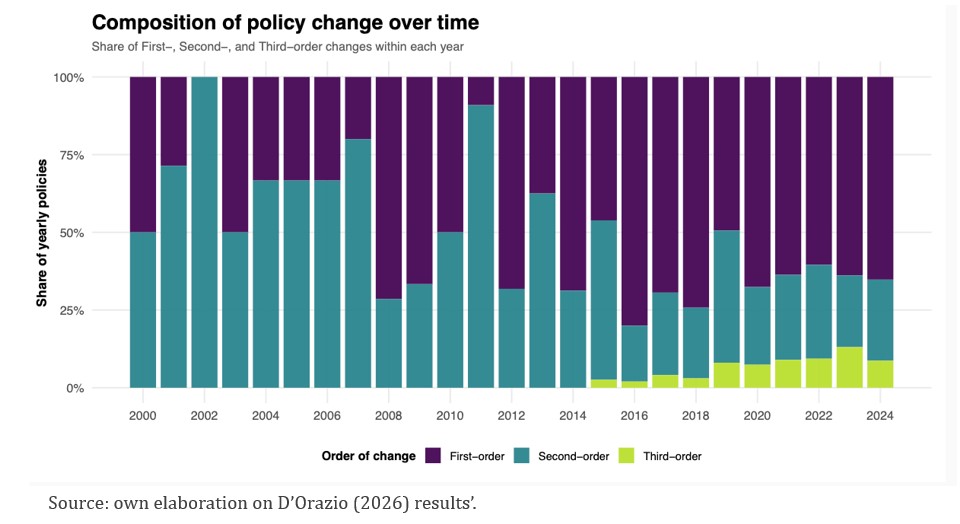
As Figure 1 makes clear, adoption accelerates sharply after 2015, with the cumulative count of CRFPs rising from below 100 in 2010 to more than 1,000 by 2024. Yet this uptake is not matched by a comparable shift in ambition. Figure 2 shows the annual share of policies by Hall (1993) order of change: first-order (incremental) instruments dominate throughout the period, second-order changes account for a stable but minority share, and third-order (paradigmatic) changes only appear from around 2015 onward and never exceed roughly 15% of yearly issuance.
Figure 2. Composition of climate-related financial policies by order of change, annual shares, 2000–2024
Synthesising the patterns documented across the article, the main findings can be summarised as follows:
Overall, the evidence is consistent with an institutional process of layering and technical convergence rather than a third-order paradigm shift in the sense of Hall (1993). Three complementary mechanisms help rationalise the heterogeneity observed across milestones and jurisdictions:
These mechanisms are also compatible with well-known political-economy constraints on the expansion of central bank mandates (“mission creep”) and explain why standard-setting milestones bundled with credible pathways to legal codification tend to align with deeper adjustments than purely declaratory commitments. The cross-country composite measures developed in D’Orazio and Thole (2022) point to similar conclusions, with deeper engagement concentrated in jurisdictions where prudential frameworks are most developed.
Given the prevalence of first-order measures across authorities and income groups (Figure 2), near-term progress is most likely where existing supervisory practices can be extended without immediate mandate reform. A pragmatic sequencing emerges from the evidence:
Reaching third-order change in the sense of Hall (1993), i.e., a redefinition of objectives, instruments, and institutional roles commensurate with the systemic character of climate risks (Carney, 2015), will require not only stronger institutional capacities and sustained international coordination, but also a re-articulation of mandates that legitimises deeper prudential recalibration.
Climate-related financial governance has institutionalised at an accelerated pace, particularly after 2015. Yet, beneath the visible expansion in policy counts, regulatory logics remain anchored in pre-existing paradigms: voluntary tools dominate, ambition is concentrated in jurisdictions with greater capacity, and paradigm-level reforms are rare and unevenly distributed. International initiatives that combine operational guidance with credible legal codification — most clearly in the EU — are the most consistent with deeper change. For policymakers, the analysis suggests that the most credible route to sustained ambition runs through mandate clarification, supervisory practice, and the disciplined sequencing of disclosure, scenario analysis, and prudential calibration.
Carney, M. (2015) Breaking the Tragedy of the Horizon – Climate Change and Financial Stability, Bank of England.
D’Orazio, P. (2023a) ‘A Global Database for Climate-Related Financial Policies’, BMC Research Notes, 16: 137.
D’Orazio, P. and Thole, S. (2022) ‘Climate-Related Financial Policy Index’, Ecological Indicators, 141: 109065.
Hall, P. A. (1993) ‘Policy Paradigms, Social Learning, and the State: The Case of Economic Policymaking in Britain’, Comparative Politics, 25(3): 275–296.
NGFS (2019) A Call for Action – Climate Change as a Source of Financial Risk. Network for Greening the Financial System.