

This policy brief is based on Andersen Institute White Paper No. 01-2026. The views expressed are those of the authors and not necessarily those of the institutions the authors are affiliated with.
Abstract
The United States and China have each built the capacity to inflict serious economic damage on each other, and neither has used it in full. This brief argues that the resulting mutual vulnerability, the Cold War logic of Mutually Assured Destruction (MAD) now constrains both sides and prevents further decoupling. The brief maps this contest across two stacks: the real economy stack of computing, semiconductors and rare earths (economic MAD, or EMAD) and the financial stack of dollar dominance and digital finance (financial MAD, or FMAD). Implications for corporate leaders, markets and policy makers are also discussed.
The United States and China have each built the capacity to inflict serious economic damage on each other, and neither has used it in full. Washington controls the semiconductor technology on which China’s ambitions depend. Beijing, through its near monopoly on rare earth processing, controls inputs that the West’s defense and advanced manufacturing cannot do without. Most analysts judge that neither side will be able to escape these weaponized dependencies for several years.
In a new Andersen Institute White Paper, we argue that the resulting mutual vulnerability—the Cold War logic of Mutually Assured Destruction (MAD), where “destruction” should read as economic disruption—now constrains both sides and prevents further decoupling. That equilibrium does not ensure stability. The baseline is several years of “unstable stability”: a world less integrated than the one we lived in for decades, less decoupled than many fear, and punctuated by flare-ups that resolve through de-escalation rather than victory or settlement.
We map this contest across two stacks: the real economy stack of computing, semiconductors and rare earths (economic MAD, or EMAD) and the financial stack of dollar dominance and digital finance (financial MAD, or FMAD).
Today’s semiconductor industry is a highly specialized yet globally integrated value chain. As more capable chips became harder to manufacture and the costs of building advanced fabrication plants soared, the industry shifted away from a vertically integrated model toward a more horizontal structure. Today, companies like Nvidia design chips but do not own factories, while geographically concentrated suppliers handle manufacturing, assembly, and testing.
This specialization resulted in a very small number of firms at each node. The U.S. controls two critical upstream layers. First, U.S. firms Synopsys and Cadence hold a near-duopoly on the Electronic Design Automation (EDA) software; without them, no firm could design a modern chip. Second, American fabless firms, like Nvidia, Qualcomm, and AMD, dominate chip design and the intellectual property that protects it, producing the blueprints that the rest of the chain manufactures.
Downstream, the Netherlands and Germany supply the equipment layer: ASML holds a near-monopoly on EUV lithography machines, relying on Germany’s Zeiss and Trumpf for the ultra-precise optics and lasers at their core. Japan dominates the adjacent materials and wafer-processing equipment layers, with Shin-Etsu Chemical, SUMCO, and Tokyo Electron as the leading firms. Taiwan’s TSMC and South Korea’s Samsung and SK Hynix then translate all of this (designs, tools, equipment, and materials) into actual silicon. TSMC dominates leading-edge logic fabrication, while Samsung and SK Hynix dominate memory.
China’s position in the semiconductor value chain is asymmetric. It is vulnerable where it matters most for its technological ambitions, yet indispensable in ways that constrain how far the U.S. can force it out of the value chain. China is dependent on the leading edge of chip design and production, likely still 5–10 years away from producing the EDA software or EUV lithography equipment needed for technological independence from the U.S., according to the latest publicly available analysts’ assessments. This dependence is the foundation of U.S. export control leverage.
However, China is critical in other parts of the value chain. To begin with, China is the world’s largest consumer of semiconductors, accounting for roughly one third to one half of global semiconductor demand, depending on the measure and year. For U.S. fabless firms, China is a major revenue source. This creates mutual dependence: China needs the chips, but the U.S. firms need the market access to generate revenues which in turn supports cash flow to invest.
Furthermore, China is also one of the world’s largest hubs for outsourced semiconductor assembly and testing, taking processed wafers and turning them into finished, packaged chips ready for devices. This is a less technologically demanding node than fabrication, but essential and difficult to relocate on a large scale in the near term.
Finally, China has significant capacity in older-generation chips, which represent the bulk of the global demand in cars, appliances, and industrial equipment, creating a vulnerability for the U.S. and its allies that was exposed by the Covid pandemic.
China’s rare earth position operates on a different layer of the computing stack and constitutes a more immediately critical second-strike capability in the tech war. China controls more than 60% of global rare earth mining and 90% of the processing capacity, dominating the supply of gallium and germanium. These materials are critical for the manufacturing of radio frequency chips, power electronics, and intensively used in the U.S. defense industry among many other sectors. This lever cannot directly affect the firms at the core of the U.S. technological advantage, but it is a more diffuse node in the global manufacturing network and very difficult to substitute at scale, even in the medium term. Available estimates suggest that meaningful processing independence is at least half a decade away, even under optimistic investment scenarios.
This extreme degree of specialization and concentration emerged from market logic during the globalization era rather than policy design. Yet, it has created chokepoints that the U.S. and China have now chosen to weaponize as instruments of geopolitical pressure, as Iran and the Houthis have weaponized the Strait of Hormuz and Bab el-Mandeb in the Read Sea.
The U.S. and China have each built export-control regimes that exploit the chokepoints each country dominates. The U.S. arsenal targets advanced computing technology. Its principal instrument, the Foreign Direct Product Rule (FDPR), extends U.S. jurisdiction to any foreign-made good produced using American technology or equipment. This policy reach is effective because every modern chip depends, at some stage, on U.S.-origin design software or manufacturing tools.
China’s counter-arsenal targets rare earths and critical minerals. Its leverage rests on a different premise: regardless of where rare earth ores are mined, processing is overwhelmingly concentrated in China, making border controls sufficient to restrict global supply. Beginning in 2023, with licensing requirements on gallium and germanium, Beijing has progressively expanded restrictions to graphite, rare earth extraction technology, and magnet-grade materials, following a tit-for-tat cadence that mirrors the U.S. escalation. The defense sector is the most acutely exposed. U.S. military systems depend on rare earth magnets with no short-term domestic substitute.
Both arsenals can impose immediate costs on the opponent but also generate side-effects on their own firms, and both triggered a derisking response that is eroding the effectiveness of the chokepoint over the longer term. This pattern comes with direct implications for the stability of the EMAD equilibrium.
The presumption that that American dominance of semiconductor design and equipment is a unilateral leverage with no credible Chinese counterpart has been the dominant paradigm to interpret the Sino-American trade and technology war. However, China’s near monopoly in rare earth processing is a mirror-image chokepoint on a different layer of the global manufacturing supply chain.
The weaponization of this critical input has resulted in a structural shift away from a single-hegemon world toward one of bilateral deterrence, grounded on mutual vulnerability, here labelled Economic Mutually Assured Destruction (EMAD) by analogy with nuclear strategy. In this new EMAD “equilibrium,” deterrence does not require symmetric capability; rather, like in the standoff in the Strait of Hormuz, it requires that the weaker party can credibly impose high enough costs on the attacker.
These two paradigms generate distinct testable predictions. In a single-hegemon world, (a) the U.S. escalates unilaterally while China accommodates or makes asymmetric concessions, as in the case of the Europe with respect to U.S. tariffs; (b) China’s retaliations remain symbolic rather than operationally credible; and (c) the corporate narratives reference only U.S. policy actions, with no measurable impact from Chinese policy actions.
Under EMAD, (a) both sides escalate and demonstrate credible and comparable retaliatory capacity; (b) mutual stand-downs prevent a full decoupling (i.e., forcing China out of the tech value chain or major disruptions to the West manufacturing capabilities) but the arsenals’ architectures remain intact rather than being dismantled—this implies neither a return to the pre-war order of open borders nor a descent into Cold War blocs; and (c) corporate narratives register a growing bilateral signal: Chinese export controls appear alongside U.S. restrictions, concentrated in the semiconductor and critical minerals sectors, even if the Chinese signal remains smaller in magnitude. The evidence that follows tests these predictions.
The first two predictions, retaliatory escalation and mutual stand-down, can be tested against a policy chronology of the trade and technology war. Donald Trump’s 2024 election brought about a quick escalation in the U.S.-China trade and tech wars. Within days of the inauguration, the administration imposed a 10% tariff on all Chinese imports. The rate was raised to 20% on March 4. On Liberation Day (April 2), an additional 34% reciprocal tariff on Chinese goods was announced, bringing the total to 54%. China responded on April 4 with a 34% tariff on all U.S. goods on top of targeted tariffs of 10 to 15% on agricultural and energy products already imposed in February and March. Critically, at that time, China also imposed new export licensing requirements on seven medium-to-heavy rare earth elements.
A tit-for-tat escalation spiral followed: the U.S. raised its China-specific reciprocal rate to 84% and then 125% (adding up to 145% with preexisting duties), while China matched each step, escalating to 84% on April 10 and 125% on April 12. On April 9, after U.S. equities, bonds and the dollar all declined sharply, reciprocal tariffs for all countries (except China) were paused.
Three rounds of negotiations between May and August followed and produced a partial and uneven de-escalation. On May 11, U.S. Treasury Secretary Bessent and China Vice Premier Lifeng met in Geneva, and the U.S. agreed to cut the April reciprocal tariffs from 125% to 10% for 90 days. Senior officials met again in London June 9–10 and in Stockholm July 28–29, broadening the talks beyond tariffs. The U.S. made several technology concessions. It rescinded a Biden-era provision, eased chip software restrictions, and in August approved Nvidia and AMD chip exports to China under a revenue-sharing arrangement. However, China’s April rare earth restrictions remained in force, with U.S. manufacturers continuing to face supply disruptions. On August 12, following the Stockholm talks, the two sides extended the May tariff truce another 90 days, to November 10, 2025.
The tech war reached a climax in the autumn of 2025. On September 29, the U.S. Dept of Commerce’s Bureau of Industry and Security (BIS) published the Affiliates Rule, already in the making for a while, extending the list of entities subject to restrictions to any foreign entity 50% or more owned by an included party. This effectively closed a loophole through which firms like Huawei had kept access to U.S. technology via unlisted subsidiaries. Ten days later, on October 9, China responded with six coordinated Ministry of Commerce (MOFCOM) announcements, its most comprehensive export control package to date.
Both sides pulled back at the APEC summit in Busan on October 30, and over the following ten days formalized a mutual stand-down agreement. MOFCOM suspended its October 9 measures until November 2026, BIS suspended the Affiliates Rule for the same period, and the tariff truce was extended for one year. However, neither side revoked its legal framework. Both sides preserved the retaliatory capacity while standing down from active usage of the arsenal (the economic equivalent of keeping warheads on alert while agreeing not to launch). The truce was followed shortly by further signs of détente including U.S. decisions to drop planned sanctions on China’s Ministry of State Security related to its role in the Salt Typhoon cyber-attacks on major U.S. telecom firms in 2024 and to allow Nvidia to begin selling one of its more advanced chips to China.
The U.S. and Chinese presidents met again in Beijing on May 14–15, 2026, with the Iran war still unresolved, and the meeting played out as a summit between peers rather than between rivals — confirming, in tone if not in substance, the new equilibrium.
On the one hand, in 2025, the policy narrative shows that China matched U.S. escalation with retaliatory measures of comparable scope, culminating in the October 9 export control package (a direct response to the September 29 issuance of the BIS Affiliates Rule). This demonstrated credible and effective retaliatory capacity, consistent with EMAD prediction (a). A month later, at the Busan bilateral meeting, both sides suspended their new measures but did not revoke them, leaving the arsenals’ architecture intact, consistent with prediction (b). On the other hand, these patterns are not consistent with the Hirschman hypothesis of unilateral escalation met by accommodation.
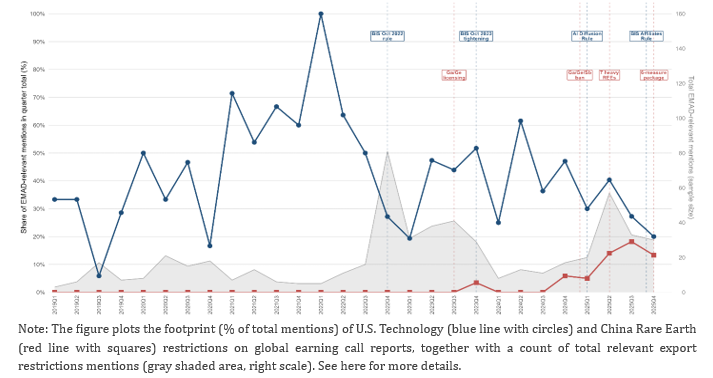
The third prediction under EMAD, a shift in corporate narratives from a unilateral to a bilateral signal, requires a different kind of evidence, which is provided in the Figure below. The evidence in the Figure shows that U.S.-led restrictions dominate the global corporate narrative from 2019 to late 2024. Chinese export restrictions are visible starting in late 2024 and quickly become salient through 2025. By the end of 2025, the gap between the impact of the two policies on the corporate narrative falls to single-digit percentage points, as each side weaponizes the supply chain rung where it holds maximum leverage.
Figure 1. U.S. and China Export Restrictions’ Footprint on the Global Corporate Narrative
With this transition from a world with a single coercive hegemon to one in which two hegemons are mutually vulnerable, weaponized technology shifts from amplifying fragmentation to limiting it. This is not because either side voluntarily chooses restraint, but because each discovers that the other can inflict comparable pain.
The standoff in the Strait of Hormuz between the U.S. and a far weaker Iran offers a parallel. As long as each side can impose economic damage on the other, both have an incentive to negotiate rather than risk extremely adverse outcomes.
Of course, these incentives remain in place only as long as each country can maintain its economic leverage. The EMAD equilibrium could break down if the U.S. achieves rare earth independence or if China can domestically produce chips and other high-tech items comparable to those produced in the West. Both are taking action along these lines to extend their own advantage and diminish the effectiveness of the economic weapons in the other’s arsenal. Nevertheless, as noted earlier, such actions will likely require concerted effort over several years before either country can meaningfully reduce its critical dependencies on the other.
EMAD can prevent Cold War-era decoupling, but it also incentivizes low-intensity competition over standards and regulation, subsidies, talent, and third-country pressure. The conflict migrates to different areas; it does not end. We can expect both sides, over time, to seek advantage along specific dimensions including finance, the critical lever to which the paper turns next.
On the financial side, a form of FMAD has existed for some time. The U.S. dollar dominance and the power to cut entities out of the global U.S. dollar payment system are a first-strike capability. China’s Treasury holdings and the exposure of U.S. interests to its regulatory reach are the second. But digital finance could tip this balance either way.
On the one hand, portable U.S. dollar-denominated stablecoins, the path the U.S. has chosen with the GENIUS Act, could deepen U.S. dollar dominance and erode China’s capital controls. More permeable Chinese capital control would diminish China’s shock absorption capacity and tilt the MAD balance toward Washington. A stronger U.S. hand, in turn, would likely lead to more fragmentation.
Table 1. Three Channels Through Which Digital Finance Could Affect Fragmentation
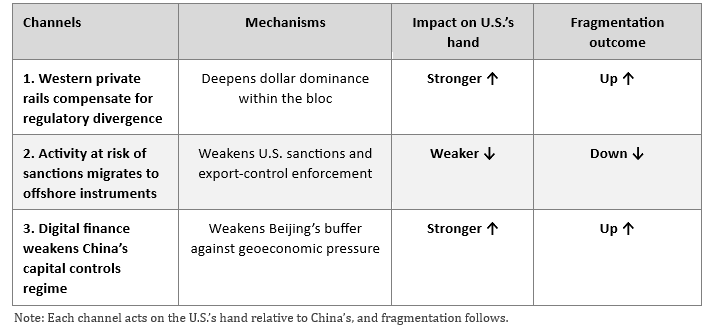
On the other hand, a shift in dollar-denominated demand for digital assets toward offshore rails like Tether in a quest to escape the risk of sanctions would do the opposite. That would weaken Washington’s enforcement capacity and, counterintuitively, restraining its hand.
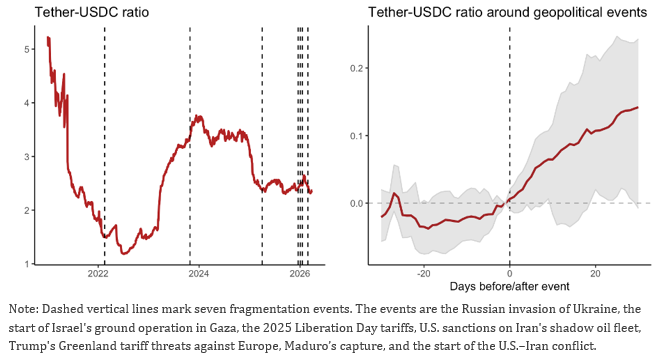
The dynamics of the relative market capitalizations of offshore, unregulated U.S. dollar stablecoins (such as Tether) and onshore, regulated U.S. dollar stablecoins (such as Circle) around fragmentation events is consistent with this idea. As the figure below shows, following such events, stablecoin demand shifts offshore, from Circle to Tether, affecting the instrument composition of U.S. dollar global demand without necessarily undermining dollar dominance itself.
Figure 2. Tether-Circle Market Capitalization Ratio and Fragmentation Events
For corporate leaders, the variable that matters most is time. Two clocks are running at once. The first is structural and slow: most analyses assess that neither side can escape its key dependency on the other for several years, which makes mutual vulnerability a reliable planning baseline. The second is unpredictable and can move fast: the policies that hold mutual vulnerability in place are internally inconsistent, and each side’s own contradictions could end the calm sooner than the structural clock implies. A surprise technological innovation on either side—such as the unexpected leaps by Chinese AI open-source models, recently underscored by Moonshot or faster than expected U.S. progress with rare earth processing capacity—could also unsettle the baseline.
The practical implication is that the multi-year horizon is enough time to plan around but no promise of globalization-era stability. Firms should decide which dependencies to reduce first (and on which side of the divide), sequencing this derisking by where they sit on the fault line. With the end-date uncertain, the payoff comes from adapting early to the new MAD reality.
For investors, the open question is valuations. National security is now an overriding government priority, yet it is unclear whether markets have fully priced in a security risk premium across asset classes and geographies. Markets have tended to read tariffs, digital finance, and financing costs as separate domains, while they are in fact interconnected. Additionally, investor expectations about earnings and cash flows of the largest U.S. hyperscalers may prove too optimistic in a world in which OpenAI and Antropic must compete with Chinese tech businesses rather than integrating vertically as Apple and Telsa did in their respective sectors during the globalization era. In this scenario, return on capital may turn out to disappoint investors, a development that could have a cascading effect given the increasing use of debt to fund the AI capex boom.
For policymakers, especially in Europe and the middle powers that have mostly been bystanders to the rewriting of the global order, the contest has created space. Now the question is whether and how to use it. Middle powers need not pick one block and stay in it. Europe, above all, has the economic weight to matter and the leverage (e.g., single-market access, the power to write rules) to stop being a target for pressure from both sides. They can either act with urgency or spend the next decade as collateral damage.
Over the next several years, the winners will be those who treat this new MAD equilibrium as a condition to plan and optimize around, managing the risks and seizing the opportunities, rather than a disruption to wait out.