

This Policy Note is based on Bennett, Duponcheele, Joulia-Paris, Ormezzano and Perraudin (2026), “Capital Cliffs and EU Securitisation Regulations”, and subsequent Trilogue text comparisons prepared in July 2026. The views expressed are those of the authors and should not be attributed to their institutions.
Abstract
European policymakers are revising securitisation rules to revive a market that can channel investment into the EU and enable greater risk transfer from banks to other market participants. The draft reforms do not address existing capital cliffs and may create new ones: sharp jumps in capital or liquidity requirements triggered by small changes in regulatory or risk inputs. This Policy Note identifies five cliff families in EU securitisation rules: rating-based cliffs, formula cliffs, label cliffs, uncollateralised risk-transfer cliffs, and collateral/liquidity cliffs. It argues that rules should minimise cliffs by design: smoothing discontinuities, making unavoidable thresholds proportionate to risk, and preferring robust origination tests to ongoing binary triggers. It applies these principles to current Trilogue examples in the Securitisation Package, aiming to preserve the benefits of reform without adding avoidable procyclicality.
The EU’s financing needs, including the green transition, digitalisation, defence and the wider competitiveness agenda, have brought securitisation back to the centre of the policy debate. Properly designed, securitisation can help banks recycle capital-intensive balance sheets into new lending, mobilise private capital and diversify risk-bearing beyond the banking sector.
This is the policy context for the European Commission’s 17 June 2025 Securitisation Package, the first legislative initiative under the Savings and Investments Union strategy. The Package aims to make the European securitisation framework simpler and more fit for purpose while preserving financial stability. It includes proposals affecting bank capital under the Capital Requirements Regulation (CRR), securitisation rules defined in the Securitisation Regulation (SECR), insurer capital under Solvency II and bank liquidity treatment under the Liquidity Coverage Ratio (LCR).
That package builds on post-crisis reforms. European authorities have adjusted securitisation capital and liquidity rules several times since the Global Financial Crisis (GFC). These reforms have strengthened transparency, investor protection and resilience, but they have also contributed to a framework that remains complex and, in some areas, burdensome, not fully effective, and insufficiently aligned with economic risk. The current reform should therefore not only reduce unnecessary barriers for issuers and risk-takers. It is also an opportunity to improve how rules behave when market conditions deteriorate, an important consideration for financial stability.
Against that background, this Policy Note builds on earlier SUERF work on securitisation and European competitiveness, which emphasised bank capital velocity (Policy Brief No. 976), and on insurance-based credit risk transfer, which highlighted the stabilising role of diversified non-life (re)insurers in significant risk transfer (SRT) markets (Policy Note No. 375). However, its focus is different. It does not address whether capital levels are too high or too low, but whether the design of the rules, including multiple safeguards and their cumulative effects, can generate sudden discontinuities, or capital cliffs, that undermine financial-stability objectives.
Capital cliffs matter because they distort incentives in normal times and amplify instability in downturns. During periods of stress, it is rarely the average level of capital that breaks the system; it is the sudden, discontinuous jump. A capital cliff arises where a small change in a risk driver, regulatory label or eligibility test produces a disproportionately large change in capital or liquidity treatment. Such discontinuities can also affect investor demand, secondary-market liquidity and new issuance, amplifying price volatility during stress.
Cliffs can arise in two ways. Static cliffs occur when economically similar exposures sit on opposite sides of a categorical boundary and receive sharply different prudential treatment. Dynamic cliffs occur when an exposure can fall into less favourable treatment over time because ratings change, pool losses accumulate or an ongoing eligibility test is breached. Dynamic cliffs are particularly important from a macroprudential perspective because they tend to bite precisely when banks have the least balance-sheet flexibility and when some investors may also face liquidity or redemption pressures.
The policy implication is straightforward. This Policy Note is not an argument for lower capital overall. It is an argument for better rule design. A prudential framework can be conservative and still avoid cliff effects. Anti-cliff design should therefore be treated as part of the financial-stability objective: capital, liquidity, eligibility and related market-access rules should be robust at origination, risk-sensitive over time and predictable in stress.
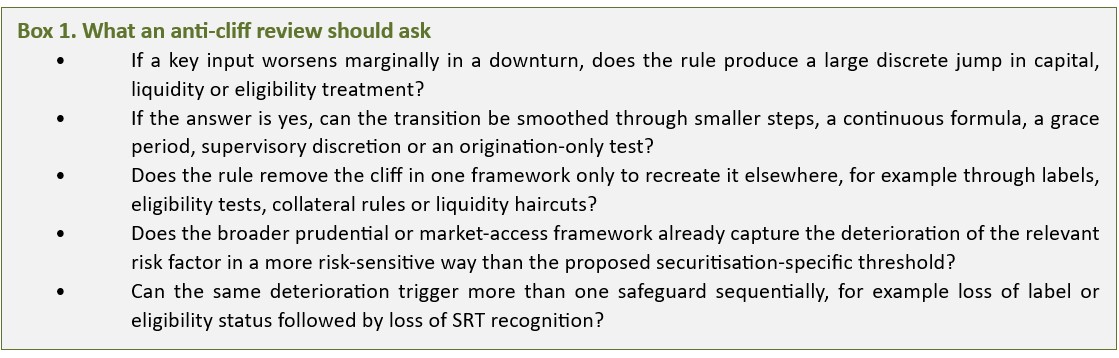
Capital cliffs in EU securitisation rules arise through several different mechanisms. Some are familiar from the post-crisis debate, such as rating-based cliffs and formula cliffs. Others are more recent, reflecting the interaction between regulatory labels, significant risk transfer, insurer participation and liquidity rules. Together, these mechanisms show that cliff effects are not confined to a single article or framework. They can emerge wherever a prudential, eligibility or liquidity rule turns a continuous change in risk into a discontinuous change in capital, liquidity or eligibility treatment.
Cliff effects may also occur sequentially, where the same deterioration first causes the loss of a regulatory label or eligibility status and then triggers a second loss of prudential recognition, such as SRT recognition. This is the cumulative-safeguards problem: safeguards that appear reasonable in isolation can interact in ways that multiply discontinuities.
The first family is rating-based cliffs. These are the most intuitive because external ratings are often mapped directly into prudential treatment, eligibility rules or investor mandates. If a rating changes by one notch, capital requirements or eligibility may change by much more than the underlying change in economic risk. The problem is amplified because rating actions do not always occur gradually. During the GFC, structured finance downgrades were highly clustered, with many tranche downgrades in short periods. Similar wave dynamics later appeared in collateralised loan obligations (CLOs), including around methodology changes and during the COVID period. Ratings should change when risk changes. The issue is that ratings can change in concentrated waves, often for reasons outside the control of banks, investors or supervisors. When regulation hardwires those rating actions into capital or eligibility rules, and attaches disproportionate consequences to them, a reassessment or methodology change by rating agencies can trigger a system-wide prudential shock.
The second family is formula cliffs. These arise not from an external trigger, but from the shape of the securitisation capital formula itself. Under the Basel II Supervisory Formula Approach (SFA), capital requirements declined sharply as tranche seniority increased, especially around the point linked to the capital that would apply to the underlying assets. Basel III approaches, including the Simplified Supervisory Formula Approach (SSFA) used in SEC-IRBA and SEC-SA, introduced the p-factor to smooth this cliff. But this smoothing involves a trade-off. A higher p-factor reduces the steepness of the capital curve, but increases non-neutrality, meaning that total capital after securitisation may exceed the capital that would apply to the underlying assets. It may also under-recognise the risk transferred to investors in SRT transactions, making securitisation uneconomic for parts of banks’ portfolios. A lower p-factor moves the framework closer to neutrality, but makes the curve steeper and reintroduces cliff effects. This matters particularly in periods of stress. If pool credit quality deteriorates, pool capital rises, and senior tranches that were designed to sit close to a low capital floor can experience large and sudden increases in risk weights.
Formula cliffs are therefore a reminder that a rule can be mathematically continuous and still behave like a cliff if the slope is too steep. Fixed minimum or maximum risk-weight floors can create a similar effect by reducing risk sensitivity at particular points in the capital framework. The ESAs’ 2022 joint advice recognised that targeted adjustments, including risk-weight floor changes for resilient senior tranches, could improve risk sensitivity, while broader formula-design issues require further work and may ultimately need to be addressed at international standard-setting level.
The third family is label cliffs. Regulatory labels, such as simple, transparent and standardised (STS) treatment or the proposed Resilient treatment, can promote transparency, standardisation and confidence. They become sources of cliff risk, however, when they create large binary differences in prudential treatment between otherwise comparable exposures, or when favourable treatment can be lost abruptly over time.
Solvency II provides a historical example for insurers. The earlier Type 1 and Type 2 securitisation distinction generated large capital jumps, particularly when rating deterioration interacted with a loss of favourable classification. The later STS framework reduced some of these effects but did not eliminate label cliffs.
The proposed Resilient treatment in bank capital rules creates a new version of the issue. If Resilient status is assessed at origination only, it can operate as a useful structuring incentive. If reassessed on an ongoing basis, it can become a dynamic cliff: favourable treatment may disappear precisely when losses rise or model inputs deteriorate. A label intended to identify resilience should not disappear exactly when resilience is most needed.
SRT recognition is another important label-related cliff because it can operate as a binary condition for capital relief and may interact with other labels or eligibility tests. At inception, a transaction designed primarily to transfer credit risk may be economically viable only if SRT is recognised, so a binary recognition decision can determine whether the transaction is issued at all. Over the life of the transaction, SRT recognition may also be lost if the competent authority concludes that risk transfer is no longer effective or no longer meets CRR requirements, for example because of ineffective credit protection, implicit support, material amendments, failure to maintain commensurate risk transfer, breach of synthetic excess spread requirements, or failure of legal, operational or servicing arrangements. The issue is not supervisory reassessment as such. The cliff risk arises where the consequence is binary and disproportionate: economically meaningful differences in risk transfer may translate into a pass/fail capital outcome rather than a proportionate adjustment. The risk is amplified where the same underlying criterion, such as counterparty credit quality, eligibility status, legal enforceability or portfolio composition, is used both in a label or eligibility test and in the SRT assessment. A first cliff may therefore arise through loss of label or eligibility status, followed by a second cliff through loss of SRT recognition.
The policy challenge is to preserve incentives for robust structures without making Non-STS or Non-Resilient treatment so punitive, or so unstable over time, that labels themselves become sources of cliff risk. Some label or eligibility cliffs may also operate as market-access cliffs where they determine which issuers, protection providers or investors can participate in a segment. Supervisory reassessment should remain available where risk transfer genuinely ceases to be effective, but the framework should avoid overlapping binary tests that create sequential cliff effects across labels, eligibility conditions and SRT recognition.
The fourth family is uncollateralised risk-transfer cliffs. These arise where recognition of unfunded, or more accurately uncollateralised, credit protection depends on ongoing counterparty eligibility tests. They are especially important for SRT because the consequence of losing recognition can be severe: the bank may lose the capital relief associated with the transaction even though the protection contract remains legally enforceable. The private-law protection may still exist, while the prudential framework treats the bank as if the protection no longer counted.
Under CRR2, banks using regulated insurers as providers of uncollateralised credit protection were exposed to an ongoing rating cliff: if the insurer ceased to meet the relevant rating condition, the bank could lose prudential recognition of the protection. CRR3 removed that cliff for banks using regulated insurers by bringing those insurers within the category of “regulated financial sector entities” under Article 201(1)(fa). A proposed amendment to CRR Article 249(3) could reactivate it by applying an ongoing credit quality step 3 (CQS 3) test to Article 201(1)(fa). The better approach is robustness at origination, for example CQS 2 when the credit protection is first recognised, without an ongoing binary rating trigger that automatically calls SRT recognition into question. Subsequent counterparty deterioration should be managed through counterparty-risk capital, credit risk mitigation, exposure limits, supervision and, where appropriate, credible mitigation actions such as replacement, additional protection or grace periods. Automatic loss of recognition should be reserved for cases where the protection has genuinely ceased to be effective or enforceable.
The same anti-cliff principle applies to the proposed SECR Article 26e(8)(aa), which would open STS synthetic securitisation to eligible insurers and reinsurers providing uncollateralised protection. This can broaden the risk-bearing base, but only if the attached safeguards are not converted into ongoing tripwires. Tests based on rating, internal model status, business mix, size, technical provisions or balance-sheet structure can all become dynamic cliffs if assessed continuously rather than only at origination.
Eligibility safeguards can also create static and dynamic cliffs. A static cliff may arise if group support is recognised only where the parent is subject to EU Solvency II group supervision, but not where the parent is subject to a third-country regime deemed equivalent under Solvency II. Economically similar EU-regulated insurance subsidiaries may then fall on opposite sides of a binary access boundary, reducing banks’ counterparty choice, weakening price discovery and making limit management more difficult. A dynamic cliff may arise if STS treatment can be lost after origination because the eligible protection provider no longer satisfies ongoing safeguards, for example due to a rating change, a reduction in total assets, or a change in the share of credit-related technical provisions. The policy objective should be to ensure that insurers are robust when the transaction is originated, while avoiding ongoing tripwires and static eligibility boundaries that are not proportionate to the underlying risk.
The fifth family is collateral and liquidity cliffs. These show that cliff effects are not limited to capital requirements. In funded synthetic securitisations, collateral-location and collateral-quality rules can force cash collateral to move if the originator bank no longer meets a rating threshold. Such rules may look prudent in isolation, but in a sovereign or banking stress episode they can drain liquidity from precisely the institutions under pressure. They may also reinforce the bank-sovereign nexus, because bank ratings in some jurisdictions are constrained by sovereign ratings. The Liquidity Coverage Ratio framework creates a related issue for traditional securitisations. Eligibility thresholds and haircut steps can affect whether securitisations are attractive for bank liquidity portfolios and market-making activity. If liquidity rules are too binary, they can replace or amplify a capital cliff with a liquidity cliff.
The common lesson across these five families is that cliff effects migrate. If policymakers smooth a capital formula but introduce an ongoing label test, the cliff reappears through classification. If they remove a rating trigger in CRR but recreate it in SECR safeguards, the cliff reappears through eligibility. If they improve bank capital treatment but leave collateral or LCR rules with hard thresholds, the cliff reappears through liquidity. This is why securitisation reform should be assessed holistically across CRR, SECR, Solvency II and the LCR Delegated Act, taking into account existing risk sensitivity and mitigants in the broader credit and counterparty-risk framework. The objective is not to remove prudential safeguards. It is to design safeguards that are robust at origination, monitored, proportionate in their consequences, capable of supporting credible mitigation actions, and predictable in stress.
The five cliff families differ in their legal mechanics, but they point to the same prudential design problem: rules should respond to changes in risk without turning small changes in ratings, labels, formula inputs, counterparty status or collateral treatment into disproportionate, abrupt capital or liquidity shocks.
Capital rules should not ignore ratings, but they should avoid making ratings perform functions that they cannot safely perform. Ratings remain useful inputs in securitisation because transactions are information-intensive. The problem arises when a rating action automatically changes eligibility or creates a large capital step. A better design lets ratings influence capital gradually and combines them with supervisory judgement, bank risk-management tools and counterparty-risk controls.
Formula cliffs require a different remedy. The p-factor provides smoothing, but it also affects the entire capital mass across tranches. Pushing the p-factor high enough to eliminate cliffs can make securitisation uneconomic by creating excessive non-neutrality. The more structural solution is to revisit formula design, for example by scaling pool capital before it enters the securitisation formula. That can flatten the cliff without simply increasing total capital. Fixed minimum and maximum risk-weight floors should also be reviewed through this lens because they may improve conservatism while reducing risk sensitivity at particular points.
Label cliffs are particularly relevant to the current reform because the proposed Resilient category creates a new prudential distinction. A Resilient label can be useful if it reflects robust structure at origination. It becomes dangerous if it is tested continuously. If a senior tranche ceases to satisfy an attachment-point test after losses or model changes, capital can jump in the downturn. A label designed to signal resilience should not disappear exactly when resilience is needed most.
The same logic applies to counterparty eligibility tests for uncollateralised credit protection. Robustness should be assessed when the protection is first recognised, while subsequent deterioration should be managed through ordinary counterparty-risk capital, credit risk mitigation rules, exposure limits and supervision. Where relevant, the framework should also facilitate credible mitigation actions, such as replacement, reinsurance, additional protection or other risk-management responses. Ongoing binary eligibility tests risk turning a prudential safeguard into a procyclical tripwire.
Anti-cliff design must also assess the cumulative effect of safeguards. A single deterioration can trigger several mechanisms in sequence: loss of eligibility, loss of label status, loss of SRT recognition, changes in collateral treatment or changes in liquidity treatment. Such cumulative effects are especially problematic where each safeguard is justified separately, but their combined operation creates a disproportionate prudential outcome.
Anti-cliff design must also include collateral and liquidity rules. Capital reform can fail if cliffs migrate into collateral or liquidity treatment. In funded synthetic securitisations, collateral-location and collateral-quality rules can force cash collateral to move if the originator bank no longer meets a rating threshold. In the Liquidity Coverage Ratio framework, eligibility thresholds and haircut steps can affect whether securitisations are attractive for bank liquidity portfolios and market-making activity. If liquidity rules are too binary, they can replace a capital cliff with a liquidity cliff.
The broader lesson is that cliff effects migrate across frameworks. A capital formula can be smoothed, only for the cliff to reappear through a label test, an eligibility condition, a collateral rule or a liquidity haircut. Anti-cliff design should therefore be assessed holistically across CRR, SECR, Solvency II and the LCR Delegated Act. The objective is not to weaken prudential safeguards, but to make them proportionate, stable and predictable in stress.
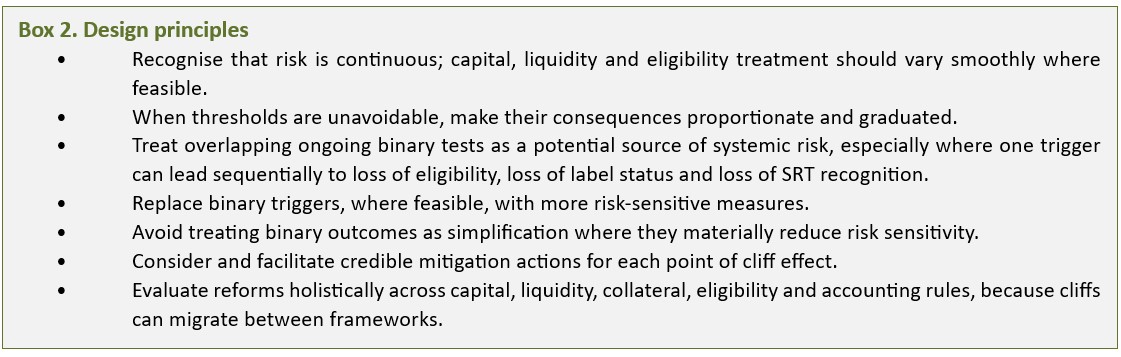
These design lessons are directly relevant to the current Trilogue, where some drafting choices remove cliff effects while others risk recreating them through eligibility, rating or label triggers.
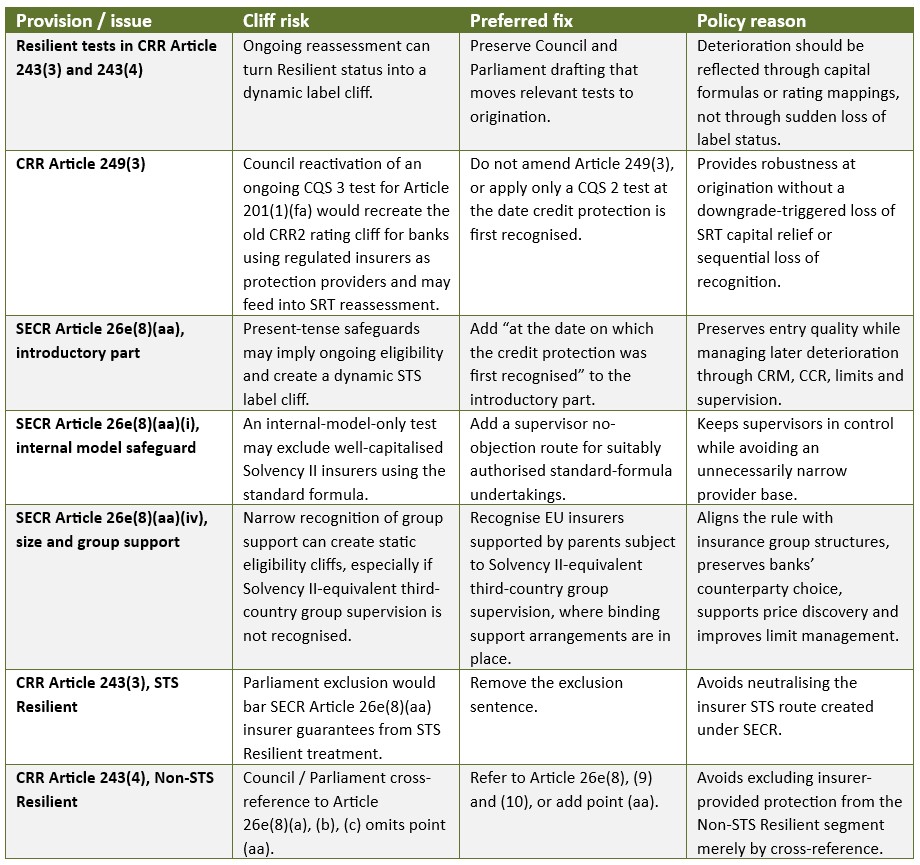
The current Trilogue on the Securitisation Package provides a practical test of the anti-cliff principles set out above. The theory is simple: prudential safeguards should be robust at origination, monitored, proportionate in their consequences, capable of supporting credible mitigation actions and predictable in periods of stress. The current legislative texts show both sides of that principle. In some places, Council and Parliament have improved the framework by moving tests from “at origination and on an ongoing basis thereafter” to “at origination”. In other places, however, the drafting risks recreating cliff effects through ongoing rating tests, eligibility conditions or narrow cross-references.
The clearest positive example concerns the proposed Resilient treatment. Both Council and Parliament move several Resilient tests to origination only. This is good anti-cliff design. It turns Resilient status into an ex-ante structuring incentive rather than a fragile label that can disappear ex post when losses rise or model inputs deteriorate, precisely when resilience is most needed. Subsequent deterioration should be reflected through capital formulas or rating mappings, not through the loss of the label itself. In terms of the taxonomy above, this reduces the risk that a label cliff becomes a dynamic cliff during stress. That improvement should be preserved.
The first remaining risk is the proposed reactivation of CRR Article 249(3). The Council proposal to replace the reference to Article 201(1)(g) with Article 201(1)(fa) would bring regulated insurers back into the old CRR2 rating-trigger mechanism. Under CRR3, Article 249(3) became moot for regulated insurers providing protection to securitisation exposures because Article 201(1)(g) no longer applies to such exposures and regulated financial sector entities were moved to point (fa). Replacing (g) with (fa) is therefore not a technical correction. It would recreate an ongoing rating cliff: if the provider ceased to meet a current CQS 3 threshold, the bank could lose recognition of the protection for prudential purposes. The practical impact could be severe: the bank may retain a legally enforceable protection contract, but face a sudden loss of regulatory capital relief at precisely the point when market conditions are weaker.
This is also where cumulative safeguards matter. A deterioration in the protection provider’s status may first affect an eligibility or label condition and then feed into the supervisory assessment of whether SRT remains effective. The same underlying event can therefore produce two sequential effects: loss of favourable treatment or eligibility under one rule, followed by potential loss of SRT recognition. Anti-cliff design should not prevent supervisors from acting where risk transfer has genuinely ceased to be effective, but it should avoid turning overlapping safeguards into automatic, duplicative tripwires.
The anti-cliff solution follows directly from the design principles. If policymakers want a robustness safeguard, they should require that the provider was CQS 2 or better when the credit protection was first recognised. They should not add an ongoing CQS 3 requirement. The first test is an origination robustness screen; the second is a dynamic tripwire. Subsequent counterparty deterioration should be managed through the ordinary credit risk mitigation framework, counterparty-risk capital, internal limits, large exposure rules, supervision and, where appropriate, facilitated replacement, additional protection, grace periods or other credible mitigation actions, not by automatic loss of SRT recognition.
The second test case is SECR Article 26e(8)(aa), which would open STS synthetic securitisation to eligible insurers and reinsurers providing uncollateralised credit protection. This reform is positive in principle because it can broaden the risk-bearing base. But the same provision can create new cliffs if the safeguards are drafted as ongoing eligibility tests. The introductory part, or chapeau, should therefore state that the insurer meets the safeguards “at the date on which the credit protection was first recognised”. Without that clarification, present-tense wording may imply continuous testing and create a dynamic STS label cliff.
A related drafting issue concerns how the insurer STS safeguards recognise group support. The Trilogue should use existing Solvency II concepts to make the safeguards both robust and workable. In particular, where an EU insurance undertaking benefits from binding parental or group support, it should be possible to recognise parents subject to third-country group supervision that has been deemed equivalent under Solvency II. This would not dilute the prudential standard: equivalence is itself an EU-recognised supervisory assessment, and the protection-providing undertaking would remain an EU-regulated insurer subject to Solvency II. Rather, it would align the drafting with how insurance groups are actually organised, including specialised EU-regulated subsidiaries supported by large, diversified international groups. From an anti-cliff perspective, recognising Solvency II-equivalent group supervision avoids an unnecessary static eligibility cliff between economically similar groups, preserves banks’ initial choice of counterparties, supports price discovery and makes counterparty limit management more effective. Equivalence assessments should remain current and should be applied consistently where relied upon in EU prudential law.
The same logic applies to the recitals. Recital 22 is useful because it recognises that the current funded-protection criterion has limited insurer and reinsurer participation in STS synthetic securitisation. But recital and operative text should be aligned. A stronger CQS 2 test at origination is preferable to a weaker entry test combined with an ongoing CQS 3 tripwire. Where ratings are used at origination, policymakers should also consider whether insurer financial strength ratings, where mapped appropriately and consistently, better capture the claims-paying capacity relevant to credit protection. Parliament’s formulation, which ties the rating assessment to the date on which the credit protection was first recognised, is therefore closer to anti-cliff design. Its statement that the size threshold should take account of market structure is also important, because a fixed solo-entity threshold may not fit the way European and global insurance groups organise underwriting capacity.
By contrast, the Council’s proposed Recital 29a on ESRB monitoring should be handled carefully. The ESRB already has a broad macroprudential mandate and has already examined STS synthetic securitisation. Re-stating that mandate in a recital specifically attached to insurer-provided uncollateralised protection may unintentionally stigmatise a regulated Solvency II risk-bearing channel. From an anti-cliff perspective, the financial-stability priority is not to create special suspicion around insurer participation. It is to ensure that the safeguards attached to that participation do not themselves become sources of static or dynamic cliff effects.
The Trilogue therefore illustrates the broader lesson of this Policy Note. Anti-cliff design is not an abstract preference. It is a practical drafting discipline: safeguards should support the regulatory objective without creating new sources of procyclicality or financial-stability risk. Where the texts move tests to origination, they reduce procyclicality. Where they introduce ongoing rating triggers, narrow eligibility categories or hard cross-reference exclusions, they risk recreating the very discontinuities the reform should remove. The objective should be clear: robust safeguards at origination, credible mitigation actions where needed, no unnecessary binary tripwires during stress, and no static eligibility divides or sequential cliff effects that restrict participation without a proportionate risk basis.
Table 1. Priority Trilogue fixes for anti-cliff design
Insurer-provided uncollateralised credit protection is often described as “unfunded”, but “uncollateralised” is the more accurate economic term. The provider is not unregulated or empty; it is a Solvency II insurer or reinsurer with capital, supervision, claims-paying obligations and risk-management requirements. The bank receives contractual protection, while counterparty risk is managed through prudential rules rather than pre-funded collateral, which is more naturally suited to less regulated or capital-market protection providers. The anti-cliff question is therefore not whether insurer protection should be accepted without safeguards, but whether those safeguards are designed as stable prudential filters or as binary triggers that can suddenly change the regulatory treatment of a securitisation.
This distinction matters for STS synthetic securitisation. The 2021 STS synthetic framework effectively excluded insurers because it was built around collateralised protection. Insurers have since developed a meaningful presence in the Non-STS segment. The 2025 Securitisation Package addresses this through SECR Article 26e(8)(aa). That is a positive step because insurers and funded investors have complementary risk appetites. Credit funds tend to be stronger in shorter-dated corporate risk; insurers and reinsurers are often better suited to longer-duration mortgage, infrastructure and diversified credit risk. Opening STS synthetic securitisation to insurers can therefore broaden the risk-bearing base, but only if eligibility criteria do not create new cliff effects.
There are two cliff risks to avoid. The first is a static eligibility cliff: if the safeguards are calibrated too narrowly, only a very small number of insurers will qualify, even where other insurers are prudentially supervised, well-capitalised and have diversified business models. That would narrow banks’ initial choice of counterparties, weaken price discovery and make counterparty limit management more difficult. This supports recognition of EU insurance subsidiaries backed by parents subject to Solvency II-equivalent third-country group supervision, where binding support arrangements are in place.
The second is a dynamic eligibility cliff: if an insurer can cease to qualify after origination because of an ongoing rating, model, size or diversification test, banks may discount the value of the protection ex ante, since the transaction could later move from STS to Non-STS or lose SRT recognition for regulatory reasons rather than because the contract has ceased to protect the bank.
In addition, Solvency II’s winding-up framework gives insurance claims preferential treatment over other claims, subject to national implementation choices and specified exceptions. This reinforces the distinction between an insurer’s contractual claims-paying obligation and an ordinary unsecured financial claim.
The best design is therefore “robust at origination, stable through the cycle”. At origination, an insurer should be demonstrably strong, well-rated, prudentially supervised, authorised for the relevant lines of business, appropriately diversified and supported by adequate group or parental arrangements where relevant. After origination, deterioration should trigger monitoring, counterparty-risk capital, credit risk mitigation responses, exposure-limit management and supervisory engagement, not automatic reclassification of the securitisation. In this sense, insurer access is a practical application of anti-cliff design: the framework should screen for robust protection providers at the start, while avoiding both static access boundaries and dynamic tripwires that are not proportionate to the underlying risk.
The EU securitisation reform is a timely opportunity to support investment, diversify risk-bearing and strengthen financial stability. But poorly designed thresholds can undermine those objectives. Capital cliffs make markets smaller in normal times because participants avoid structures that during their life might be subject to change in regulatory status. They make stress episodes worse because a small change in ratings, labels, formula inputs or eligibility conditions can trigger a large jump in capital or liquidity needs.
The Securitisation Package is therefore a live test of anti-cliff design. The practical policy agenda is straightforward. Preserve the Council and Parliament improvements that move Resilient tests to origination. Do not reactivate CRR Article 249(3) as an ongoing rating cliff for banks using regulated insurers as protection providers. Draft SECR Article 26e(8)(aa) so insurer safeguards are assessed at the date on which the credit protection is first recognised. Fix the CRR Article 243(3) and Article 243(4) cross-references so the new insurer STS route is not neutralised by capital rules, including in the STS Resilient and Non-STS Resilient segments. Calibrate size, diversification and internal model safeguards to the actual European insurance market, not to an idealised market structure.
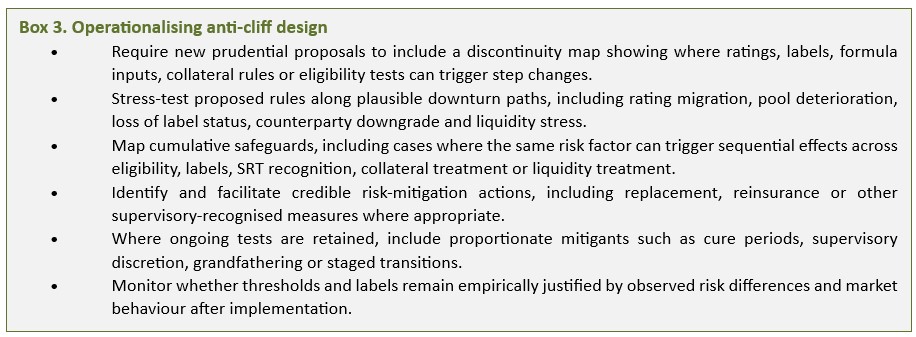
The broader lesson is that anti-cliff reform cannot be siloed. A capital rule that is smoothed while a liquidity rule remains binary may still create procyclical market behaviour. Policymakers should therefore conduct cliff mapping across CRR, SECR, Solvency II and the LCR Delegated Act before final implementation, including the cumulative effect of safeguards where the same deterioration may sequentially affect eligibility, labels and SRT recognition.
In short, the framework should be robust at origination, risk-sensitive over time and stable in stress. An anti-cliff review should become part of the normal prudential design toolkit, helping regulation mitigate rather than amplify financial-stability risks. If Europe wants securitisation to contribute meaningfully to the Savings and Investments Union, its rules should distinguish prudent risk transfer from excessive risk avoidance. More broadly, anti-cliff analysis should become part of the EU Better Regulation toolkit for financial legislation, alongside impact assessment, proportionality and financial-stability analysis.
Bell, I., M. Bennett, G. Duponcheele, T. Joulia-Paris and V. Ormezzano (2025), “Insurance-based Credit Risk Transfer: a resilient risk-bearing capacity untapped in the EU,” SUERF Policy Note No. 375, September.
Bennett, M., G. Duponcheele, T. Joulia-Paris, V. Ormezzano and W. Perraudin (2026), “Capital Cliffs and EU Securitisation Regulations,” Report, May. Available at: www.riskcontrollimited.com.
Duponcheele, G., M. Fayémi, F. González Miranda, W. Perraudin and A. Tappi (2024), “Securitisation Reform to Boost European Competitiveness,” SUERF Policy Brief No. 976, September.
Duponcheele, G. and W. Perraudin (2025), “How to Calibrate Securitisation Capital Rules,” Report, Risk Control, March. Available at: www.riskcontrollimited.com.
European Commission (2025), Commission proposes measures to revive the EU securitisation framework, 17 June.
European Commission (2025), Proposal amending Regulation (EU) No 575/2013 as regards requirements for securitisation exposures, 17 June.
European Commission (2025), Proposal amending Regulation (EU) 2017/2402 as regards the securitisation framework, 17 June.
European Supervisory Authorities (2022), “Joint Committee Advice on the Review of the Securitisation Prudential Framework”, Report JC 2022 66, Joint Committee of the ESAs, December.
European Systemic Risk Board (2025), Unveiling the impact of STS on-balance-sheet securitisation on EU financial stability, Report, May.