

The opinions expressed in the paper are those of the authors and do not necessarily reflect the views of the Bank of Italy. We are grateful for comments by Andrea Polo, Luigi Federico Signorini, Alessio De Vincenzo, Francesco Cannata, Emilia Bonaccorsi di Patti, Enrico Sette, Antonio Di Cesare, Marcello Bofondi, Pierluigi Bologna, Raffaele Gallo, Fabiana Sabatini, Giacomo Manzelli, Arianna Miglietta, Francesco Palazzo, Anna Maria Rinaldi.
Abstract
We analyse the effects of internal ratings-based (IRB) models on risk-weighted asset (RWA) variability, investment strategies and capital management among significant banks in the euro area, using a unique supervisory dataset. Our findings indicate a decline in RWA density (i.e. the ratio of risk-weighted assets to total exposure at default) following the adoption of internal models. We find no evidence that post SSM weakly capitalized or fragile banks reduced RWA density more than other banks after the adoption of IRB models along the margins examined in the paper. This is consistent with the view that supervision may have limited the scope for opportunistic post-adoption reductions in RWAs. Finally, we provide evidence that IRB models encourage banks to reallocate credit towards more profitable borrowers – particularly large non-financial corporations – while reducing sovereign and central bank exposures.
Risk-weighted assets (RWAs) are a cornerstone of bank capital regulation. By linking capital requirements to the riskiness of individual exposures, they are meant to ensure that riskier balance sheets are backed by more capital. Under the internal ratings-based (IRB) approach introduced with Basel II, banks can use internally developed models to estimate credit risk, subject to supervisory approval.
The rationale is straightforward: a more risk-sensitive framework can distinguish between safer and riskier assets more precisely than a system based only on fixed regulatory weights. But greater risk sensitivity also creates modelling discretion. Credit institutions may operate more than one hundred risk models, with thousands of parameters that need continuous validation and recalibration. Because equity is costly, the long-standing concern is that banks could use this discretion to lower measured risk and reduce regulatory capital requirements.
European Union offers a particularly useful setting in which to revisit this concern. Since the establishment of the Single Supervisory Mechanism (SSM) in late 2014, supervision of significant euro-area banks has become more centralised and harmonised. The ECB’s Targeted Review of Internal Models (TRIM), launched in 2016 and completed in 2021, specifically sought to reduce unwarranted variability in model outcomes and improve the consistency and comparability of internal models.
Against this background, our analysis asks a simple but policy-relevant question: when banks adopt internal models and their measured risk declines, is the decline consistent with strategic modelling by banks under capital pressure, or does IRB adoption mainly change the way banks allocate their balance sheets?
A lower RWA density, however, is not sufficient evidence of regulatory arbitrage. Internal models are designed to be more risk-sensitive and can legitimately generate lower capital charges for exposures assessed as safer. The policy question is therefore whether the reduction is especially pronounced where incentives to obtain capital relief are strongest.
In the spirit of Mariathasan and Merrouche (2014), we test two different ex-ante hypotheses, both based on the general idea that IRB models can influence banks’ risk assessment and, consequently, capital management:
We use quarterly confidential supervisory data for 124 significant institutions in the euro area from March 2015 (i.e. from the launch of the SSM) to December 2023. The sample accounts for about 83.9% of SSM banking-system assets at the end of 2023. The common supervisory reporting framework is important: it allows the analysis to focus on cross-bank differences within a substantially harmonised institutional environment.
Our central measure is credit-risk RWA density – credit-risk RWAs divided by exposure at default (EAD). This metric is preferable to RWAs over total assets because EAD captures off-balance-sheet exposures, credit-risk mitigation and conversion factors, and – more importantly – it captures the mechanical reduction of the shift from standardized to internal models. Credit risk is also the dominant component of RWAs for European banks, accounting for around 85% of total RWAs over the period studied.
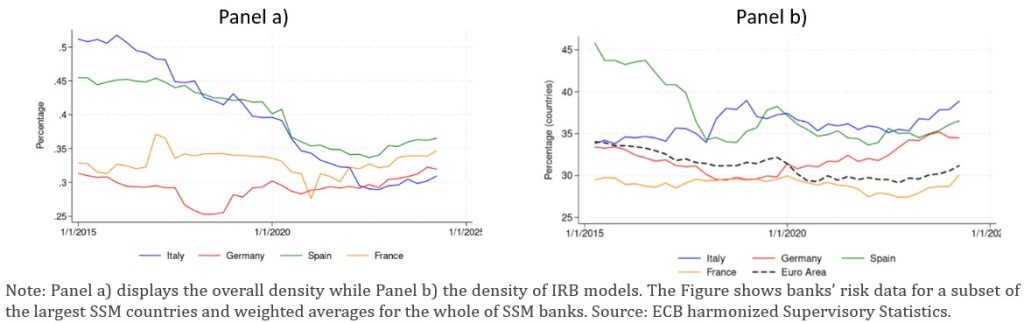
The descriptive evidence already shows two features that motivate the analysis. RWA density has shown significant variation across banks and a gradual downward convergence over time (Figure 1, panel A), as highlighted by Bohnke et al. (2023). Yet, when looking only at banks adopting IRB (Figure 1, panel B), the picture is less clear-cut, casting doubts on the strategic modelling hypothesis.
Figure 1. The evolution of risk density across countries
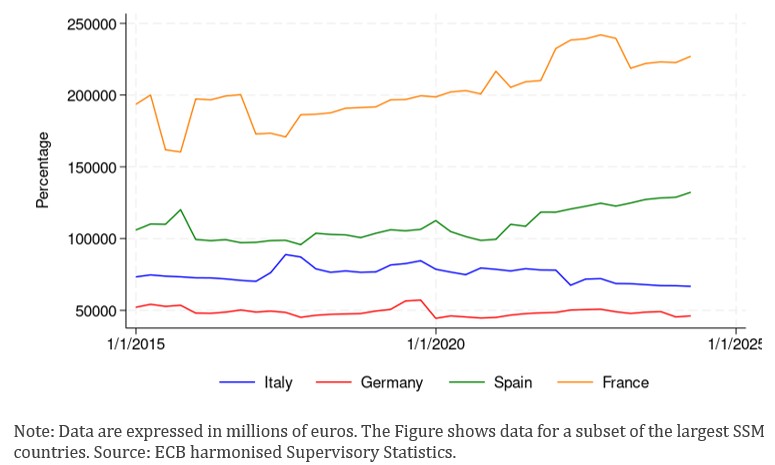
At the same time, the share of credit-risk RWAs calculated with internal models varies across institutions, reflecting different timing and intensity of IRB roll-out (Figure 2).
Figure 2. The evolution of the RWA from credit risk across countries
The first result is robust and economically intuitive: RWA density declines after the adoption of internal models. This relationship survives controls for capitalisation, bank size, loans, trading assets, deposits, non-performing loans and country-time conditions.
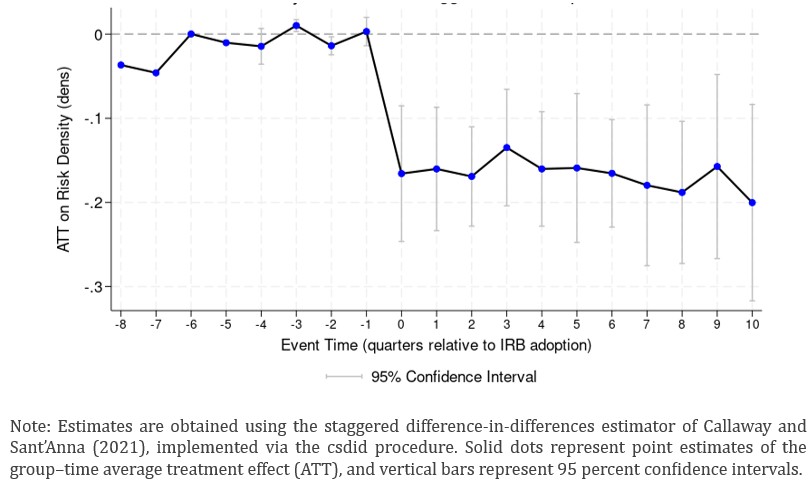
To address the fact that banks obtain IRB approval at different points in time, the paper also uses a staggered difference-in-differences design. The dynamic estimates show no evidence of differential pre-trends before adoption. The decline begins around the time of IRB approval and persists as internal models are rolled out across a larger share of the portfolio. This strengthens the interpretation that the transition to IRB itself contributes to the fall in measured risk density.
Figure 3. Event-study estimates of staggered IRB adoption effects on RWA density
Earlier studies raised the possibility that less-capitalised banks could have stronger incentives to exploit the complexity and discretion embedded in internal models. This hypothesis has a clear observable implication: conditional on IRB adoption, banks with smaller capital buffers should reduce RWA density more than better capitalised banks.
In our sample, we do not find this pattern. Interactions between IRB adoption and measures of low capitalisation are generally not statistically significant. The finding contrasts with evidence from earlier periods and broader cross-country samples examined in literature, where declines in reported risk were found to be more pronounced among weakly capitalised banks, particularly in jurisdictions with weaker supervisory scrutiny.
The institutional comparison matters. Our sample is restricted to significant institutions supervised within the SSM and starts after the common supervisory framework was established. Earlier studies often covered the years immediately following the global financial crisis and jurisdictions with more heterogeneous supervisory arrangements. The results are therefore consistent with – although they do not by themselves prove – the view that harmonised supervision and, in particular, the TRIM might have limited the scope for opportunistic post-adoption reductions in RWAs.
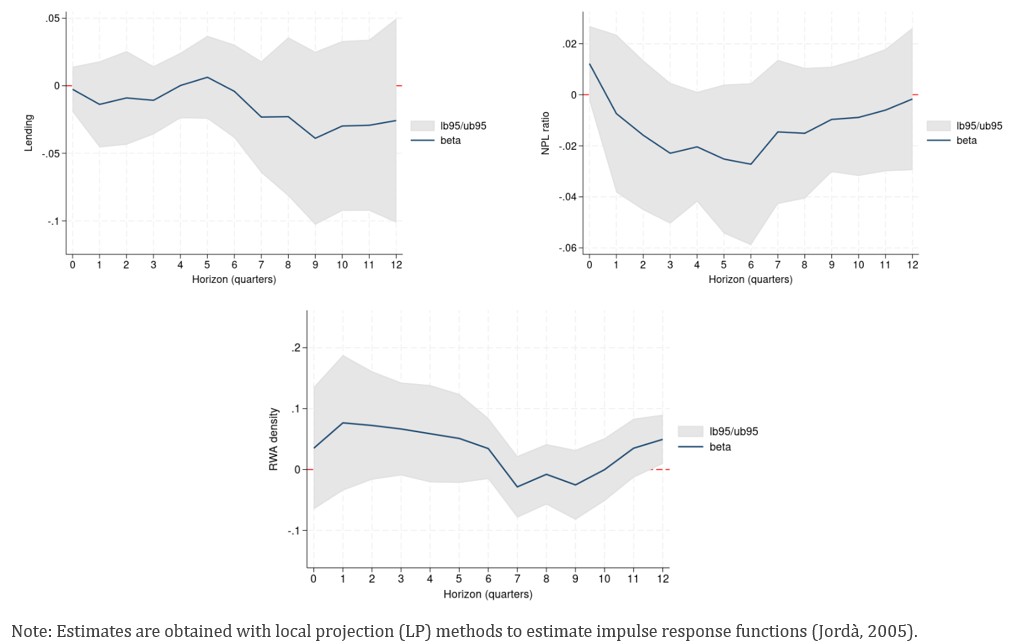
We also focus on banks that combine low capitalisation with a high non-performing loan ratio. If strategic modelling were especially important for these fragile institutions, IRB validation might be followed by a distinctive path for RWA density, lending or asset quality.
The paper finds no such differential response over the horizons examined (Figure 4). Following IRB validation, fragile banks do not display statistically distinguishable changes in RWA density, corporate lending or NPL ratios relative to other banks. This result directly challenges the specific weak-bank mechanism emphasised in part of the earlier literature.
Figure 4. Local projection of the response of RWA density, lending and NPL ratio to IRB validation of fragile banks
The interpretation nevertheless requires care. The tests cover specific observable margins. They cannot rule out every form of strategic modelling: discretion could operate through portfolio-level model choices, probability-of-default or loss-given-default calibration, model roll-out, or anticipatory adjustments before formal approval. The evidence is therefore narrower – and more useful – than a blanket claim that model risk has disappeared.
TRIM provides an additional perspective. The exercise was designed to reduce unwarranted cross-bank variability in RWAs, enforce more consistent model-governance standards and improve the reliability of IRB-based capital metrics. If earlier IRB outcomes had reflected strategic choices that were subsequently corrected by supervisory review, one might expect RWA density at IRB banks to rise relative to banks on the standardised approach after TRIM began.
The paper does not find a statistically significant differential post-TRIM change in RWA density for IRB banks relative to standardised-approach banks, possibly because of small sample issues before 2016. This exercise cannot separately identify a causal effect of TRIM or of harmonised supervision. Still, taken together with the capitalisation and fragility results, it is consistent with an environment in which common supervision constrains some forms of opportunistic capital optimisation.
The most policy-relevant result may lie elsewhere. A risk-sensitive capital framework changes the relative regulatory cost of different assets. Banks can therefore respond to IRB adoption not only through measured risk weights, but by changing the composition of their exposures.
After IRB adoption, corporate exposures increase, while sovereign and central-bank exposures decline in the first-time adoption specification. The increase in corporate credit is concentrated in exposures to large non-financial corporations. For SMEs, by contrast, the estimated IRB effects are smaller and not statistically significant in the specifications reported in the paper.
One plausible explanation is the SME supporting factor. Since the beginning of the SSM period, qualifying SME exposures benefit from a regulatory capital reduction for both standard and IRB banks. Large corporate exposures do not receive the same treatment, so the move to a more granular internal-model framework can change their relative capital cost more visibly.
Table 1. What changes after IRB adoption? A summary of the evidence
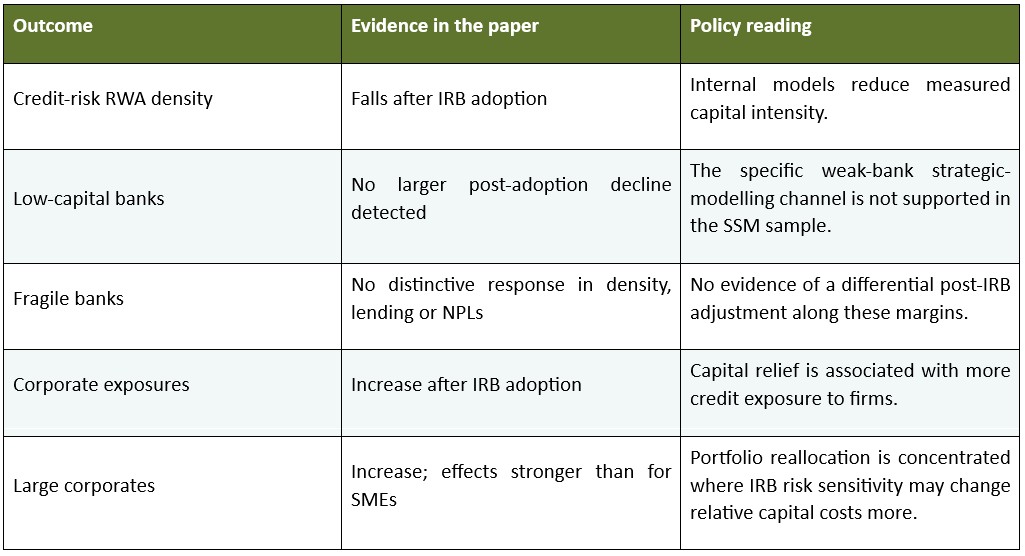
This paper investigates the variability of RWA density and the implications of IRB model adoption on a sample of significant institutions in the euro area over a ten-year period, which extends beyond the immediate aftermath of the Global Financial Crisis. The results highlight the presence of heterogeneity across SSM banks in terms of RWA density, and that part of that variability is linked to banks’ characteristics. IRB banks with a better capital adequacy have, on average, a higher density than the IRB intermediaries with lower capitalization. Furthermore, the analytical framework considered in our analysis does not provide evidence that, in the post-2015 SSM setting, weakly capitalized or fragile banks reduced RWA density more than other banks after IRB adoption along the margins examined. This is consistent with the view that harmonized supervision may have limited the scope for opportunistic postadoption reductions in RWAs. Finally, we provide evidence that IRB models encourage banks to reallocate credit toward more profitable assets — particularly large non-financial corporations — while reducing exposures to sovereigns and central banks.
The debate over internal models is often framed as a trade-off between risk sensitivity and the danger of regulatory arbitrage. The evidence from euro-area significant institutions points to a more nuanced picture. Internal models do lower RWA density, but the paper does not find that banks with the strongest apparent incentives to obtain capital relief reduce density more than their peers along the margins examined.
At the same time, IRB adoption is associated with a reallocation of credit towards non-financial corporations, particularly large firms. This shifts the focus from a narrow question – whether models reduce risk weights – to a broader one: how does risk-sensitive regulation change banks’ incentives to use their balance sheets?
For supervisors, preserving confidence in internal models requires continued attention to model governance, comparability and the link between measured and underlying risk. For policymakers, the broader lesson is that capital regulation also influences the destination of credit. The success of the framework should therefore be judged not only by the level of regulatory ratios it produces, but also by whether it combines credible risk measurement with an efficient allocation of bank capital.
Avramova, S. and Le Leslé, V. (2012), Revisiting Risk-Weighted Assets, IMF Working Paper.
Behn, M., Haselmann, R. and Vig, V. (2022), The limits of model-based regulation, Journal of Finance.
Bohnke, V., S. Ongena, F. Paraschiv, and E. J. Reite (2023). Back to the roots of internal credit risk models: Does risk explain why banks’ risk-weighted asset levels converge over time? Journal of Banking Finance 156 (C).
Callaway, B. and Sant’Anna, P. H. C. (2021), Difference-in-Differences with multiple time periods, Journal of Econometrics.
ECB (2021, 4). Targeted Review of Internal Models. Technical report, ECB Banking Supervision
Ferri, G. and Pesic, V. (2017), evidence on RWA density and IRB regulatory arbitrage, as cited in the working paper.
Jordà O’., (2005, March). Estimation and inference of impulse responses by local projections. American Economic Review 95 (1), 161–182.
Mariathasan, M. and Merrouche, O. (2014), The manipulation of Basel risk-weights, Journal of Financial Intermediation.