

This policy brief is based on ECB, Working Paper Series No 3111. This brief should not be reported as representing the views of the European Central Bank (ECB). The views expressed are those of the authors and do not necessarily reflect those of the ECB.
Abstract
To ensure that means of payments are readily interchangeable at face value – i.e. fungible – for retail payments, three elements are required: (1) settlement finality; (2) interoperability; and (3) seamless convertibility of the means of payment into the “ultimate” or quasi-ultimate means of payment. This brief argues that stablecoins issued by different issuers on different blockchains can be fungible to the same extent as commercial bank deposits from different banks provided that (i) payment and settlement technologies are interoperable, (ii) payments are transacted on ledgers that offer settlement finality, and (iii) that central bank money acts as the anchor to the monetary system (assuming that the central bank money is itself underscored by a homogenous unit of account). On this basis, this paper asserts that tokenised funds and off-chain collateralised stablecoins are fungible means of payments under some conditions, and that on-chain collateralised stablecoins can be prima facie classified as fungible means of payments, so long as the identical preconditions associated with accomplishing means of payment fungibility for tokenised funds/off-chain collateralised stablecoins can be fulfilled, and on the premise that the on-chain collateral can be readily converted into higher level money. Finally, it is determined that algorithmic stablecoins are not fungible means of payments.
Fungibility is an overriding precondition for payment and settlement, which infers that means of payments issued by different entities underpinned by the same unit of account (e.g. EUR, AUD, USD etc.) are more or less indistinguishable as they can be mutually interchanged at face value (see e.g. Brunnermeier and Niepelt, 2019; Brunnermeier and Landau, 2022; Garratt and Shin, 2023).
Unlike unbacked crypto-assets (e.g. Bitcoin, Ether etc.), stablecoins operate under the premise of price stability by being either (i) backed by and convertible into commercial bank money/other assets/crypto-assets, or (ii) through “algorithmic” backing, as summarised in Table 1 below (see also e.g. G7 Working Group on Stablecoins, 2019; Arner, Auer and Frost, 2020; Chanson and Senner, 2022).
Table 1. Stablecoin type segregated by stabilisation mechanism

If it is believed that stablecoins have the potential to serve as a means of payment, do they currently/can they fulfill the three elements of fully fungible means of payments in the sense that:
Based on Coste and Pantelopoulos (2025), this brief argues that for stablecoins issued by different issuers on different blockchains to be considered fungible (to the same extent as commercial bank deposits from different banks), interoperability and settlement finality are prerequisites,1 but true fungibility is only achieved if central bank money acts as the anchor to the monetary system (assuming that the central bank money is itself underscored by a homogenous unit of account).
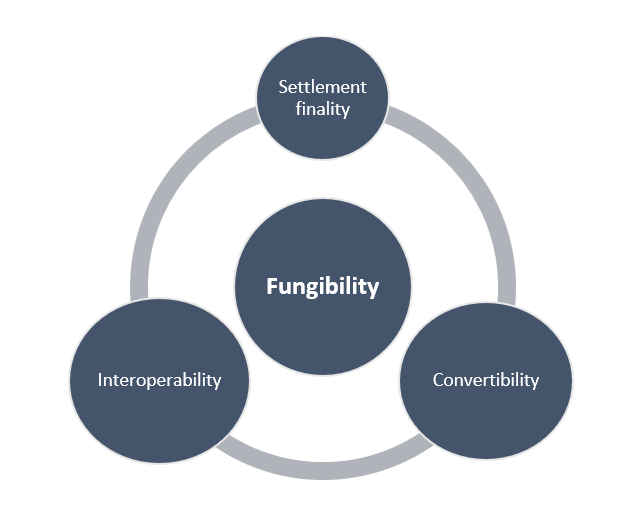
At a high-level, three elements must generally be fulfilled if means of payment fungibility is to be achieved, as shown in Figure 1 below (see also Pantelopoulos, 2025a).
Figure 1. Elements for means of payment fungibility
Settlement finality
Settlement finality means that after a trade is completed, there should be no remaining financial obligations between the payer and the payee. If there are, then settlement isn’t truly final because one party might still have the right to force the other to do something to meet an obligation (Kahn and Roberds, 2007) – i.e. obligations are not fully discharged. Such “weaker” forms of settlement finality may appear if for instance following settlement, the payer may incur a contingent liability vis-à-vis the payee.
Interoperability
Interoperability refers to the ability of payment and settlement technologies that support means of payments to interact effectively so that value can be shifted between accounts, otherwise means of payments can circulate as independent “silos”. In the context of token-based (or similar – i.e. paper-based/commodity money) means of payments, interoperability resides in the context of means of payment homogeneity (e.g. one 5 euro banknote is exactly the same as another 5 euro banknote; two 5 euro banknotes are equal to one 10 euro banknote; one precious metal coin is the same as another precious metal coin etc.).
Convertibility
Aside from actually shifting deposits between banking institutions, the inference that means of payments can be readily converted into the “ultimate” (or quasi-ultimate) means of payment implies that the “cross-exchange rate” between two means of payments is equal to unity; they are tradeable at par. Aside from enabling the cross-exchange rate to equate to par, convertibility into central bank money is also mechanism to “bridge” heterogeneities between means of payments (see Pantelopoulos, 2025b for a discussion).
In centralised payment systems, there is a clear designated payment system operator responsible for ensuring settlement. Decentralised payment systems however operate differently as there is usually no single identifiable operator responsible for ensuring settlement finality. These systems rely on a consensus mechanism among participants to achieve distributed agreement about the ledger’s state and updates. This consensus can be achieved using several means, notably via proof-of-work (network members expend computational power to gain the right to update the network) and proof-of-stake (network participants stake the network’s tokens to gain the right to validate blocks of transactions).
Proof-of-work ledgers achieve probabilistic settlement finality. Network members expend computing power to compete for the right to update the network by adding a new block, and users trust the system’s consensus. Transactions reach finality based on the likelihood they remain part of the longest chain accepted by the network. The longest chain represents the version of the ledger with the most accumulated computational work, making it the most secure and trusted record of transactions. Competing chains may temporarily exist, but the network ultimately converges on the longest one, ensuring a single authoritative ledger.
In contrast, proof-of-stake systems achieve deterministic settlement finality. Network participants put at stake the network’s tokens to gain the right to validate blocks of transactions. In proof-of-stake, the exact moment a transaction becomes irrevocable can be pinpointed once it is included in a finalized block, aligning more closely with traditional financial system’s definition of settlement finality. From a legal perspective, this deterministic settlement finality is usually preferred because it offers more legal certainty about then “when” a transaction can effectively be considered final.
Boar et al (2021; see also CPMI, 2024) classify payment system interoperability into three types: technical, semantic and business:
In the context of stablecoins, the main limitation to fungibility arises from business interoperability. Since stablecoins from different issuers may be governed by different legal frameworks, rights, and obligations, they are not always interchangeable on a business level. Factors like the issuer’s policies on redemption, compliance with regulations, and trust in the issuer can make one stablecoin more acceptable or valuable in certain contexts, thereby limiting their fungibility between users, platforms, or jurisdictions.
Convertibility refers to the ability of a means of payment to be readily redeemed at par to the pegged asset. Convertibility of private retail money implies that it must be readily tradable at par with the “ultimate” (or quasi-ultimate) means of payment – i.e. ultimately central bank money in the form of banknotes. Convertibility into central bank money is crucial, because it ensures that the holder of a means of payment that is lower on the hierarchy of money can readily trade it with other means of payments that are of higher credit quality that in turn can be converted into central bank money. Convertibility is generally ensured by the issuer. If the issuer cannot guarantee the convertibility of the means of payment into other means of payments, the holder may potentially incur additional costs and/or delays, or in the extreme may be unable to convert their means of payment – both of which impact on the asset’s value and usability.
Irrespective of the technologies which underpin means of payments, fungibility is an overriding precondition for fluidity in payment and settlement. Given the perception that stablecoins can serve as genuine means of payments, this brief proceeded to apply the framework to the various guises of stablecoins and offers the following conclusions as to whether stablecoins issued by different issuers on different blockchains are fungible (on the presumption that central bank money is itself homogenous in terms of its unit of account):
Arner, D. W., Auer, R., & Frost, J. (2020). Stablecoins: risks, potential and regulation. BIS Working Papers No. 905.
Bindseil, U., Coste, C., & Pantelopoulos, G. (2025). Digital money and finance: a critical review of terminologies. Journal of Financial Market Infrastructures, 12 (2), 73-118.
Boar, C., Claessens, S., Kosse, A., Leckow, R., & Rice, T. (2021). Interoperability between payment systems across borders. BIS Bulletin No. 49.
Brunnermeier, M. K., & Landau, J. P. (2022). The digital euro: policy implications and perspectives.
Brunnermeier, M. K., & Niepelt, D. (2019). On the equivalence of private and public money. Journal of Monetary Economics, 106, 27-41.
Chanson, M., & Senner, R. (2022). Stablecoins’ Quest for Money: Who is Afraid of Credit?. The Journal of FinTech, 2(01n02), 2250002.
CPMI. (2024). Service level agreements for cross-border payment arrangements. Recommendations and key features. Bank of International Settlements, Basle.
Coste, C. E., & Pantelopoulos, G. (2025). Central bank money as a catalyst for fungibility: the case of stablecoins. ECB Working Paper No. 3111.
Garratt, R., & Shin, H. S. (2023). Stablecoins versus tokenised deposits: implications for the singleness of money. BIS Bulletin No. 73.
G7 Working Group on Stablecoins. (2019). Investigating the impact of global stablecoins. Bank of International Settlements, Basle.
Kahn, C. M., & Roberds, W. (2007). Transferability, finality, and debt settlement. Journal of Monetary Economics, 54(4), 955-978.
Pantelopoulos, G. (2025a). Between payments and credit: an introduction to the IOU economy. Springer Nature.
Pantelopoulos, G. (2025b). Bridging heterogeneities in retail means of payments. Available at SSRN: https://papers.ssrn.com/sol3/papers.cfm?abstract_id=5350276
This is setting aside that the term “stablecoin” is to some extent redundant/problematic (see e.g. Bindseil, Coste and Pantelopoulos, 2025).