

This SUERF Policy Brief summarizes Caselli et al (2026), IMF Working Paper. The views expressed are those of the authors and do not necessarily represent those of the International Monetary Fund, its Executive Board, or IMF management.
Abstract
When uncertainty rises and inflation becomes harder to forecast, should a central bank talk more about prospects and projections or explain what happened in the past? Leveraging novel Artificial Intelligence (AI) based indicators built from the monetary policy statements of eleven European central banks over 2009–2025, we document that references to uncertainty itself have become increasingly prominent in their communications during major economic and geopolitical shocks, but communication strategies to respond to the elevated uncertainty differed. Advanced-economy central banks have recently responded with more forward-looking language, while emerging-market central banks have tended to use more backward-looking language. The findings suggest that institutional capacity and credibility shape what central banks say about the future when that future is genuinely uncertain — with implications for how emerging-market central banks should sequence the build-up of forward-looking communication tools.
Uncertain environments have become the backdrop rather than the exception for monetary policy. Repeated shocks — from the Covid pandemic, the war in Ukraine, and recurring geopolitical and trade tensions — have kept financial-market and economic-policy uncertainty elevated for several years running, with the task of forecasting inflation and growth becoming harder. In this environment, central bank communication has shifted from a supporting role in the implementation of monetary policy to increasingly becoming a tool in its own right. When conventional policy signals are noisy, communication becomes more important: central banks need to explain not only what they are doing, but also how they are reading the outlook and how policy may respond as conditions evolve (Bernanke, 2024).
Yet, communicating under uncertainty involves a trade-off. Forward-looking language about the outlook can help anchor expectations by clarifying the policy reaction function (Blinder et al., 2008). But if the outlook is highly uncertain, too much forward-looking language can be perceived as a commitment, potentially limiting flexibility when it is most needed or even creating credibility risks if conditions change.
Europe provides an especially useful setting to analyze how central banks have managed this trade-off: central banks have broadly similar objectives and face broadly similar shocks, but differ in institutional frameworks and communication practices.
We construct novel text-mining indicators of monetary policy communication from the monetary policy statements of eleven European central banks with sufficiently long publication records.1 One indicator measures the extent to which central banks explicitly discuss uncertainty itself (the “uncertainty communication index”), by which each statement is classified according to the share of its sentences containing pre-selected words reflecting uncertainty.
A second indicator (the “net-forward looking index”) quantifies the balance between forward- and backward-looking communication, that subtracts the share of sentences containing forward-looking from the share of sentences with backward-looking words.2 Importantly, the forward-looking index captures predominantly information-based forward-looking communication (i.e., references to the outlook, projections, expectations, and possible policy paths conditional on the outlook), rather than explicit commitment-based forward guidance.
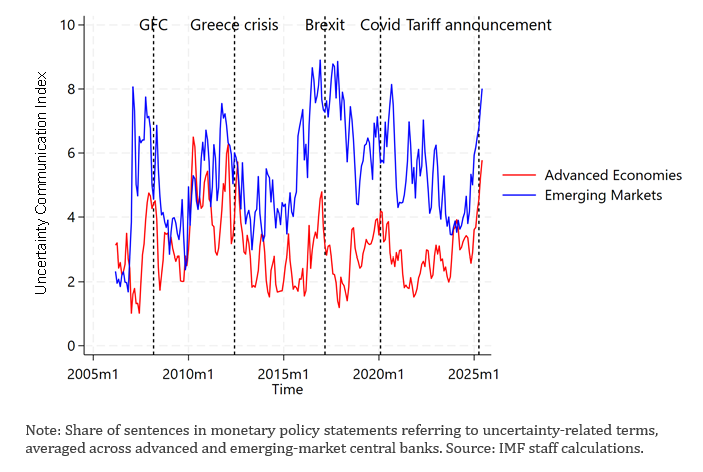
Our “uncertainty communication index” rises sharply for advanced and emerging market countries in the sample around major shock episodes — including the Global Financial Crisis, Brexit, the Covid pandemic, and recent trade tensions (Figure 1) — suggesting that central banks have increasingly incorporated discussions of uncertainty into their policy communications across the income spectrum.
Figure 1. Central bank uncertainty communication aligns with large shock events
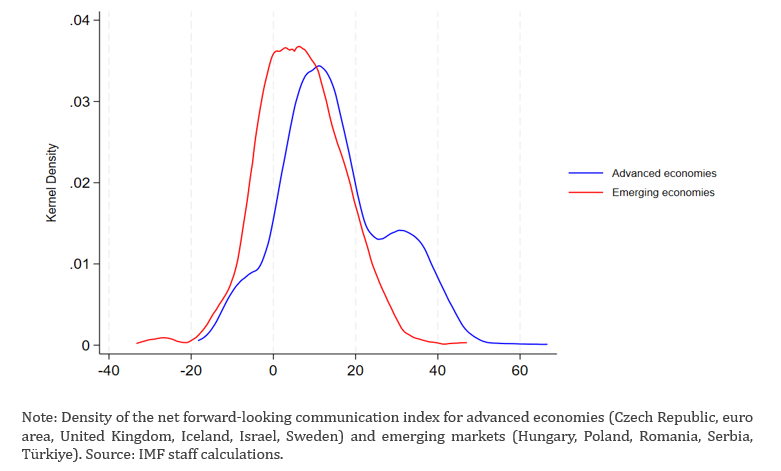
Advanced-economy central banks use more forward-looking language, relative to backward-looking language, than emerging-market central banks. This difference is visible in the distribution of the “net forward-looking index” across country groups (Figure 2). The difference is not only a matter of communication style. It also shows up in formal regression analysis linking how central bank communication responds across the two income groups to varying sources of uncertainty. The estimates show that when inflation-expectations become more uncertain, advanced-economy central banks respond by leaning further into forward-looking communication. Emerging-market central banks, by contrast, tend to place relatively more weight on backward-looking language when inflation uncertainty rises.
Figure 2. Distribution of the “net forward-looking index” across country groups
Interestingly, the difference in central bank communication traits is changing over time. Rolling window estimates show that during 2015- 2020, a period of low and stable inflation, advanced-economy central banks did not respond to inflation uncertainty with more forward-looking language. Only after the pandemic did advanced-economy central banks begin responding to inflation uncertainty with distinctly more forward-looking messaging (Figure 3).
Figure 3. Advanced-economy central banks’ communication response to inflation uncertainty over time
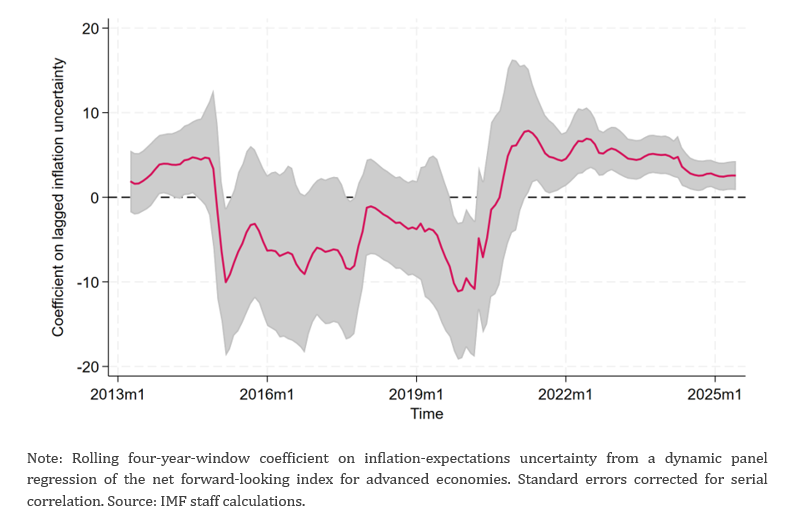
The timing of the shift is telling: advanced-economy central banks became more forward-looking when inflation uncertainty returned as a live concern, after a long period of low and stable inflation and constrained policy rates. Why is this important? Caselli et al. (2026) discuss suggestive evidence that forward-looking communication may help reduce market uncertainty about the future path of policy rates. In the ECB case, forward-looking communication appears to be associated with lower volatility in interest-rate expectations, pointing to a potential stabilizing role when communication clarifies how policy will respond to changing economic conditions.
This divergence in communication styles may reflect differences in credibility. Central banks in advanced economies often have a longer track record of achieving their policy objectives and may therefore be better positioned to communicate about an uncertain economic future. By contrast, central banks with less-established credibility may play greater emphasis on explaining incoming data and past developments (Evdokimova et al., 2024).
For emerging-market central banks, the implication is not to avoid forward-looking communication altogether, but to develop it gradually, using information-based forward-looking language —explaining the outlook, the risks around it, and the conditions under which policy would respond, without creating the perception of firm commitments— to build credibility over time.
European central banks have developed broadly similar communication toolkits, but they do not use them in the same way when uncertainty rises. Advanced-economy central banks have recently leaned more on forward-looking language around the economic outlook to help anchor inflation expectations when inflation is uncertain. Emerging-market central banks have stayed closer to incoming data, likely reflecting a greater premium on flexibility and limited credibility preservation. At the same time, central banks across Europe have become more explicit in discussing economic uncertainty itself, particularly during major economic and geopolitical shocks.
The policy lesson is therefore nuanced. More forward-looking communication around the outlook might not always be better. Its effectiveness depends on credibility, institutional capacity, and the ability to communicate policy conditionality clearly. As elevated uncertainty looks set to persist, central banks should continue investing in the analytical and forecasting tools, transparency, and track record that make forward-looking communication credible.
Bernanke, B. (2024). “Forecasting for Monetary Policymaking and Communication at the Bank of England: A Review.” Bank of England, April.
Blinder, A. S., Ehrmann, M., Fratzscher, M., De Haan, J., and Jansen, D.-J. (2008). “Central Bank Communication and Monetary Policy: A Survey of Theory and Evidence.” Journal of Economic Literature, 46(4), 910–945
Caselli, F., L. Charry, L. Cui, P. Deb, A. Dizioli, A. Fotiou, and S. Weber (2026). “Central Bank Communication in Times of Uncertainty: AI-Assisted Decoding of Recent Trends in Europe.” IMF Working Paper WP/26/133.
Evdokimova, T., Mohácsi, P., Ponomarenko, O., and Ribakova, E. (2024). “Emerging Market Central Banking and Communication: The Great Catchup.” Financial and Economic Review, 23(1), 29–49.
The sample includes the ECB and the national central banks of the United Kingdom, Iceland, Israel, Sweden, the Czech Republic, Hungary, Poland, Serbia, Romania, and Türkiye.
A higher value of the “net forward-looking index” means that forward-looking language receives greater relative emphasis than backward-looking language. This distinction matters because central banks often use both forward- and backward-looking language in the same statement.