

This paper is based on ECB Working Paper Series, No 3188. The views expressed in this paper are those of the authors and do not necessarily reflect those of the European Central Bank, the Eurosystem, or the Deutsche Bundesbank.
Abstract
Under which conditions do usability constraints for regulatory capital buffers emerge? To answer this question, we build a non-linear banking sector model with a non-releasable capital buffer requirement (CBR) that banks can breach, but if they do so potential stigma applies. We show that very small stigma costs induce banks to fulfil the CBR. However, these very small stigma costs also rule out that banks “use” the CBR in crisis times. That is, they will not allow their capital ratio to fall below the CBR to absorb losses and rather deleverage. There are two important policy implications. First, introducing a CBR in “normal” times seems desirable to increase bank resilience and reduce bank failure probabilities with little impact on aggregate bank credit supply. Second, a structural non-releasable CBR is unlikely to fully achieve its macro stabilisation objective to support aggregate credit supply when the banking sector faces losses, due to the likely presence of buffer usability constraints. A shift towards a higher share of releasable capital buffers could therefore be desirable.
As a response to the global financial crisis, the Basel III reform package for the banking system introduced a capital buffer requirement (CBR) on top of the minimum capital requirement. The main difference of a CBR compared to a minimum capital requirement is that banks are allowed to “use” the CBR, i.e. they are allowed to operate with a capital ratio below the CBR, whereas banks are put into resolution if their capital ratio falls below the minimum capital requirement. The main macroprudential policy motivation for introducing a CBR into banking regulation is to increase banking system resilience to systemic shocks and to reduce cyclicality of the banking system by supporting aggregate loan supply during crises via allowing banks to operate with capital ratios below the CBR.
Different capital buffers exist within the regulatory framework: some are structural, i.e. they always remain in place, and some are releasable, i.e. they can be reduced during crises. Prominent structural buffers are the capital conservation buffer (CCoB) of 2.5% and buffers for systemically important institutions (G-SII/O-SII buffers) of up to 3.5%. The most prominent releasable buffer is the countercyclical capital buffer (CCyB), which is varied between 0% and 2.5%. Given the limited build-up of releasable buffers after the global financial crisis, the CBR in most European countries is currently composed mainly of structural non-releasable macroprudential capital buffers (Figure 1 panel a).
Figure 1. The CBR is mainly structural and banks appear reluctant to “use” it during stress episodes
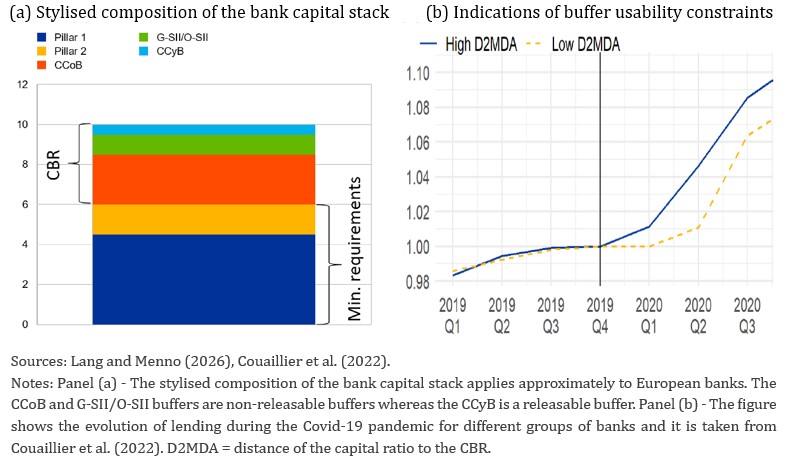
Some recent empirical banking papers have found indications of potential buffer usability constraints, i.e. indications that banks would rather reduce loan supply and deleverage when faced with adverse shocks rather than let their capital ratio fall below the applicable CBR (Berrospide et al., 2024; Couaillier et al., 2022; Mathur et al., 2023. See also Figure 1 panel b). While this empirical evidence suggests that banks may face buffer usability constraints, others question whether impediments to buffer usability exist and that this could have a significant effect on bank lending (Schmitz et al., 2021). We take this debate as a motivation to study in a structural model under which conditions buffer usability constraints can emerge for non-releasable capital buffers.
There are a number of reasons why banks might be reluctant to let their capital ratio fall below the applicable CBR. First, under the Basel III regulatory framework breaching the applicable CBR entails consequences that banks might not like, such as increased supervisory scrutiny, the need to submit a capital conservation plan, or restrictions on dividends and AT1 coupon payments. Second, breaching the applicable CBR could entail market stigma in the true sense of the word. For example, the literature has shown that banks cutting or not paying dividends face lower stock market values (Acharya et al., 2022; Bessler and Nohel, 1996) and higher CDS spreads (Acharya et al., 2022). These findings are in line with the literature on the signalling channel of dividend distributions (Acharya and Viswanathan, 2011; Bhattacharya, 1979; Forti and Schiozer, 2015; Miller and Rock, 1985).1 In the context of our analysis below, we summarize all of the potential private costs to banks of breaching the applicable CBR with one single sufficient statistic that we label stigma costs.
To analyse under which conditions buffer usability constraints can indeed emerge, we build a non-linear structural banking sector model that features a CBR and stigma (See Lang and Menno 2026). The model builds on the structural banking sector model developed in Lang and Menno (2025) which features monopolistic competition, an occasionally binding equity issuance constraint, and an occasionally binding minimum capital requirement. To this set-up we add two important ingredients. First, we add costly bank liquidation 2 in case the capital ratio falls below the minimum capital requirement, which is in line with how banking regulation is implemented. This gives rise to voluntary capital buffers, i.e. banks maintain a higher capital ratio than the regulatory minimum requirement to partially self-insure against the risk that their capital ratio could fall below the minimum requirement. Second, we add a structural non-releasable CBR of 2.5 percentage points (pp) to the model, similar to the CCoB. Banks are allowed to “use” the CBR, i.e. banks are allowed to operate with a capital ratio below the CBR. However, if banks decide to “use” the CBR potential stigma costs apply.3 These stigma costs are a convenient reduced-form way to model that under the Basel III framework breaching the CBR entails various consequences that banks may not like and that cause private costs to banks. We abstract from which specific mechanism leads to such costs. The focus of our analysis is on whether such private costs to banks (“stigma costs”) need to be high or low for buffer usability constraints to emerge. We calibrate the model to euro area data.
Our first finding is that in “normal” times, when banks make profits and are not equity constrained, very small stigma costs of around 0.5-3 basis points (bps) are sufficient to induce banks to fulfil the CBR. The economic intuition for this result is simple. Banks will fulfil the CBR whenever stigma costs are larger than the net cost of maintaining a higher capital ratio in order to fulfil the CBR. The latter net cost consists of two parts. First, the additional funding cost induced by a higher capital ratio because bank equity tends to be more costly than bank debt. Second, this higher funding cost is partially offset by the benefit of lower expected bank liquidation costs. The latter benefit results from a lower bank failure probability 4 due to the higher capital ratio induced by the CBR.
The magnitudes of necessary stigma costs to induce banks to fulfil the CBR can be explained with the help of Figure 2. For the benchmark model calibration (yellow bars), the introduction of a non-releasable CBR leads to bank capital ratios that are 0.5 – 1.3 pp higher compared to the case with only a minimum capital requirement (Figure 2 panel a). These higher capital ratios will lead to an increase in the weighted average funding cost for banks of 1.5 – 3.9 bps under a realistic bank equity premium of 6 pp and a realistic average risk weight of 50 %. At the same time bank liquidation probabilities decrease by 1.25 – 2.0 pp (Figure 2 panel c), which reduces expected bank liquidation costs by 1.25 – 2.0 bps.5 Hence, the net cost of fulfilling the CBR is therefore just 0.25 – 1.9 bps. If stigma costs exceed this value, it pays off for banks to fulfil the CBR. Varying some other parameters of the model increases this range of necessary stigma costs to induce banks to fulfil the CBR to 0.5-3 bps.
Figure 2. Effect of a CBR on the banking sector in “normal” times when banks are unconstrained
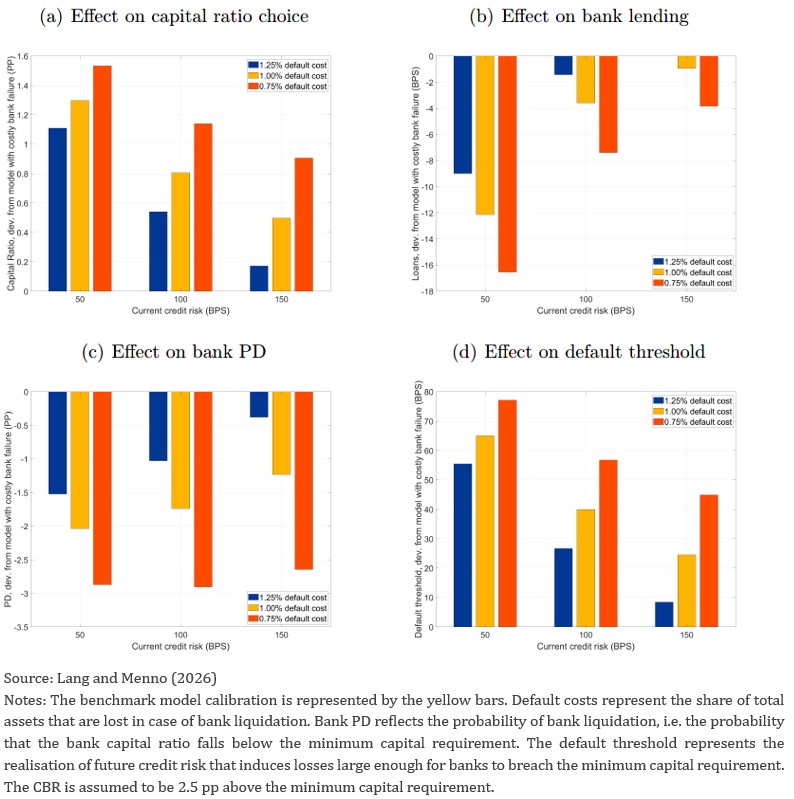
The result that low stigma costs induce banks to fulfil the CBR is reassuring, as it shows that the imposition of a CBR can be effective in increasing bank capital ratios and therefore bank resilience. As explained above, compared to a model with only a minimum capital requirement the introduction of a CBR leads to bank capital ratios that are 0.5 – 1.3 pp higher, and bank liquidation probabilities (PDs) that are 1.25 – 2.0 pp lower. This increased resilience comes at arguably low economic costs, as aggregate bank lending is only reduced by 1 – 13 bps compared to a model with only a minimum capital requirement (Figure 2 panel b). Hence, the introduction of a CBR in “normal” times, when banks are profitable and not equity constrained, should fulfil the macro stabilisation objective of having more resilient banks without reducing aggregate loan supply much.
Our second finding is that in “bad” times, when banks make losses and become equity constrained, these very small stigma costs of 0.5-3 bps will also be sufficient to rule out that banks “use” the CBR.6 In other words, these low stigma costs will prevent that banks allow their capital ratio to fall below the CBR to absorb losses. The economic intuition for this key result about buffer usability constraints is simple. Banks that “use” the CBR face stigma costs, whereas banks that deleverage to fulfil the CBR face foregone “excess profits” from supplying fewer loans. Banks will only “use” capital buffers if stigma costs are lower than these foregone “excess profits” from deleveraging. It is important to note that “excess profits” are profits above the marginal cost of loans, where the marginal cost also takes into account the required return on bank equity. We show that these foregone “excess profits” from deleveraging tend to be extremely low under commonly used assumptions and only increase gradually as banks face growing losses and deleveraging pressure. This implies that banks will not “use” buffers when they face losses, as long as some form of stigma is present when breaching the CBR: our analysis shows that for deleveraging pressure of up to 10% banks will not “use” buffers if stigma costs are in the range of 0.5-3 bps (Figure 3).
Figure 3. Minimum stigma costs to rule out “use” of the CBR when banks become equity constrained
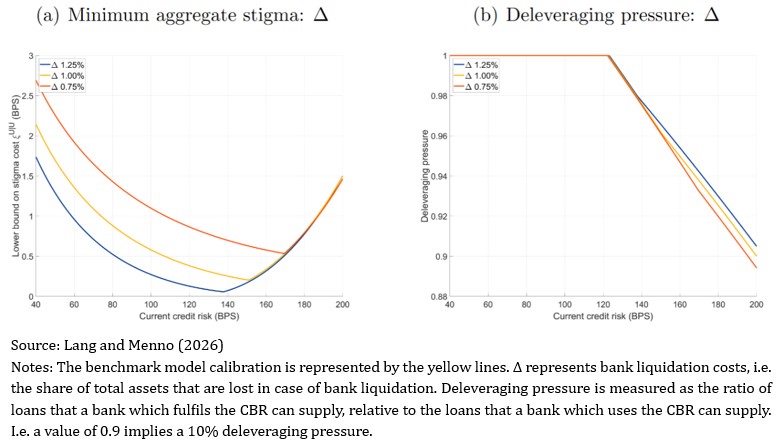
Our results show that buffer usability constraints are likely to occur, as the magnitudes of required stigma costs to rule out the “use” of the CBR in crisis times are within empirically plausible ranges. For example, a meta-analysis by Andreeva et al. (2020) reports that a 100 bps lower capital ratio is on average associated with an increase of 2-4 bps in the overall bank funding cost, an increase of 15-30 bps in bank bond yields, and a 5-30 bps increase in CDS spreads. Hence, the results from our structural model indicate that buffer usability constraints are likely to exist at empirically plausible private costs for banks. This is a very powerful result. It indicates that structural non-releasable macroprudential capital buffers might not work fully as intended: banks are unlikely to “use” such buffers when faced with shocks to their capital ratios as long as banks perceive some form of private costs to be associated with breaching the CBR, even if these costs are minimal.
There are two important policy implications of our findings. First, gradually introducing a CBR in “normal” times when banks make profits seems desirable to increase bank resilience and to reduce bank failure probabilities, while this should not constrain bank credit supply much. Second, a structural non-releasable CBR is unlikely to fully achieve its macro stabilisation objective to support aggregate loan supply when the banking sector faces losses due to the likely presence of buffer usability constraints. The latter finding could potentially suggest that the composition of the CBR within the regulatory framework should be rethought with a view to increasing the share of releasable capital buffers.
Acharya, Viral V and S Viswanathan, “Leverage, moral hazard, and liquidity,” The Journal of Finance, 2011, 66 (1), 99–138.
Acharya, Viral V, Irvind Gujral, Nirupama Kulkarni, and Hyun Song Shin, “Dividends and bank capital in the global financial crisis of 2007–2009,” Journal of Financial Crises, 2022, 4 (2), 1–39.
Andreeva, Desislava, Paul Bochmann, and Cyril Couaillier, “Financial market pressure as an impediment to the usability of regulatory capital buffers,” Macroprudential Bulletin, 2020, 11.
Arnould, Guillaume, Giuseppe Avignone, Cosimo Pancaro, and Dawid Zochowski, “Bank funding costs and solvency,” The European Journal of Finance, 2022, 28 (10), 931–963
Aymanns, Christoph, Carlos Caceres, Christina Daniel, and Liliana Schumacher, “Bank solvency and funding cost”, International Monetary Fund, Working Papers 2016, No 64.
Berrospide, Jose M, Arun Gupta, and Matthew P Seay, “The Usability of Bank Capital Buffers and Credit Supply Shocks at SMEs during the Pandemic,” International Journal of Central Banking, 2024, 20 (3), 185–255.
Bessler, Wolfgang and Tom Nohel, “The stock-market reaction to dividend cuts and omissions by commercial banks,” Journal of Banking & Finance, 1996, 20 (9), 1485–1508.
Bhattacharya, Sudipto, “Imperfect information, dividend policy, and ”the bird in the hand” fallacy,” The bell journal of economics, 1979, pp. 259–270.
Bouwman, Christa HS, Hwagyun Kim, and Sang-Ook Simon Shin, “Bank Capital and Bank Stock Performance: When Times are Tough, Capital is King,” Capital is King (December 31, 2023), 2023.
Couaillier, Cyril, Marco Lo Duca, Alessio Reghezza, and Costanza Rodriguez d’Acri, “Caution: do not cross! Capital buffers and lending in Covid-19 times,” ECB Working Paper Series, Feb 2022, No 2644.
Forti, Cristiano and Rafael F Schiozer, “Bank dividends and signaling to information-sensitive depositors,” Journal of Banking & Finance, 2015, 56, 1–11.
Gambacorta, Leonardo and Hyun Song Shin, “Why bank capital matters for monetary policy,” Journal of Financial Intermediation, 2018, 35, 17–29.
Hasan, Iftekhar, Liuling Liu, and Gaiyan Zhang, “The determinants of global bank credit-default-swap spreads,” Journal of Financial Services Research, 2016, 50 (3), 275–30.
Lang, Jan Hannes and Dominik Menno, “The state-dependent impact of changes in bank capital requirements,” Journal of Banking & Finance, 2025, 176, 107439.
Lang, Jan Hannes and Dominik Menno, “A structural model of capital buffer usability,” ECB Working Paper Series, 2026, No 3188.
Mathur, Aakriti Matthew Naylor, and Aniruddha Rajan, “Useful, usable, and used? Buffer usability during the Covid-19 crisis,” Bank of England working papers 1011, Bank of England Jan 2023.
Miller, Merton H and Kevin Rock, “Dividend policy under asymmetric information,” The Journal of finance, 1985, 40 (4), 1031–1051.
Schmitz, S. W., V. Nellessen, M. Posch, and P. Strobl, “Buffer usability and potential stigma effects“, SUERF Policy Note 219, 2019.
Moreover, a growing empirical literature suggests that lower bank capital ratios are associated with higher bank funding costs (Andreeva et al., 2020; Arnould et al., 2022; Aymanns et al., 2016; Gambacorta and Shin, 2018), higher credit default swaps (e.g. Hasan et al., 2016), lower credit ratings (Andreeva et al., 2020), and lower stock market returns, especially during crisis times (Bouwman et al., 2023).
Banks are liquidated or put into resolution whenever their capital ratio plus realized losses falls below the regulatory minimum requirement. The liquidation cost for banks scales linearly with bank size.
The stigma costs for banks scale linearly with bank size.
The bank failure probability represents the probability that the bank capital ratio falls below the minimum capital requirement.
In the benchmark model calibration bank liquidation costs are set to 1% of the total asset value.
To be precise, 0.5 – 3 bps are sufficient to rule out a buffer-use equilibrium where the representative bank uses the CBR.