

This policy brief is based on ECB Working Paper Series, No 3202. The views expressed are those of the authors and not necessarily those of the institutions the authors are affiliated with.
Key messages
Every day, billions of transactions flow across borders to pay for goods and settle invoices. Yet this movement of money — the invisible backbone of international trade — remains remarkably slow, costly and fragmented in many regions. For example, sending a small remittance from Europe to sub-Saharan Africa can cost more than 8% of the amount transferred. A medium-sized enterprise in the Western Balkans paying a supplier across the border may face fees ten times higher than a comparable transaction within the Single Euro Payments Area. For firms in many parts of Africa, an international transfer can take several days and require multiple bank intermediaries, each charging their own fee (Financial Stability Board, 2020).
These frictions are not accidents of geography or culture — they reflect the current architecture of the global payment system. Most international transactions flow through a chain of “correspondent banks”: large, globally active financial institutions that hold accounts on behalf of local banks and process cross-border payments on their behalf. Each intermediary in the chain adds costs and delays the payment. Moreover, the correspondent banking network has retrenched in recent years — partly due to rising compliance costs and regulatory pressure — worsening the problem for the world’s most under-served regions (Borchert et al. 2024, Rice et al. 2020).
Against this backdrop, policymakers have been working to build alternatives. Fast payment systems (FPS) — digital rails that can settle transactions within seconds — have developed globally, with more than 100 jurisdictions working on or operating one domestically. Increasingly, these domestic systems are being linked across borders, reducing the reliance of firms and households on the traditional correspondent, long, banking chains. Initiatives of FPS such as the Eurosystem’s TIPS, India’s UPI, Brazil’s PIX, and the BIS’s Project Nexus are at the forefront of this new landscape.
But does connecting payment systems actually affect the real economy and boost trade? And by how much? Until now, surprisingly little evidence existed. This column presents findings from a new ECB Working Paper (Ferrari Minesso, Lebastard and Triay Bagur, 2026) that aims to fill that gap, providing a global causal estimate of the effects of interlinking payment systems on trade.
The paper exploits a unique new dataset mapping over 2,000 cross-border payment system connections across more than 150 countries between 2021 and 2024. The dataset, documented in a companion paper, identifies both fast and non-fast payment links, distinguishing between bilateral and multilateral connections, enabling unidirectional or bidirectional transaction flows and between retail and wholesale-capable systems.
Figure 1. Cross-Border Connections Between Fast Payment Systems
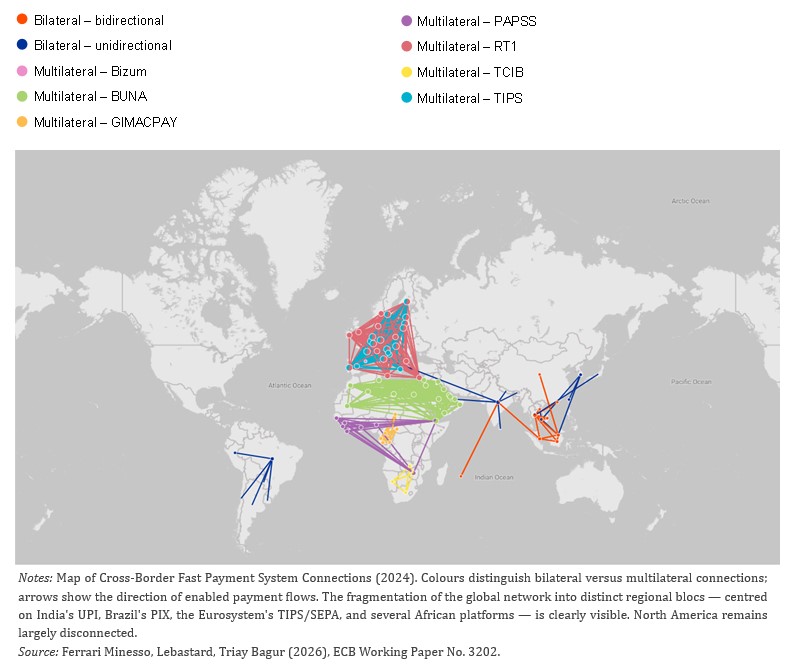
Three structural features stand out from the data. First, the global fast payment network is fragmented into regional blocs that do not communicate with one another. Geopolitical factors are a significant driver of this fragmentation: countries with similar foreign policy preferences are more likely to link their payment systems (Ferrari Minesso et al. 2025). Second, each regional network is centred around a successful domestic platform — UPI in India or PIX in Brazil — that acts as a hub for surrounding countries. Third, the African continent is notable both for the density of payment initiatives and for their fragmentation: multiple competing platforms operate with limited cross-network connectivity, leaving correspondent banking as the main channel for most transactions.
This fragmentation matters economically. When payment networks do not connect, businesses must route payments through correspondent banks, facing associated fees and delays. Interlinking offers a way around this: rather than a long chain of intermediaries, the sending bank’s domestic payment system can communicate more directly with the receiving country’s system, settling transactions in seconds. A key question is whether this translates into more trade — this new analysis provides a rigorous answer.
To quantify how much these links matter for trade, we build on the gravity model — the standard framework in international trade economics — which predicts that trade between two countries is proportional to their economic size and inversely related to the distance and barriers between them (Santos Silva and Tenreyro, 2006). Over time, the gravity model has been extended to capture the effects of trade agreements, currency unions, and other policy variables. Our analysis adds payment system connectivity as a new bilateral variable: a dummy equal to one if the two countries have interlinked fast payment systems in a given year.
A critical concern is endogeneity. Countries with similar preferences might trade more and for the same reason be more likely to connect their payment systems. Moreover, regions that already trade heavily with each other may be more likely to interlink their payment systems — meaning that the correlation between payment links and trade could reflect reverse causality. To address this, the standard gravity model is extended across two dimensions. The first, a parametric bias-correction method (Carlson and Joshi 2024), uses instrumental variables based on technical characteristics of payment systems — such as whether both domestic FPS use the same payment messaging standards — that influence the ease/likelihood of interlinking but are unrelated to trade flows. The second is the synthetic difference-in-differences (SDID) estimator (based on Arkhangelsky et al. 2021), a state-of-the-art semi-parametric approach that constructs a synthetic control for each country pair that establishes a payment link, identifying the causal effect from the divergence in trade trajectories after the connection is established.
The main finding of the analysis is that countries with interlinked fast payment systems trade approximately 4% more with each other than comparable non-linked pairs, after accounting for all the standard determinants of bilateral trade. This estimate is confirmed across all three methodological approaches, increasing confidence in its causal interpretation.
Table 1. Summary of Main Estimates
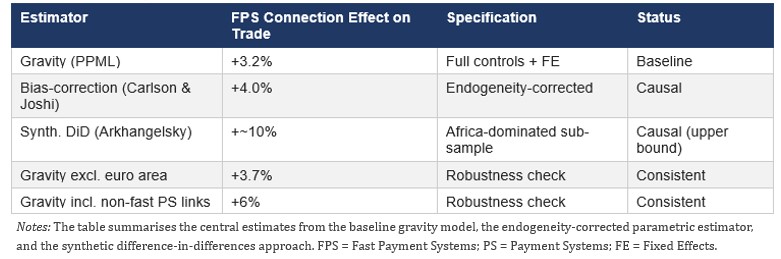
To put this in perspective, being in a formal trade agreement is associated with a roughly 5–7% increase in bilateral trade, while sharing a common currency is associated with a gain of around 12–16%. Payment connectivity thus delivers an effect about half as large as a trade agreement and a quarter as large as monetary union — a remarkable outcome for what is essentially a technical infrastructure improvement rather than a formal policy commitment.
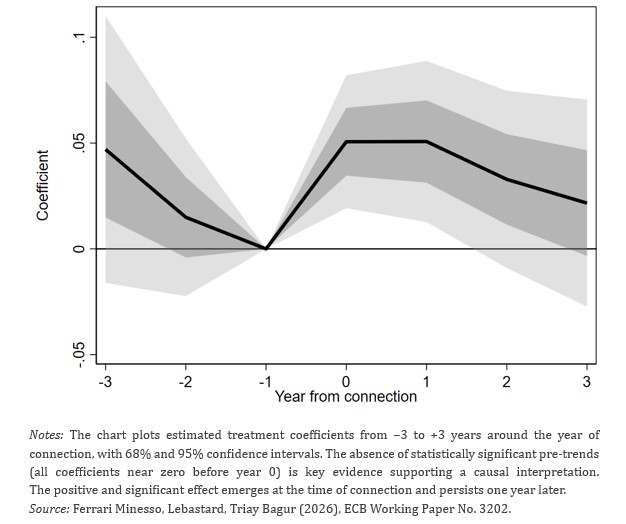
An event study analysis reinforces this interpretation. There is no evidence of a pre-existing trend: treated and control country pairs followed similar trade trajectories before the payment link was established, which supports a causal reading of the post-connection increase. The trade effect materialises in the year of connection and remains significant in the following year.
Figure 2. Event Study- Effect of Connecting System Payments Over Time
The aggregate 4% estimate is an average across a diverse sample including the euro area, South-East Asia, and Africa. One of the most policy-relevant findings of the paper is that the benefits of interlinking are highly heterogeneous — and that they are largest precisely where they are needed most.
Country size matters. Small countries gain significantly more from payment interlinking than large ones. This reflects the fact that smaller economies are typically less well-served by the correspondent banking network: global banks have less incentive to maintain relationships in markets where the volume of transactions does not justify the compliance and operational costs. For these countries, a fast payment link is not an add-on to an already functional system — it can be a genuine alternative to expensive and unreliable correspondent banking channels.
Moreover, countries in regions where cross-border payment costs are highest — notably in Africa and parts of the Middle East — see the largest trade gains from interlinking. The SDID estimates, which rely on a sub-sample dominated by African payment initiatives, yield trade effects of around 10% — broadly consistent with case-study evidence from South Africa, where payment system integration has been estimated to boost bilateral trade by up to 30% (Mariani et al. 2024).
Payment links that support both wholesale and retail transactions — where wholesale refers to large-value, business-to-business payments — generate significantly larger trade gains than purely retail-focused links. This finding makes intuitive sense: most of the value of international trade flows through corporate payment systems, not personal remittances. A payment infrastructure that can handle the invoicing and settlement needs of firms, not just the personal transfers of individuals, has a far greater potential to reduce trade costs.
Table 2. Gravity Model Results Interacting with Cross-Border Transaction Costs

Why does payment connectivity boost trade? Table 2 reports estimates from the baseline model where the interlinking dummy is interacted with measures of trade costs. The interactions terms are positive, consistently with a trade costs channel. Trade costs are the expenses that firms must incur to establish an export relationship, such as fees charged by intermediaries or exchange rate hedging costs, they can be fixed or variable. While variable costs affect all participants in the same proportions, fixed costs act as a barrier that prevents many small firms and those in remote markets from exporting at all. Reducing fixed costs not only increases trade volume within already established partnerships (intensive margin), but – most importantly – expands the range of viable trade relationships (extensive margin).
The asymmetric pattern of gains suggests that the trade benefits arise primarily from the extensive margin, supporting the interpretation of a decrease in fixed costs. If interlinking were merely reducing proportionally transaction costs, one would expect broadly similar gains for all connected pairs. Instead, the much larger effects found for small countries and under-served regions suggest that interlinking is enabling transactions that were previously infeasible or prohibitively expensive — lowering the bar to entry for international commerce rather than just trimming the cost of existing flows.
An important nuance is that the estimated effects represent the additional benefit of payment interlinking on top of the access to correspondent banking that country pairs already have. The correspondent banking channel is absorbed by the country-pair fixed effects in the gravity model. The 4% estimate therefore reflects the incremental value of fast, direct payment connectivity — a lower bound on the total gain for countries that lack correspondent banking access altogether.
The findings carry several concrete policy messages. First, they provide an empirical validation for the G20 Roadmap for Enhancing Cross-Border Payments, which has made fast payment system interlinking a strategic priority. The quantifiable trade premium associated with connectivity confirms that the investments required to implement such linkages — technical, regulatory, legal — are economically justified.
Second, the results underscore that not all interlinking initiatives are equally valuable. Those that prioritise wholesale transaction capabilities, and those that extend connectivity to countries underserved by the correspondent banking network, generate the highest returns. Policymakers and development institutions designing or funding interlinking projects should weight these dimensions heavily in their prioritisation frameworks.
Third, the paper highlights the importance of technical standardisation. Many of the barriers to interlinking are not economic but technical: incompatible messaging standards, different settlement assets (central bank versus commercial bank money), and misaligned regulatory frameworks. The adoption of common standards — such as the ISO 20022 messaging protocol, which the Eurosystem has already embraced in its TARGET services — substantially lowers the cost and complexity of establishing new links. A push for interoperability standards at the multilateral level, analogous to the role of the WTO in goods trade, could yield significant welfare gains.
Fourth, the findings have a geopolitical dimension that policymakers should also consider. The fragmentation of the global payment network along geopolitical lines is not merely a technical inconvenience. It could shape the map of trade, financial influence, and economic interdependence. Dividing payments into separated blocs would reduce net trade, with negative implications for global growth.
This paper suggests that payment systems, the plumbing of international trade, matter and that improving them can have economically relevant implications. Connecting fast payment systems improves trade by about 4% on average. These gains are larger for the countries that need it most — small economies, developing markets, and regions shut out of the correspondent banking network. As the world’s payment architecture continues to evolve — with new interlinking initiatives, the expansion of digital payment rails, and the strategic fragmentation of financial networks along geopolitical lines — understanding the economic consequences of connectivity choices will only become more important.
Arkhangelsky, D., Athey, S., Hirshberg, D. A., Imbens, G. W., and Wager, S. (2021). “Synthetic difference-in-differences”. American Economic Review, 111(12), 4088–4118.
Borchert, L., De Haas, R., Kirschenmann, K., and Schultz, A. (2024). Broken relationships: De-risking by correspondent banks and international trade. EBRD Working Paper (number 285) .
Carlson, M., and Joshi, K. (2024). “Sample selection in linear panel data models with heterogeneous coefficients”. Journal of Applied Econometrics, 39(2):237–255, 2024
Financial Stability Board (2020). Enhancing cross-border payments: Stage 3 roadmap.
Ferrari Minesso, M., Lebastard, L., and Triay Bagur, O. (2026). Interlinking payment systems and trade flows. ECB Working Paper No. 3202.
Ferrari Minesso, M., Mehl, A, Triay Bagur, O., and Vansteenkiste , I. (2025). Geopolitics and Global Interlinking of Fast Payment Systems. CEPR Discussion Papers 20105.
Mariani, L. A., Cortes, G., and Sant’anna, V. P (2024). Unleashing international trade through financial integration: Evidence from a cross-border payment system. ERSA Working Paper Series, (890), 2024.
Rice, T., von Peter, G., and Boar, C. (2020). On the global retreat of correspondent banks. BIS Quarterly Review, March 2020.
Santos Silva, J. M. C., and Tenreyro, S. (2006). “The log of gravity”. Review of Economics and Statistics, 88(4), 641–658.