

This policy brief is based on Central Bank of Ireland Research Technical Paper Vol. 2026, No. 8. The views expressed are those of the authors and not necessarily those of the Central Bank of Ireland and other institutions the authors are affiliated with.
Abstract
Public investment can be used to affect the economy over the business cycle, but also to boost its long-term potential. However, public investment is often subject to delays related to planning, construction, or both. These delays can affect the usefulness of public investment for managing the economy. In a downturn, a delay in delivering an announced public investment can worsen the downturn if public investment is not delivered quickly. If public investment that has been planned during the recession is delayed so that it occurs when the recession is over, it risks overheating the economy. Delays in the delivery of public investment shift the benefits from higher public capital further into the future and reduce welfare. These findings hold in the standard setting, but with search frictions planning delays become less concerning, because the expansion in the future is brought forward due to the friction.
Public investment is an interesting policy instrument (Ramey 2021) because it has two distinct properties. First, it has short-term demand-side effects similar to those of government consumption, and can therefore be used to stimulate the economy in the short run. Second, public investment increases long-lasting public capital that has long-term supply effects similar to the productivity increase. Both properties have been increasingly recognised by policymakers as useful instruments to manage the economy (see Coenen, Straub, Trabandt, 2012, 2013), especially after the Great Recession, but also in the more strategic longer run. A very prominent recent example is the report of Mario Draghi (Draghi 2024), which, amongst other things, calls for a structural reform in Europe with a permanent increase in public investment.
However, the issue with public investment is that the planning process is complex, and there are technological constraints during construction. Delays not only happen, but are ubiquitous. The result is that benefits from public investment come further in the future than initially envisaged.
We investigate two cases that cause delays (see Conefrey, Lozej, O’Reilly & Walsh, 2026). The first case, which we call planning delay or time-to-plan, is the time that passes between the moment a public investment is announced and the time it starts being carried out. The second case, called construction delay or time-to-build, is the time that passes from the moment construction starts to when the project is delivered and comes on line. There is an important distinction between them. Time-to-plan implies an announcement of public investment in the future, but no (or minimal) spending and hence no immediate demand stimulus until investment commences. Time-to-build implies that the demand stimulus of public investment is already taking place, but the project has not yet been finished and put to use, so that there are no supply-side effects from higher public capital yet.
A delay of any kind by itself is not a problem. However, suppose a government wishes to stimulate the economy during the recession and there is a delay. This can have two less desirable consequences. First, a delay can worsen a recession because benefits are anticipated to happen only in the future, and households and firms may decide to postpone their actions until then, which can lead to a temporary decline in aggregate demand. Second, when the stimulus from public investment finally commences, the economy may already be out of the recession and in a boom, so that the additional stimulus may overheat the economy.
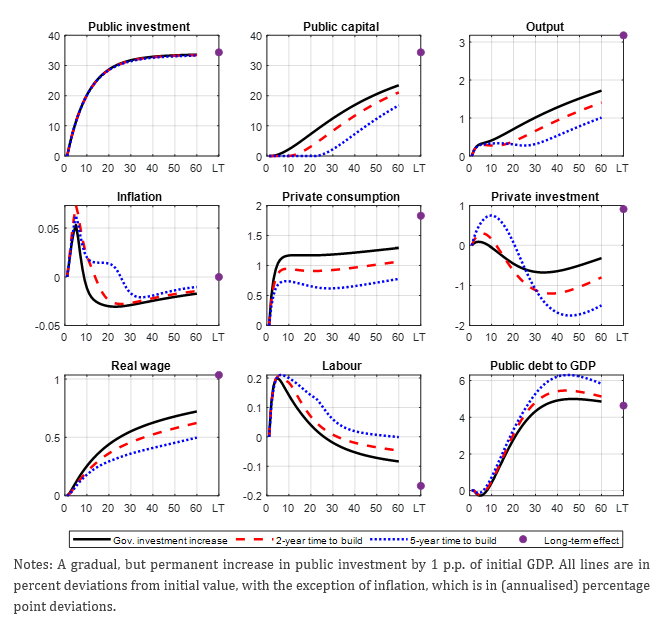
We show this in Figure 1 for the case of planning delays and in Figure 2 for the case of construction delays. In both cases we simulate a gradual, but permanent increase in public investment, standardised to 1% of initial GDP. We take the case with no delays (full black line) as the benchmark, and compare this to a 2-year (dashed red line) and a 5-year delay (dotted blue line).1
Note that in the case of planning delays (Figure 1) both output and employment fall during the planning delay, with the decline being stronger and more persistent if the delay is longer. Note also that inflation increases on impact, when the public investment increase is announced, and then increases again when the investment finally starts. While the increase in inflation is small, it still highlights that if, after say a 5-year delay, the economy finds itself in a boom, the additional stimulus coming from the commencement of the investment spending planned in the past will contribute to the economic stimulus. An unlucky timing and a long planning delay can therefore exacerbate the business cycle by worsening the recession and amplifying the expansion.
Figure 1. Planning delays in public investment
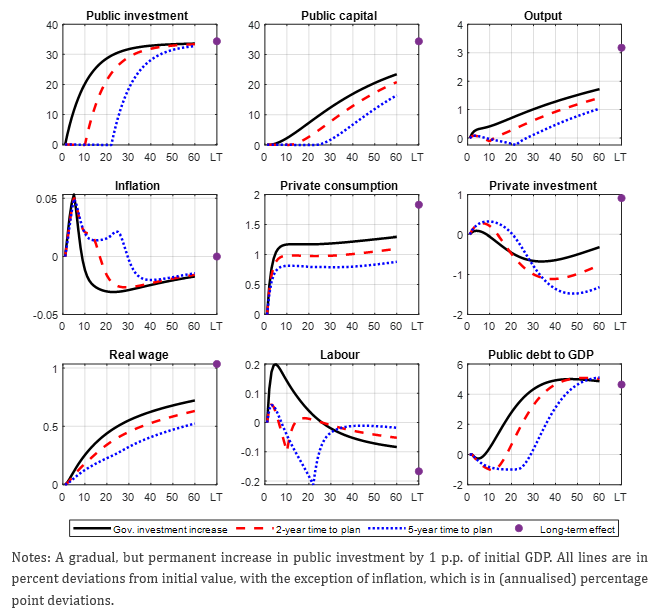
Figure 2 shows the same simulation, but this time with construction delays (time-to-build). In this case the demand stimulus from public investment occurs immediately, but the supply-side effect from productive public capital is delayed, because it takes time before the construction is finished and comes on line. This case is less problematic than planning delays, as both output and employment start increasing immediately. Inflation increases on impact, but then quickly recedes when public capital increases. This is because productive public capital acts similarly as a productivity shock and drives a wedge between wages and marginal costs, allowing wages to increase and marginal costs to fall. While inflation lingers on for longer in the case of long delay, this is a very small and relatively benign effect given that output and employment have increased.
Figure 2. Construction delays in public investment
Is there a setting where planning delays are also relatively benign and do not pose the risk of exacerbating a bust-boom cycle? It turns out that this can be the case if we consider an economy where there are search frictions in the labour market, but only if the labour market is sufficiently volatile.
Search frictions with respect to the labour market imply that hiring of workers is slow and costly: firms have to post a vacancy and incur some costs to do so. Moreover, posting a vacancy does not guarantee that a worker will be hired, because finding a worker occurs only with some probability. This implies that hiring workers is a forward-looking decision: when higher demand from higher public investment or higher productivity from more public capital materialise in the future, firms have to have workers already in place to benefit from this. Hiring workers just before would imply a lot of vacancies, which would make the labour market tight and would reduce the probability of finding workers. The stronger is this effect (the more volatile the labour market is), the earlier will firms start hiring additional workers in anticipation of stronger demand.
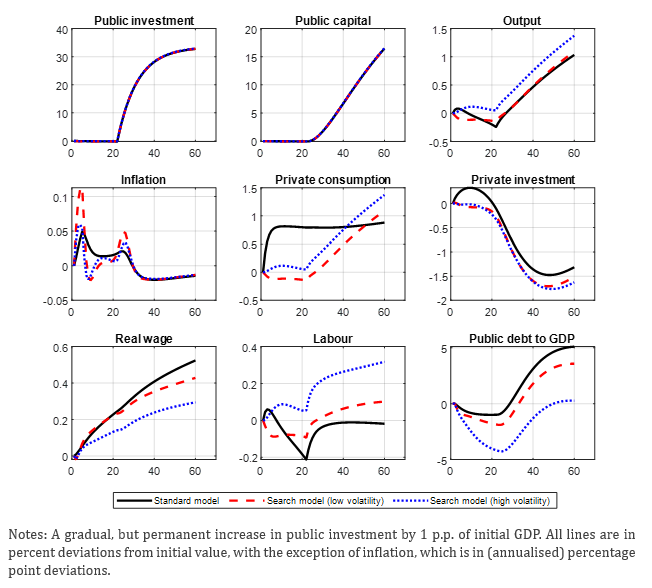
We analyse this case in Figure 3 below, where we, to avoid congestion and to make the point clearly, focus on 5-year planning delays (as explained above, construction delays are less of an issue). The figure shows the planning delay in the standard economy without search frictions (the black line in Figure 3 is the same as the dashed blue line in Figure 1). We compare this with two cases of an otherwise identical economy, but with different degrees of labour market volatility.2 In the first case, we consider an otherwise identical economy, but with weak congestion effects and low labour market volatility (red dashed lines in Figure 3). In this case, a planning delay still leads to a worsening of output and employment during the delay phase, but by less and with a different dynamic than in an economy without search frictions. However, the second case with high volatility of the labour market (dotted blue lines) exhibits an increase in output and employment already during the delay phase. In this case, the stimulus of the economy occurs immediately, even if public investment is delayed in the planning phase (and even if this phase is relatively long).
The result is interesting not only from a policy perspective, but because it is related to a debate whether a news shock about the future productivity can cause a simultaneous increase in output, consumption, investment and employment (a so-called Pigou cycle) already now.3 It turns out that, with the exception of private investment that stagnates during the delay phase, it can. However, a closer look at the mechanism (beyond the scope of this note) is that the expansion is not due to the anticipated productivity increase from more public capital in the future, but due to the demand increase due to more public investment.
Figure 3. Planning delays with different degrees of labour market volatility
Beaudry, P., Portier, F., 2006. Stock prices, news, and economic fluctuations. American Economic Review 96, 1293–1307.
Clancy, D., Jacquinot, P., Lozej, M., 2016. Government expenditure composition and fiscal policy spillovers in small open economies within a monetary union. Journal of Macroeconomics 48, 305–326.
Coenen, G., Straub, R., Trabandt, M., 2012. Fiscal policy and the great recession in the euro area. American Economic Review 102, 71–76.
Coenen, G., Straub, R., Trabandt, M., 2013. Gauging the effects of fiscal stimulus packages in the euro area. Journal of Economic Dynamics and Control 37, 367–386.
Conefrey, T., Lozej, M., O’Reilly, G. and Walsh, G., 2026. Delivering public investment efficiently: if possible, avoid delays. Research Technical Paper 08/RT/26, Central Bank of Ireland.
Den Haan, W.J., Kaltenbrunner, G., 2009. Anticipated growth and business cycles in matching models. Journal of Monetary Economics 56, 309–327.
Den Haan, W.J., Lozej, M., 2011. Pigou cycles in closed and open economies with matching frictions, in: NBER International Seminar on Macroeconomics, University of Chicago Press Chicago, IL. pp. 193–234.
Draghi, M., 2024. The future of European competitiveness: A competitiveness strategy for Europe. Report. European Commission.
Gomes, S., Jacquinot, P., Pisani, M., 2012. The eagle. a model for policy analysis of macroeconomic interdependence in the euro area. Economic Modelling 29, 1686–1714.
Gomes, S., Jacquinot, P., Lozej, M., 2025. A single monetary policy for heterogeneous labour markets: the case of the euro area. Macroeconomic Dynamics, 29, e111.
Jaimovich, N., Rebelo, S., 2009. Can news about the future drive the business cycle? American Economic Review 99, 1097–1118.
Ramey, V.A., 2021. The macroeconomic consequences of infrastructure investment, in: laeser, E.L., Poterba, J.M. (Eds.), Economic Analysis and Infrastructure Investment. University of Chicago Press, pp. 219–268.
We use the version of the global New Keynesian model of the euro area, the EAGLE, which features sticky prices and wages, international trade linkages, and where Ireland is modelled as a small open economy within the euro area, so that it shares the interest rate and the exchange rate against other parts of the world with the rest of the euro area. The model is a version of Clancy, Jacquinot, Lozej (2016), which is in turn based on Gomes, Jacquinot, Pisani (2012).
The model with search frictions on the labour market is based on Gomes, Jacquinot, Lozej (2025), which has otherwise identical features as Clancy, Jacquinot, Lozej (2016), with the exception that it includes search frictions on the labour market and does not include public investment. For the purpose of this exercise, it has been modified so that it includes public investment. Steady states of both models have been harmonised, so that they are the same and that the results are comparable.
There was a lively literature on the effects of news shocks about future productivity (Beaudry and Portier, 2006, Jaimovich and Rebelo, 2009). Den Haan and Kaltenbrunner (2009) have shown that a search model can generate a Pigou cycle in a closed economy and Den Haan and Lozej (2011) have extended this to an open economy. However, these papers are about the shocks about future productivity. A public investment shock with productive public capital, however, is a mix of demand shock and a shock about the future productivity.