

This policy brief is based on ECB Working Paper No. 3185: “Why is Europe Lagging Behind in High-Tech Sectors? The Role of Institutional and Regulatory Quality”. The views expressed are those of the authors and do not necessarily reflect those of the European Central Bank.
Abstract
Europe’s persistent productivity gap vis-à-vis the United States is closely linked to lower private investment in high-tech and innovative sectors. This policy brief highlights the role of institutional and regulatory quality in explaining that gap. The findings show that better governance, more flexible labour markets and lower administrative burdens significantly increase the share of private investment directed towards high-tech and artificial intelligence (AI)-intensive sectors. Convergence of EU countries’ institutional frameworks towards the EU frontier could raise high-tech investment shares by up to 50%, thereby helping to narrow Europe’s innovation gap with the US by a similar extent and strengthening long-term productivity growth.
Since the mid-1990s, productivity growth in the European Union has lagged behind that of the United States. A key driver of this divergence is Europe’s lower share of investment in high-tech and innovative sectors, as highlighted by Draghi (2024). While the US has increasingly specialised in cutting-edge sectors such as information and communication technologies (ICT), artificial intelligence, and biotechnology, European economies remain more focused on traditional mid-tech industries. In 2021, approximately 17 % of market sector gross fixed capital formation in EU countries was concentrated in sectors classified as high-tech by Eurostat, while the corresponding share in the United States was nearly double, reaching 33 % (Figure 1).
This difference in investment composition matters for growth. High-tech sectors generate stronger productivity spillovers, faster innovation cycles, and larger long-term gains. In contrast, mid-tech sectors tend to deliver more incremental improvements and are increasingly exposed to competition from China (Fuest et al. 2024).
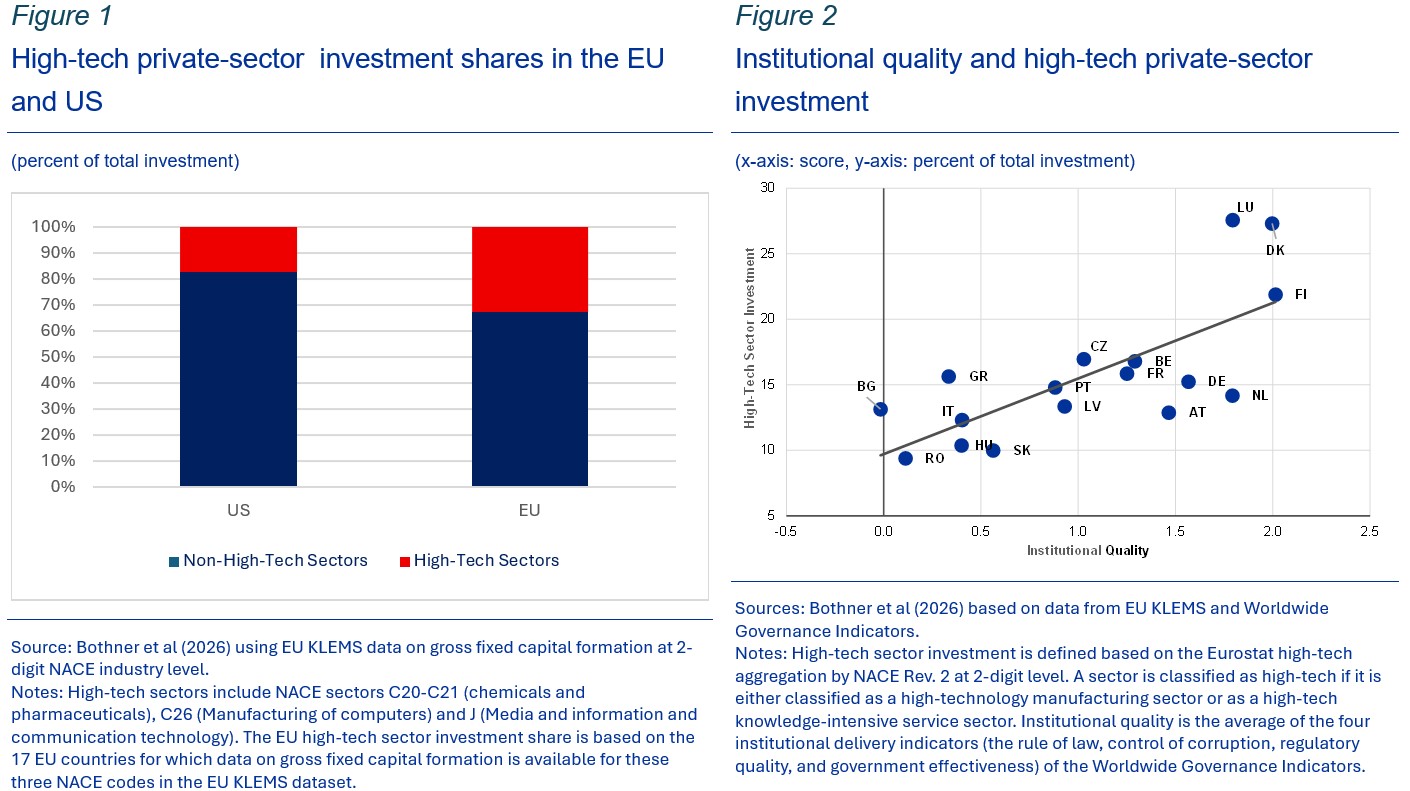
This policy brief argues that differences in institutional and regulatory quality are a key factor behind Europe’s lag in high-tech investment. Strong governance, alongside efficient labour and product market regulations, is essential to support investment in innovative, high-tech and AI-intensive sectors. These sectors are characterised by high uncertainty, frequent trial-and-error, and strong scaling requirements, making them particularly sensitive to the costs of adjustment and failure (Coatanlem and Coste 2025). Inefficient regulatory and institutional frameworks raise these costs and thereby discourage investment.
In particular, rigid labour markets increase the cost of restructuring and scaling projects up or down, and high administrative burdens slow firm entry, weaken competition and hamper firm expansion. Weak governance raises uncertainty and reduces investor confidence. Taken together, these factors disproportionately discourage investment in innovative sectors compared to more stable, less risky, traditional industries. Consistent with this mechanism, unconditional correlations show that countries with more effective governance and less restrictive regulatory environments allocate a larger share of investment to high-tech sectors (Figure 2), underlining the importance of institutional and regulatory quality for Europe’s innovation and productivity performance.
Our analysis covers 25 EU countries over the period 2004–2019 (extended to 2023 for the AI-related analysis). It examines how institutional and regulatory conditions affect the allocation of private investment across sectors with different levels of innovativeness.
We focus on three key dimensions of institutional and regulatory quality. These indicators can be broadly interpreted as determinants of firms’ start-up and rescaling costs which strongly determine firms’ profitability in disruptively innovative sectors (Coatanlem and Coste 2025):
The analysis links these institutional and regulatory indicators to investment in sectors with different degrees of innovativeness. The sectors are classified in terms of their level of technological advancement and innovativeness using three different approaches:
The empirical framework assesses how improvements in institutions differentially affect investment in innovative versus non-innovative sectors.
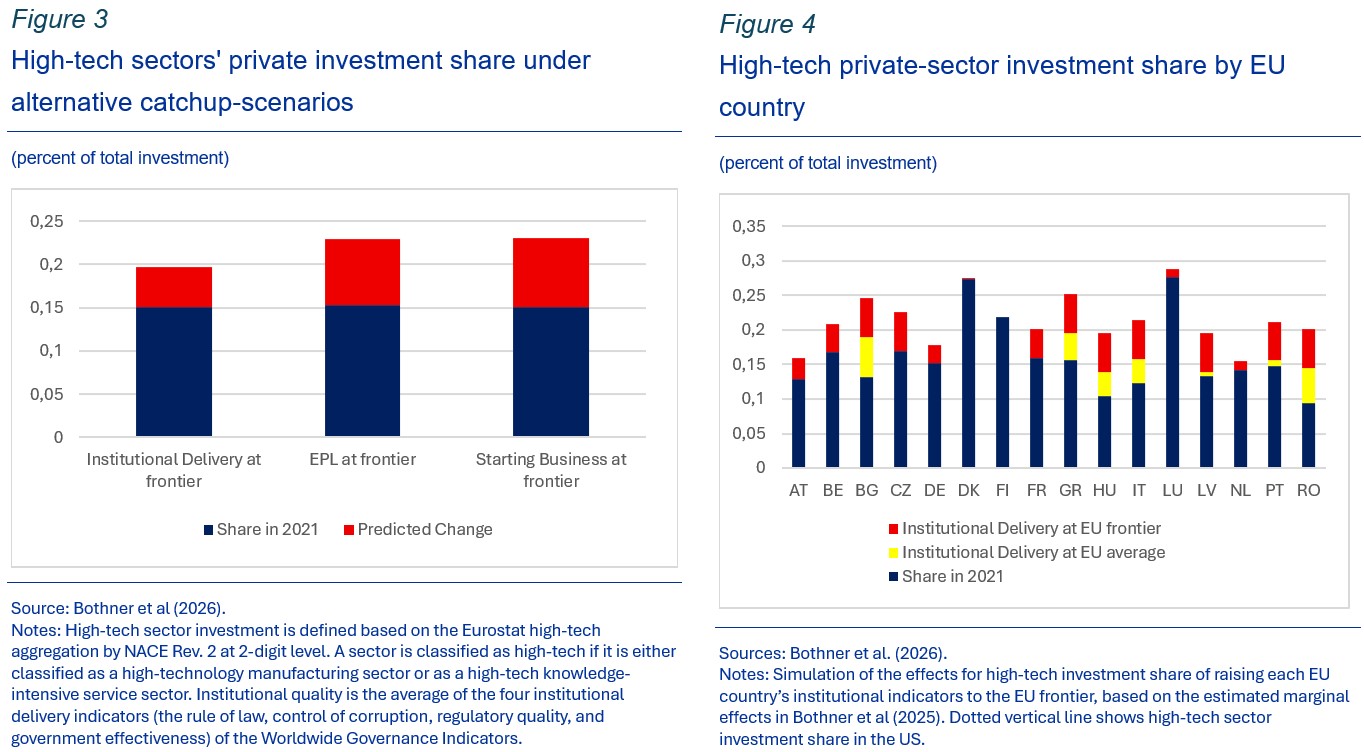
The results show a clear and robust relationship: better institutional and regulatory quality is associated with higher investment shares in high-tech sectors. The magnitude of the effect is economically meaningful. Raising each EU country’s Institutional Delivery Index to the EU frontier would increase the high-tech sector investment share by 4.6 percentage points. Similarly, aligning each country’s EPL index and Starting a business score with their respective EU frontiers is estimated to raise the high-tech sector investment share by 7.6 and 7.9 percentage points, respectively. This suggests that institutions play an important allocative role in directing market investment toward more productive and innovative activities, in addition to any broader effect they may have on overall investment levels.
A comparison to the investment shares of high-tech sectors in EU countries puts this into perspective: In 2021, investment in high-tech sectors accounted for 15.1% of total market sector investment across 17 EU countries. The estimated increases associated with raising each country’s institutional indicators to the frontier are substantial, corresponding to roughly a rise of 30% to 50% compared to current levels (Figures 3 and 4).
The positive impact of the institutional and regulatory framework is also evident under alternative measures of innovation. Our findings suggest that better governance and simpler business regulations significantly increase investment in AI-intensive sectors. Raising institutional quality to the EU frontier could increase AI-intensive investment shares by 2 to 7 percentage points, which represents an increase of between 8% and 27%. Similarly, patent-intensive sectors receive disproportionately more investment when institutional quality improves, indicating that governance improvements particularly benefit sectors closer to the technological frontier.
Institutional and regulatory frameworks play an important role in the allocation of investment to different sectors in Europe. Aligning institutional frameworks with those of best-performing EU countries could substantially help direct more private funds into high-tech activities and narrow the respective gap with the United States.
Improving the rule of law, reducing corruption, and enhancing government effectiveness could significantly boost investment in high-tech sectors compared to traditional industries. Simplifying procedures for starting and running businesses can lower entry barriers and encourage competition, innovation-driven entrepreneurship and risk-taking. More adaptable labour markets and less cumbersome administrative procedures could reduce the cost of failure, restructuring and rapid scaling up, which is crucial for high-risk innovation, enhancing productivity and long-term growth.
These reforms are particularly important in the context of increasingly complex EU and national regulatory frameworks. Legislation on anti-money laundering, sustainability reporting, due diligence, data protection, online content, AI, and digital services has addressed the need to protect fundamental rights in a modern, digitalised society but has also added to the cumulative regulatory burden, particularly and often disproportionately for small and medium-sized enterprises.
Structural reforms aimed at strengthening governance and reducing regulatory frictions should therefore be at the core of Europe’s competitiveness strategy, complementing policies to deepen the Single Market and advance the Savings and Investment Union. At the EU level, relevant initiatives, aligned with the European Commission’s Competitiveness Compass, include the ongoing simplification “Omnibus” packages and the proposal for a 28th corporate law regime. At the national level, several EU countries provide useful benchmarks. Denmark, Finland, Sweden and the Netherlands are among Europe’s innovation leaders, while being characterised by sound institutions, transparent governance mechanisms and relatively high levels of public sector integrity and trust. Drawing lessons from such best practices could help other EU countries overcome reform barriers and strengthen their position in high-tech sectors, boosting overall productivity and living standards.
Bothner, J., Lopez-Garcia, P., Momferatou, D., and Setzer, R. (2026). Why Is Europe Lagging Behind in High Tech Sectors? The Role of Institutional and Regulatory Quality. ECB Working Paper, No. 3185.
Calvino, F., Dernis, H., Samek, L., and Ughi, A. (2024). A sectoral taxonomy of AI intensity. Technical report, OECD Publishing.
Coatanlem, Y. and Coste, O. (2025). Cost of failure, disruptive innovation and targeted flexicurity. IEP@ BU Working Paper, Bocconi University.
Draghi, M. (2024). The future of European competitiveness. European Commission Report.
Fuest, C., Gros, D., Mengel, P.-L., Presidente, G., and Tirole, J. J. (2024). EU Innovation Policy: How to Escape the Middle Technology Trap. ifo Institute Technical Report.