

This policy brief is based on Humann, Kanelis, Kranzmann, and Siklos (2026) published in Finance Research Letters. The views expressed here are those of the authors and do not necessarily reflect the opinions of the Deutsche Bundesbank or the Eurosystem.
Abstract
Federal Open Market Committee (FOMC) minutes remain a relevant source of information even though they are released roughly three weeks after the policy decision. We use text embeddings to identify what they add to decision-day communication and whether that content comes from staff analysis or committee deliberation. Greater semantic novelty in the minutes is associated with larger market reactions, while staff versus decision-makers’ views contained in the minutes are informative about the direction of market reactions. Methodologically, we develop an easy-to-implement method to identify the market-moving content in central bank documents.
Since 2005, the minutes of Federal Open Market Committee (FOMC) meetings have been published roughly three weeks after each policy decision. They provide a detailed account of the FOMC meeting, summarizing the economic and financial information considered, the participants’ views and policy deliberations, as well as the decisions taken, including their rationale and individual votes. Like the FOMC statement and the Chair’s post-meeting press conference, their release elicits immediate movements in asset prices and trading activity. This continued market repricing, despite the publication lag, suggests that the minutes convey information not yet reflected in prevailing market expectations. Unlike decision-day communication, which present the policy decision and its rationale, however, the minutes provide a more structured account of two institutionally distinct sources of information: the staff section, presenting a detailed assessment of economic and financial conditions, including the staff’s outlook, and the committee section, recording how participants interpret these conditions, assess the outlook and its risks, and deliberate over the appropriate course of monetary policy.
In Humann et al. (2026), we leverage this publication sequence and the separation between staff assessment and committee discussion to examine how novel information – and its placement within the minutes – elicits market reactions. We develop a framework that measures both how much of the minutes’ content is novel relative to decision-day communication and whether that novelty is concentrated in the staff assessment or the committee discussion. Linking these novelty indicators to high-frequency financial market data around the release of the minutes, we find that the overall degree of novelty is positively associated with the magnitude of market reactions, whereas the location of novelty within the minutes is associated with the direction (i.e., sign) of market reactions.
To identify what the minutes add relative to decision-day communication, we compare their content with the information already disclosed for the same meeting. Our benchmark combines the FOMC statement with the Chair’s prepared opening remarks at the post-meeting press conference. We divide these documents, along with the staff and committee sections of the minutes, into individual paragraphs. This paragraph-level segmentation preserves the context necessary to interpret them while still isolating a reasonably coherent subtopic (Kanelis et al., 2025). We then use Google’s Gemini pretrained embedding model to convert each paragraph into a text embedding. Such an embedding represents each paragraph as a vector (i.e., a point in a high-dimensional semantic space), so that passages conveying similar ideas are located close together even when their wording differs. Such paragraph-level embeddings thus allow us to compare substantive meaning rather than mere word overlap.
Using these embeddings, we compare each paragraph in the minutes with all paragraphs in the corresponding decision-day benchmark to identify its closest semantic counterpart using cosine similarity. The intuition here is that if similar content appeared anywhere in the FOMC statement or the Chair’s prepared remarks, the minutes paragraph receives a low novelty score. Any paragraph in the minutes that is identical to one in the FOMC statement or the Chair’s remarks will receive a score of zero because it contains no novel information. By contrast, the more distant its closest match is, the greater its semantic novelty. This allows us to compute a novelty score for each paragraph in the minutes. We aggregate these scores separately for the staff and committee sections to construct two measures: overall novelty, capturing how much novel content the minutes contain, and novelty tilt, capturing whether that content is concentrated relatively more in the committee discussion section or the staff assessment section.
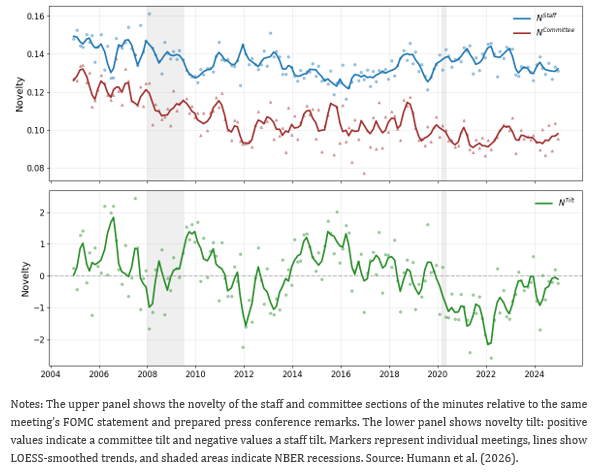
Figure 1 reveals a clear asymmetry in the resulting novelty indices. The staff section contains consistently more semantic novelty than the committee discussion section, with the gap widening over time. Negative values of novelty tilt in the lower panel show that the information balance shifts toward staff material during several periods of macro-financial stress and particularly during the increase in inflation since 2021. One interpretation is that decision-day communication during these times focuses on conveying the committee’s narrative, while the minutes remain the main vehicle for the staff’s more detailed assessment.
Figure 1. Dynamics of Novelty in FOMC Minutes
Having measured the semantic novelty of the minutes relative to decision-day communication, we test whether and to what extent novelty explains market reactions. Following the literature, we relate our novelty measures to high-frequency changes in short-term interest rates, Treasury yields, and exchange rates around each release. Such high-frequency event studies are widely used to examine central bank communication, because asset price changes within narrow windows around scheduled announcements allow researchers to measure how investors revise their expectations while minimizing confounding influences from other events (e.g., Kuttner, 2001; Gürkaynak et al., 2005; Nakamura and Steinsson, 2018).
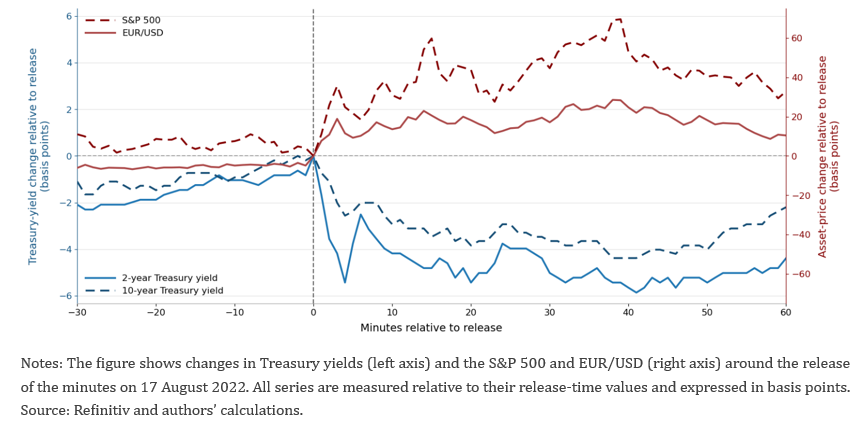
Figure 2 illustrates such market reactions to the minutes using the 17 August 2022 release as an example. Although this release reaffirmed the need for restrictive policy, it provided novel information relative to the statement and press conference, which markets interpreted as less hawkish. In particular, the staff had revised its growth forecast noticeably lower, much of the effect of earlier tightening had yet to reach the economy, and many committee members explicitly recognized the risk of tightening more than necessary. Over the 30-minute event window, the two-year and ten-year Treasury yields fell by approximately 5 and 4 basis points (bp), respectively, while the S&P 500 rose by 40 bp and the euro appreciated by 20 bp against the dollar.
Figure 2. High-Frequency Market Responses to the 17 August 2022 FOMC Minutes Release
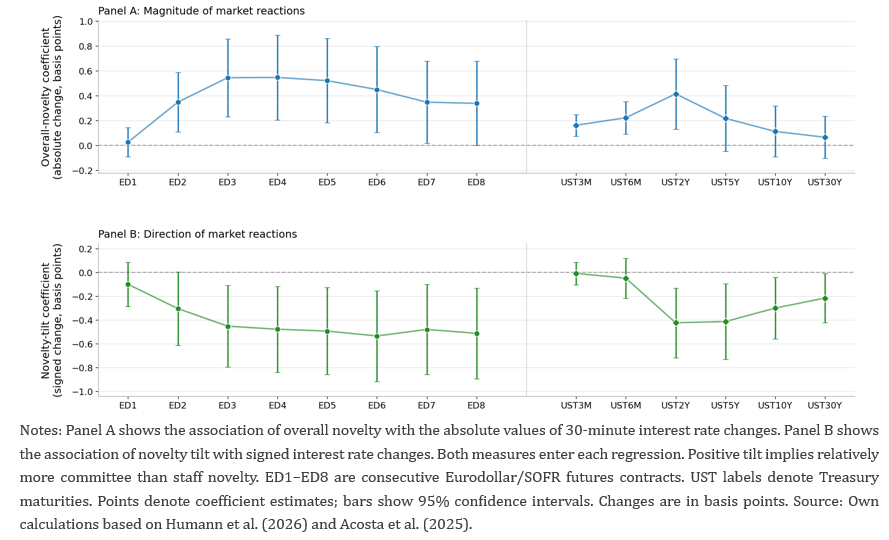
We use the U.S. Monetary Policy Event-Study Database by Acosta et al. (2025), which provides changes in median prices and yields of financial assets around the release of the minutes, measured within a 30-minute window around each release. Figure 3 summarizes our central findings. Greater overall novelty is associated with larger absolute market movements, particularly in short-term interest rates and the two-year Treasury yield (Panel A). However, overall novelty is not associated with whether interest rates rise or fall. This result highlights that our measure of semantic novelty is deliberately agnostic as to whether novel information updates expectations about monetary easing or tightening. Instead, our results show that a greater degree of novelty is associated with larger market reactions.
The composition of novelty in the minutes, by contrast, is informative about the direction of market reactions (Panel B). Holding overall novelty constant, committee-tilted novelty is associated, on average, with lower expected policy rates and Treasury yields, whereas staff-tilted novelty is associated with movements in the opposite direction. These directional relationships are strongest at short and intermediate maturities. Taken together, the results suggest that markets respond not only to how much new information the minutes contain, but also to their institutional source. In particular, novel information originating in the committee discussion is associated with revisions in market expectations toward a less restrictive policy path, whereas novel information originating in the staff assessment is associated with revisions in the opposite direction. In sum, the amount of novelty helps explain how far prices move, while its location helps explain which way they move.
Figure 3. Interest Rate Reactions to Novel Information in FOMC Minutes
The release of the FOMC minutes moves financial markets, but the specific information underlying these reactions has remained less well understood. Our analysis shows that the minutes matter not only because they add information beyond the decision-day communication, but also because markets appear to distinguish information in the staff assessment from information in the committee discussion. The institutional context of novel information therefore provides a relevant dimension for understanding how investors interpret central bank communication.
Our framework offers a content-based perspective on market repricing around the publication of the minutes. Rather than treating these movements as an undifferentiated response to the document as a whole, it helps identify which parts of the document are associated with market reactions and how their institutional source shapes those reactions. For monetary policymakers, this approach provides a practical tool for understanding what moves markets and how the sequencing and placement of information across the communication cycle may affect monetary policy transmission.
Acosta, M., Ajello, A., Bauer, M. D., Loria, F., and Miranda-Agrippino, S. (2025), “Financial market effects of FOMC communication: Evidence from a new event-study database,” Federal Reserve Bank of San Francisco Working Paper No. 2025-30. https://doi.org/10.24148/wp2025-30
Gürkaynak, R. S., Sack, B., and Swanson, E. T. (2005), “Do actions speak louder than words? The response of asset prices to monetary policy actions and statements,” International Journal of Central Banking, 1(1), 55–93. https://www.ijcb.org/journal/v1n1/do-actions-speak-louder-words-response-asset-prices-monetary-policy-actions-and
Humann, N., Kanelis, D., Kranzmann, L. H., and Siklos, P. L. (2026), “Financial market reactions to the novelty of information in FOMC minutes,” Finance Research Letters, 108, Article 110475. https://doi.org/10.1016/j.frl.2026.110475
Kanelis, D., Kranzmann, L. H., and Siklos, P. L. (2025), “The financial instability–monetary policy nexus: Evidence from the FOMC minutes,” Deutsche Bundesbank Discussion Paper No. 13/2025. https://www.bundesbank.de/en/publications/research/discussion-papers/the-financial-instability-monetary-policy-nexus-evidence-from-the-fomc-minutes-925466
Kuttner, K. N. (2001), “Monetary policy surprises and interest rates: Evidence from the Fed funds futures market,” Journal of Monetary Economics, 47(3), 523–544. https://doi.org/10.1016/S0304-3932(01)00055-1
Nakamura, E., and Steinsson, J. (2018), “High-frequency identification of monetary non-neutrality: The information effect,” The Quarterly Journal of Economics, 133(3), 1283–1330. https://doi.org/10.1093/qje/qjy004