

This policy brief is based on DNB Working Paper No 852. This policy brief represents the authors’ views and does not necessarily reflect the views of De Nederlandsche Bank.
Abstract
We use data from a representative Dutch household survey to examine how Dutch households form inflation expectations one year head. We find that on aggregate consumers tend to overreact to current inflation levels. However, forecasting rules vary substantially across individual households, depending also on socio-economic characteristics, such as gender, age and education. Only 2.5 percent behave consistently with rational expectations. Instead, most consumers follow simple forecasting rules, adaptive expectations being the most prevalent. This suggests that when assessing inflation dynamics, policymakers should closely monitor inflation expectations of households with different socio-economic characteristics.
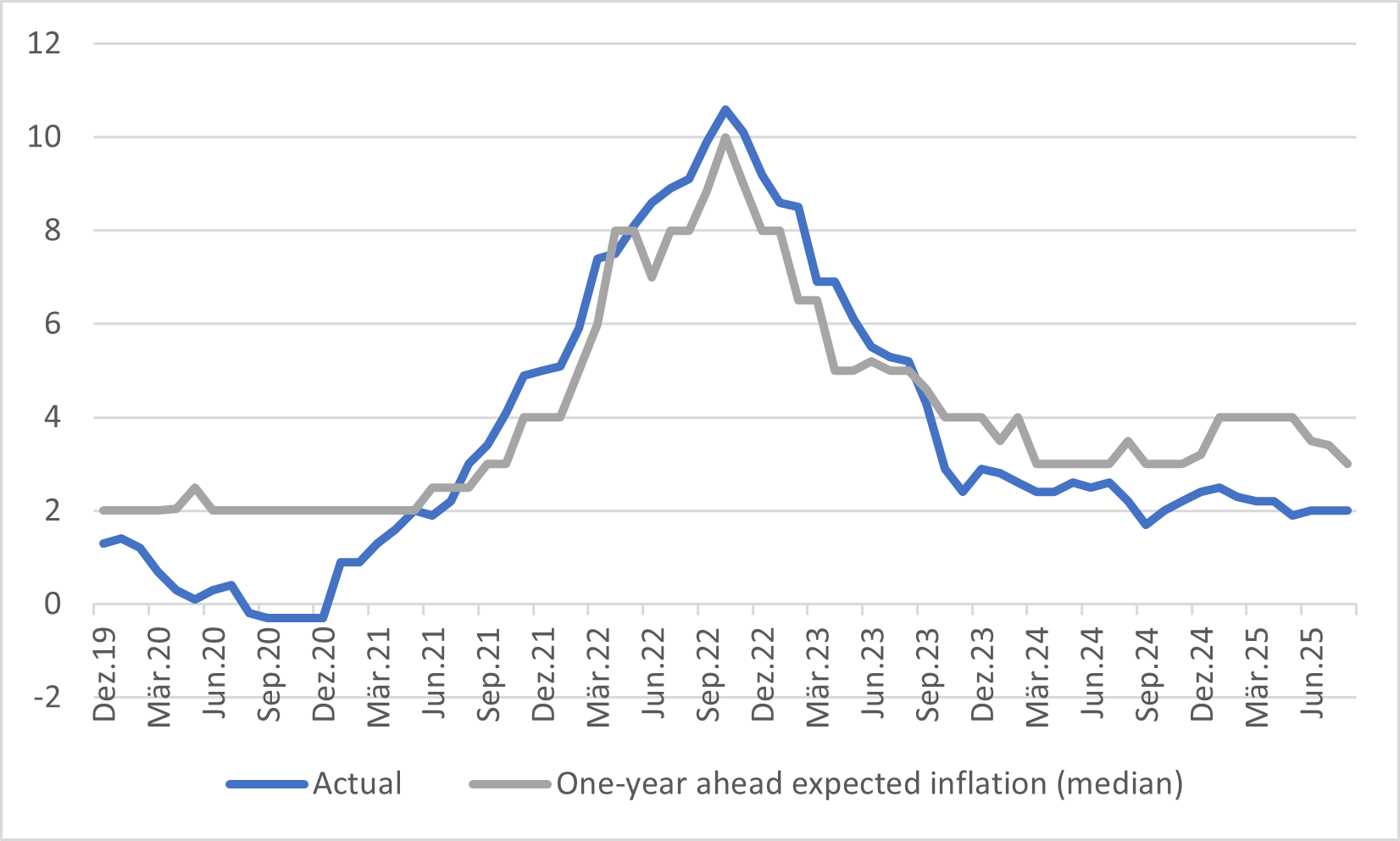
Household inflation expectations shape key economic decisions, including consumption, saving, investment, and portfolio choices, thereby playing a key role in monetary policy transmission and asset pricing. Their importance has become particularly pronounced during the recent episode of elevated inflation, when households’ information processing and belief formation gained greater relevance. As euro area inflation surged in mid-2021, households’ euro area inflation expectations rose rapidly in tandem (Figure 1). After peaking in September 2022, expectations declined steadily but eventually stabilized at levels that remain visibly higher than before the inflation surge.
Figure 1. Euro area inflation and 1-year ahead inflation expectations of Dutch households
The hypothesis that agents form expectations rationally has played a dominant role in modern macroeconomics. It has been attractive because it has helped explain the stagflation in the 1970s, allowed rigorous modelling of macroeconomic dynamics, and has been difficult to refute empirically (Born et al., 2025). Over the past two decades, however, a rich empirical literature based on survey data has provided evidence of systematic departures of expectations of professional forecasters, households and firms from rational expectations (Coibion and Gorodnichenko, 2015).
The literature on the formation of inflation expectations of households using survey data has documented several important facts, as discussed in detail e.g. in D’Acunto et al. (2024). First, households typically form expectations in a way that is not consistent with the Full Information Rational Expectations (FIRE) hypothesis. Second, there is evidence that households’ inflation expectations and perceptions of actual inflation are systematically biased upward compared to realized inflation outcomes, particularly during periods of low inflation (see Figure 1). Third, there is persistent heterogeneity and disagreement among consumers. In particular, expectations are generally right skewed, meaning that a significant portion of consumers expect inflation to be higher than the median, with a number of respondents anticipating very high inflation. Expectations also differ across consumers depending on their personal experience and the speed with which they adjust to changes in actual inflation. Fourth, when individual households update their beliefs, they frequently overreact to their own past revisions. Fifth, households tend to pay more attention to inflation when actual inflation is higher and unemployment is lower, suggesting some overreaction to salient macroeconomic conditions.
There is extensive evidence based on the cross-sectional distribution of household inflation expectations and on the updating behaviour over time of the average consumer. Much less is known instead about how different types of consumers update their beliefs. A frequently used approach in the literature consists in providing specific, randomly assigned information to subsets of a panel of households, and assessing how this information changes their inflation expectations. This analysis, however, typically relies on single survey waves, offering limited guidance on how individuals update expectations in real time or how they evolve with real macroeconomic conditions.
In a new DNB Working Paper (Reiche et al., 2025), we address these gaps in the literature by estimating the dynamics with which specific consumers in a panel of Dutch households update their beliefs. We do this by running separate time-series regressions for each respondent of the DNB Household Survey (DHS) and recovering the sensitivity of individual consumers’ inflation forecasts to past inflation and past forecasts.
Our analysis exploits unique features of the DHS. Since December 2019, DHS respondents have been asked monthly to provide one-year-ahead inflation forecasts, yielding rich longitudinal microdata (Galati et al., 2023, 2026). Compared to other major surveys such as the Michigan Survey of Consumers or the New York Fed Survey of Consumer Expectations in the United States, or the ECB’s Consumer Expectations Survey in the euro area, the DHS contains a highly balanced panel covering an extended period: more than 1700 respondents have participated for more than 36 consecutive months. Respondents are randomly assigned either to national (Dutch) or euro area inflation questions, and half of the sample receives regular information on the ECB’s inflation target and recently realized inflation.
This design allows us to study how information provision and the reference area shape forecasting rules. Notably, the sample period spans both the pre-pandemic low-inflation regime and the sharp inflation surge during and after the Covid-19 pandemic. Covering the high-inflation environment is important, as the literature has documented significant differences in household expectations formation during periods of high and low inflation (Granziera et al. 2025). Moreover, households tend to pay more attention to inflation and to increase the amount of information they acquire when inflation is high (Weber et al. 2025; Mikosch et al. 2024; Galati et al. 2026). Inflation expectations also have a stronger effect on actual inflation when it is high (Moessner 2024).
As in other surveys, the DHS satellite survey shows significant heterogeneity in responses by demographic groups, and in particular between men and women, and across different ages, education and income levels.
In our empirical analysis, we examine alternative forecasting rules that households may follow within a simple Bayesian updating framework, in which households revise their expectations when new information arrives. We assume that inflation follows a stationary first-order autoregressive process, and households observe current inflation with noise. Consumers follow FIRE if they possess complete information about the underlying data process and update their expectations rationally. Alternatively, consumers could form expectations rationally, which are consistent with the data but based on incomplete information (we will call those types “data consistent”). Departures from FIRE may also result when consumers use simplified forecasting rules. Using data on household expectations from the DHS, we examine those types of departures and focus on four heuristic models that are prominent in the literature (see Pesaran and Weale 2006 for a detailed analysis of these heuristics).
First, agents can form naïve expectations when their inflation forecasts are given by the current realization (Lakonishok et al. 1994). In our framework, this implies that agents over-extrapolate from the signal they receive relative to their prior.
Second, agents can form adaptive expectations if these are a weighted average of the current realization of inflation and a previous forecast for the current period (Nerlove 1958). Agents that use adaptive expectations therefore place less weight on current inflation and more weight on their own past forecasts than naïve forecasters.
Third, expectations can reflect a mean-reverting heuristic when they are given by a weighted average of current and lagged inflation realizations. Mean-reverting types place more weight on past inflation than on current inflation. In our empirical framework, this heuristic is followed if agents receive an additional signal about past values of inflation and thus ignore their previous forecast.
Fourth, agents can be fundamentalist if they choose a constant anchor for inflation and ignore all new information. Thus, they perceive inflation to be constant and disregard all signals. Fundamentalists can have expectations anchored at an inflation target, although this does not need to be the case.
In our empirical tests, we also examine combinations of heuristics, whereby consumers form adaptive or mean-reverting expectations together with a constant, positive inflation anchor.
The empirical results at the aggregate level show that on average, individual consumers tend to overreact to current inflation levels. This result is consistent with the findings of the literature on professional forecasters’, households’ and firms’ expectations, but rejects the assumptions of FIRE on average (Born et al. 2025). Further, we find that consumers on average rely on current realizations of inflation, their own previous forecasts and lagged realizations in equal parts when forming their predictions over the next 12 months. They do so in a way that is not substantially different from professional forecasters, and the coefficients yield a parametrization of our model that is close to the true model parameters under noisy information as estimated by a simple back-of-the-envelope calculation.
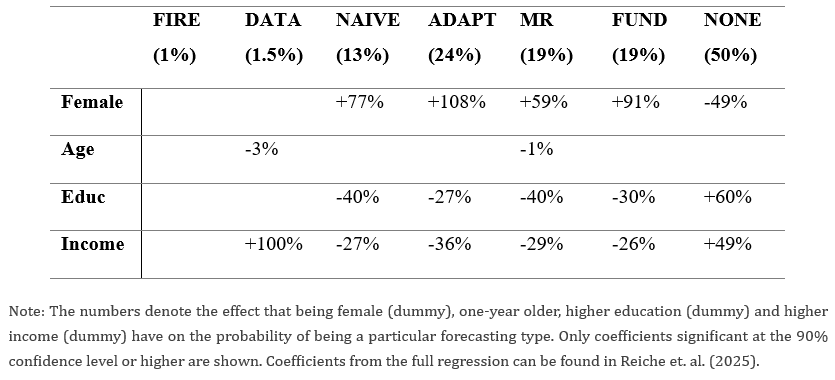
However, these aggregate results hide a substantial heterogeneity in forecasting behaviour. When we examine individual respondents, we find that only 2.5% of the sample follow ‘Full Information Rational Expectations’ (FIRE) or are consistent with data observations. These individuals tend to be wealthier, highly educated men. This aligns with existing research showing upward biases in inflation expectations among women, lower-income, and less-educated individuals (D’Acunto, Malmendier & Weber 2021, D’Acunto et al. 2019, Reiche 2025, Piccolo et al. 2025).
We then explore alternative forecasting rules that depart from FIRE and find that the most prevalent are adaptive expectations with a positive inflation anchor (24%), mean-reverting expectations with a positive inflation anchor (19%) and a fundamentalist rule (18%). We confirm anchoring at the 2% inflation level for less than 1% of fundamentalists, a finding consistent with our sample period covering the high-inflation period post-pandemic. Respondents who make use of these heuristics are more frequently female, have lower education and earn lower incomes.
For approximately 50% of respondents, we cannot identify a simple heuristic, although we also reject FIRE for them. Aside from FIRE and data-consistent forecasts, these individuals tend to have the most accurate forecasts, possibly due to a reliance on more forward-looking behaviour, unobserved heuristics, switching strategies, or the use of alternative information. All of our results are summarized in Table 1. The rows correspond to different socio-demographic characteristics of survey respondents: (gender) being female, age (being one year older), education (having high education levels) and income (having high net household income). The columns refer to different forecasting styles: FIRE, data consistent, naïve, adaptive, mean-reverting, fundamental, none). The numbers in the table indicate the effect each socio-demographic characteristic has on the probability (in percent) of being a particular forecaster type. For example, earning a high income increases the probability to forecast data consistently by about 100% (i.e. doubles it relative to low income earners), but being one year older decreases it by 3%.
An important policy implication of our paper is that when confronted with a sudden surge in inflation, policymakers should closely monitor inflation expectations of households with different socio-economic characteristics, as this may be relevant for the assessment of the persistence of inflationary pressures.
Table 1. Who Uses Which Forecasting Style?
Coibion, O. & Gorodnichenko, Y. (2015). “Information Rigidity and the Expectations Formation Process: A Simple Framework and New Facts”. American Economic Review 105(8), 2644–2678.
D’Acunto, F., Charalambakis, E., Georgarakos, D., Kenny, G., J. Meyer and M. Weber (2024). “Household inflation expectations: an overview of recent insights for monetary policy”. ECB Discussion Paper No. 24.
D’Acunto, F., Hoang, D., Paloviita, M. and M. Weber (2019). “Cognitive Abilities and Inflation Expectations”. AEA Papers and Proceedings 109, 562–66.
D’Acunto, F., Malmendier, U. And M. Weber (2021). “Gender Roles produce divergent economic expectations”. Proceedings of the National Academy of Science 118(21).
Born, B., Enders, Z. and G. Müller (2025). “On FIRE, News, and Expectations”. In The Routledge Handbook of Economic Expectations in Historical Perspective, 1st edition, Routledge.
Galati, G., R. Moessner and M. van Rooij (2026). “Reactions of household inflation expectations to a symmetric inflation target and high inflation”. Oxford Bulletin of Economics and Statistics, forthcoming.
Galati, G., R. Moessner and M. van Rooij (2023). “The anchoring of long-term inflation expectations of consumers: Insights from a new survey”. Oxford Economic Papers 75(1), 96-116.
Granziera, E., Reiche, L., Maffei-Faccioli, N., Weber, M. and T. Fastbø (2025). “Five facts about inflation expectations: Evidence from four different groups of agents”. Norges Bank Working Paper No. 7/2025.
Lakonishok, J., Shleifer, A. and R. Vishny (1994). “Contrarian Investment, Extrapolation, and Risk”. The Journal of Finance 49(5), 1541–1578.
Mikosch, H., Roth, C., Sarferaz, S. and J. Wohlfart (2024). “Uncertainty and Information Acquisition: Evidence from Firms and Households”. American Economic Journal: Macroeconomics, 16(2), 375–405.
Moessner, R. (2024). “Effects of inflation expectations on inflation”. National Institute Economic Review 270, 55–63.
Nerlove, M. (1958). “Adaptive Expectations and Cobweb Phenomena”. The Quarterly Journal of Economics 72(2), 227-240.
Pesaran, H. and M. Weale (2006). Survey Expectations, Handbook of Economic Forecasting, 1, 715–776.
Piccolo, J., Russo, A., Granziera, E. And E. Castelnuovo (2025). “Households’ macroeconomic beliefs: The role of education”. Marco Fanno Working Papers – 316
Reiche, L. (2025). “Beyond Groceries: Forecast Confidence and the Gender Gap in Inflation Expectations”. CESifo WP No. 11588.
Reiche, L., Galati, G., Moessner, R. and M. van Rooij (2025). “Who’s on FIRE? Household characteristics and the formation of inflation expectations”. DNB Working paper No. 852, 17 December.