

This policy brief is based on “Heterogeneous responses to monetary policy: the role of floating-rate loans” Bank of Finland Research Discussion Paper No. 7/2025. The views expressed are those of the authors and not necessarily those of the institutions the authors are affiliated with.
Abstract
Using euro area credit registry data, we show that firms’ exposure to floating-rate bank debt materially shapes how quickly and how strongly monetary tightening translates into lower borrowing. Following the ECB’s rapid hiking cycle starting in 2022, firms with a higher share of floating-rate loans cut investment related borrowing by about 4–5% more than otherwise similar firms with mainly fixed-rate loans. The response is substantially larger for micro and small firms: by 2024, their investment borrowing is 7.5–11% lower relative to comparable larger firms with similar floating-rate exposure. These patterns are consistent with a “floating-rate channel” operating through higher debt servicing costs on existing loans, with financial constraints amplifying the effect.
The ECB’s 2022–2023 tightening cycle was unusually fast and, at the time, largely unexpected. When policy rates move abruptly, an often-overlooked question is who feels higher rates immediately. For firms financed with floating-rate bank loans, higher market and policy rates pass through quickly into debt servicing costs on existing debt—potentially forcing them to scale back investment and reduce new borrowing even if bank loan supply is unchanged. Because the prevalence of floating-rate corporate loans varies sharply across euro area countries and sectors, this mechanism can contribute to heterogeneous macro-outcomes and can also shape banks’ credit risk and profitability during tightening phases.
We use the ECB’s AnaCredit credit registry to track euro area firms’ outstanding bank loans and new borrowing, distinguishing between floating-rate and fixed-rate contracts. We focus on loans used for productive investment, although the results are similar for total lending. The key comparison is between otherwise similar firms that entered the tightening cycle with different shares of floating-rate debt. We also examine heterogeneity by firm size, a widely used proxy for financial constraints. This second approach overcomes potential violation of common trend assumption by utilizing triple difference (TD) specification.
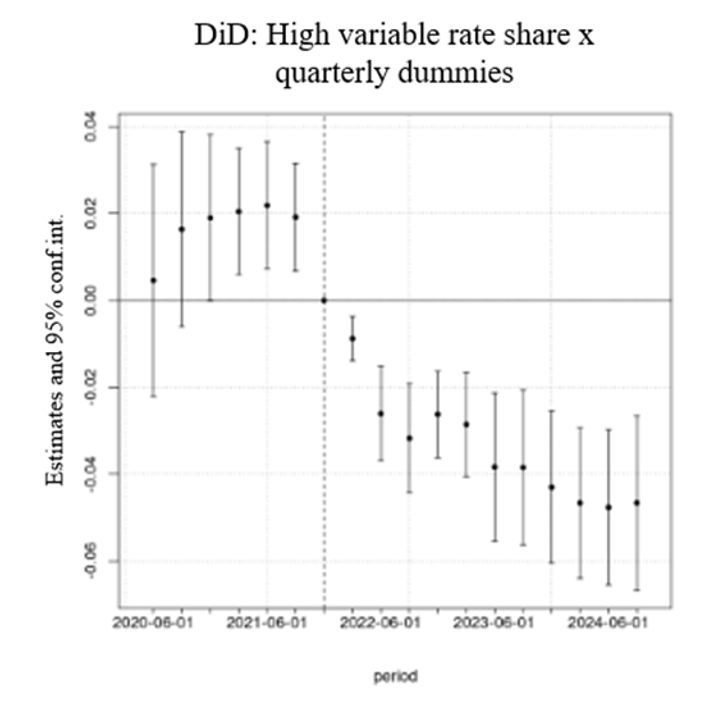
We find clear evidence that floating-rate exposure amplifies the credit demand response to the ECB’s tightening cycle. Firms that entered 2022 with a high share of floating-rate debt reduced their investment related borrowing by around 4–5% more than otherwise similar firms whose debt was mainly fixed-rate (Figure 1). Importantly, this gap widens over time, consistent with a gradual pass-through of monetary policy and the progressive repricing of loan stocks during 2022–2024.
Figure 1. Quarterly difference-in-differences parameter estimates and their confidence intervals
The response is markedly stronger among micro and small firms. By 2024, investment borrowing by smaller firms with high floating-rate exposure is about 7.5–11% lower relative to comparable larger firms with similar exposure. This size gradient is consistent with the idea that financial constraints matter: when debt-service costs on existing loans rise quickly, smaller firms — typically with thinner liquidity buffers and fewer outside financing options — adjust more forcefully by cutting borrowing for investment.
These patterns are not driven by a single country, sector, or banking-group episode: they remain when we account for country and industry developments and for time varying bank factors. While our analysis cannot rule out all supply side channels, the evidence is consistent with a borrower side mechanism in which higher interest expenses on existing debt compress cash flows and lower the willingness (and sometimes the ability) to take additional loans.
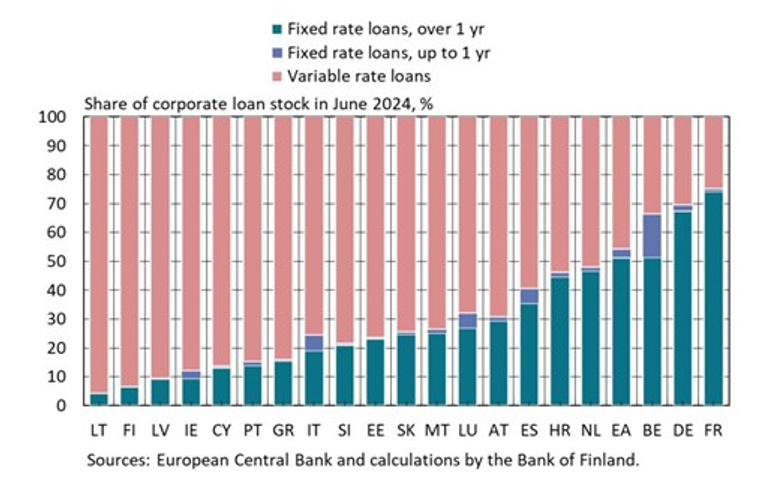
A distinctive feature of the euro area is the large — and persistent — cross country variation in interest-rate fixation (Figure 2). In some countries (e.g., France and Germany), floating-rate corporate loans represent only about a quarter to a third of the loan stock, whereas in others (e.g., Finland and the Baltics) they exceed 90%. The variation is not well explained by short-term economic conditions and changes only slowly over time, suggesting an important role for institutional arrangements, banks’ and firms’ long-standing preferences, and market conventions (including the typical reference rate maturity used for floating-rate contracts). This matters for policy transmission: when floating-rate contracts dominate, increases in policy rates pass through quickly into firms’ interest expenses on outstanding debt, so a common policy move can affect corporate cash flows and investment incentives at very different speeds across member countries.
Figure 2. Composition of interest rate fixation in the euro area
Floating-rate loans link borrowers’ interest expenses to short-term rates. When policy rates rise quickly, interest payments on outstanding floating-rate loans adjust at the contract’s reset frequency (often monthly or quarterly), increasing debt-service costs without any new borrowing. For firms that finance investment with bank credit, higher interest expenses can reduce internal funds and increase perceived risk — both of which tend to curb investment and the demand for additional loans. The mechanism is likely to be stronger for smaller firms that rely on bank funding and have less scope to substitute towards capital markets or to hedge interest-rate risk.
First, our results imply that the speed and strength of monetary transmission depend not only on banks’ pricing of new loans but also on the contract structure of the existing corporate debt stock. In economies where floating rate loans dominate, a rapid hiking cycle can reprice corporate cash flow quickly, leading to an earlier and stronger pullback in investment borrowing. This can help explain why investment and credit aggregates may cool off faster in some euro area countries than in others after a common policy move. In addition, changes in the aggregate share of floating-rate debt at the euro area level can influence the overall effectiveness of monetary policy.
Second, because floating-rate prevalence differs so widely across countries and sectors, a uniform change in policy rates can produce uneven outcomes and widen dispersion within the monetary union. This argues for routinely monitoring the share of floating-rate corporate debt (and its concentration in vulnerable firm segments) as part of the toolkit for assessing the transmission of monetary policy across countries and over time, especially after large, unexpected rate moves.
Third, the floating-rate channel has a financial stability dimension. When rate hikes simultaneously reduce loan demand and weaken repayment capacity among highly exposed and financially constrained firms, banks may face both slower loan growth and higher credit risk. This highlights the value of linking information on interest-rate fixation to indicators of borrower vulnerability when monitoring credit conditions and bank resilience during tightening phases.
Overall, our euro area evidence suggests that the contract structure of corporate debt is an important—and measurable—source of cross-country heterogeneity in monetary transmission. Making floating-rate exposure more visible in regular monitoring can help policymakers and supervisors better anticipate where tightening will bite first, and where risks to investment and credit quality may be concentrated.