

This policy brief is based on Sveriges Riksbank Working Paper Series 464. The views expressed are those of the author and not necessarily those of Sveriges Riksbank.
Abstract
A common premise in policy debates is that households with little liquidity are weakly self-insured: they have few financial buffers against income fluctuations and therefore spend most of an income gain. Affluent households, by contrast, are typically viewed as well-insured and expected to save most of any additional income. Under this view, fiscal stimulus is most effective when targeted toward low-income or low-wealth households. Such transfers both raise aggregate demand and provide public insurance to households whose private self-insurance is limited. This brief argues that this mapping is incomplete. Household self-insurance operates through two margins: a liquidity margin, linked to current resources, and an intertemporal margin, linked to desired savings. When saving motives and the capacity to accumulate wealth do not move together, liquidity can fail to predict spending responses. In particular, some affluent households can react strongly to income shocks because their desired savings are lower, while some poorer households may react less because stronger precautionary motives make them preserve resources for the future. Evidence from Italian household data and a quantitative incomplete-markets model supports this mechanism. The implication is simple but important: wealth and liquidity are useful, but not sufficient statistics for understanding the transmission of income shocks.
A central question for macroeconomic policy is how households adjust spending when their income changes. The answer matters for the impact of tax rebates, transfers, wage changes, and interest-rate movements that affect disposable income or cash flow. A common shortcut is to rank households by liquidity or wealth. Households with low liquid resources are expected to spend a large share of additional income; households with high resources are expected to save most of it.
This shortcut is intuitive and often useful. Liquidity gives households the ability to smooth consumption over time. But this shortcut also hides a second, forward-looking margin. Households differ not only in how much they have saved, but also in how much they want or need to save. In fact, a household with substantial resources but a low desired buffer may spend more out of an income gain than a household with fewer resources but a strong motive to preserve savings.
The brief is based on Savoia (2026), which studies consumption behavior when saving motives differ across households because of preferences or exposure to future income risk. The main message is that liquidity can fail as a sufficient statistic for marginal spending responses.
Household self-insurance is usually associated with current resources: a household with more cash-on-hand — current income plus accumulated liquid savings — can better absorb shocks and should therefore be less responsive to temporary income changes. This is the liquidity margin.
The paper highlights a second margin: intertemporal self-insurance. Households also choose how much to tilt consumption toward the future. Stronger saving motives raise desired savings and make households preserve resources more aggressively. This lowers the share of an income gain that is spent today, independently of current cash-on-hand.
In standard incomplete-market models, these two margins typically move together. Households with stronger saving motives accumulate more savings, so high cash-on-hand and low spending responses appear to be two sides of the same coin. This mapping breaks down when saving motives and saving capacity are negatively related.
For example, households facing higher income risk may want to save more to insure themselves against future income fluctuations. But the same households may also have lower incomes, which limits their ability to accumulate the savings buffers they would like to hold. In this case, low observed savings do not necessarily mean weak self-insurance, and high observed cash-on-hand does not necessarily imply a low spending response.
The key distinction is between liquidity insurance and intertemporal insurance. Liquidity insurance comes from having resources available today. Intertemporal insurance comes from how strongly households try to keep current and future consumption balanced. Unless a household is exactly at the borrowing constraint, a high-risk household may be more intertemporally insured even with low current resources, because it behaves as if preserving future consumption is especially important. This stronger concern for smoothing current and future consumption reduces its response to income shocks.
By contrast, an affluent household facing lower income risk may have more liquidity insurance today, but weaker intertemporal insurance. Since it is less concerned about protecting future consumption, it may be more willing to spend an additional euro of income. This is why households with relatively high cash-on-hand can sometimes display stronger spending responses than households with lower savings but stronger self-insurance motives.
The mechanism is not limited to income risk. The same logic can apply to preference heterogeneity. Some households may have stronger saving motives because they are more patient or more risk averse but still have a limited ability to accumulate liquid savings because of low income, high committed expenses, or other constraints on saving capacity. In such cases, observed cash-on-hand again mixes two different forces: how much households would like to save and how much they are actually able to save. The paper focuses mainly on income level- income risk heterogeneity because such a covariance it provides a measurable empirical application, but the underlying mechanism is broader.
The empirical application uses the Bank of Italy’s Survey of Household Income and Wealth, which jointly records income, consumption and wealth. Again, the evidence is organized around income-risk heterogeneity because income risk is a measurable source of precautionary saving and income is a key determinant of the capacity to accumulate assets.
The data show a pattern that is difficult to summarize with liquidity alone. Income risk is persistent and negatively related to income, savings and cash-on-hand. High-risk households have lower resources, but they also display evidence of stronger precautionary motives: their consumption path is tilted more toward the future. Consistent with the intertemporal self-insurance channel, they exhibit lower marginal spending responses despite having less liquidity.
Figure 1. Spending responses by income risk and cash-on-hand.
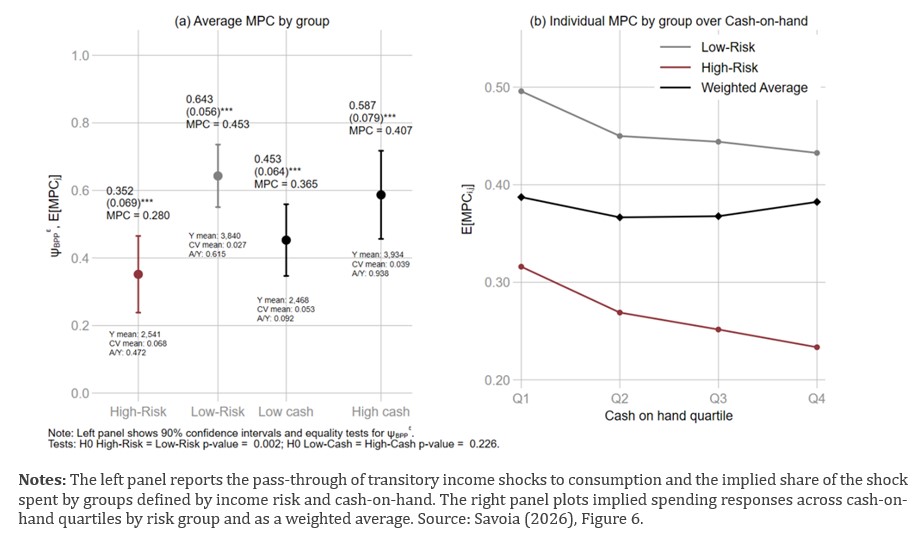
Figure 1 summarizes the main empirical finding. The left panel compares spending responses across groups. Low-risk households have a higher response than high-risk households, even though they are more affluent on average. The right panel shows that, within each risk group, spending responses decline with cash-on-hand. Yet the aggregate profile is almost flat because low-risk, higher-response households are more common in the upper cash-on-hand quartiles. This is a composition effect: the cross-sectional relationship between liquidity and spending responses is shaped by the sorting of household types along the cash-on-hand distribution. Households located at the top may have stronger liquidity insurance because they hold more liquid resources, but weaker intertemporal insurance because their desired savings are lower. As a result, they can display higher marginal consumption responses than households with lower cash-on-hand but stronger saving motives.
The mechanism is particularly relevant for policy because affluent households account for a large share of aggregate consumption. If some of these households have sizeable marginal spending responses, they can shape aggregate demand more than standard liquidity-based classifications would suggest.
This does not mean that affluent households always have high spending responses, nor that liquidity constraints are unimportant. The point is more precise: the same level of liquid resources can imply different spending behavior depending on desired savings. Conversely, households with different liquidity positions can have similar spending responses because the composition of household types changes along the resource distribution.
This distinction helps rationalize why empirical studies often find substantial unexplained heterogeneity in spending responses after controlling for asset holdings. Unobserved saving motives can make the observed MPC-resource relationship flat, non-monotonic or sensitive to sample composition.
The paper evaluates the mechanism in a quantitative incomplete-markets model with two permanent household types: high-risk with low permanent income and low-risk with high permanent income. The calibration matches group-specific liquid-asset-to-income ratios and reproduces the observed degree of liquid-wealth inequality. This discipline is important because it limits the extent to which the results can be attributed mechanically to differences in resources.
Figure 2. Model validation: spending responses and wealth inequality
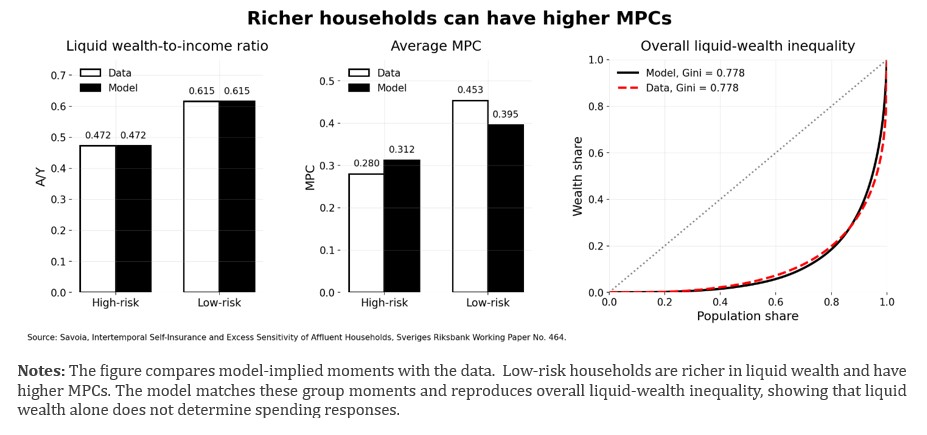
The model reproduces the key empirical ranking: low-risk high-income households are wealthier and have higher spending responses, while high-risk low-income households are poorer but have lower responses. It also generates a broadly flat aggregate spending-response profile across cash-on-hand quartiles. Figure 2 compares the model and data.
For fiscal policy, the results caution against targeting or forecasting spending responses using liquidity alone. Transfers or tax rebates may have effects that depend not only on recipients’ current balance sheets, but also on their saving motives and expectations about future income. These motives are difficult for governments to observe, creating an important information friction in the design of stimulus programmes.
A low-liquidity household may save a transfer if it is trying to rebuild a desired buffer. An affluent household may spend a relatively large share if it is already close to, or above, its desired savings target. This logic can alter the interpretation of estimated fiscal multipliers and the design of policies aimed at stimulating aggregate demand.
The lesson is not that transfers to affluent households are generally more effective. Rather, it is that the distribution of spending responses is partly shaped by unobserved intertemporal motives. Policies evaluated only through wealth bins can therefore miss important heterogeneity within and across those bins.
For monetary policy, the findings matter because heterogeneous-agent models often transmit shocks through household balance sheets. If the cross-sectional distribution of marginal spending responses is inferred mainly from liquidity, the transmission of interest-rate and income shocks may be mismeasured.
The mechanism also has implications for HANK models. Within each household type, spending responses still decline with resources, as standard concavity implies. But the aggregate profile can look flat or even increasing because high-response types sort into higher resource bins. This is a Simpson’s-paradox logic: the within-type relationship and the aggregate relationship need not have the same sign.
A richer representation of household types, including saving motives and risk exposure, can therefore improve the mapping from micro data to aggregate demand dynamics.
Liquidity remains central for understanding household consumption, but it is not the whole story. Households also self-insure intertemporally by choosing desired savings. When desired savings differ across households, and when the ability to reach those targets differs as well, liquidity can fail to predict who spends after an income shock.
The policy implication is that household’s balance sheets should be read together with the motives behind them. Some affluent households may respond strongly to income shocks, while some lower-resource households may respond less because they are trying to insure future consumption. Accounting for this hidden heterogeneity
Savoia, E. (2026). Intertemporal Self-insurance and Excess Sensitivity of Affluent Households. Sveriges Riksbank Working Paper Series No. 464.