

This policy brief is based on de Leeuw, T. and K.M. Wacker (2026): “How does FDI transmit into domestic investment? Exploring intra-industry and financial channels.” Journal of Comparative Economics: in press. The views expressed are those of the authors and not necessarily those of the institutions the authors are affiliated with.
Abstract
Foreign direct investment (FDI) should in principle boost domestic investment in recipient countries and thereby foster capital accumulation. But the evidence for such a positive investment effect of FDI is inconclusive. A possible reason is that FDI is often directed towards banks and other financial firms that do not physically invest much by themselves. In new research, we show how such financial FDI can transmit to domestic investment of other industries. We develop novel financial linkage weights and analyse industry-level FDI and investment data from 12 Central and Eastern European countries between 1997 and 2019. Our results show that industries with close links to the financial sector increase domestic investment in the presence of financial FDI, particularly manufacturing, trade and real estate. Additionally, we provide suggestive evidence that this relationship operates through a liquidity channel.
Foreign direct investment (FDI) is a key cross-border capital flow that is widely believed to have positive macroeconomic effects. An example of FDI is when a car manufacturer or microchip producer opens a factory in another country. Such FDI projects often go hand in hand with employment creation and investment in the local economy, which explains why many policymakers are eager to attract FDI to their country.
It is often overlooked that a considerable amount of FDI takes place in the financial sector. Banks, insurance and financial service firms (e.g., fintech or payment processors) are increasingly multinational in nature. Many of them have established a strong affiliate presence in Central and Eastern European (CEE) economies. This is visible from the blue bar of Figure 1: FDI flows amount to more than a third of value added in the financial sector. Even though these countries are tightly integrated into global value chains of many manufacturing industries, FDI to value added is much lower in the manufacturing sector.
Figure 1. Industry-level FDI inflows and domestic investment (% of value added)
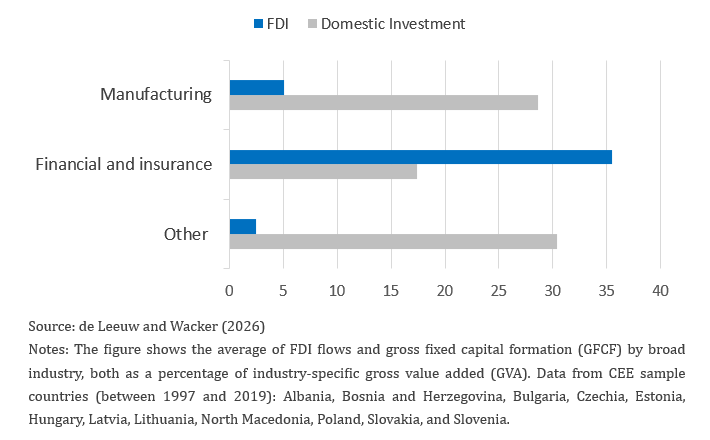
It is critical to understand how financial-sector FDI transmits into other industries because financial corporations rarely perform real activities themselves. This is also visible from Figure 1: domestic investment (GFCF) ratios for the financial sector are only half of what they are in the rest of the economy. But financial-sector FDI likely spills over into other industries of the economy, where it results in investment and employment creation. However, it cannot readily be tracked how financial FDI works its way through the host economy. It is not straightforward to understand the linkages between financial FDI and the investment patterns of non-financial industries.
We develop a methodology to link financial FDI to non-financial industries in a newly published paper (de Leeuw and Wacker, 2026) and study its effect on domestic investment using data from 12 CEE economies between 1997 and 2019. Our results highlight that financial-sector FDI plays a decisive role for investment and capital accumulation in the host economy and that this effect is mainly driven by a liquidity channel.
Financial FDI can only raise investment in other industries if those industries can absorb and use the extra finance. Two forces determine this absorption. First, an industry’s dependence on external finance (the extent to which firms rely on bank loans, trade credit, or other intermediated funding). This aspect shapes how responsive investment will be when credit becomes more available. Industries with a high dependence on external finance (for example, real estate or capital‑intensive manufacturing) are more likely to invest in capital goods when banks expand lending. Second, an industry’s economic scale (its share of value added in the economy) determines how much of a country‑level inflow it can plausibly absorb: a large but moderately credit‑dependent industry may absorb more newly available funds than a tiny, highly dependent niche. Both forces are captured in the “financial linkage weights” we construct for our research. Without such weights, a country‑level measure of financial FDI cannot tell us which industries will actually see investment responses.
Our financial linkage weights reflect where credit is demanded and where it can be absorbed. These weights therefore act as a bridge: they translate a country-wide inflow of financial FDI into industry‑level exposure by combining (i) how much each industry typically draws on financial intermediation and (ii) how large each industry is. Read this way, the weights are not direct measures of post‑inflow loan flows but indicators of where additional credit is most likely to be channelled and thus where investment effects should appear.
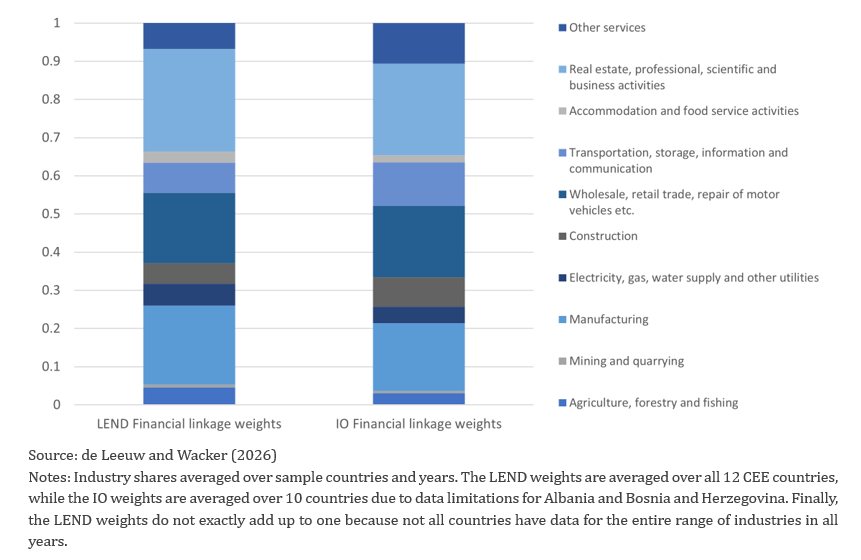
We propose two complementary sets of financial linkage-weights that operationalise this bridge. LEND is loan‑based: it assigns larger weights to industries that account for bigger shares of the stock of commercial bank loans to non‑financial firms, so it directly reflects the existing distribution of bank credit across sectors. IO is input‑output based: using input‑output tables (WIOD and additional supply‑use tables), IO records each industry’s share of domestic financial‑service inputs. IO therefore captures the intensity with which industries consume financial services in production and is a natural proxy for their reliance on financial intermediation even when direct loan data is unavailable. Both measures show broadly similar sectoral patterns (see Figure 2), despite differences in coverage. This strengthens confidence that both linkage weights capture the same underlying concept: where financial FDI is most likely to translate into real investment.
Figure 2. Average shares of financial linkage weights across industries
Financial‑sector FDI does not raise investment uniformly across industries. At the country level, treating financial FDI as a single national shock hides industry-level variation: on its own, financial‑sector FDI is not associated with higher investment across all non‑financial industries.
Allocating financial FDI inflow by financial linkages reveals clear heterogeneity. When we distribute the country‑level financial FDI to industries using our financial linkage weights, a consistent pattern appears: industries with stronger ties to the financial sector increase investment when financial FDI rises, while weakly linked industries do not. Our interaction coefficient between country‑level financial FDI and industry linkage weights is positive and statistically significant in most specifications, showing that the investment response depends on an industry’s link to the financial sector.
Real estate and business services, manufacturing and trade benefit most. These industries experience the largest and most robust investment increases in the presence of financial FDI inflows. In our preferred specification, a one‑standard‑deviation rise in financial FDI is associated with about 1.14 percentage points higher investment in real estate and business services and about 0.64 percentage points higher investment in manufacturing. Although these industry effects are economically relevant, they are modest relative to typical investment levels; substantial financial FDI inflows or very strong financial linkages are therefore needed to generate large changes in industries’ investment.
Overall, the impact of financial FDI hence depends on an economy’s industrial structure. Financial FDI matters for capital formation, but its effect is channelled through financial linkages: it raises investment primarily in industries that rely on external finance and/or are large enough to absorb additional credit.
Two channels can link financial FDI to higher domestic investment. Under the liquidity channel, foreign financial inflows bring new funds that local banks and intermediaries can lend out. Through this channel, firms facing credit constraints obtain better access to loans and can invest in the short‑term. This effect is tied to flows. Under the financial productivity channel, foreign firms transfer potentially superior screening, risk management and networks to their affiliates, which raises the productivity of the domestic financial sector. This effect accumulates over time and is tied to the stock of foreign presence.
Our analysis points to the liquidity channel as the main source. We find that investment responses are concentrated in the years of inflows; replacing flows with stocks removes our effect of financial FDI on investment. Moreover, measures of bank efficiency and value added per worker in the financial sector do not improve after an inflow of financial FDI, whilst aggregate credit in the host economy does appear to increase. Together, these patterns indicate that FDI flowing into the financial sector mainly boosts domestic investment by adding funds that are quickly intermediated into loans, rather than by permanently improving financial‑sector productivity.
If policy aims to raise domestic investment through FDI attraction, our research suggests that the following aspects should be considered:
Our final recommendation is to improve data and diagnostics on industry‑level finance, including industry‑level financial accounts. Better data will sharpen policy targeting, improve forecasting of where inflows will land, and enable more effective monitoring of the real effects of inflowing financial FDI.
de Leeuw, T. and K.M. Wacker (2026): “How does FDI transmit into domestic investment? Exploring intra-industry and financial channels.” Journal of Comparative Economics: in press.