This policy brief is based on ECB Working Paper Series, No 3107. The views expressed are those of the authors and do not necessarily reflect those of the Central Bank of Ireland or the Eurosystem, the IMF, its Executive Board or management.
Abstract
How much firms’ heterogeneity matters for macroeconomic fluctuations depends not only on firms’ individual responses, but also on how these responses correlate with their aggregate weights in the economy. Using U.S. nonfinancial firm-level data from 1990 to 2019 and a modern machine-learning approach, we document that firms contributing more to aggregate activity systematically respond less in their sales, investment, and debt issuance to business cycle fluctuations. This asymmetry means that firm heterogeneity tends to dampen real fluctuations over the business cycle. The implication is that the effectiveness of macroeconomic policy depends on the underlying distribution of firm characteristics and weights, which differs across economies and evolves gradually over time.
Macroeconomic models usually assume that the average elasticity across firms adequately captures the overall aggregate effects. Yet the U.S. economy is dominated by a relatively small set of firms with large aggregate shares. If these firms react differently from the average, aggregate responses may diverge substantially from those implied by a representative-firm model. This issue is not merely theoretical: it affects how policymakers interpret market movements and how they design complementary tools to reach smaller but more responsive firms.
We present a bottom-up aggregation theory of firm-level sensitivities. The aggregate response of any outcome variable to aggregate fluctuations can be decomposed into two components: the unweighted average firm’s response and a covariance term that captures whether firms with greater aggregate weights are systematically more or less sensitive to those fluctuations. The covariance term therefore indicates whether heterogeneity dampens or amplifies aggregate dynamics.
Firms’ shares in aggregate outcomes can be directly constructed from a panel of firm-level data, whereas firms’ sensitivities to aggregate fluctuations must be estimated. We employ the Generalized Random Forests (GRF) by Athey et al. (2019)—a nonparametric method—to estimate how each firm’s sales, investment, debt issuance respond to business-cycle fluctuations. The GRF allows us to estimate firms’ micro-sensitivities to aggregate fluctuations as a function of a high-dimensional space of characteristics, such as leverage, liquidity, distance-to-default, industry scope, and scale, without imposing any ex-ante functional form.
We use quarterly data from Compustat covering U.S. nonfinancial firms from 1990 to 2019. We study the responses of three main outcome variables: sales, investment, and debt issuance. Firm characteristics include leverage, liquidity, distance to default, share of short-term debt, size, return on assets, sales volatility, and industry scope. Our main analysis focuses on business-cycle fluctuations measured by real GDP growth and, as robustness, we extend the analysis to exogenously identified shocks to monetary policy and oil price and to financial outcomes such as market value.
Our analysis yields two main insights.
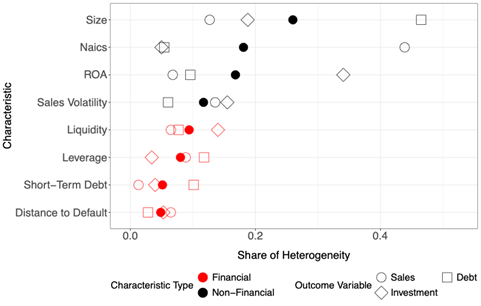
First, firms’ non-financial characteristics like size and industry scope are by far more important to understand differences in firm-level sensitivities in sales, investment and debt issuance over the cycle, in line with Crouzet and Mehrotra (2020). Firms’ characteristics often shape sensitivities in ways that cannot be captured by a linear model. For example, liquidity and distance-to-default display clear non-linear patterns: firms that are very safe or very risky respond less than those in the middle of the distribution. Interactions across characteristics explain a sizable share of the variation in sensitivities, underlining the value of machine-learning tools. Figure 1 summarizes which characteristic matters most for the heterogeneity in firm response across outcomes.
Figure 1. Drivers of heterogeneity.
Characteristics importance by outcome for business cycle fluctuations.
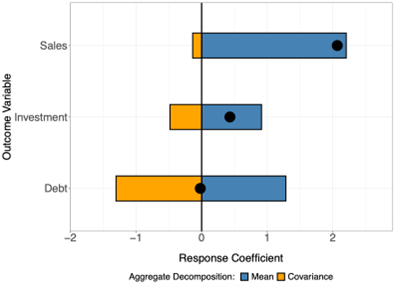
Second, heterogeneity in sensitivities consistently dampens aggregate fluctuations in sales, investment, and debt issuance over the cycle. Figure 2 illustrates the mean–covariance decomposition for each outcome. During booms, sales rise, firms issue more debt, and finance new investment. However, firms with greater aggregate weights tend to be less sensitive to business-cycle fluctuations, as captured by the covariance term. Specifically, aggregate responses in sales and investment over the cycle are reduced by about 6 and 53 percent, respectively, while the response of debt issuance is fully offset on average. The modest dampening in sales reflects that larger firms— which account for most output—are only slightly less cyclical, leaving the covariance term relatively small. Similar patterns emerge when examining responses to individual shocks, particularly the investment response to monetary-policy shocks. By contrast, stock-market valuations behave differently: firms with greater market shares exhibit stronger sensitivity in their stock-market valuations to both the business cycle and monetary-policy shocks.
Figure 2. Aggregate response decomposition by outcome over the business cycle.
Bars show mean (unweighted) vs covariance contributions.
Our results call for closer monitoring of the distribution of firm characteristics. Macroeconomic multipliers should be adjusted for the distribution of firm-level sensitivities, rather than taken from average responses alone. Complementary instruments—such as credit supply measures targeted at smaller, more sensitive firms—could potentially also help restore balance when the policy objective is to influence aggregate outcomes more directly.
Firm heterogeneity acts as a stabilizer for real activity in the United States. Our findings underscore that the distribution of firm characteristics is a central determinant of how effectively macroeconomic stabilization operate. Differences in firm size, financial structure, and sectoral structure shape both the strength and the symmetry of business cycle fluctuations. Looking ahead, extending this framework across countries and embedding international production and financial linkages would offer valuable insights into how heterogeneous firm responses influence the global propagation of economic shocks.