

This policy brief is based on Kirschenmann, K. and Knebel-Seitz, C. (2025). To Release or Not to Release? Preferences for Home Equity Products in Retirement. ZEW Discussion Paper Nr. 25-069, Mannheim. The views expressed are those of the authors and not necessarily those of the institutions the authors are affiliated with.
Abstract
Population ageing and growing pressure on retirement systems are increasing interest in housing wealth as a potential source of retirement financing. Home equity release products, such as home annuities and reverse mortgages, could help older households unlock housing wealth while continuing to live in their homes. Yet little is known about how consumers evaluate these products. Using evidence from a survey experiment, we study preferences for different home equity release options and the choice not to use any financial product. We find that the majority of participants prefer not to release housing wealth. Among those choosing an equity release product, home annuities are preferred over reverse mortgages. The way the options are presented does not significantly affect product choices. Instead, decisions are mainly driven by individual characteristics, particularly risk tolerance, bequest motives, and financial literacy. The findings highlight the importance of financial education, transparent product design, and consumer protection in supporting informed retirement decisions.
Population ageing is increasing pressure on retirement systems across Europe and raising concerns about the financial well-being of older households. In this context, housing wealth has become an increasingly important component of retirement provision. While owning a home can reduce housing expenses in old age, retirees may still seek additional income while wishing to remain in their homes. Home equity release products, such as home annuities and reverse mortgages, are designed to help older homeowners access part of the wealth tied up in their property without having to move. However, converting housing wealth into retirement income is a complex financial decision, and demand for such products is limited in many countries.
The market for home equity release products in Germany is still very small and only slowly developing. Home annuities and reverse mortgages were introduced in the 2000s, but uptake has been very limited, and several providers have exited the market due to weak demand. By 2020, only a small number of contracts had been concluded (e.g., Ben-Shlomo, 2015; Bartsch et al., 2021). More recently, new products such as partial home sales and arrangements allowing homeowners to sell their property while retaining lifelong occupancy have emerged. Compared with other countries, Germany still lacks a clear regulatory framework and public support schemes.
In contrast, home equity release products are more established in the United States, the United Kingdom, and Australia, although take-up remains limited overall (e.g., Mayer and Moulton, 2022; Hanewald and Bateman, 2024). The U.S. market is the largest and is supported by a government-backed insurance scheme that protects lenders, yet only a small share of older homeowners participates. The U.K. relies on private providers but has a strong regulatory framework with consumer safeguards, which has supported market growth. Australia combines public and private options, including a government-supported scheme that allows retirees to access housing wealth while remaining in their homes. Overall, these countries show that clear rules and consumer protections can support market development, but demand remains modest even in more mature systems.
To better understand consumer demand for equity release products, we conducted an online survey experiment with a representative sample of the German population aged 30 and older.
Participants are introduced to two home equity release products and the option to choose no financial product. In the home annuity option, homeowners sell their property in exchange for lifelong monthly payments while continuing to live in the home for the rest of their lives. The provider takes over maintenance costs, but the property usually does not remain with the heirs. With the reverse mortgage option, homeowners keep ownership of their home but receive regular payments based on the value of the property. The loan is repaid when the home is sold after death or moving out, while heirs may keep the property by repaying the loan. Under the opt-out option, homeowners continue living in their home without using housing wealth for additional income. The property remains fully available to pass on to heirs or to finance possible future care costs.
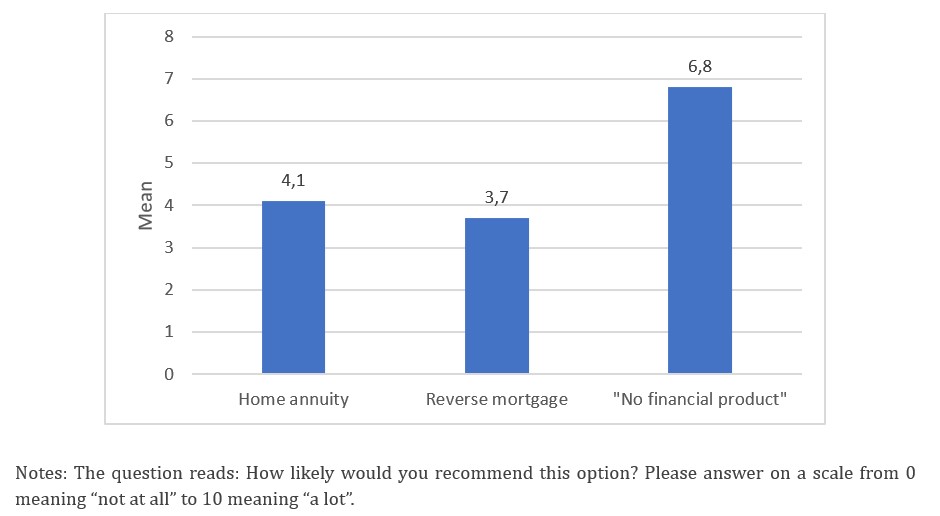
Participants were presented with a hypothetical scenario involving a retired couple living in a fully paid-off home. They were asked to advise the couple on how to use their housing wealth during retirement. In a first step, participants were asked to provide a general recommendation for each of the three options individually. Figure 1 presents the results. The most popular choice is not to use any financial product. It has a mean score of 6.8 on a scale from 0 meaning “not recommend at all” to 10 meaning “recommend a lot”. Among the equity release options, home annuities are slightly more attractive than reverse mortgages.
Figure 1. Average recommendation score
In a second step, participants were asked to choose one option for the retired couple. Figure 2 presents the results for the full sample in the hatched bars. The majority of participants (62.8%) selected the option not to use any financial product, while 24.9% chose the home annuity and 12.3% chose the reverse mortgage. These findings are consistent with the general recommendation in the first step.
The study also examines whether decision-making depends on how the available options are presented. While one group of participants evaluated all options simultaneously, another group made the decision step by step: they first chose between the two financial products and then decided whether they preferred this product or no financial product at all.
The findings provide no evidence that presentation format significantly affects final product choices. Instead, personal characteristics play a more important role.
Because the scenario presented to participants included only basic information about a retired couple, such as their age, home value, and pension income, we can assess which product features and individual characteristics drive product demand. Factors such as attitudes toward risk, inheritance motives, or additional savings were intentionally left open so that participants could relate the situation to their own views and experiences.
The results show that people are more likely to support home equity release products if they are comfortable taking financial risks, own a home themselves, or trust financial institutions. By contrast, people with higher incomes, greater financial knowledge, investment experience, strong wishes to leave an inheritance, or positive expectations about their future health are more likely to prefer not using such products.
Figure 2. Final product choice by level of financial literacy
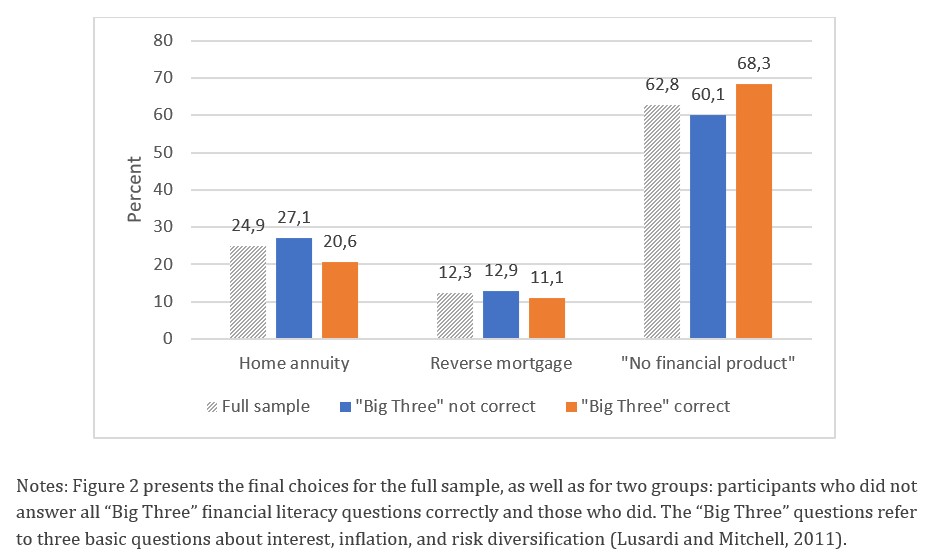
The results regarding financial knowledge are shown in Figure 2. They might be surprising at first glance. Because home equity release products are complex, one might expect that people with lower financial knowledge would avoid them. However, our results show the opposite: participants with lower financial literacy are less likely to advise against using any product and are more likely to choose a home equity release option.
One possible explanation is that financially literate households may engage more in retirement planning and therefore rely less on housing wealth decumulation (e.g., Lusardi and Mitchell, 2007; Fornero et al., 2016).
The findings highlight several important implications for policymakers and financial institutions. As European societies continue to age, housing wealth is likely to become an increasingly important source of retirement financing. At the same time, the low demand for existing home equity release products suggests that substantial barriers to market participation remain. However, low demand may also reflect genuine household preferences, including strong bequest motives and reluctance to borrow against housing wealth in old age.
One important challenge is the complexity of these products. Many households may struggle to fully understand the long-term financial consequences of home equity release decisions. Improving financial literacy and strengthening retirement planning education could therefore help consumers make more informed choices. Clear, simple, and transparent product designs may also help increase consumer trust and market acceptance, particularly among less financially literate households.
Compared with countries such as the United States, the United Kingdom, and Australia, Germany still lacks a clear regulatory framework for home equity release products. Providers have identified legal uncertainty as an important obstacle to market development. A clearer regulatory framework could improve consumer confidence while reducing legal uncertainty for providers.
Bartsch, F., Buhlmann, F., Kirschenmann, K. and Schmidt, C. (2021) ‘Is there a need for reverse mortgages in Germany? Empirical evidence and policy implications’, EconPol Policy Report, 31.
Ben-Shlomo, J. (2015) Reverse Mortgage – Ein integrativer Ansatz zur Erklärung der Nachfrage nach Umkehrhypotheken. Albert-Ludwigs-Universität Freiburg.
Fornero, E., Rossi, M. and Urzí Brancati, M.C. (2016) ‘Explaining why, right or wrong, (Italian) households do not like reverse mortgages’, Journal of Pension Economics and Finance, 15(2), pp. 180–202. Available at: https://doi.org/10.1017/S1474747215000013.
Hanewald, K. and Bateman, H. (2024) ‘Home equity release in retirement: The role of behavioural factors, aged care and bequests’, ARC Centre of Excellence in Population Ageing, Research Working Paper 2024/11.
Lusardi, A. and Mitchell, O.S. (2007) ‘Baby Boomer retirement security: The roles of planning, financial literacy, and housing wealth’, Journal of Monetary Economics, 54(1), pp. 205–224. Available at: https://doi.org/10.1016/j.jmoneco.2006.12.001.
Lusardi, A. and Mitchell, O.S. (2011) ‘Financial Literacy and Planning: Implications for Retirement Wellbeing’, In: Olivia S. Mitchell and Annamaria Lusardi (Hrsg.), Financial Literacy: Implications for Retirement Security and the Financial Marketplace. Oxford: Oxford University Press, pp. 17–49.
Mayer, C. and Moulton, S. (2022) ‘The market for reverse mortgages among older Americans’, in New Models for Managing Longevity Risk. Edited by Olivia S. Mitchell, Oxford University Press. Available at: DOI: 10.1093/oso/9780192859808.003.0013.