

This policy brief is based on Banco de España Working Paper No. 2549. The views expressed are those of the authors and not necessarily those of the institutions the authors are affiliated with.
Abstract
Latin America’s main obstacles to sustained economic growth stem from institutional weaknesses and volatile economic‑policy frameworks, which create uncertainty about policy direction. Our evidence shows that higher uncertainty in the region reduces GDP growth, discourages capital inflows and contributes to exchange rate instability. This uncertainty also spills across borders: Brazil and Mexico are major sources of regional spillovers, and uncertainty shocks originating in Latin America affect financial and real variables in key partner economies, with Spain being particularly exposed.
A core prerequisite for sustained and inclusive growth is the robustness of institutional arrangements across economic, political, and legal domains (Acemoglu, Johnson, and Robinson (2001)). In the same vein a substantial body of research identifies institutional instability and economic policy volatility as key obstacles to development (among others, see Barro (1996), Alesina et al. (1996), Fatás and Mihov (2013), Besley and Mueller (2018), Aromí, Bermúdez, and Dabús (2022), Del Tedesco Lins (2024), Seffino and González (2025)). In this sense, Latin America’s growth has been constrained by institutional instability and volatile economic policies, often shaped by shifting political cycles. Frequent and pronounced policy swings – ranging from market-oriented reforms to interventionist and populist measures – together with corruption, and weak rule of law-, have eroded trust in public institutions. This environment of uncertainty has weighed on productivity, discouraged both domestic and foreign investment, and ultimately limited inclusive and sustainable development.
To quantify the degree of uncertainty in an economy, researchers commonly rely on Economic Policy Uncertainty (EPU). These indices follow the methodology of Baker, Bloom, and Davies (2016), which consists of identifying newspapers articles in which a set of terms co-occur. These terms fall into three categories: those related to the economy (e.g., GDP growth, inflation), those referring to politics and policy-making institutions (e.g., government, parliament), and those explicitly linked to uncertainty (e.g., instability, risks). The index measures how frequently these terms appear in the press at a given point in time, relative to the total number of articles published in that period.
On our recent work (Andres-Escayola et al., 2024) we show that using a wide range of sources – from both local and international news outlet – , is essential for constructing robust and reliable EPU indices. Following these guidelines, we build EPUs for ten Southern Cone countries (Argentina, Bolivia, Brazil, Chile, Colombia, Ecuador, Paraguay, Peru, Uruguay and Venezuela), as well as for Mexico. All indexes are updated monthly and can be downloaded from the Banco de España website and at Economic Policy Uncertainty website. Figure 1 depicts the regional aggregate index for Latin American and highlights major episodes of uncertainty that the aggregate EPU captures well.
Figure 1. Uncertainty events in Latin America according to the EPU index
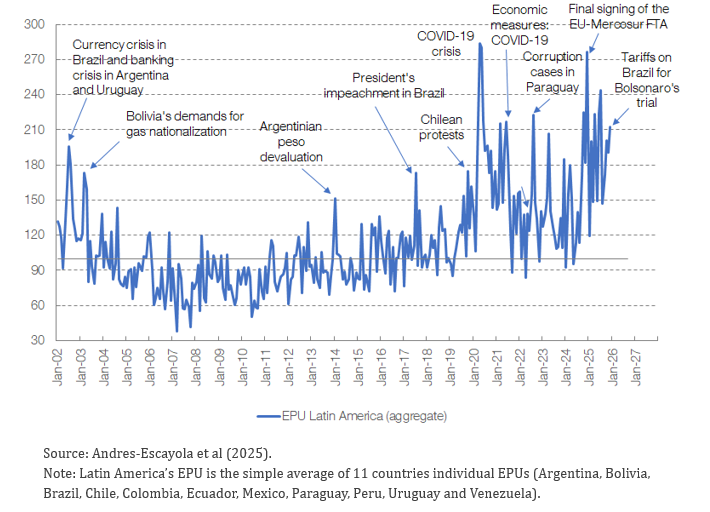
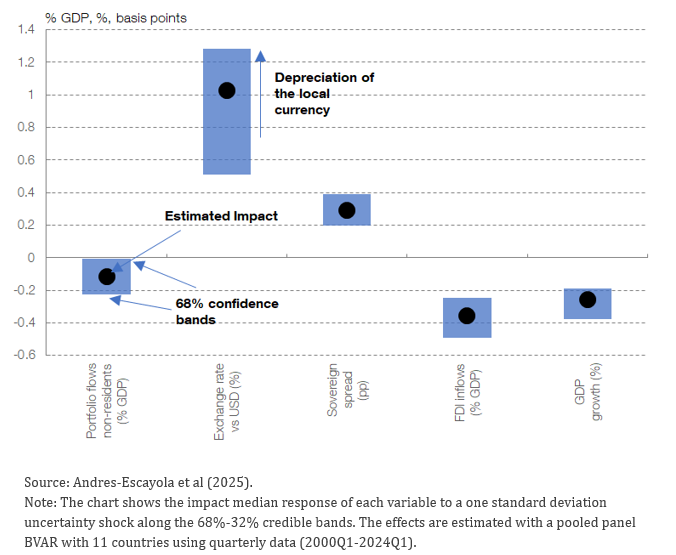
What are the effects of increased uncertainty in the region? Using a panel vector autoregressive model estimated with Bayesian methods, we find that a one standard deviation increases in uncertainty in the representative country –equivalent to a rise of 44 points in the index shown in Figure 1 – triggers significant short-term macro-financial adjustments. Non-resident portfolio capital outflows fall about 0.1 pp of GDP after one year, the exchange rate depreciates sharply against the USD (1 pp on impact), and external financing conditions deteriorate markedly, as reflected in an increase of 30–50 basis points in sovereign spreads after a few quarters. Foreign direct investment also falls on impact, by up to 0.36 pp of GDP. Finally, uncertainty shocks weigh on real activity, reducing GDP growth of up to 0.26 pp on impact (Figure 2).
The underlying mechanism is straightforward: higher instability raises risk aversion among financial markets and foreign investors, prompting a rebalancing away from regional assets. Local currency tends to depreciate, perceptions of sovereign risk increase, and the cost of external financing rises. Taken together, these effects constrain longer-term investment and business decisions, ultimately slowing economic growth.
Figure 2. Response of economic variables to regional uncertainty shocks
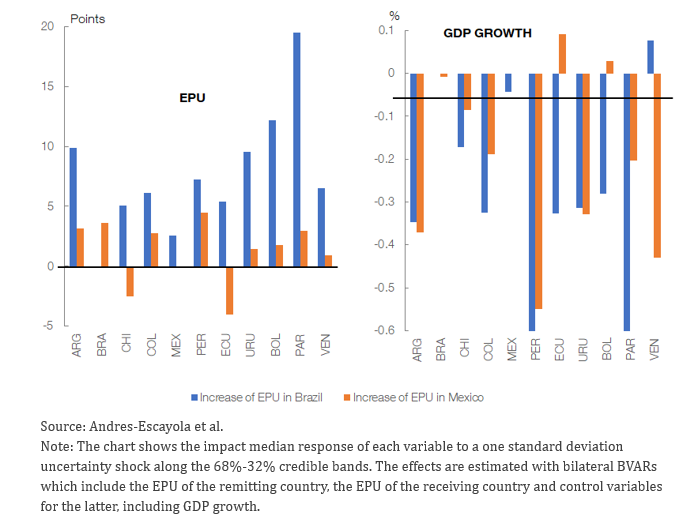
Uncertainty does not stop at national borders; it also propagates across countries. Using two complementary metrics, we find that a substantial share of the variance in a country’s EPU is driven by changes in uncertainty in neighbouring economies. Within the region, Brazil and Mexico stand out as the main sources of uncertainty spillovers (Figure 3, left panel). Moreover, EPU shocks in any given country significantly affect GDP growth beyond its borders (Figure 3, right panel).
Figure 3. Spillovers of uncertainty shocks from Brazil and Mexico on the other economies
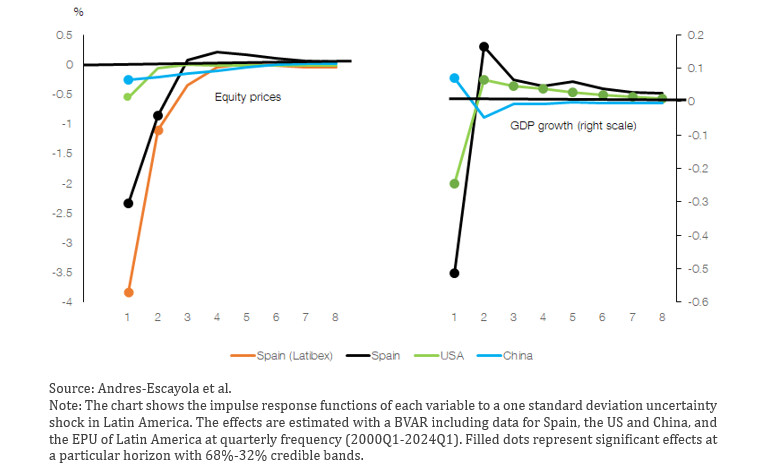
Periods of acute or persistent uncertainty in Latin America affect not only the region’s own economic performance but also have repercussions for countries with strong economic ties to it. Our results show that increases in Latin American uncertainty negatively influence both macroeconomic and financial variables in its main trade and financial partners, with Spain standing out as particularly exposed. A one-standard deviation rise in regional uncertainty prompts a notable sell-off in Spanish equity markets: both the Latibex – the only international market for Latin American securities denominated in euros–, and Spain’s benchmark stock index register significant declines (Figure 4).
The shock also transmits to the real economy. Spanish GDP growth temporarily falls by up to 0.5 pp, and Spanish bank’s claims on Latin American residents’ contract by about 0.11 pp of GDP. Foreign direct investment flows are similarly affected: Spanish FDI in the region decreases by around 0.04 pp of GDP, while Latin American investment into Spain drops by roughly 0.01 pp of GDP.
The region’s two other major economic partners – the United States and China – also experience adverse effects following an increase in Latin American uncertainty, although the magnitude of their responses is noticeably smaller than in Spain’s case.
Figure 4. Spillovers of an uncertainty shock in Latin America on its main trade and financial partners
In an increasingly interconnected global economy, understanding the dynamics of economic policy uncertainty is crucial for effective macroeconomic and financial policymaking. Our evidence shows that uncertainty shocks in Latin America have sizeable domestic effects, slowing GDP growth, discouraging capital inflows, and raising external financing costs. Moreover, EPU does not remain within national borders: uncertainty shocks originating in Brazil and Mexico are key drivers of EPU movements across the rest of Latin America. Spillovers extend even further, with Spain displaying particularly high sensitivity due to its deep financial and investment linkages with the region.
Acemoglu, Daron, Simon Johnson and James A. Robinson. (2001). “The colonial origins of comparative development: An empirical investigation”. American Economic Review, 91(5), pp. 1369-1401. https://doi.org/10.1257/aer.91.5.1369.
Alesina, Alberto, Sule Özler, Nouriel Roubini and Phillip Swagel. (1996). “Political instability and economic growth”. Journal of Economic Growth, 1, pp.189-211. https://doi.org/10.1007/ BF00138862.
Andres-Escayola, Erik, Corinna Ghirelli, Luis Molina, Javier J. Perez and Elena Vidal. (2024a). “Using newspapers for textual indicators: guidance based on Spanish- and Portuguese speaking countries”. Computational Economics, 64, pp. 643-692. https://doi.org/10.1007/ s10614-023-10433-z
Aromí, Daniel, Cecilia Bermúdez and Carlos Dabús. (2022). “Uncertainty and economic growth: evidence from Latin America”. CEPAL Review, 2022(137), pp. 7-21. https://doi. org/10.18356/16840348-2022-137-1
Baker, Scott R., Nicholas Bloom and Steven J. Davis. (2016). “Measuring economic policy uncertainty”. The Quarterly Journal of Economics, 131(4), pp. 1593-1636. https://doi. org/10.1093/qje/qjw024
Barro, Robert. (1996). “Democracy and growth”. Journal of Economic Growth, 1, pp. 1-27.
https:// doi.org/10.1007/BF00163340
Besley, Timothy, and Hannes Mueller. (2018). “Institutions, volatility, and investment”. Journal of the European Economic Association, 16(3), pp. 604-649. https://doi.org/10.1093/jeea/ jvx030
Del Tedesco Lins, Maria Antonieta. (2024). “Chapter 10 – Economic policies amid political instability in Latin America”. In Dimitris Katsikas, Maria Antonieta Del Tedesco Lins and Andrea Ribeiro Hoffmann (eds.), Finance, Growth and Democracy: Connections and Challenges in Europe and Latin America in the Era of Permacrisis: Democracy, Finance, and Growth. Springer, pp. 151-167. https://doi.org/10.1007/978-3-031-68475-3_10
Fatás, Antonio, and Ilian Mihov. (2013). “Policy volatility, institutions, and economic growth”. The Review of Economics and Statistics, 95(2), pp. 362-376. https://doi.org/10.1162/ REST_a_00265
Seffino, Mario, and Germán González. (2025). “Regional institutions, political volatility and their impact on productivity: a Latin American perspective”. International Economics and Economic Policy, 22(34). https://doi.org/10.1007/s10368-025-00663-x.