

This policy brief is based on Banco de Portugal “Trade wars, trade woes? EU export performance in a new age of protectionism“. The views expressed are those of the author and not necessarily those of the institutions the author is affiliated with.
Abstract
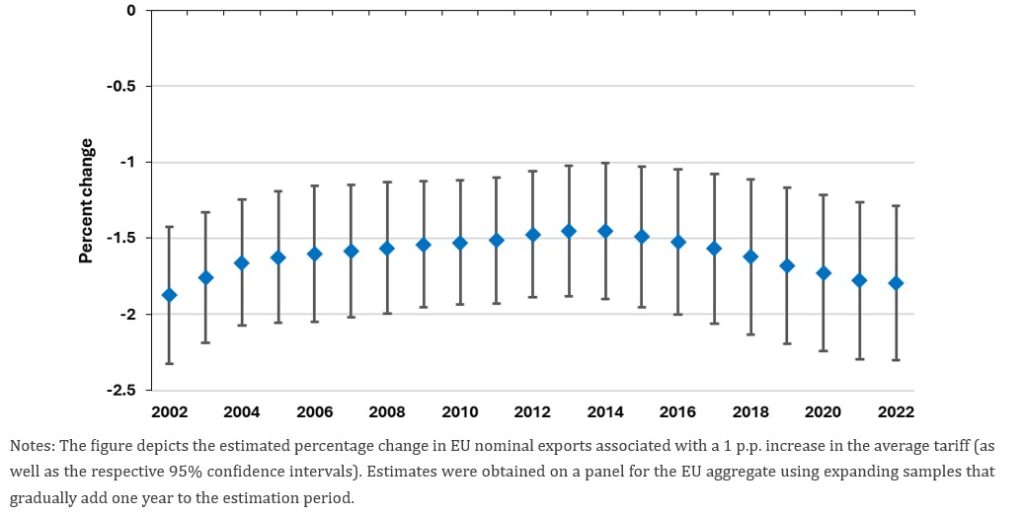
EU exports benefited from two decades of declining tariffs, but that also created a new vulnerability. As the share of exports concentrated in low-tariff product categories rose, exposure to protectionist reversals increased. Using data for 2002–2022, the study underpinning this brief shows that a 1 percentage point increase in the average tariff is associated with a fall in EU nominal exports of about 1.8%. The effect appears stronger for exports to advanced economies and weaker where trade relationships are deeper or products are more differentiated. While the EU remains a highly competitive exporter, its export structure is not immune to renewed trade fragmentation. The findings suggest that preserving openness remains important, but diversification across products and markets also matters.
For much of the last two decades, European exporters broadly operated in an increasingly liberalised international environment created by multilateral arrangements and preferential trade agreements. But that environment has recently become less favourable. Trade tensions, geopolitical rivalry, supply-chain disruptions, and a turn towards economic security have brought tariffs back to the centre of policy debate.
These matters are particularly relevant for the EU because it is deeply integrated into global trade. When tariffs rise, they alter prices, compress margins, disrupt supply chains and weaken incentives to maintain or expand market presence. Against this backdrop, understanding how sensitive EU exports are to tariff changes is essential for assessing Europe’s resilience in a more fragmented global economy. This paper examines this issue on the basis of an empirical gravity model of international trade (Tingergen, 1962 and Anderson, 1979) estimated by Poisson Pseudo-Maximum Likelihood (Santos-Silva and Tenreyro, 2006).
Statutory tariffs on EU exports fell substantially between 2002 and 2022, from 10.6% to 7.5%. When weighted by the composition of the export basket, the average effective tariff also declined but to a smaller degree, from 4.5% to 2.9%. This reflects the fact that, during this period, EU exports increasingly expanded in products and destinations that faced relatively higher tariffs. In other words, the shift in export composition partly offset the relief created by trade policy liberalisation. This evidence shows that actual exposure to trade policy shifts is not solely determined by formal rates, depending also on what and where a country exports. As such, while all EU Member States face the same external tariff schedules abroad, the effective tariff burden differs significantly across countries because their export baskets are different.
The central result of the paper is straightforward and unsurprising: on average, a 1 percentage point increase in the average tariff rate is associated with a decline in EU nominal exports of about 1.8%, most of which reflects lower volumes rather than price adjustments. While the estimates should not be interpreted as causal effects of tariffs, particularly during large-scale trade wars, they nevertheless provide a useful benchmark suggesting that even relatively modest tariff hikes can materially affect export performance.
Importantly, the relationship between tariffs and exports is found to be broadly stable over time. Nonetheless, the point estimates suggest that export sensitivity may have become somewhat stronger in the post-2014 years, a period marked by higher policy uncertainty and renewed protectionism. Another important insight is that the effect is non-linear: the same increase in the tariff rate has a stronger proportional impact when the rate is initially low. With European exports still very concentrated in markets and products where tariffs are small, vulnerability to policy reversals is not negligible.
Figure 1. Sensitivity of EU exports to changes in tariffs in 2002-2022 | percent change
Although the differences across destination groups are not statistically significant, there is some evidence that exports to the EU’s largest trading partners may be less sensitive to tariff changes. One plausible explanation is that long-standing trade relationships, integrated supply chains, and relationship-specific investments make firms more willing to absorb higher trade costs rather than exit those markets following a tariff hike. By contrast, exports to advanced economies appear to be more sensitive to tariffs. These markets are typically more competitive, with a wider range of alternative suppliers, making demand for EU exports more sensitive to changes in tariffs.
Product characteristics matter too. The point estimates suggest that differentiated goods – for which brand, quality, technology or customisation are important – are less sensitive to tariff changes than homogeneous or reference-priced goods. This is consistent with the idea that differentiated goods are less substitutable and trade relies more heavily on established relationships.
Among other factors, Europe’s trade performance hinges on competitiveness, innovation, exchange rates, regulation and foreign demand conditions. But recent trade policy uncertainty is a powerful reminder that an open trading system cannot be taken for granted. Three broad lessons emerge from the paper.
Europe enters this new era of fragmentation from a position of strength. It is a large, competitive and diversified exporter, and it has benefited greatly from decades of tariff reduction. But this also created a potential vulnerability: with exports still concentrated in low-tariff products and/or destinations, the EU is exposed to the costs of protectionist reversals.
In the current context, policy choices are particularly important. Policymakers should look at tariffs not only as border measures, but as signals of a wider deterioration in the trading environment. From that perspective, strengthening supply-chain resilience, widening trade partnerships and encouraging export diversification are no longer secondary objectives: they are central to safeguarding Europe’s growth model and its strategic autonomy. For the EU, the best response is neither complacency nor closure, but a renewed strategy built on openness, diversification and resilience.
Anderson, James E. (1979). “A Theoretical Foundation for the Gravity Equation.” American Economic Review, 69(1), 106–116.
Santos-Silva, João and Silvana Tenreyro (2006). “The Log of Gravity.” The Review of Economics and Statistics, 88, 641–658.
Tinbergen, Jan (1962). “Shaping the World Economy: Suggestions for an International Economic Policy.” Twentieth Century Fund, New York.