

This policy brief is based on ECB Working Paper No 3228. The views expressed are those of the authors and not necessarily those of the institutions the authors are affiliated with.
Abstract
Environmental policies change the costs and risks associated with polluting assets. When these assets are financed with credit, lending conditions can shape how policy signals reach borrowers. Vertically integrated lenders may respond differently because they internalize product-market objectives in addition to credit-risk considerations. Using European car-loan data around Dieselgate and the introduction of low-emission zones, we show that lending responses differ systematically across lender types. Following Dieselgate, captive lenders offer more favorable diesel financing conditions than independent banks, particularly for their own brands. As circulation restrictions tighten, independent banks increasingly price regulatory risk, while captive lenders respond less. Our findings show that lender incentives can shape the transmission of environmental policy through credit markets.
The transition to a sustainable economy and the reduction of air pollution require appropriate economic incentives. Credit markets can play an important role in this process. When purchases are financed with credit, the terms offered by lenders can discourage or incentivize the purchase of high-pollution assets.
How lenders respond to environmental risks may depend on the incentives they face. Independent banks have no direct product-market link to manufacturers. Captive lenders, by contrast, are affiliated with manufacturers and may also internalize product-market considerations in addition to credit and collateral risk (Hankins et al., 2026; Murfin and Pratt, 2019). When environmental shocks affect the demand for and the value of the assets they finance, these differences can lead to different lending responses.
The auto loan market offers a particularly useful setting to study this question. Cars are durable assets whose value depends on expected future demand and usability, and credit plays an important role in household car purchases. At the same time, the same car models can be financed by both independent banks and captive lenders affiliated with vehicle manufacturers. Using loan-level data on used-car financing in four major European countries, we compare lending conditions across lender types for closely comparable vehicles and across fuel types.
We focus on two shocks that specifically affected diesel vehicles. The 2015 diesel emissions scandal revealed that the environmental performance of diesel cars was substantially worse than previously understood and increased uncertainty about their future demand and value. In addition to this information shock, we also explore the introduction and the tightening of low-emission zones in Germany, which directly restrict the use of high-pollution vehicles. Together, these two shocks allow us to study how lenders respond when environmental risk becomes salient and when it materializes through increasingly binding regulation.
In September 2015, the diesel emissions scandal revealed that Volkswagen had used defeat devices to understate the emissions of toxic pollutants like nitrogen dioxide by its diesel vehicles. Other manufacturers subsequently came under investigation, broadening concerns about the environmental performance and future value of diesel cars (Ater and Yoseph, 2022; Bachmann et al., 2023). Because the scandal affected diesel but not petrol vehicles, we compare how lending conditions for otherwise similar diesel and petrol cars changed after Dieselgate. To assess the role of lender incentives, we compare these changes across captive and independent lenders.
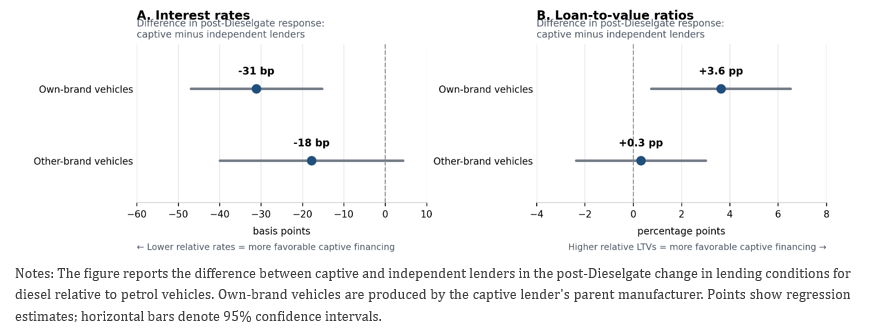
Across our empirical approaches, we find that captive lenders ease financing conditions for diesel vehicles relative to independent banks following Dieselgate. Loan-level evidence further shows that lender affiliation matters. Captive lenders offer particularly favorable financing for vehicles produced by their parent manufacturer.
For these own-brand vehicles, captive lenders offer lower interest rates and higher loan-to-value ratios than independent banks financing the same car models, while no significant differences emerge for vehicles of other brands. This pattern is consistent with product-market considerations affecting captive lenders’ financing decisions in addition to credit and collateral risk.
Figure 1. Differences in captive and independent lenders’ responses to Dieselgate
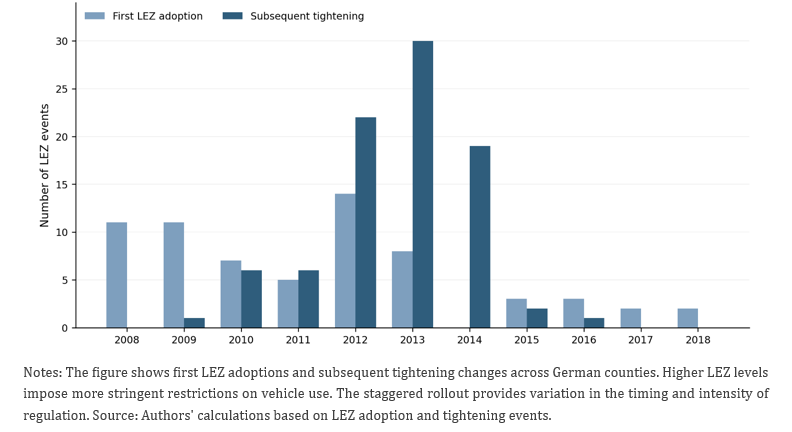
Low-emission zones (LEZs) directly restrict the use of high-pollution vehicles, reducing their usability and potentially their future value. We exploit their staggered introduction and tightening across German counties to examine how lenders respond to regulatory risk. Unlike Dieselgate, which did not immediately constrain the use of diesel vehicles, LEZs allow us to study lending responses as environmental regulation becomes increasingly binding. Figure 2 illustrates the identifying variation: LEZs were introduced at different points in time and subsequently tightened across counties.
To account for this staggered, multi-step rollout, we use a stacked difference-in-differences design that treats each LEZ introduction or tightening as a separate event. For each event, we compare changes in lending conditions for diesel relative to petrol vehicles in the affected county with changes in counties that have not yet implemented the same restriction. We estimate these responses separately for captive and independent lenders.
Figure 2. Staggered introduction and tightening of low-emission zones in Germany
Across our empirical approaches, lending responses vary with LEZ stringency and lender type. Independent banks increasingly reflect regulatory risk in diesel loan rates as restrictions become more stringent. Captive lenders show no corresponding systematic variation in interest rates, although there is some evidence of adjustment in loan-to-value ratios.
Taken together, the two settings show that lender incentives and organizational structure shape how environmental risk is transmitted through credit markets. Captive lenders are exposed to credit and collateral risk but also have incentives to support the profitability of their parent manufacturers and the market value of their vehicles. Following Dieselgate, these incentives are reflected in more favorable financing conditions for diesel vehicles relative to independent banks, particularly for vehicles produced by the captive lender’s parent manufacturer. The concentration of the response among own-brand vehicles is consistent with product-market considerations affecting captive lenders’ financing decisions.
The nature of the environmental shock also matters for how these incentives affect lending decisions. Dieselgate changed information about the environmental performance and future value of diesel vehicles but did not immediately constrain their use. LEZs, by contrast, impose direct and progressively more stringent restrictions on vehicle use. Independent banks increasingly reflect this regulatory risk in diesel loan rates as restrictions become more binding, while captive lenders show less systematic adjustment through interest rates. Binding restrictions therefore appear to leave captive lenders less scope to offset the shock through favorable financing.
More broadly, our findings suggest that the transmission of environmental policy through credit markets depends on the incentives of the financial intermediaries involved. When lenders have product-market interests in the assets they finance, environmental risk may not be fully reflected in financing conditions. Vertical integration between manufacturing and finance can therefore attenuate the transmission of environmental shocks through credit markets. For policymakers, this implies that the effectiveness of environmental regulation may depend not only on the design and stringency of the policy itself, but also on the structure and incentives of the credit markets through which purchases are financed. Accounting for these interactions between product and credit markets may therefore be important when assessing the transmission and effectiveness of environmental policies.
Ater, I., and Yoseph, N. S. (2022). The impact of environmental fraud on the used car market: Evidence from Dieselgate. Journal of Industrial Economics, 70, 463–491.
Bachmann, R., Ehrlich, G., Fan, Y., Ruzic, D., and Leard, B. (2023). Firms and collective reputation: A study of the Volkswagen emissions scandal. Journal of the European Economic Association, 21(2), 484–525.
Beyene, W., Falagiarda, M., Ongena, S., and Scopelliti, A. (2026). Do Lenders Price Diesel Risk? Evidence from Dieselgate and Low-Emission Zones in Captive vs. Independent Banks. ECB Working Paper Series, No. 3228.
Hankins, K. W., Momeni, M., and Sovich, D. (2026). Consumer credit and the incidence of tariffs: Evidence from the auto industry. American Economic Review, 116 (2), 627-673.
Murfin, J., and Pratt, R. (2019). Who finances durable goods and why it matters: Captive finance and the Coase conjecture. Journal of Finance, 74(2), 755–793.