

This brief is based on Chatzouz (2026). The views expressed are solely those of the author and should not be reported as representing the views of the IMF, its Executive Board, or member governments.
Abstract
Public debt and wealth concentration have co-moved persistently across advanced economies and historical periods, defying standard theories of wealth inequality. In this brief, I discuss why public indebtedness is essential to understanding the historical evolution of wealth inequality and its variation across countries, including why the same public debt shock can produce different distributional outcomes. The analysis establishes the distribution of the tax burden as a primary driver of long-run wealth inequality, and public debt as a central mediating channel through which structural shocks, such as population aging or artificial intelligence, propagate to the wealth distribution.
After several decades of postwar decline, wealth inequality, the most concentrated and politically contentious form of economic inequality, began rising around 1980 and has since become a defining feature of advanced economies (Piketty and Zucman 2014; Saez and Zucman 2016). Yet more than a decade after Piketty (2014) brought the subject to the center of economic debate, a convincing account of its long-run evolution remains elusive. The question has taken on renewed urgency as technological change, particularly advances in artificial intelligence, threatens to intensify already extreme wealth concentration and to undermine social cohesion.
Much of the academic literature has focused on a narrower question, why the distribution of wealth is skewed (De Nardi and Fella 2017; Benhabib and Bisin 2018; Achdou et al. 2022), a regularity known since Pareto (1897). That question, however, cannot tell us why periods of low wealth inequality give way to periods of high inequality. The most influential explanation, the r > g hypothesis of Piketty (2014), holds that when the return on capital, r, exceeds growth, g, those who live off capital accumulate wealth faster than those who live off wages. However, this explanation fits the twentieth century poorly. Wealth concentration fell in the first half of the century despite r > g (Abel et al. 1989), and then rose after 1980, in an era of low interest rates commonly attributed to excess saving (Rachel and Summers 2019; Blanchard 2019; Geerolf 2018). This post-1980 era defies standard theories of wealth inequality, as the rise in concentration occurred alongside eased credit constraints, broader equity access, and expanded welfare programs—developments that, in principle, should have helped poorer households accumulate wealth and narrow the gap with the rich.
In this brief, I summarize the arguments and evidence developed in Chatzouz (2026), where I examine public debt as a deferred tax, a feature that determines the associated tax burden and, by extension, its affordability.. As I argue there, tax-burden shocks, , are essential to understanding the historical evolution of wealth inequality and its variation across countries, including why the same shock can produce different distributional outcomes.
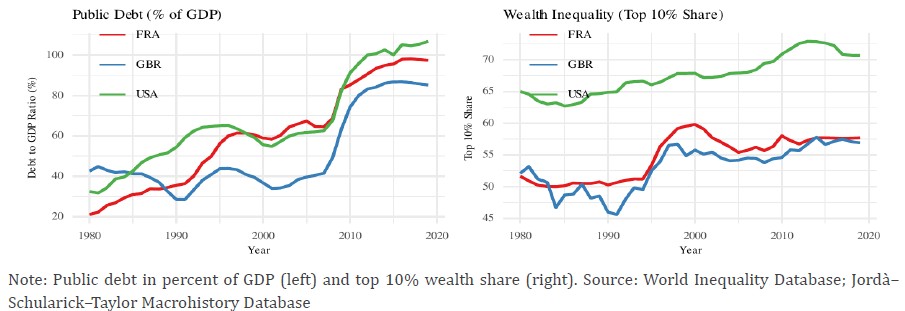
First, public debt is intrinsically linked to wealth inequality by affecting every component of wealth accumulation. Beyond constituting a household asset, its tax burden directly affects disposable income, while its general equilibrium effects on interest rates and wages govern households’ ability to save and build wealth. This intrinsic link shows quite robustly in the data as well. Over the past four decades, an overlooked fact is that public debt and wealth concentration have risen together across advanced economies, echoing nineteenth-century Britain and France, where large public debts held by the wealthy sustained high wealth concentration (Piketty 2014). In the United States, just as the debt-to-GDP ratio began a threefold increase from 1980, the top 10% wealth share climbed from roughly 65% in 1980 to 71% in 2019, with France and the United Kingdom following similar trajectories (Chart 1).
Chart 1. Public debt and the top 10% wealth share, 1980–2019
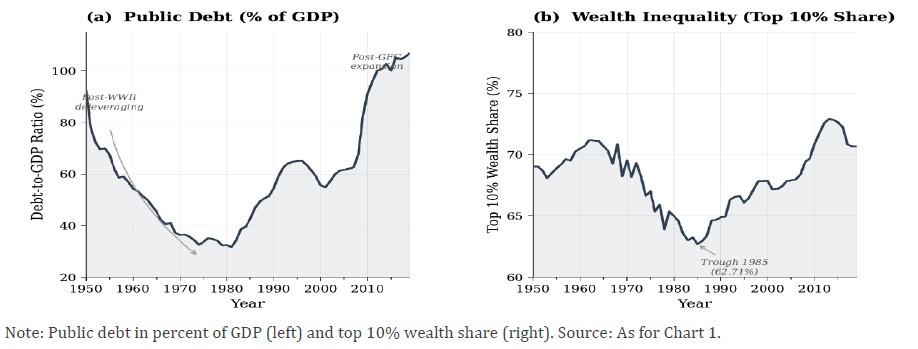
Is this pattern merely a coincidence, or one confined to these three countries and to episodes of rising public debt? The data suggest not. In the United States, the co-movement goes back much further and holds in both directions. Public debt fell alongside wealth inequality from the 1950s until both reversed course around 1980, with debt turning upward at least five years before wealth concentration (Chart 2).
Chart 2. Public debt and the top 10% wealth share in the United States, 1950–2019
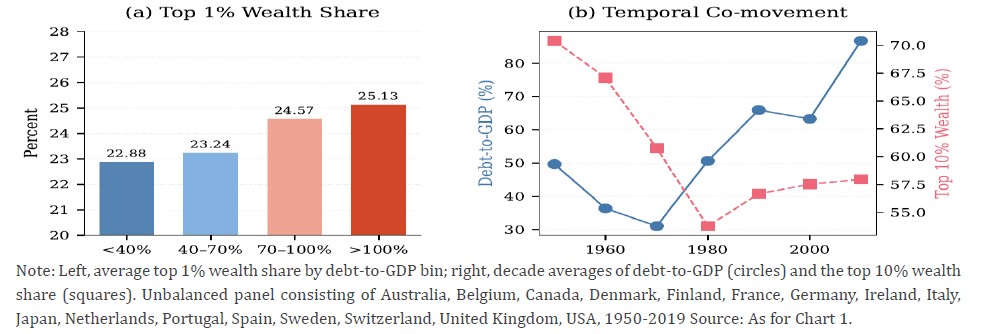
This pattern extends beyond the United States. Across advanced economies, lower public debt typically accompanies lower wealth inequality. Both series declined in tandem during the postwar decades before rising together after the 1970s (Chart 3).
Chart 3. Public debt and wealth concentration across advanced economies
These stylized facts suggest that the co-movement of public debt and wealth concentration is widespread across countries and recurrent over time, raising immediate questions about the distributional cost of public debt. But the landscape has shifted since nineteenth-century Britain and France, where, according to Piketty (2014), public debt sustained wealth concentration. Rather than financing wars and being held by a distinct capitalist class, public debt today is increasingly held by workers, mainly through pension funds, and finances social transfers. If debt still matters for wealth inequality, it must matter through something other than who holds it and what it finances. This leaves the tax burden as the sole underlying factor common to these periods and institutional settings, helping explain the persistent co-movement of public debt and wealth concentration across countries and over time.
The conceptual framework builds on the foundational work of Diamond (1965), who conceptualized public debt as a tax burden (deferred tax) and linked a government’s ability to run persistent deficits to the cost of servicing public debt.
In the paper, I take a further step and formalize how the overall tax burden is in turn distributed across households through the progressivity of the tax system. Intuitively, changes in debt-service costs affect the revenues required to maintain solvency, which can then alter how the tax burden is distributed across households through adjustments to tax and transfer policies. Through this channel, I then examine how a permanent change in the level of public debt affects wealth inequality in the long run under two macroeconomic regimes: a high-interest-rate regime, in which long-term natural interest rates exceed long-term real growth rates (r > g) and borrowing costs are typically high, and a low-interest-rate regime, in which r < g and borrowing costs are relatively low.
A permanent increase in public debt, which, as noted above, translates into a permanent change in the tax burden, raises tax progressivity in a high-interest-rate regime and lowers it in a low-interest-rate regime within the model. This result reflects the government’s intertemporal budget constraint and the notion of public debt as a deferred tax. Treating debt as a deferred tax does not imply that higher debt always requires higher future taxes, but rather that taxation must remain compatible with government solvency. When r > g, servicing additional debt raises revenue needs, which are met through greater tax progressivity. Conversely, when r < g, favorable debt dynamics allow the government to sustain higher debt without a subsequent increase in taxes; Debt must become sufficiently high before taxes need to rise meaningfully. Below that threshold, higher public debt lowers tax progressivity without compromising government solvency.
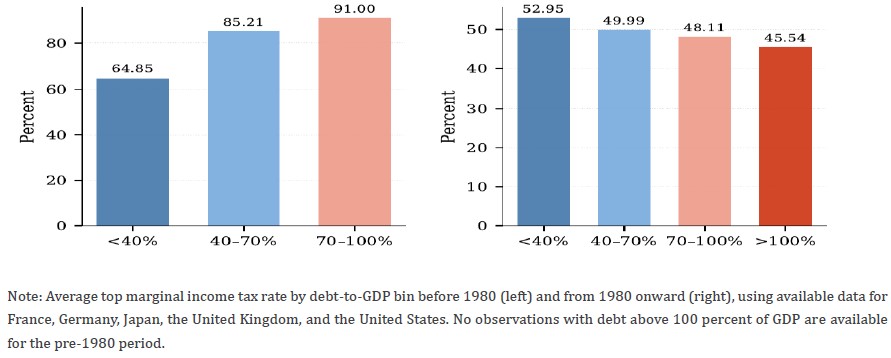
Chart 4 shows a corresponding pattern in the data. Before 1980, higher public debt was associated with higher top marginal income tax rates. From 1980 onward, this association reversed, with higher public debt accompanying lower top marginal rates, consistent with a decline in tax progressivity.
Chart 4. Top marginal income tax rate by level of public debt, before and after 1980
How does all this feed into wealth inequality? In a high-interest-rate regime, higher public debt necessarily raises the tax burden, which leads to greater tax progressivity. But it also raises interest rates, which benefits richer households. As long as the tax burden is not too high, the interest-rate effect dominates and wealth inequality rises. In a low-interest-rate regime, the mechanics work differently. Progressivity falls, and wealth inequality rises mainly because richer households are taxed less.
The decline in tax progressivity over recent decades can thus be understood, in part, as an endogenous response to the greater affordability of public debt. As such, it need not reflect an exogenous shock to tax progressivity, as the literature typically treats it (Kaymak and Poschke 2016; Hubmer, Krusell and Smith 2021), or a sudden shift in preferences for redistribution. On this reading, the fall in top marginal tax rates from their mid-century highs was, to some degree, an unintended consequence of the decline in interest rates and the greater affordability of debt that came with it.
This offers a consistent explanation for an otherwise puzzling fact, namely why countries with very different attitudes toward redistribution responded in the same way. The United States and France sit at opposite ends of that spectrum, with the United Kingdom in between. Yet all three experienced the same debt-affordability shock, and all three cut their top marginal income tax rates, although not to the same degree. Lower top rates raised the disposable income of the rich, and even where top rates remained relatively high, as in France, the cuts exposed what really separates the rich from the poor: the rich can save more, both as a share of their income and in absolute terms. Put simply, it was the size of their savings and investment, rather than higher capital returns, that made the rich richer in the low interest rates era.
In the corresponding empirical analysis, which I discuss more extensively in Chatzouz (2026), I estimate the long-term impact of a permanent rise in public debt on wealth inequality in the United States, France, and the United Kingdom, alongside a panel of advanced economies. To make the estimates comparable and aid interpretation, I scale the shock to a permanent 74 pp increase in the debt-to-GDP ratio, matching the U.S. increase between 1980 and 2019. To better capture public debt’s role as a deferred tax, the analysis also accounts for its long-run effects on private investment, interest rates, and wages, while remaining agnostic about the underlying factors driving the permanent increase in public debt and what the additional borrowing finances.
Table 1 shows that a 74 pp debt shock raises the top 10 percent wealth share by roughly 6 pp in the United States, nearly matching the observed historical increase between 1980 and 2019. The effect is 8 pp in the United Kingdom, 20 pp in France, and a median of 2 pp across the broader panel.
Table 1. A permanent rise in public debt lifts top wealth shares
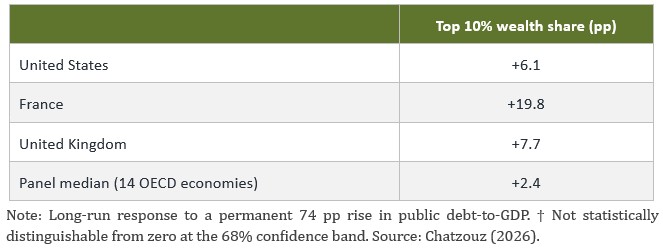
Taken together, these findings indicate that a permanently higher level of public debt typically raises wealth inequality substantially over the long run. They also show why an identical debt shock can leave countries with different distributional outcomes. France provides the clearest example. The estimated effect of debt is largest there, yet the observed rise in French wealth concentration has been far smaller than this estimate implies, suggesting that other forces offset much of the debt effect, among them France’s structurally higher tax progressivity. The muted effects in the broader panel, which comprises mostly European countries, reinforce the importance of these institutional differences. In other words, while public debt can move tax progressivity in the same direction across countries, the resulting level of progressivity may still mitigate the disequalizing effects of public debt without necessarily preventing them.
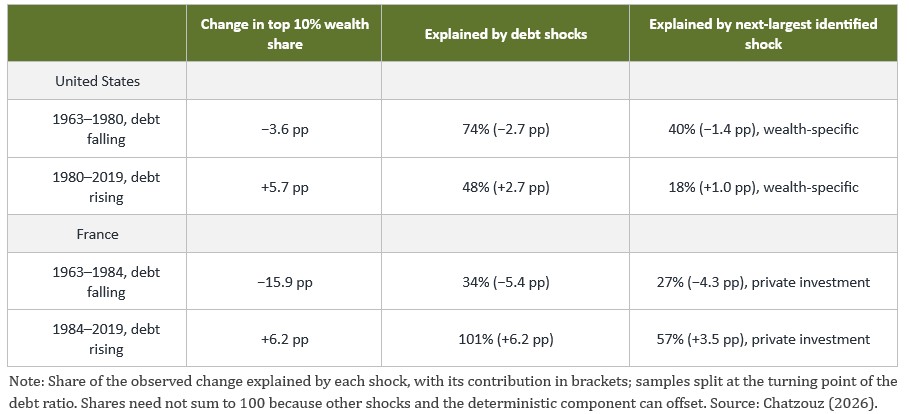
To better understand the role of public debt in the evolution of wealth inequality, Table 2 shows how much of the observed change in wealth inequality the identified permanent public debt shocks account for. The findings suggest that, declining public debt explains about 74% of the decline in US wealth concentration before 1980, and 34% of the French decline before 1984. Similarly, the permanent rise in public debt after 1980 explains about half of the subsequent increase in US wealth concentration — and most of the increase in France. In every period, debt is the largest single driver, ahead of shocks to wages, investment, wealth-specific factors such as bequests or tax avoidance, and interest rates — suggesting that explanations based on capital returns (or asset appreciation) find little support.
Table 2. Debt shocks are the largest single driver of top wealth shares in every period
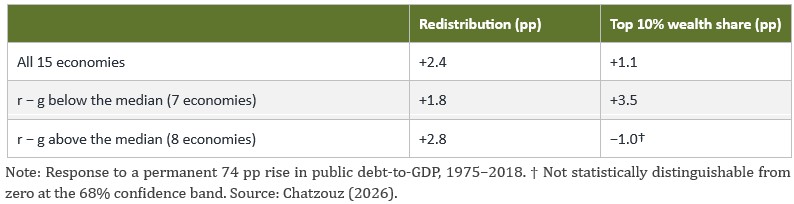
The earlier discussion implies that a rising tax burden should increase tax progressivity. As the tax burden rises, progressivity could eventually become sufficiently high not only to neutralize the disequalizing effects of public debt but even to reduce wealth inequality. This suggests that, more generally, wealth inequality is a nonlinear function of public debt, as I formalize in Chatzouz (2026). To test this empirically, I establish a correspondence between public debt and the intensity of redistribution, which mirrors how tax progressivity moves with debt. This allows to use readily available redistribution series to assess the theoretical prediction by splitting a panel of OECD countries into groups with structurally different r-g differentials. Table 3 presents the results, providing strong support for the theoretical predictions. When r−g is low, redistribution responds weakly (1.9 pp versus 2.4 pp across the full panel), and the top 10% wealth share rises by roughly 3.5 pp, which is about 2.4 pp higher than the median cross-country response. When r − g is high, the redistributive response strengthens to 2.8 pp (roughly 1 pp larger than in low-tax-burden countries), and the effect on wealth inequality becomes statistically insignificant. This is consistent with the hypothesis that, when the response of tax progressivity, captured here by the intensity of redistribution, is particularly strong, the resulting level of progressivity may be sufficiently high to make the impact of public debt on wealth inequality more neutral.
Table 3. Where r − g is high, redistribution rises more and the effect on top wealth shares fades
These results do not imply that public debt is itself the ultimate structural shock behind swings in wealth inequality. There is no permanent debt shock without a shift in primary balances or debt-service costs, and these depend in turn on the structural forces that move the secular macroeconomic equilibrium. The argument is rather that such forces, whether AI, population aging, a change in risk aversion or persistent quantitative easing, have a permanent effect on debt-service costs and hence ondebt affordability . It is this effect that creates the incentive for permanent tax reforms, which shape wealth inequality, with public debt acting as an important mediating channel. Put in terms of Piketty’s r − g, the gap matters far less for the returns of the wealthy than for the distribution of the tax burden across the population,. An extension in Chatzouz (2026) illustrates this point more clearly by showing that, while AI and population aging may well be disequalizing on their own, if they move economies into an r > g regime, as they can, tax progressivity must increase to service public debt. This neutralizes their disequalizing effects, and inequality falls precisely because the tax system becomes more progressive.
In this policy note, I have documented how waves of rising wealth inequality have been associated with rising debt levels, and showed how the tax burden of public debt is essential to understanding the historical evolution of wealth inequality and its variation across countries, including why the same shock can produce different distributional outcomes.
The analysis carries two main policy implications. First, the findings suggest that the decline in tax progressivity may have responded more to the greater debt affordability created by the low-interest-rate era, which made, for example, permanent reductions in top tax rates feasible, than to any distributional objective aimed at limiting inequality. Nevertheless, the distributional implications of public debt ultimately depend on policy choices and on how averse countries are to high levels of wealth inequality. This suggests that we may now see a departure from the largely uniform response seen after 1980 toward greater divergence across countries in how tax progressivity and, with it, distributional outcomes evolve, given current pressures on debt sustainability and already high levels of wealth inequality.
Second, the disequalizing effects of public debt stem largely from the fact that labor income remains, by a wide margin, the primary tax base. Given that governments have a statutory obligation to preserve social cohesion, mitigating the social cost of public debt may now require broadening the tax base and relying more on progressive instruments, such as wealth or capital taxation. This is especially important today, as a range of structural pressures is likely to keep debt elevated. Governments must manage climate change and population aging, expand social safety nets in response to AI’s risks to labor markets, and meet rising defense spending and higher interest expenditures, which are already absorbing a growing share of budgets, while also facing the socio-economic pressures of high wealth concentration.
Abel, Andrew B., N. Gregory Mankiw, Lawrence H. Summers, and Richard J. Zeckhauser. 1989. “Assessing Dynamic Efficiency: Theory and Evidence.” Review of Economic Studies 56 (1): 1–19.
Achdou, Yves, Jiequn Han, Jean-Michel Lasry, Pierre-Louis Lions, and Benjamin Moll. 2022. “Income and Wealth Distribution in Macroeconomics: A Continuous-Time Approach.” Review of Economic Studies 89 (1): 45–86.
Benhabib, Jess, and Alberto Bisin. 2018. “Skewed Wealth Distributions: Theory and Empirics.” Journal of Economic Literature 56 (4): 1261–91.
Blanchard, Olivier. 2019. “Public Debt and Low Interest Rates.” American Economic Review 109 (4): 1197–1229.
Chatzouz, Moustafa. 2026. “Public Debt, Wealth Inequality, and the Burden of Taxation.” IMF Working Paper 2026/171. Washington, DC: International Monetary Fund.
De Nardi, Mariacristina, and Giulio Fella. 2017. “Saving and Wealth Inequality.” Review of Economic Dynamics 26: 280–300.
Diamond, Peter A. 1965. “National Debt in a Neoclassical Growth Model.” American Economic Review 55 (5): 1126–50.
Geerolf, François. 2018. “Reassessing Dynamic Efficiency.” Working paper, University of California, Los Angeles.
Hubmer, Joachim, Per Krusell, and Anthony A. Smith, Jr. 2021. “Sources of US Wealth Inequality: Past, Present, and Future.” NBER Macroeconomics Annual 35 (1): 391–455.
Kaymak, Barış, and Markus Poschke. 2016. “The Evolution of Wealth Inequality over Half a Century: The Role of Taxes, Transfers and Technology.” Journal of Monetary Economics 77: 1–25.
Pareto, Vilfredo. 1897. Cours d’économie politique. Vol. 2. Lausanne: F. Rouge.
Piketty, Thomas. 2014. Capital in the Twenty-First Century. Cambridge, MA: Harvard University Press.
Piketty, Thomas, and Gabriel Zucman. 2014. “Capital Is Back: Wealth-Income Ratios in Rich Countries 1700–2010.” Quarterly Journal of Economics 129 (3): 1255–1310.
Rachel, Łukasz, and Lawrence H. Summers. 2019. “On Secular Stagnation in the Industrialized World.” NBER Working Paper 26198.
Saez, Emmanuel, and Gabriel Zucman. 2016. “Wealth Inequality in the United States since 1913: Evidence from Capitalized Income Tax Data.” Quarterly Journal of Economics 131 (2): 519–78.