

This policy brief is based on Banco de Portugal Working Papers “Balancing acts: policymakers’ choices between bank resilience and economic growth”. The analyses, opinions, and findings expressed in this policy brief are those of the authors and do not necessarily reflect those of the Banco de Portugal or the Eurosystem.
Abstract
Higher bank capital requirements reduce bank failures but also affect credit and general economic conditions. With different households – patient households (savers) preferring stability and impatient households (borrowers) credit availability – the policymakers’ choices between bank resilience and growth can be expressed in terms of the maximization of welfare, according to different criteria. In a model calibrated to the United States, maximising the sum of patient and impatient households’ welfare gains gives the largest reduction in bank defaults. Maximising impatient households’ gains produces the strongest long-run GDP increase, while equalising gains has the smallest effect on credit but leaves both groups less well off than the other choices. Higher capital shifts lending towards mortgages and away from firms. GDP and credit become somewhat less volatile, whereas house prices and lending spreads fluctuate more. The selected level of capital depends on the balance between policymakers’ goals.
Financial stability has several dimensions. The European Central Bank emphasises banks’ resilience, the containment of vulnerabilities and the continued provision of financial services to the economy. Resilience calls for capital that can absorb losses; lending flows place a limit on how restrictive requirements can become. Choosing a capital requirement therefore involves a potential trade-off between reducing risk and supporting economic activity.
The Federal Reserve’s definition likewise stresses the financial system’s ability to serve households and firms, including during shocks. These perspectives raise a practical question: how much resilience should policymakers seek when tighter capital requirements may affect borrowing conditions and economic growth?
Bank capital protects depositors and the wider economy against losses. Requiring more of it can reduce the likelihood of bank failure, but raising equity may increase banks’ funding costs and raise the price or reduce the availability of credit. The welfare benefits of safer banks must therefore be considered alongside these effects.
Basto, Lima and Maia (2026) examine this choice in an economy calibrated for the United States. Their analysis distinguishes patient households, who save and own bank equity, from impatient households, who borrow to finance housing, and shows how alternative capital requirements affect each group’s welfare, bank failures, lending, investment and output. Expressing welfare gains as percentage changes from the initial position makes the groups’ gains comparable.
Patient households (savers) provide bank deposits and own bank equity. They value deposit safety and tend to gain when higher capital lowers the risk of bank failure. Impatient households (borrowers) take mortgage loans to finance housing. They, too, can gain from more resilient banks, especially when lower risk reduces deposit funding costs, but mortgage rates have a more direct effect on their disposable income.
As capital first rises, lower bank risk can improve impatient households’ welfare. Beyond a certain point, the cost of raising additional equity outweighs those savings, mortgage rates increase and impatient households’ welfare declines. Patient households’ welfare continues to rise over the range studied. This difference explains why a policymaker’s preference concerning resilience and growth can affect households in a different way.
The study uses a model developed by Clerc et al. (2015) and extended by Mendicino et al. (2018), calibrated for the United States. Banks fund mortgage and corporate loans with deposits and equity. Impatient households, entrepreneurs and banks can default, so lending decisions affect losses throughout the economy. Deposit insurance protects deposits, while bank failure imposes costs on the insurance arrangement. The deposit insurance agency (DIA) is financed through lump-sum taxes on both types of households.
Capital requirements limit incentives for banks to take excessive risk, and banks respond by changing their funding and lending decisions. The analysis follows these effects through default, credit conditions, investment, GDP and the welfare of both household groups.
Starting from a capital ratio of 10.48% of risk-weighted assets, we compare alternative long-run outcomes as requirements rise. The exercise compares positions after adjustment; it does not estimate the short-run path following a policy announcement.
A single household welfare measure would yield one preferred capital ratio. However, with both patient and impatient households, and therefore two distinct welfare functions, the answer depends on how policymakers compare their gains and set their choices between resilience and economic growth. Patient households provide funds through banks, while impatient households and entrepreneurs use those funds for housing and investment. Both groups matter for the economy, and their preferred capital levels need not coincide.
Due to the absence of an established criterion for choosing weights across household types, each type of household’s percentage welfare gain is measured relative to the initial position. Three criteria are established to determine capital requirements:
The three criteria answer distinct questions about whose gains to prioritise.
For each of the three independent criteria is identified an “optimal” level of bank capital ratios. These criteria imply capital ratios of about 10.9%, 12.3% and 13.3%, respectively, compared with the initial 10.48%, which translates into increases of 0.432, 1.814 and 2.853 percentage points. They are different ways of expressing a policymaker’s priorities, not three estimates of one universal optimum. Figure 1 shows the welfare implications. Equalising welfare gains gives each group a 0.294% improvement, whereas both groups gain more welfare under either of the two higher-capital choices.
Figure 1. Welfare (Gains)
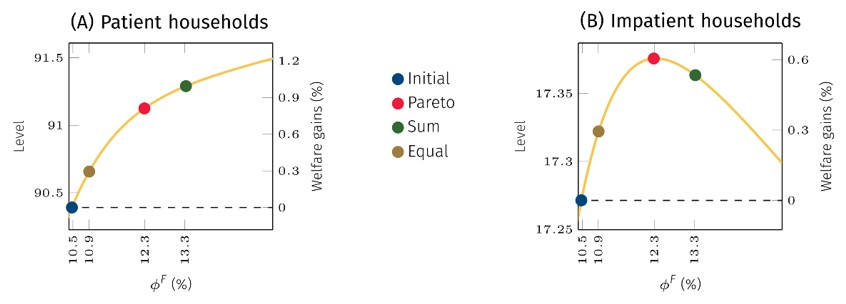
All three criteria reduce the annual average rate of bank default, meaning that these higher capital levels increase banks’ resilience. The reduction is 0.304 percentage points under equal welfare gains, 0.777 percentage points under the Pareto improving approach and 0.889 percentage points under the sum of welfare gains approach. Lower failure risk also reduces transfers from the DIA. These resilience gains are particularly beneficial to patient households, who are exposed to bank performance through two channels: as depositors, they benefit from greater deposit safety, while as bank owners, they benefit from more stable dividend income and a lower risk of losses associated with bank failures.
Corporate and mortgage credit respond inversely in all three cases: corporate lending contracts while mortgage lending rises relatively to the initial state. Following regulatory rules in place, in the model, mortgages carry a lower regulatory risk weight, so expanding them uses less capital for a given loan amount. Stronger capital requirements thus encourage a shift in banks’ portfolios towards housing. The shift helps explain why residential investment increases even as business investment declines. A headline measure of total lending can conceal this change in the financing of productive capital.
Figure 2 traces that portfolio change. In the equal welfare gains case, the rise in mortgages more than offsets the corporate lending decline, leaving total credit 0.055% above its initial level. Under the Pareto improving and sum of welfare gains choices, total credit falls by 0.139% and 0.467%, respectively. The largest change is in corporate lending: it falls by 0.600% under the Pareto choice and 1.097% under the sum of welfare gains choice.
Higher capital first lowers banks’ risk and the premium patient households demand for deposits. This can lower the cost of mortgage finance. At higher capital ratios, banks’ growing need for equity makes funding more expensive, mortgage interest rates increase, and impatient households’ welfare begins to decline. The point at which that happens helps explain why the borrower-focused optimization approach stops at a lower ratio than the sum of welfare gains approach.
Figure 2. Effects on the financial sector
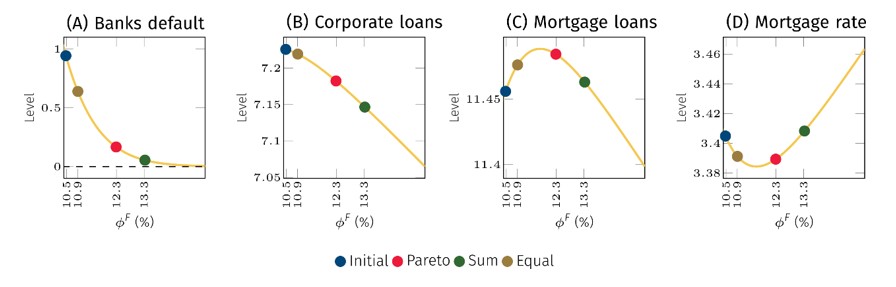
Figure 3 illustrates the long-run effects of the different welfare criteria on key macroeconomic variables, namely GDP, consumption and investment.
All three approaches lead to a small increase in long-run GDP despite lower physical capital investment. Aggregate consumption rises by 0.070% under equal welfare gains, 0.165% under the Pareto improving choice and 0.174% under the sum of welfare gains choice. Both household groups consume more in every case. These gains, together with reduced losses from default, support activity, while the decline in corporate loans weighs on firms’ physical capital investment.
The composition of investment therefore matters. Physical capital investment falls by 0.075%, 0.299% and 0.459% under equal welfare gains, Pareto improving and sum of gains, respectively. Housing investment instead rises by 0.108%, 0.200% and 0.145%. Total investment therefore falls under every criterion, by 0.048%, 0.225% and 0.370%. The banking system becomes safer, and GDP rises slightly, but firms build less productive capital in the long run.
The Pareto improving choice delivers the largest GDP increase (0.068%), followed by equal welfare gains (0.041%) and the sum of welfare gains choice (0.038%). The differences are small in level, but their ordering is informative: the approach with the greatest reduction in bank failures is not the approach with the strongest GDP gain. Interpreting this growth result requires looking at consumption and investment as well as the headline change in output.
Figure 3. Effects on the financial sector
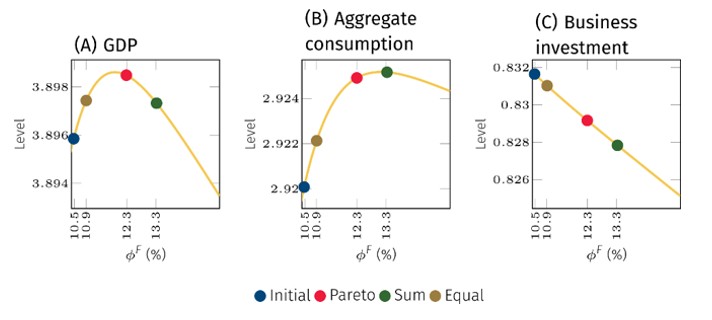
Figure 4 compares long-run effects of financial and real economy variables, as well as patient and impatient households’ welfare, along the three solutions analysed. All values compare an approach’s long-run position with the initial capital ratio of 10.5%.
The Pareto improving choice maximises impatient households’ welfare in the range considered. It still reduces bank default substantially and raises patient households’ welfare by 0.811%, but gives impatient households the largest gain, 0.605%. The sum of welfare gains choice raises capital further: patient households gain 0.994% and impatient households still gain 0.534%. Relative to the Pareto choice, patient households gain an additional 0.183 percentage points of welfare while impatient households give up 0.071 percentage points. Bank default falls another 0.112 percentage points, but corporate credit and business investment contract more, and GDP rises less.
Figure 4. Long-run effects of increasing capital requirements from the initial steady-state level (10.48%)
to the optimal levels under each welfare criterion
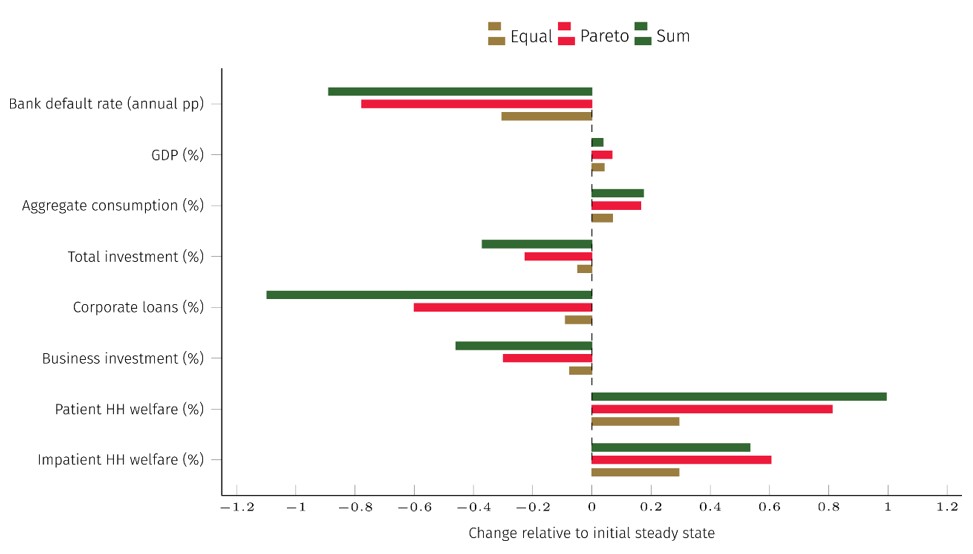
With equal welfare gains both groups gain 0.294%, less than under other choices. Bank failures are reduced with the least effect on corporate lending, and it is the only case in which total credit grows. Which of the other two choices is preferable depends on the value placed on additional resilience (favouring patient households’ welfare) relative to business investment and output growth (benefiting the impatient households more).
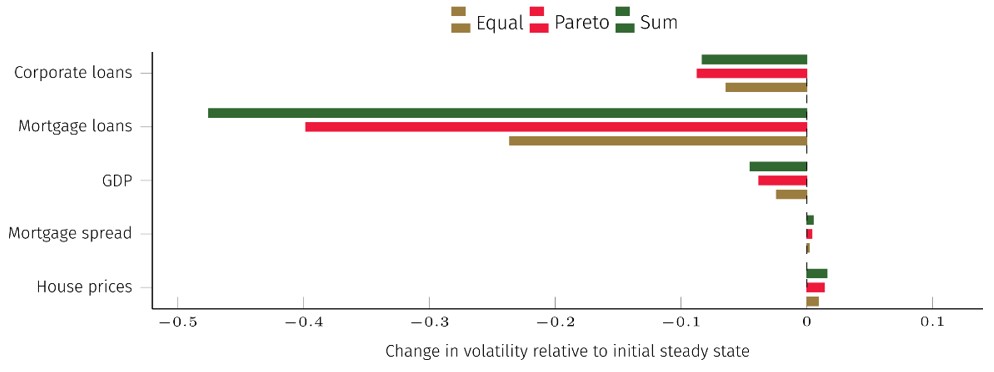
Average outcomes are only one dimension of financial stability. Comparing how strongly the economy fluctuates around each long-run position offers a complementary information on the resilience of the financial system and propagation/amplification effects of shocks originating both on the financial system and the wider economy. The results show that GDP volatility falls from 2.367 in the initial situation to 2.343 (-0.024%) under equal welfare gains, 2.329 (-0.038%) under the Pareto improving choice and 2.322 (-0.045%) under the sum of welfare gains choice. These results show the stabilization effect from higher capital requirements, with the financial system being better prepared to absorb and contain the shocks, reducing the transmission effects to the economy. Mortgage credit volatility also falls, most under the sum of welfare gains choice. Corporate credit volatility declines in all three cases, with the largest decline under the Pareto improving choice.
These improvements coexist with slightly greater fluctuations in house prices and lending spreads. House price volatility rises from 12.842 initially to 12.858 (+0.016%) under the sum of welfare gains choice, while mortgage spread volatility rises from 0.042 to 0.047 (+0.005%) in the corresponding scenarios. The magnitudes are small in the reported simulations, but the direction matters: a safer banking system need not destabilize the housing market. The assessment of a capital policy should track asset prices and borrowing costs alongside defaults, output and credit volumes.
Figure 5. Changes in the volatility of model variables relative to the initial steady state under each welfare criterion
The preferred capital ratio depends on the policymaker’s preference about resilience and growth. All three welfare maximisation criteria improve the welfare of patient and inpatient households, lower bank failures and raise long-run GDP relative to the initial US-calibrated position. The equal welfare gains choice yields the smallest gains for both groups; the Pareto improving choice favours impatient households and delivers the strongest GDP increase; and the sum of welfare gains choice produces the greatest resilience and combined welfare gain.
Higher capital also changes what banks finance. Corporate credit and business investment fall as lending shifts towards mortgages. Consumption gains support GDP, but the strongest resilience outcome carries the largest cost for firms’ credit and productive investment. GDP and credit become somewhat less volatile while house prices and lending spreads become somewhat more volatile. All these outcomes should be considered in policy decisions.
These results, however, should be interpreted in light of some important features that are not captured by the model. In particular, the model does not account for systemic risk or for the role of releasable capital buffers, which may provide additional benefits by allowing banks to absorb losses and sustain lending during periods of stress. As a result, the model may understate some of the benefits associated with higher capital requirements.
Basto, Rita, Diana Lima, and Duarte Maia (2026). “Balancing acts: policymakers’ choices between bank resilience and economic growth”. Working Paper 2026/07. Banco de Portugal.
Clerc, Laurent, Alexis Derviz, Caterina Mendicino, Stephane Moyen, Kalin Nikolov, Livio Stracca, Javier Suarez, and Alexandros P. Vardoulakis (June 2015). “Capital Regulation in a Macroeconomic Model with Three Layers of Default”. International Journal of Central Banking 11.3, pp. 9–63.
Mendicino, Caterina, Kalin Nikolov, Javier Suarez, and Dominik Supera (Sept. 2018). “Optimal Dynamic Capital Requirements”. Journal of Money, Credit and Banking 50.6, pp. 1271–1297.