

This brief is based on the authors’ research supported by the Anniversary Fund of the Oesterreichische Nationalbank (Project No. 18833). The views expressed are those of the authors and not necessarily those of the institutions the authors are affiliated with.
Abstract
Technologically compatible trading partners can adapt products and meet foreign requirements more easily. Evidence from 76 countries and 45 sectors over the 1996-2020 period indicates that a 0.1-point increase in a patent-based compatibility index is associated with about 5% higher bilateral exports in estimates addressing endogeneity. Sectoral estimates reveal substantial differences in the trade effects of technological proximity, using the highly patent-intensive computer, electronic and optical products sector as a benchmark. The evidence also points to easier compliance with sanitary and phytosanitary requirements. Trade integration should therefore combine market access with technological convergence and cooperation on standards, tailored to sectoral capabilities and the demands of foreign markets.
Removing a border charge does not make a foreign supplier immediately usable. Products may need to be adapted, production processes coordinated and compliance demonstrated before trade can take place. These tasks are easier when trading partners possess compatible technological capabilities, which helps explain why access to a market can remain difficult even where formal trade barriers are low.
In Ghodsi, Landesmann and Stehrer (2026), we examine this dimension of trade costs. Our central finding is that countries whose sectors specialise in similar technological fields tend to trade more with each other. The relationship becomes substantially larger in estimates designed to address the possibility that trade itself brings technological capabilities closer together.
For trade policy, the implication is that technological upgrading and regulatory cooperation can reinforce market access. For firms assessing new suppliers, compatibility is a potentially important part of the cost of switching. For policymakers analysing changes in supply networks, it is one reason why replacing an established source of imports may take time and require investment.
We combine OECD trade data with firms’ granted patents from Orbis Intellectual Property for 76 countries and 45 sectors during the 1996-2020 period. The patent information covers 680 technology classes. For each country and sector, we identify the fields in which patenting is relatively concentrated and then compare these profiles across trading partners. The resulting index runs from −1 to 1, with higher values indicating more similar patterns of technological specialisation.
This measures the composition of capabilities rather than the number of patents or a country’s overall level of technological sophistication. Two countries can have different patent totals and still specialise in related fields. A 0.1-point increase means, for example, moving from 0.2 to 0.3 on the index.
The estimates account for persistent bilateral sector characteristics, changes in each country’s sectoral conditions and shocks common to a country pair, alongside trade-policy measures. In the specifications addressing endogeneity, a 0.1-point increase in compatibility corresponds to approximately 4.9-5.4% higher bilateral export values on average across all sectors and 3.9-4.2% across non-services sectors. These results are similar whether patents are dated by first filing, publication or grant, as Figure 1 shows.
Trade can itself encourage technological convergence, while unobserved bilateral links and measurement error may also affect the estimates. To address these sources of endogeneity, we use a control-function instrumental-variable (IV) approach that combines countries’ pre-sample technological specialisation with subsequent global innovation trends, excluding each country’s own patenting. Identification assumes that these external trends affect bilateral exports through technological proximity, conditional on the model’s controls.
The importance of this correction is illustrated by the non-services results: using patent priority dates, the estimated export increase rises from approximately 0.3% without IV correction to 4.2% with it (Table 2 of the main study). This difference is consistent with attenuation of the relationship in the conventional estimates.
Figure 1. Estimated change in bilateral export values for a 0.1-point increase in technological proximity
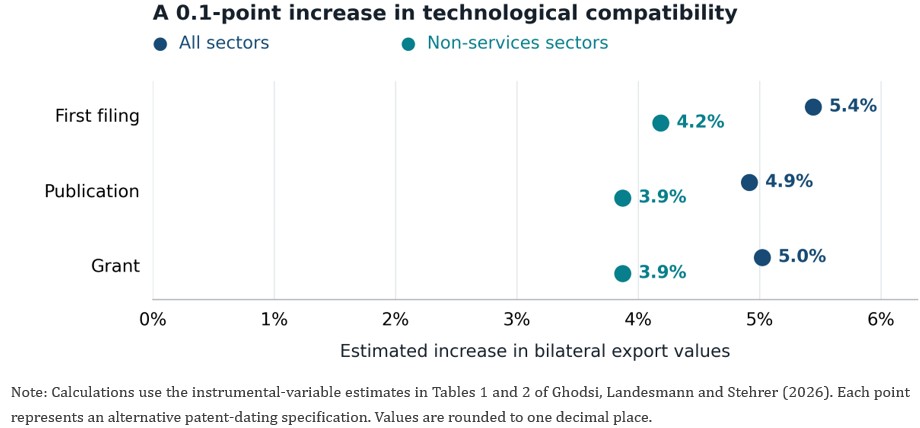
The IV correction applies to the benchmark estimates presented in Figure 1. The specifications examining interactions with trade-policy measures, sectors or regions use Poisson pseudo-maximum likelihood (PPML) estimation with high-dimensional fixed effects, without IV correction. These results describe conditional associations and should therefore be compared with the corresponding non-IV benchmarks.
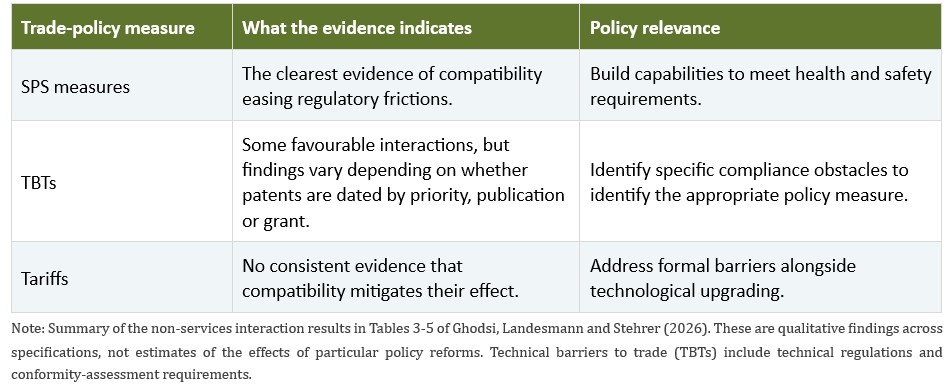
The distinction between tariffs and regulatory requirements is central to interpreting the results. A tariff directly raises the cost of entering a market. Health and safety rules, technical specifications and conformity assessments can instead require exporters to acquire knowledge, adapt processes or demonstrate that their products meet the destination’s requirements. Compatible capabilities may make these tasks easier.
The clearest interaction results concern sanitary and phytosanitary (SPS) measures, which protect human, animal and plant health. Technological proximity is associated with a more favourable export response where SPS measures are more intensive, mitigating trade costs associated with divergence in their regulatory objectives in several specifications. These patterns support the interpretation that compatible capabilities help exporters meet foreign requirements.
Table 1. How compatibility relates to different trade frictions
Regulation can protect consumers, improve information and support trade by making quality more credible. The stock of regulatory measures is therefore not uniformly associated with lower exports. Differences in regulatory objectives are a separate potential source of friction, as also examined by Ghodsi and Santeramo (2026). The policy objective should be to make legitimate requirements easier to understand and meet while preserving their protective purpose.
This places compliance capacity at the centre of trade integration. Technical knowledge, suitable production processes and the ability to demonstrate conformity help firms turn formal market access into actual sales. The interaction estimates identify where technological capabilities and regulatory cooperation can most usefully reinforce each other.
The sectoral results show how the relationship between technological compatibility and trade differs across industries. Manufacture of computer, electronic and optical products (C26) has the largest estimated effect among manufacturing sectors when proximity is measured using patent priority dates, the earliest filing dates associated with inventions. In this specification, estimated without IV correction, a 0.1-point increase in proximity is associated with approximately 1.9% higher bilateral exports, and the relationship is statistically significant at the 1% level. For comparison, the corresponding pooled estimate across all sectors, also without IV correction, implies an increase of approximately 0.15% (Tables 1 and 7 of the main study). The larger benchmark estimates in Figure 1 incorporate IV correction and therefore represent a different basis for comparison.
This finding gives economic content to the compatibility mechanism. In computer, electronic and optical manufacturing, alignment in emerging technologies can help trading partners work with complex components, adapt products and coordinate production. The priority-date result is consistent with early technological alignment supporting export competitiveness while innovations are still close to the invention stage.
Other industries show a different relationship with the innovation cycle. When proximity is measured using publication or grant dates, sectors including mining support, water supply and waste management, transport, and health and social work show stronger responses relative to the electronics benchmark. The publication date marks when technical knowledge becomes publicly accessible, while the grant date is when legal protection is provided. The pattern suggests that compatibility becomes commercially useful at different stages across sectors, as technologies are disclosed, adopted and incorporated into production or service delivery.
The regional estimates add a further dimension. Several trade relationships involving technological frontier economies display stronger responses to compatibility. Access to advanced knowledge and the capacity to absorb it can help firms integrate into international production networks. This supports a focus on the capabilities needed to work with particular partners and technologies, alongside the sectoral context.
For policy, the sectoral findings favour matching support to the stage at which firms use technology. Research collaboration and links between inventors and producers may be particularly useful in advanced manufacturing. Cross-border investment and joint ventures can help strengthen these links by facilitating knowledge exchange and cooperation in production. In sectors such as mining support, transport, and water supply and waste management, technological proximity measured using patent publication or grant dates exhibits stronger estimated trade effects than in the benchmark sector (manufacture of computer, electronic and optical products). These findings suggest that technology diffusion, technical training and compliance support may be particularly useful for strengthening trade integration in sectors where adopting and implementing established technologies are central.
Trade negotiations should connect market-access provisions with the capabilities needed to use them. Cooperation on standards, transparent conformity assessment and recognition of equivalent testing procedures where justified can reduce avoidable adaptation costs. The regulatory results give particular reason to combine technical regulatory cooperation, such as on SPS requirements, with support for firms’ compliance capabilities.
Innovation policy can contribute directly to this agenda. Research cooperation, supplier upgrading and the adoption of relevant production technologies can help firms serve foreign markets. For catching-up economies, the useful question is which capabilities would allow firms to participate in the production networks they seek to join. Simply increasing patent counts or making every country specialise in the same fields would not follow from our results.
Supply-chain diversification plans should assess whether prospective suppliers can meet product specifications and destination requirements at commercial scale. A supplier with an attractive production price may still require substantial investment in adaptation and compliance. Shared technical capabilities can inform that assessment, alongside logistics, capacity and exposure to disruption. The patent-based index is a research measure, however, and cannot replace firm-level due diligence.
For European integration, cross-border research programmes and cooperation with technologically advanced partners offer ways to develop the capabilities that make trade relationships work. The regional results do not justify selecting partners based solely on geography or political grouping. When it comes to the appropriate fit, what matters is how well partners’ technological capabilities match the needs of the sector and the requirements of the intended market.
For firms assessing supply-chain diversification, technological fit has to be considered alongside price, logistics and production capacity. Prospective suppliers need to meet product specifications and destination requirements on a commercial scale. Assessing their technological capabilities can help identify adaptation needs, investment requirements and opportunities for cooperation before a new supply relationship is established.
For policymakers analysing the adjustment of trade networks, the findings suggest that supplier substitution involves capabilities as well as prices. Scenario analysis can incorporate the time and expenditure needed to adapt products, coordinate production and establish compliance. The sectoral evidence helps explain why these adjustments may differ between advanced manufacturing and activities that rely more heavily on adopting established technologies.
Conventional trade policy remains important. We find no consistent evidence that technological compatibility cushions the effect of tariffs. Investment in compatible capabilities should therefore be considered alongside efforts to reduce formal trade barriers. Compatibility is especially relevant to knowledge, coordination and compliance costs, while tariffs remain a separate policy instrument. Combining market access with technological capabilities and workable regulatory arrangements can help firms build and sustain international trade relationships.
Ghodsi, M., Landesmann, M. & Stehrer, R. (2026). Technological proximity and the mitigation of trade costs. wiiw Working Paper No. 279. The Vienna Institute for International Economic Studies (wiiw), September. https://wiiw.ac.at/technological-proximity-and-the-mitigation-of-trade-costs-p-7705.html
Ghodsi, M. & Santeramo, F. (2026). SPS and TBT measures through the lens of bilateral and GVC-related regulatory distance. International Economics, 185, 100674. https://doi.org/10.1016/j.inteco.2025.100674