

This SUERF Policy Brief is based on BIS Working Paper no 1380 “Chasing El Dorado: gold under shifting geopolitical and financial conditions”. The views expressed here are those of the authors and do not necessarily reflect those of the Bank for International Settlements or the Central Bank of Chile. Any errors and omissions are our own.
Abstract
This piece examines how geopolitical risks affect gold prices under different financial conditions, focusing on gold’s safe-haven role. Although geopolitical risks are typically associated with tighter financial conditions, recent data suggest that this relationship has weakened. We find that both geopolitical threats and realised events increase gold returns, with stronger effects during periods of loose financial conditions. We identify two potential mechanisms: the credit and liquidity risk channel and the opportunity cost channel. The results indicate that the relationship operates primarily through credit and liquidity risks, suggesting that investors’ capacity to rebalance portfolios is the key factor. Evidence for the opportunity cost channel is less conclusive.
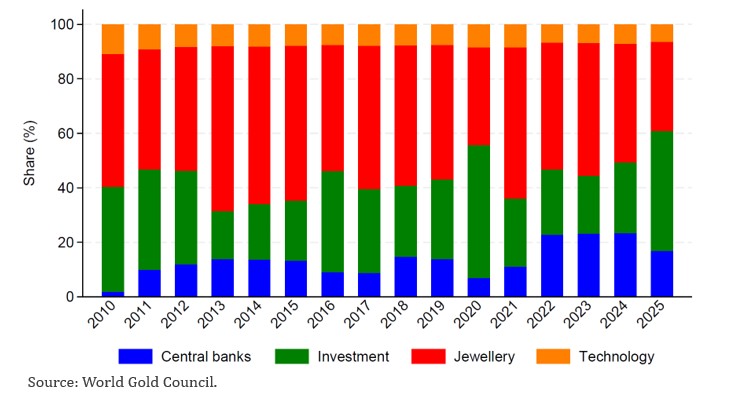
Gold plays a distinctive role in the international financial system. Its large and liquid market, combined with unique institutional characteristics, supports its role as a safe-haven asset during periods of stress. Unlike most financial assets, gold does not carry counterparty or issuer risk: it is not issued or backed by a government, cannot be created through money printing and is not subject to redenomination. These characteristics make it attractive to investors seeking protection from financial and geopolitical risks. Gold is now held mainly as a reserve and investment asset rather than for industrial purposes (Figure 1). Its price can therefore largely reflect its safe-haven role and serve as an indicator of systemic stress. As gold prices have recently reached unprecedented levels, academic interest in their behaviour has grown amid increasing geopolitical fragmentation.
Figure 1. Composition of gold demand
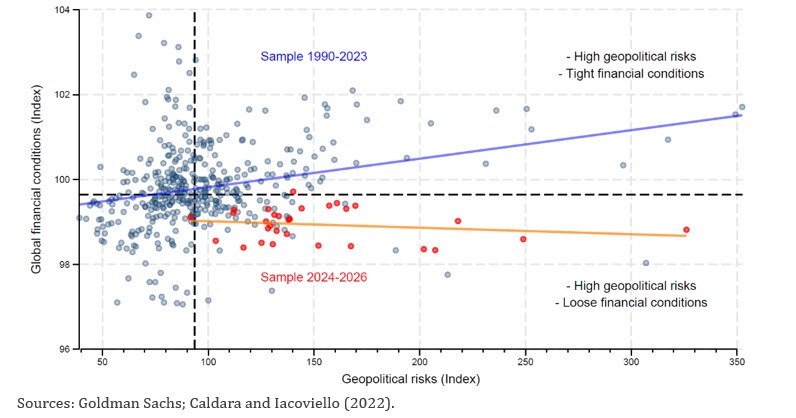
Moreover, it is difficult to consider in isolation the link between the effect of geopolitical risks on agents’ decisions to seek refuge in gold without accounting for the macro-financial landscape, which may serve as a catalyst for this mechanism – in this case, global financial conditions. Usually, geopolitical risks go hand in hand with tighter financial conditions (Caldara and Iacoviello, 2022; IMF, 2025); however, one exception to this rule is the recently observed period where there is a decoupling between geopolitical risks and tighter financial conditions, which may potentially benefit gold’s safe-haven status. As observed in Figure 2, the historical positive correlation between high geopolitical risks and tight financial conditions (dots in blue) has reversed in recent years (dots in red).
Figure 2. Historical link between global financial conditions and geopolitical risk index
Between 2024 and 2026, gold prices surged to unprecedented levels (Figure 3). Prices rose by over 130% between January 2024 and April 2026, when gold peaked. Newspapers and financial experts attributed this surge to major geopolitical conflicts, including the ongoing Russian invasion of Ukraine and escalating tensions in the Middle East, which boosted demand for gold by some central banks and investors (ECB, 2025). However, such a sharp increase in gold prices had not been seen during earlier spikes in geopolitical risks (Figure 3).
Against this background, in our recent research, we study the state-dependent effects of geopolitical shocks on gold price returns, under different global financial conditions – a research question that has not been addressed previously. Finally, we explore the financial channels that explain these results (Guerra and Zelpo, 2026).
Figure 3. Gold prices and geopolitical risk index
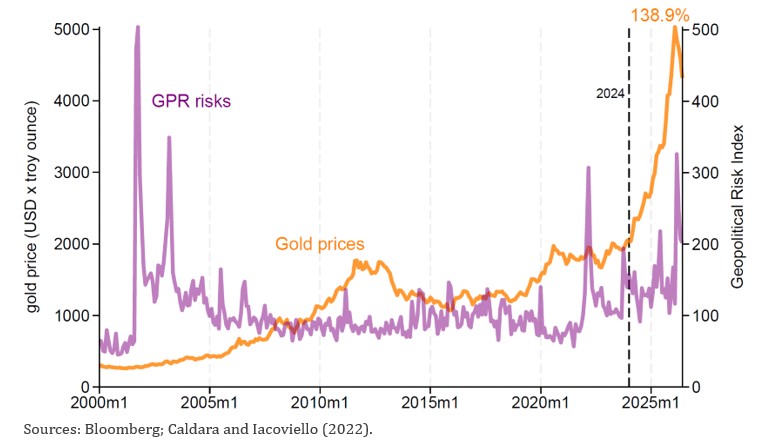
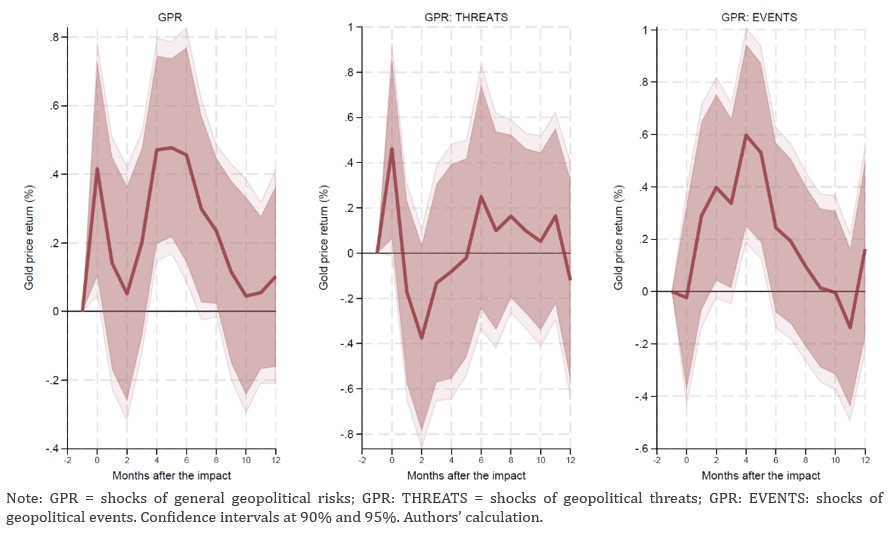
Figure 4 shows the impact of shocks to general geopolitical risks (GPR), geopolitical threats (GPR threats) and geopolitical events (GPR events) on gold price returns. We observe that these shocks generally have positive and statistically significant effects, although their magnitude and duration differ.1
We find that the dynamics of the overall impact of GPR on gold price returns is a combination of the impacts of its two subcomponents: threats and events (Figure 4, first panel). First, there is a short-lived response to GPR threats of 0.45% (second panel), indicating that the impact is contemporaneous and short-lived. Second, a medium-term response of 0.60% emerges from GPR event shocks (third panel), statistically significant at 5% level, reflecting a longer and lagged response from this subcomponent.2
The horizon at which each subcomponent operates requires explanations of why we expect realised events to act with a delay. Geopolitical threats are news about the distribution of future conflict: they arrive in the headlines and are incorporated into prices essentially on impact.
Realised events differ in two key respects. First, a substantial part of the information they contain may already have been priced in – the invasion follows the mobilisation; the strike follows the ultimatum – so what moves prices on the day of the event is only its unanticipated component, which can be small even when the event itself is large. Second, the information revealed by realised event unfolds progressively: markets learn about the expected duration, severity and geographic scope of a conflict, whether the geopolitical event in question will trigger chain disruptions, the sanctions and policy responses it prompts, and the reallocation of official reserves it induces, over weeks and months rather than hours. Under this interpretation, the coefficient at h=0 for geopolitical event shocks on gold returns understates the total effect of an event. The response is expected to build over the subsequent quarter, as observed in the third panel of Figure 4, peaking four months after the shock.
Figure 4. Cumulative impulse response function of GPR shocks on gold price returns
Then, we analyse our principal research question on the impact of geopolitical risks on gold price returns conditional on the levels of global financial conditions.
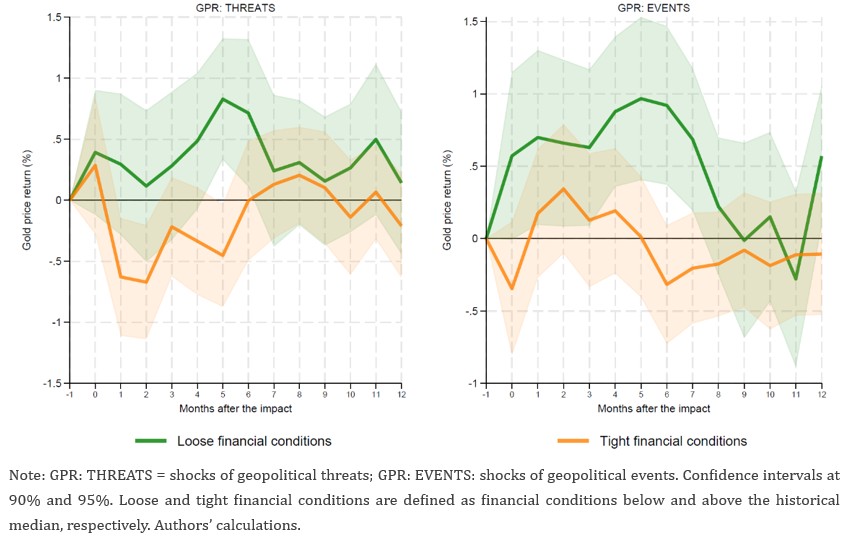
We find non-linear patterns (Figure 5). Under tight conditions, the responses of gold returns to both GPR threats and events are not statistically significant for most of the horizons. There is even a negative response of gold prices to geopolitical threats at the second month after the shock.
Under loose conditions, by contrast, the threats shock elicits a positive response of about 0.6% on impact (h=0), while the cumulative geopolitical event impact peaks at roughly 1.0% around the six-month horizon (h=6), a pattern consistent with fewer frictions when investors rebalance their portfolios.
These results support our main hypothesis: when a geopolitical shock occurs under loose financial conditions – characterised by low financing costs, reduced transaction frictions, and fewer liquidity constraints – safe-haven demand for gold is stronger, leading to larger gold returns following such shocks.3
Figure 5. Cumulative impulse response function of GPR shocks on gold price returns conditional
on loose and tight financial conditions
Finally, we examine the mechanisms through which financial conditions influence the relationship between geopolitical risks and gold returns, separating the relationship into the two channels most commonly examined in the literature: (i) the credit and liquidity risk channel, and (ii) the opportunity cost channel. We analyse each in turn and find that our results operate most clearly through the first channel, while the evidence for the second is less conclusive.
The two channels are:
Credit and liquidity risk channel: During periods of heightened market stress, including episodes following geopolitical shocks, credit and liquidity risks can significantly constrain investors’ ability to allocate capital to safe-haven assets like gold. When credit risk is high – marked by tighter credit conditions and elevated borrowing costs – or when liquidity risk is elevated – characterised by margin calls and forced asset liquidations – investors are often compelled to prioritise meeting short-term obligations rather than reallocating to gold as a safe-haven asset. For instance, margin calls during such periods can trigger asset sales to cover collateral requirements (e.g., Brunnermeier and Pedersen, 2009), leaving little room for portfolio reallocation towards gold. This dynamic was evident during the Covid-19 episode (e.g., Akhtaruzzaman et al., 2021).
The same logic applies on the credit side: widening credit spreads are not merely a symptom of stress but a tightening of financial conditions, operating through the risk-bearing capacity of the financial sector (Gilchrist and Zakrajšek, 2012). When intermediary balance sheets are impaired, risk premium rises across assets because constrained intermediaries cannot take positions, rather than because fundamentals have changed (He and Krishnamurthy, 2013). In contrast, when credit and liquidity risks are low, agents face fewer balance sheet frictions and are better positioned to reallocate to gold in response to geopolitical shocks.
Opportunity cost channel: Low interest rates can reduce the yield sacrifice of holding gold relative to interest-bearing alternatives (e.g. Erb and Harvey, 2013; Chen, Miao, and Tee, 2023). This reduction in opportunity cost makes gold a more attractive investment, particularly during periods of heightened geopolitical uncertainty. However, it is important to note that low interest rates can also introduce opposing effects on this channel. While low rates reduce the opportunity cost of holding gold, they often coincide with periods of economic weakness or recessions, reflecting the business cycle position. In such scenarios, agents may face immediate financial pressures, such as the need to consume or invest in productive or liquid assets to address short-term economic challenges. These financial constraints may dampen the demand for gold as a safe-haven asset, as agents prioritise meeting immediate consumption needs or maintaining liquidity over reallocating to gold. Thus, while the opportunity cost mechanism generally supports higher gold demand during periods of low interest rates, the broader economic context may complicate this relationship, introducing opposing forces that can limit the extent of gold’s safe-haven appeal during geopolitical shocks, as stated in Chen, Miao, and Tee, 2023.
Taken together, our analysis suggest that the state dependence results documented in this previous subsection operate most clearly through the credit and liquidity risk channel and is less conclusive for the opportunity cost channel. Loose financial conditions appear to amplify gold’s safe-haven response to geopolitical shocks by easing frictions that would otherwise prevent or hinder investors’ reallocation towards gold.
We do not, however, interpret these results as ruling out the opportunity cost channel. The two channels are not mutually exclusive, and it is equally plausible that the two channels interact: a low yield sacrifice raises the incentive to hold gold, but investors can act on that incentive only when funding conditions permit investors to take positions. Thus, the second channel may amplify the first without being separately identified in a univariate split of the sample. Disentangling the interaction between the two channels, rather than testing them in isolation, is a natural direction for further analysis.
Akhtaruzzaman, M, S Boubaker, B M Lucey and A Sensoy (2021): “Is gold a hedge or a safe-haven asset in the COVID–19 crisis?”, Economic Modelling, vol 102, p 105588.
Brunnermeier, M K and L H Pedersen (2009): “Market liquidity and funding liquidity”, The Review of Financial Studies, vol 22, no 6, pp 2201–2238.
Caldara, D and M Iacoviello (2022): “Measuring geopolitical risk”, American Economic Review, vol 112, no 4, pp 1194–1225.
Chen, P, X Miao and K-H Tee (2023): “Do gold prices respond more to uncertainty shocks at the zero lower bound?”, Resources Policy, vol 86, p 104057.
ECB (2025): “Gold demand: the role of the official sector and geopolitics”, in International Role of the Euro.
Erb, C B and C R Harvey (2013): “The golden dilemma”, Financial Analysts Journal, vol 69, no 4, pp 10–42.
Gilchrist, S and E Zakrajšek (2012): “Credit spreads and business cycle fluctuations”, American Economic Review, vol 102, no 4, pp 1692–1720.
Guerra, R and G Zelpo (2026): “Chasing El Dorado: gold under shifting geopolitical and financial conditions”, BIS Working Papers, no 1380, 6 October.
He, Z and A Krishnamurthy (2013): “Intermediary asset pricing”, American Economic Review, vol 103, no 2, pp 732–770.
IMF (2025): Global financial stability report: enhancing resilience amid uncertainty.
For further technical aspects and the implemented empirical strategy, consult Guerra and Zelpo (2026).
By placing these results in context, the historical average gold return from 1990 to 2023 was 0.4%, while the recent average gold return from 2024 onwards has been 2.6%, with a standard deviation of 4.2%.
Tests for statistical evidence of non-linearities confirm that our results differ significantly across regimes in most months, particularly for shocks to geopolitical events. We also conduct several robustness checks that account for potential confounding factors. The main results remain consistent.