

The views expressed in this paper are those of the authors and do not necessarily reflect those of the European Central Bank. We are grateful for comments by Irene Heemskerk, Giuseppe Davide Barillà, Andrej Ceglar, Pierre Monnin, Jolien Noels, Victor Smid, Livio Stracca, Agnieszka Trzcinska, Catharine van Wijmen, and Ariana Gilbert-Mongelli.
Abstract
The urgency of addressing climate change has grown since the adoption of the 2015 Paris Agreement, which aims to limit global warming to well below 2°C. Despite its ambitious goals, progress has been hindered by an “ambition gap” and an “implementation gap,” reflecting insufficient climate targets and inadequate actions to meet them. Rising greenhouse gas emissions continue to increase the risk of crossing critical tipping points and breaching planetary boundaries. The climate policy trilemma highlights the need to balance mitigation, adaptation, and restoration. While mitigation is vital to reducing greenhouse gases, adaptation strategies are essential to minimize damages from extreme climate events and buy time for long-term policies. The climate crisis presents complex challenges, including escalating physical and transition risks and deep uncertainty surrounding future climate dynamics, calling for precautionary measures and adaptive policies. Delayed action intensifies these risks, raising costs of adaptation and restoration, and threatening economic stability. Effective policies must address two key dimensions of climate risk management: reaction time — the delay between warnings and policy implementation—and intervention time — the shrinking window to avoid irreversible tipping points. To mitigate these risks, innovative technologies like carbon capture and storage (CCS) and climate-resilient systems, coupled with public-private collaboration, are critical. As extreme weather events become more frequent, adaptive climate policies and decisive action are crucial for global financial stability, economic resilience, and sustainable development. The time to act is now.
The climate crisis is one of the most urgent and far‑reaching challenges of the 21st century. A root cause of climate change is the tragedy of the commons, a situation in which firms and individuals, acting in their own self‑interest, overuse and deplete a common, finite resource, even though this goes against the long‑term best interests of the entire group (Hardin, 1968). When resources, such as water or clean air lack effective governance or clearly defined ownership, overexploitation is likely to occur. The same is happening to our climate. Firms and individuals, with limited incentives to cut greenhouse gas (GHG) emissions, are driving global warming. This, in turn, threatens food security, water availability, human health, and habitable land. If left unchecked, global warming risks crossing “tipping points” that could lock in catastrophic, long‑lasting, or even irreversible changes to the planet.1
Faced with these increasingly alarming trends, the 2015 Paris Agreement stands as a historic and ambitious milestone in global climate governance. It provides a framework to limit the most severe climate impacts through collective action. The agreement enshrines the commitment of 193 countries to limit global warming to well below 2°C — preferably to 1.5°C — above pre-industrial levels by the end of the 21st Century.2 A key objective is to reduce global GHG emissions as quickly as possible in order to achieve climate neutrality by the mid‑21st century, balancing remaining human‑caused emissions with natural absorption. Additionally, the agreement seeks to enhance climate adaptation and resilience, align global finance with low-emission and climate-resilient development, and strengthen national emission-reduction commitments through five-year review cycles.
Despite these ambitious goals and broad-based agreement, progress has been slower than required to limit global warming and uneven across countries.3 TThis is due to both an “ambition gap,” and an “implementation gap” (UNEP, 2021; IPCC, 2022).4 TThe ambition gap reflects that climate targets are collectively insufficient to meet the Paris objectives. The implementation gap refers to the shortfall between stated commitments and the climate policies, actions, and investments undertaken to deliver those goals. It is increasingly apparent that with these two gaps efforts are falling short as GHG emissions continue to rise (albeit at a slower pace).5 If this trend continues, the world faces decades of extreme climate events, escalating with every additional increment of global warming (IPCC, 2022; UNFCCC, 2022; EEA, 2024). A key challenge is that climate change is subject to deep uncertainty.
Uncertain climate trajectories require adaptive climate policies. The trajectory of climate change is deeply uncertain and may involve nonlinear shifts and tipping points. In this context, government, policy makers, firms, investors, and consumers must remain prepared to adjust course of action as new information about climate change as well as innovative technologies emerge. This requires flexible, adaptive climate policies and decision‑making processes that account for potential surprises, while still being anchored in the overarching objective of phasing out net emissions and limiting the most severe climate impacts.6
The climate crisis is not a distant threat — it is unfolding now. According to the latest World Economic Forum Global Risks Report, extreme weather events, biodiversity loss, and ecosystem collapse are projected to intensify, ranking as the top three global risks over the next decade (WEF, 2026). As tipping points loom and urgency increases, the question is no longer whether to act, but how decisive, adaptive, and collective actions can tilt the odds in favour of a sustainable future. It’s a race against time.
The 2015 Paris Agreement presents valuable lessons about what it will take to rise to this unprecedented challenge. Its ambitious objectives, progress, setbacks, and emerging opportunities underscore the need for a clear long‑term emissions reduction target as an organizing framework for planning and implementing green transition strategies. This target provides a reference point against which risks, opportunities, investments, and trade‑offs can be assessed under uncertainty.
In what follows, we raise a series of issues about the current predicament, beginning with the puzzling disregard for a crisis that threatens our very existence. We also look at a set of levers for further accelerating climate action.
There is no simple answer to the lack of adequate collective action in the face of a catastrophe. A combination of barriers might explain the enigma Our collective indifference to the climate crisis might stem from outdated mental models, the distraction of overlapping global crises that take precedence, geopolitical tensions undermining cooperation, and declining policy prioritization, despite publics’ high concern. There might be disillusionment in our ability to collectively address climate change in a timely and effective manner (Eichhorn et al., 2025).
First, indifference to the climate crisis might stem from outdated mental models of the world. Samama (2025) argues that inadequate climate action does not stem from a failure of science, technology, or even politics, but from a “failure of our mental model of the world and how societies understand progress, threats, and responsibilities”. Modern cognitive science reveals that we create models based on past observations, and these model stops being updated leaving us in “societal bubbles”. Samama calls for a “cognitive reframing” and a shift in perspective to trigger a more holistic view of the planet.7
Second, in recent years, a sequence of crises has taken centre stage, unprecedented in their speed, depth, and global reach. The COVID‑19 pandemic in early 2020 and the ensuing lockdowns created bottlenecks, widespread shortages, and severe strains on global value chains. Geopolitical shocks have triggered severe disruptions in global energy and commodity markets, affecting both fossil fuels and critical climate minerals, and have contributed to broader economic uncertainty.8 Furthermore, diverging national interests, armed conflicts and escalating regional tensions have heightened geopolitical risks, undermined trust, and complicated international cooperation, including efforts to coordinate long‑term climate and energy policies. An “unknown” 10 years ago was the increasing energy demand from data centres and AI (IEA, 2025a).
Third, since the initial signing of the Paris Agreement, public sector policy priorities have shifted. Concerns about energy security and affordability prevail over global warming and environmental threats. Geopolitical conflicts and the need to step up defence spending are draining public budgets. The global trade war challenges efforts to advance collaborative progress on strengthening climate policies. Climate policy slips down the political agenda and is often crowded out by these other priorities, which is problematic given that the public sector has already underdelivered on what were modest climate policy commitments to begin with. There is growing “climate regulation fatigue,” alongside resistance to additional rules designed to compensate for persistently low carbon prices.
Fourth, policy debate has paid less attention in recent years to the urgent need to step up climate action. This reflects a persistent awareness gap and cognitive deficit, with limited recognition by the public at large of the climate dynamics in motion, and the risks they entail (Hondroyiannis et al., 2022; Mongelli, 2023). At the same time, economic challenges such as high inflation and reduced affordability have intensified. Attitudes toward climate have shifted in recent years, a change most pronounced in the US, Canada, and Europe. For example, recent polls show that the share of people who view climate change as a major threat has decreased in many of the high-income countries, whereas in countries such as Brazil and India, levels of concern increased.9 Public opinion spans a wide spectrum — from climate change denial to the view that society can live with projected levels of warming and that health, technology, and prosperity will provide sufficient protection. Furthermore, political polarization has grown in the US and Europe and far-right groups are more likely to deny climate change and oppose the implementation of the Paris Agreement (Jylhä et al., 2020). Corporate interests might prefer the convenience of fewer regulations.
These four barriers underscore the need to confront the urgency of effective climate policies head-on. While the barriers are formidable, there are also opportunities for innovation and progress that demonstrate the potential for impactful change — if ambition, commitment, and implementation are scaled up with urgency. The next sections explore why decisive climate action is essential and how it can be achieved — if ambition, policy, and implementation are rapidly scaled up.
Recent years have been marked by several climate-change related crises causing widespread damages. Most notably the deadly, record-breaking heatwaves across Europe and South Asia which caused tens of thousands of excess deaths and shattered temperature records. Events scientists determined were made vastly more probable by human-caused climate change. This trend of extreme weather is also evident in the catastrophic flooding events in Pakistan in 2022, Brazil in 2024 and Valencia in 2024, where warmer air holding more moisture led to massive displacement, loss of life and widespread destruction. Compounding these crises are unprecedented wildfire seasons, such as the “Black Summer” fires in Australia (2019-2020) and record-setting blazes in Canada (2023), where prolonged droughts and soaring temperatures created perfect conditions for highly destructive, fast-spreading infernos. In January 2025 a series of catastrophic wildfires raged in Southern California with losses of lives, properties and wildlife (Eaton, Palisades and Altadena fires).10 The 2024 Yagi typhoon was the strongest to hit Vietnam in 70 years. In recent years, climate change-induced extreme heat and dry conditions also fuelled extensive wildfires in Spain, Portugal, Greece, Turkey, Russia, Australia, Indonesia, Algeria, Chile and across the Balkans, amongst others. In short, more people are living through extreme climate events.
The urgency of effective climate policies to mitigate such extreme events in the future hinges on understanding a critical relationship between reaction time and intervention time. On one side is the reaction time to scientists’ alerts on tipping points—how long it takes most countries to agree on and implement a successful response at yearly COPs. On the other side is the rapidly shrinking intervention time to prevent those tipping points from being breached, i.e. the window before a climate tipping point is irreversibly crossed (Lenton et al., 2019). This gives rise to two forms of inertia: one in climate policy and another in the geophysical system itself. Inertia in policy involves the sluggish process of policy agreement, implementation, and periodic reviews. Inertia in geophysical processes implies that mitigation might only bring benefits with long lags. As a result, the climate might continue warming, exposing the world to an increase in extreme climate events and to risk stemming from diverse non-linearities, such as planetary boundaries, tipping points, and compound hazards.11 Together, these inertia generate deep uncertainty, and sharply increase the odds of crossing climate tipping points.
Over the past decades, fortunately, important progress has been made in understanding the effects of climate change. Climate data and models have become more refined, understanding of the interactions between ecosystems, societies, and the economy has deepened, and the contours of the climate policy are clearer. We are also understanding the significant vulnerability to ecosystem degradation and dependence on nature service (Ceglar et al., 2025). At the same time, major limitations and caveats remain. At a fundamental level, it is still impossible to forecast the future climate trajectory and its implications with great precision. Ten years after the 2015 Paris Agreement, worsening climate scenarios should therefore give renewed momentum to the climate policy debate, and the central question is which combinations of public policy and private‑sector involvement, and innovation can still “tilt the odds” away from catastrophic outcomes. Before moving there, we first need to understand one critical challenge: the climate policy trilemma.
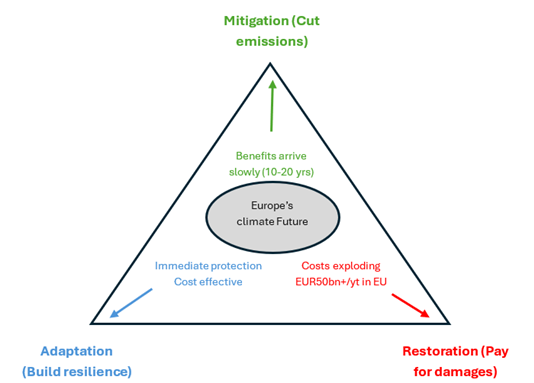
Within a dynamic and deteriorating geophysical system the world is facing a climate policy trilemma. In the case of Europe, for instance, this trilemma involves inadequate mitigation, insufficient and underfunded adaptation, and rapidly rising damage and restoration costs (see Figure 1). Financing needs and gaps remain large for mitigation but are even greater for adaptation (Mongelli et al., 2024). The trilemma underscores the need both to accelerate mitigation — to reduce and ultimately reverse GHG accumulation — and to rapidly scale up adaptation to contain rising damages and restoration needs from extreme climate events (Bilal et al., 2024). Decisive adaptation creates time for climate policies to work, whereas delayed action becomes progressively riskier, costlier, and potentially less effective.
Figure 1. The Climate Trilemma: mitigation is essential but slow to take effect, restoration alone is unsustainable, and adaptation remains the neglected middle ground
Part of the trilemma is also the recognition that transition risks and physical risks are not substitutes that offset each other if action is delayed; they amplify each other. If mitigation is postponed, such as the green energy transition, greenhouse gas concentrations in the atmosphere will keep rising, geophysical inertia lock in additional warming, and physical risks (extreme events, tipping points, restoration costs) will increase.12 At the same time, the later a serious transition starts or accelerates, the steeper and more disruptive that transition must be — raising transition risks for firms, workers, financial systems and public finances.13 Delayed action on either front makes overall climate, economic and financial risks increasingly higher and more costly to manage.
The climate policy trilemma — balancing mitigation, adaptation, and restoration — further has two profound implications for macro-financial stability. First, climate hazards and extreme events reduce GDP, weaken fiscal indicators and debt sustainability, and negatively affect credit ratings and borrowing costs for sovereigns and corporates. This, in turn, leaves fewer financial resources available to finance mitigation efforts such as the green energy transition. Second, increasing climate hazards and extreme events must be absorbed by insurance and other risk‑sharing arrangements to buffer their adverse economic and financial impacts. Where such coverage is lacking, losses either must be met through ad hoc, ex post government support or be fully borne by households, firms, and financial institutions. As a result, again fewer resources would be available to finance mitigation. These concepts underpin the NGFS macro-scenarios that are discussed next.14
Experts warn that as cumulative GHG emissions continue to rise at a pace incompatible with the 2015 Paris Agreement targets, both transition and physical risks will grow more severe and become even less predictable. In parallel, the task of slowing and ultimately reducing emissions will become increasingly challenging. NGFS macro‑scenarios vividly capture this impasse, as they weigh the timeliness and strength of both adaptation and mitigation efforts. At the cost of some oversimplification—but with significant benefits in addressing the awareness gap and cognitive deficits — it is useful to think in terms of four extreme but plausible developments (see Figure 2).
The NGFS distinguishes three “orderly” scenarios. In these scenarios rapid adaptation and a swift transition to a low‑carbon economy reduce future climate risks: Low Demand, where behavioral change, carbon pricing, and technology lower energy use and help reach global net zero CO₂ around 2050; Below 2°C, where gradually tightening climate policies give a two‑thirds chance of limiting warming below 2°C; and Net Zero 2050, where very stringent policies and innovation limit warming to 1.5°C with net zero around mid‑century. At the opposite end, a “too little, too late” scenario, Fragmented World, features delayed and uneven action, high physical and transition risks, and only partial delivery on net‑zero pledges. Two “hot house world” scenarios, Nationally Determined Contributions and Current Policies, involve limited further mitigation — either only pledged targets or just today’s policies — resulting in high physical but low transition risks. Finally, in the “disorderly” Delayed Transition scenario, emissions do not fall before 2030, forcing much stronger later policies to keep warming below 2°C.
Figure 2. Key NGFS scenarios along physical risks and transition risks dimensions
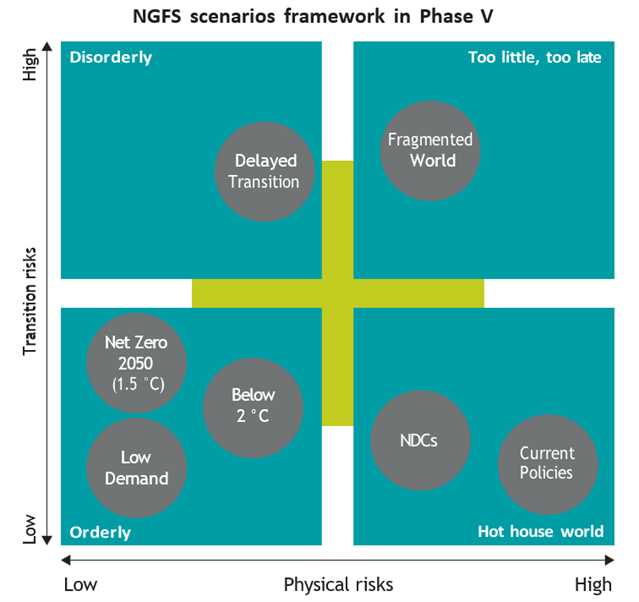
Source: https://www.ngfs.net/ngfs-scenarios-portal/explore/. Note: Positioning of scenarios is approximate, based on an assessment of physical and transition risks out to 2100.
These contrasting scenarios are not merely abstract constructs: they reveal deep uncertainty about climate dynamics and tipping points. Therefore, they reinforce the case for robust precautionary action (Broeders and Schlooz, 2021).15 Many future climate impacts — and the timing and magnitude of possible disasters — are not just unknown but may be fundamentally unknowable with current scientific tools, beyond the scope of standard statistical risk assessment (Bolton et al., 2020). It is also important to note in this context that many climate-economic models do not anticipate accurately the possible unfolding of tail climate-related risks. Because scientists cannot quantify worst‑case possibilities, conventional cost–benefit analysis is an inadequate guide to policy. A precautionary approach therefore holds that society should act strongly and early to avoid potentially irreversible, catastrophic harm at tipping points, even without complete certainty — and precisely because the world may be drifting from an orderly transition toward a “too little, too late” scenario (Chenet et al., 2021; Gollier and Treich, 2023).
The last moment at which a precautionary approach remains both effective and affordable is not the tipping point itself: it lies well before it. This is because crossing a tipping point often means triggering irreversible changes with significant latency. If humanity’s reaction time exceeds the intervention time remaining, risks are more likely to materialize, forcing humanity into crisis management and recovery rather than prevention. Effective ex-ante prevention is only possible when reaction time is shorter than intervention time, making early, proactive action essential long before the climate system reaches the physical brink. A window of effective climate intervention is the critical period during which specific mitigation and adaptation actions can produce the most positive outcomes.16
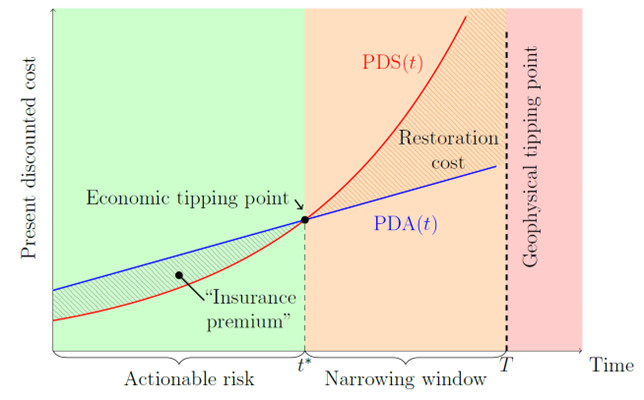
Building on this logic, deep uncertainty does not simply argue for “more” or “earlier” climate action: it calls for acting before the window of effective intervention closes. Rather than emphasizing only the scale of action, it focuses attention also on timing — on the narrowing period in which mitigation can still prevent dangerous, potentially irreversible shifts in the Earth’s geophysical system. Suppose a climate tipping point could occur around (uncertain) time t = T. Well before T, the risk is still actionable: humans can collectively take measures to avoid crossing the tipping point, and mitigation efforts can still have a large effect. We assess this by comparing the present discounted cost of adaptation (PDA) with the present discounted cost of the severity of a tipping point (PDS). The PDA measures the expense of planning and implementing actions like building dikes or transitioning energy systems to moderate harm. This can be regarded as an “insurance premium” that helps avoid the need for crisis measures and large-scale restoration costs later on. Early on, the PDA is above the present discounted cost of the severity of a tipping point (PDS)—the extensive damages, economic losses, and potential societal disruption that would result from inaction. Figure 3 is provided for illustrative purposes and to build intuition. As we move closer to T, however, the risk becomes progressively less actionable. Simultaneously, the less action taken to avoid the tipping point, the more severe and potentially catastrophic the eventual impact becomes, causing the PDS to rise exponentially. At some point, well before T, these two trajectories cross in an economic “tipping point”. Beyond this point, avoiding the tipping point would start requiring extreme, draconian measures, and it may in practice become unavoidable as the PDS has ballooned and the window for affordable, efficient prevention has closed. Early, precautionary climate action therefore acts as a hedge against the cost of catastrophic impacts and extreme, draconian interventions later. At the same time, the cost of this hedging should not be allowed to undermine the current economy. There are examples of actionable risks from recent history.
Figure 3. Economic tipping point
Collective actions have successfully addressed environmental and health threats in the past. Examples include the international response to acid rain in the 1980s, when coordinated policies such as sulphur dioxide (SO₂) emission caps, flue‑gas desulfurization (“scrubbers”), and changing energy sources to fuels that contain less sulphur in Europe and North America led to sharp reductions in transboundary air pollution and a gradual recovery of affected ecosystems. Similarly, the 1987 Montreal Protocol on Substances that Deplete the Ozone Layer, strengthened by subsequent amendments, mandated a global phase‑out of chlorofluorocarbons (CFCs) and related chemicals. As a result, atmospheric concentrations of ozone‑depleting substances have declined, and the ozone layer is on track to recover over the course of this century, demonstrating that timely, science‑based multilateral cooperation can reverse severe environmental damage.
Moreover, collective action has successfully addressed other threats in the past. To address concerns about the Year 2000 software bug, airplanes were grounded and hospitals were secured. Faced with Covid-19, societies mobilized at unprecedented and life-saving speed. In the context of past global challenges, history shows that solutions are possible, given adequate policy responses. However, while these examples could be addressed with targeted measures and without overhauling of the entire economy, climate change might be more arduous. It requires more structural changes to the economy and a widespread shift in global awareness, cognition and behaviour. A large number of similar successes, both big and small, would be needed simultaneously time in the future. In the next section, we review key levers that can improve the odds on climate outcomes by accelerating the transition to a green economy.
Solutions to the tragedy of the commons, in theory, include assigning property or usage rights to resources such as water or clean air. In this way, negative externalities like pollution can be internalised by the owner giving them an incentive to maintain them. This, however, is not straightforward. Critics argue that full privatisation of essential resources can endanger access for vulnerable groups, especially as water is widely recognised as a basic human right. Other approaches therefore include government regulation—for example, quotas or taxes that limit use. Further, community management offers another path, whereby local groups develop their own rules and institutions for sustainable resource use and nature preservation (Ostrom, 1990). An important additional element is that the transition must be inclusive both within countries and across countries, and factor in historic contributions to GHGs accumulation. Without fairness in how costs and benefits are shared, it is unlikely to proceed at the necessary scale and speed, because societies will resist and reject it, regardless of how clear or urgent the scientific warnings may be. The state of climate adaptation and resilience further acquires a broad and systemic perspective.17
Many countries have introduced green industrial policies and financial incentives to address climate change. These measures include large clean‑energy support packages that have been instrumental in accelerating the deployment of renewables. Prominent examples are the 2019 European Green Deal, the US Inflation Reduction Act (IRA), and China’s successive five‑year plans for clean energy. Although the pace of decarbonisation implied by the Paris Agreement remains insufficient — due to uneven implementation of climate commitments in nationally determined contributions (NDCs) — and current trajectories still undershooting climate targets, the Paris Agreement nonetheless marked a groundbreaking turning point in global climate governance.
Despite falling short of climate targets, several promising levers for accelerating climate action have emerged, while some obstacles may be addressed. Below six of them are briefly discussed:
Lever 1. Progress in renewable energy. One of the positive developments of the decade following the signing of the Paris Agreement has been the rapid deployment of renewable energy by the private sector.18 Renewables account today for about 30% of global electricity supply up from about 23% in 2015 (IEA, 2025b). The year 2025 marked a significant milestone in Europe’s energy transition, as wind and solar energy combined to generate more electricity than fossil fuels for the first time in the EU power mix.19 Between 2023 and 2025, over 90% of newly added power generation capacity came from renewables. Solar photovoltaics (PV) and wind power drove most new capacity additions. In many regions, solar PV is now the cheapest source of electricity thanks to cost declines of nearly 90% since 2010. By contrast, deployment of wind power is constrained by supply-chain pressures, permitting delays, and higher capital costs. Battery storage technologies, which were virtually absent in 2015, scaled up significantly by 2025. This in turn improves grid flexibility and supports the integration of variable renewable sources. Hydropower, geothermal, and bioenergy experienced more modest growth due to environmental, geographic, and other limitations. Addressing these supply chain issues is vital to scaling up clean energy transitions.20 Studies estimate that the global deployment of renewables from 2015–2025 avoided about 7–10 gigatonnes (Gt) of CO₂ that would otherwise have been emitted by fossil-fuel power plants. To set this into context: annual global CO₂ emissions are ~36–37 Gt.21
Lever 2. Remove industrial and governance bottlenecks to scale the transition. The next phase of climate action should focus on structural barriers that slow progress or increase the cost of the clean‑energy transition. For governments, this involves reviving and strengthening global climate governance and enhancing the credibility of domestic policy frameworks. For the private sector, the primary obstacles are industrial, technical, and financial. Key priorities include expanding and reducing the cost of smart grids, which currently lag renewable deployment as well as addressing intermittency by scaling up storage and demand‑side flexibility. Smart grids are electricity networks that use digital technologies, sensors, communication systems, and automation to monitor and manage the flow of electricity in real time. Another priority is securing resilient supply chains for critical minerals such as lithium, cobalt, and other rare earths. If these bottlenecks and geophysical constraints are effectively addressed, existing technologies and capital could scale more rapidly, enabling a shift from incremental progress to a truly systemic clean‑energy transition.
Lever 3. Aim for climate policy certainty, clarity and harmonization. To pursue energy security, affordability and sustainability, policymakers need to create a predictable environment for sustained investments in renewable energy sources (Lagarde, 2025). Investors will not step forward if the green transition is clouded by uncertainty; especially if they also see growing pushback against green initiatives. Creating the right environment begins with credibility: following through on existing green targets and steadily raising the carbon prices to reflect the true social costs of carbon emissions on the environment.22 Shortening approval processes is also beneficial. In the European Union, for instance, completing the permitting process can take up to five years for utility-scale solar photovoltaic projects and up to nine years for onshore wind projects (IEA, 2025c).
Building and operating a renewables-based energy system entails high “system costs”. These include substantial investments in new renewable generation capacity and modernised, interconnected smart grids. The European Commission estimates that these will require an annual investment of nearly € 150 billion. Such costs may rise if restrictions on critical raw materials increase input costs or delay projects, or in cases of energy curtailment, when renewable output is deliberately reduced to keep the system balanced. Such composite costs will be passed on to energy bills at least for some years (Helm, 2025). Yet, considering the whole decarbonising of industry, transport and energy supply, the financing needs for the green transition are even larger and are estimated at € 1.2 trillion per year (European Commission, 2023). The private sector will have to account for over two-thirds of this investment (Bouabdallah et al., 2025).
Lever 4. Deploy more innovative finance. Even though Europe has ample private savings, current financing arrangements are not channelling this supply towards demand. Nearly four in ten European firms see the lack of investor willingness to finance green investment as a significant obstacle (Lagarde, 2025). The types of funding encompass bank loans, loans with fiscal support, retained earnings, debt securities and equity (Andersson, et al. 2025). A weak link here is capital markets: debt and equity financing currently rank lowest among the funding sources that firms expect to use for green investment. Deepening and integrating EU capital markets is critical to supporting the large-scale investments needed. Closing the climate investment gap requires not just more capital, but smart financial structures that can mobilize private investment at scale. Innovative finance aims to reduce risks, lower the cost of capital, and align financial incentives with long‑term climate goals.
One avenue is the growth of blended finance and innovative climate bonds, where public funds are used to “crowd in” private capital. If governments provide first‑loss tranches or credit guarantees this can make projects more attractive to finance and that would otherwise be considered too risky (Monasterolo et al., 2025). Another area is the growth of green, sustainability‑linked, and transition bonds and loans. Green bonds earmark proceeds for climate‑aligned projects, while sustainability‑linked instruments tie the pay-off to the achievement of emissions‑reduction or other environmental targets. Transition finance is emerging to support high‑emitting sectors — such as steel, cement, and shipping — in credibly moving toward lower‑carbon technologies rather than being starved of capital altogether. Ensuring robust taxonomies and disclosure standards is essential here to avoid greenwashing and to maintain investor confidence. Climate-linked bonds can accelerate the transition process by directly aligning governments’ financial incentives with climate action, encouraging immediate mitigation efforts. The bonds’ structure, where payouts are linked to climate variables, means the present discounted cost of servicing the debt decreases with better climate outcomes, providing a long-term fiscal motivation for effective climate policies and continuity across administrations. By distributing long-term climate risks and enhancing market pricing, these bonds signal a credible commitment to a net-zero future, mobilizing private sector investment in sustainable practices (Broeders et al., 2025). Furthermore, innovative instruments should be complemented by mainstreaming climate objectives in traditional finance, with macroprudential policy using targeted buffers and incentives to steer funding toward credible transition activities, away from non‑transitioning firms, thereby safeguarding financial stability (Ikeda and Monnin, 2024).
Lever 5. Allow for adaption in climate policy while retaining overall targets. Effective adaptability to changing circumstances and new information is crucial for a successful climate transition, as it allows policies and practices to evolve alongside emerging insights, technologies, and societal preferences. In complex systems like the climate and the economy, outcomes cannot be predicted or controlled with any mathematical precision. There will be potential surprises. Therefore, flexible approaches help decision-makers adjust course when assumptions prove inaccurate or new opportunities arise. This adaptability minimizes the risks of being locked into ineffective pathways and allow for responses to more-frequent-than-expected extreme weather events or faster-than-expected cost declines in low-carbon technologies. At the same time, maintaining clear long-term objectives while allowing short- and medium-term strategies to be revised increases the likelihood that mitigation and adaptation efforts remain feasible, cost-effective, and publicly legitimate. By embedding adaptability, societies can better navigate the transition without relying on a fixed, predetermined path to net‑zero emissions.
Lever 6. Increase the role for “carbon management”. Carbon management includes various techniques such as carbon dioxide removal (CDR), carbon capture and storage (CCS), and carbon capture, utilization and storage (CCUS). The IPCC highlights that, if we are to achieve the ambitions of the 2015 Paris Agreement and limit future temperature increases, we must do more than just increasing efforts to reduce emissions – we also need to deploy technologies to remove CO2 from the atmosphere. The IPCC defines CCS as a “process in which a relatively pure stream of carbon dioxide (CO2) from industrial and energy-related sources is separated (captured), conditioned, compressed and transported to a storage location for long-term isolation from the atmosphere.” (IPCC, 2022). The Potsdam Institute for Climate Impact Research (PIK) is especially interested in options to remove carbon from the atmosphere (CDR), and approaches to capture and store CO2 emissions (carbon capture, storage and usage, CCUS), comprising both biogenic and anthropogenic carbon flows (Strefler et al., 2021).23 The current combined contributions of carbon management approaches seems in the range of 0.1% of current GHG emissions, but the technologies are fast advancing and hold potential in specific sectors such as cement production and oil refining.24
Over the first decade efforts to achieve the goals of the 2015 Paris Agreement have not unfolded as planned. We are witnessing an increasing number of extreme climate events linked to global warming. This underscores that unabated GHG emissions continue to drive ongoing global warming accompanied by rising extreme climate events. Scientists warn of tipping points and trespassing planetary boundaries, introducing unprecedented risks to geophysical systems. Yet the agreement remains a cornerstone of global climate governance and its framework can support further collective actions. At the same time, over the last ten years we have learned important lessons and witnessed a rising role for the private sectors and witnessed the strengthening of various policy and financial levers.
The world is now facing two important risk management dimensions: reaction time and intervention time. The first, reaction time, stems from the delay between scientists’ warnings about severe climate risks — such as tipping points and planetary boundaries — and the implementation of effective climate policies. It captures the time required for countries to agree and implement a response, for example through annual COP meetings. Climate policy responses need to be commensurate not only to past climate impacts but especially with future climate hazards. The second dimension, the intervention time, emerges from the shrinking intervention window in which we can still prevent breaches of tipping points and planetary boundaries. This window is the remaining time available before a climate tipping point is irreversibly passed.
These risk management dimensions ideally need to be addressed jointly, including by climate sceptic jurisdictions. Even climate sceptics have an incentive to reduce emissions because it preserves future flexibility under uncertainty. This allows society to respond adaptively to scientific evidence about the risks of crossing tipping points, which may otherwise lead to irreversible damage (van Wijnbergen and Willems, 2015). Doing right for the right reasons requires balancing human welfare with urgent climate action. This requires dual action: forcefully curbing temperature increases through mitigation, while simultaneously strengthening adaptation and resilience measures to live with higher temperatures. Achieving net-zero emissions requires not just more climate policies but carefully designed policy packages that use diverse instruments, account for their interactions and sequencing, and are informed by stronger ex‑post evidence on what works in different country and sectoral contexts (OECD, 2025).
Despite the setbacks, the last decade has also brought diverse advancements that are helping to turn the tide. There is an increasing role by the private sector and the free market. While public sector efforts to decarbonize have fallen short since the signing of the 2015 Paris Agreement, encouragingly, private sector innovation and ingenuity — such as renewable technologies — have compensated somewhat. However, scalability faces bottlenecks, including limited access to rare earths and essential minerals like copper and aluminium. Investments in affordable energy storage for households and seasonal renewable deployment are critical to managing these risks and are within reach.
Given the undershooting of the Paris Agreement goals, the public and private sectors face different challenges. For signatory countries there is a need to safeguard and strengthen global climate governance. For the private sector instead, the challenges are largely scientifical, technological, industrial and financial. There is a need to: expand and reduce costs of smart grid that are lagging renewable deployment; address the intermittency of renewables without adequate storage; secure critical mineral supply chains (e.g., for lithium, cobalt, and rare earths); simplify and harmonize permitting and land-use conflicts; and reduce financing costs for large projects.
Humanity is in a collective race against time. The race is tight, but it is one that can still be won. The central message that emerges is not one of inevitability, but of choice under time pressure. Climate risks will not stand still, but neither will human ingenuity. Progress will be shaped by how quickly policies catch up with science, how effectively public and private sectors work together, and how rapidly mitigation, adaptation, and innovative finance are scaled and integrated. Acting now — forcefully curbing emissions while building resilience — does more than reduce future damage; it preserves flexibility, anchors expectations, and keeps orderly transition scenarios within reach.
Andersson, M. et al. (2025), “Green investment needs in the EU and their funding,” Economic Bulletin, Issue 1, ECB, available here: https://www.ecb.europa.eu/press/economic-bulletin/articles/2025/html/ecb.ebart202501_03~90ade39a4a.en.html.
Bateson B., and S. Rothstein (2024), “Will climate risk trigger the next great financial crisis?,” Green Central Banking, available here: https://greencentralbanking.com/2024/03/28/will-climate-risk-trigger-the-next-great- financial-crisis/.
Bilal A. and D. R. Känzig (2024) “The macroeconomic impact of climate change: Global vs. local temperature,” NBER Working Paper 32450 see: http://www.nber.org/papers/w32450.
Black S., J. Chateau, F. Jaumotte, I.W.H. Parry, G. Schwerhoff, S.D. Thube, and K. Zhunussova (2022), “Getting on track to net zero: Accelerating a global just transition in this decade,” IMF Staff Climate Note 2022/010, available here: https://doi.org/10.5089/9798400223877.066.
Bolton, P., M. Despres, L. Awazu, P. da Silva, F. Samama and R. Svartzman (2020), “The Green Swan,” Bank for International Settlements, BIS Books, no. 31, available here: https://www.bis.org/publ/othp31.pdf.
Bouabdallah, O. et al. (2025), “Time to be strategic: How public money could power Europe’s green, digital and defence transitions,” The ECB Blog, ECB, 25 July, available here: https://www.ecb.europa.eu/press/blog/date/2025/html/ecb.blog20250725~f26b4ef0f3.en.html.
Broeders, D., and M. Schlooz (2021), “Climate change uncertainty and central bank risk management,” Journal of Risk Management in Financial Institutions, 14(2), 121–130.
Broeders, D., D. Dimitrov, and N. Verhoeven (2025), “Climate-linked bonds,” ECB Working Paper No. 3011, available here: http://dx.doi.org/10.2139/ssrn.5091140.
Ceglar A., M. Jwaideh, E. O’Donnell, F. Danieli, C. Pasqua, J. Hutchinson, F. Cimini, J. Sabuco, J. Alvarez, N. Ranger, I. Heemskerk (2015), “Nature at risk: Implications for the euro area economy and financial stability Economic and financial risks stemming from degradation of ecosystem services,” ECB Occasional Paper Series 380.
Chenet, H., J. Ryan-Collins, and F. van Lerven (2021), “Finance, climate-change and radical uncertainty: Towards a precautionary approach to financial policy,” Ecological Economics, vol. 183, May.
European Commission (2023), “Investment needs assessment and funding availabilities to strengthen EU’s Net-Zero technology manufacturing capacity,” Commission Staff Working Document, available here https://single-market-economy.ec.europa.eu/publications/staff-working-document-investment-needs-assessment-and-funding-availabilities-strengthen-eus-net_en.
EEA (2024) “European Climate Risk Assessment 2024,” Report 1.2024, available here: https://www.eea.europa.eu/publications/European-climate-risk-assessment.
Eichhorn, J. and H. Grabbe (2025), “Europeans still want climate action, but don’t trust governments to deliver,” Policy Brief 08/2025, Bruegel, available here: https://www.bruegel.org/policy-brief/europeans-still-want-climate-action-dont-trust-governments-deliver.
Gollier, C., and N. Treich (2003), “Decision-making under scientific uncertainty: The economics of the precautionary principle,” Journal of Risk and Uncertainty 27, 77–103.
Hardin, G. (1968), “The tragedy of the commons,” Science 162(3859): 1243-48.
Helm, D. (2025), “The price of energy and the system costs of renewables,” available here: https://dieterhelm.co.uk/energy-climate/the-price-of-energy-and-the-system-costs-of-renewables/.
Hondroyiannis G., E. Papapetrou, and P. Tsalaporta (2022), “New insights on the contribution of human capital to environmental degradation: Evidence from heterogeneous and cross-correlated countries,” Energy Economics, 116, 106416.
IEA (2025a), “Energy and AIFehler! Linkreferenz ungültig.,” International Energy Agency, available here: https://www.iea.org/reports/energy-and-ai.
IEA (2025b), “Global Critical Minerals Outlook 2025,” International Energy Agency, available here: https://www.iea.org/reports/global-critical-minerals-outlook-2025/overview-of-outlook-for-key-minerals.
IEA (2025c), “IEA Support to Accelerating Renewable Energy Permitting (ARPE),” International Energy Agency, available here: https://www.iea.org/reports/iea-support-to-accelerating-renewable-energy-permitting-arpe.
Ikeda, S. and P. Monnin (2024), “Principles for addressing climate systemic risks with capital buffers”, CEP Policy Brief, https://www.cepweb.org/principles-for-addressing-climate-systemic-risks-with-capital-buffers/.
IPCC (2022), Global Warming of 1.5 ºC, Special Report, Intergovernmental Panel on Climate Change, https://www.ipcc.ch/sr15/.
Jylhä, K.M., P. Strimling, and J. Rydgren (2020), “Climate Change Denial among Radical Right-Wing Supporters,” Sustainability, 12(23), 10226, https://doi.org/10.3390/su122310226.
Lagarde C. (2025), “Europe’s road to renewables,” speech at Norges Bank’s Climate Conference, available here: https://www.ecb.europa.eu/press/key/date/2025/html/ecb.sp251021_1~a1cd961530.en.html.
Lenton T.L., J. Rockström, O. Gaffney, S. Rahmstorf, K. Richardson, W. Steffen, and H.J. Schellnhuber (2019), “Climate tipping points — Too risky to bet against,” Nature 575, 592-595.
Monasterolo, I., M. Pagano, A. Pacelli, and C. Russo (2024) “A European Climate Bond”, CEPR Discussion Paper Series nr 18988, SSRN, see: https://ssrn.com/abstract=4701414
Mongelli, F.P. (2023), “The green energy transition, part 1: Background and hurdles,” in Gollier, C. and D. Rohner (eds), Peace not Pollution: How Going Green Can Tackle Climate Change and Toxic Politics, CEPR Press, Paris & London.
Mongelli, F.P., A. Ceglar and B. Alois Scheid (2024), “Why do we need to strengthen climate adaptations? Scenarios and financial lines of defence,” ECB Working Paper No. 3005, available here: https://www.ecb.europa.eu/pub/pdf/scpwps/ecb.wp3005~35f938a452.en.pdf.
Nordhaus, W.D. (2017), “Revisiting the social cost of carbon,” Proceedings of the National Academy of Sciences, vol. 11(7), 1518-23.
OECD (2025), “Packaging and sequencing policies for more effective climate action,” OECD Net Zero+ Policy Papers, https://www.oecd.org/en/publications/packaging-and-sequencing-policies-for-more-effective-climate-action_fced4e28-en.html.
Ostrom, E. (1990), “Governing the commons: The evolution of institutions for collective action,” Cambridge University Press.
Parry, I.W.H., S. Black, and K. Zhunussova (2022), “Carbon Taxes or Emissions Trading Systems?: Instrument Choice and Design,” IMF Staff Climate Notes 2022/006, available here: https://doi.org/10.5089/9798400212307.066.
Samama, F. (2025), “The Enigma of Climate Inaction: Why Are We Doing Nothing (or Almost Nothing) in the Face of Catastrophe?,” Routledge.
Stern N. (2022) “New approaches to the economics of climate change: Urgency, scale, opportunity,” Princeton Economics, https://www.youtube.com/watch?v=zDbOh-Lnx5M.
Strefler, J., E. Kriegler, N. Bauer, G. Luderer, R.C. Pietzcker, A. Giannousakis, and O. Edenhofer (2021), “Alternative carbon price trajectories can avoid excessive carbon removal,” Nature Communications, 12, 2264.
UNEP (2021), “Emissions Gap Report 2021: The Heat Is On – A World of Climate Promises Not Yet Delivered,” United Nations Environment Programme, available here: https://wedocs.unep.org/items/a72e3be5-2204-4590-a65d-ea8f64c588d7.
UNEP (2025a), “Off Target: The Emissions Gap Report 2025,” see: https://www.unep.org/resources/emissions-gap-report-2025.
UNEP (2025b), “Running on Empty: Adaptation Gap Report 2025,” see: https://www.unep.org/resources/adaptation-gap-report-2025.
UNFCCC (2022), UN Climate Change Annual Report 2022, available here: https://unfccc.int/sites/default/files/resource/UNClimateChange_AnnualReport_2022.pdf.
van Wijnbergen, Sweder and Tim Willems (2015), “Optimal learning on climate change: Why climate skeptics should reduce emissions,” Journal of Environmental Economics and Management, 70: 17-33.
WEF (2026), Global Risks Report 2026, World Economic Forum, available here: https://www.weforum.org/publications/global-risks-report-2026/.
These “tipping points” include planetary boundaries, geophysical thresholds, and other forms of climate‑ and nature‑related non‑linear change. The tipping points likely to be crossed earlier than previously thought, include: the collapse of Greenland’s and West Antarctic’s Ice Sheets; collapse of ocean circulation in the polar region of the North Atlantic; die off of the Coral reef in the Southern Hemisphere; the thawing of permafrost in the Northern Hemisphere (GHGs released); and the loss of sea ice in the Barents Sea (Stern, 2022). The vanishing ice sheets reduce the reflection of solar heat. Scientific evidence also points to rising sea levels and coastal flooding; increasing frequency and intensity of hurricanes, droughts, and fires; food and water scarcity in some regions; losses in biodiversity; and heat stress, air pollution, and disease transmission (IPCC, 2022, Chapter 3).
The COP21 in Paris was concluded with an agreement on 12th December 2015, while the actual signing of the Paris Agreement was on 22nd April 2016. Today over 140 countries still have net-zero targets.
See https://climateactiontracker.org/, www.climatewatchdata.org/net-zero-tracker, and https://globalenergymonitor.org/.
Parry et al. (2022) and Black et al. (2022) argue that “measures equivalent to a global carbon price exceeding $ 75 per tonne by 2030 are needed to stay below 2°C, whereas the current global average carbon price is only $ 5 per tonne”.
The carbon budget originally calculated in 2015 for a 50% chance of limiting warming to 1.5°C above pre-industrial levels is almost eroded and the room of manoeuvre for limiting warming to 2.0°C is closing.
Potential surprises is central to British economist George Shackle’s decision-making theory under uncertainty, where outcomes are valued by their perceived possibility rather than mathematical probability. Shackle emphasized the potential for surprise—how much an outcome deviates from expectations.
When Apollo 17 photographed Earth from space, it revealed our planet as a distinctive blue sphere in darkness, a “Blue Marble”. Astronauts described the resulting “overview effect,” a shift in perspective that we should strive to regain.
The IEA argues that restrictions on critical raw materials such as lithium, nickel and rare earths, increase input costs and delay renewable projects (IEA, 2025b).
See https://www.pewresearch.org/2025/08/19/global-climate-change-as-a-threat/.
See https://www.epa.gov/california-wildfires
The initial warming response to a greenhouse gas pulse occurs within roughly a decade, the full impact on global temperatures is delayed by 20 to 40 years due to the massive heat-absorption capacity of the Earth’s oceans. The temperature may remain elevated for centuries or even millennia because CO2 persists in the atmosphere for a very long time.
Rising physical risks and increasing global temperatures could lead to reduced carbon uptake (e.g., hotter oceans, fewer trees, methane release from thawing permafrost), making it harder to meaningfully mitigate emissions.
See progress in climate mitigation across Europe being tracked by Eurostat Environmental accounts: https://ec.europa.eu/eurostat/statistics-explained
The Network for Greening the Financial System (NGFS) is a global network of central banks and financial supervisors working to integrate climate-related risks into the financial system, mobilize green finance, and support the transition to a sustainable economy in line with the Paris Agreement goals. See https://www.ngfs.net/en.
Deep or radical uncertainty refers to situations where neither the probabilities nor the impacts of future events can be known or quantified, unlike risk, where possible outcomes are identifiable and measurable. It encompasses unforeseeable events, such as natural disasters or technological disruptions, that may require re-evaluating current actions. To manage such potential surprises, precautionary and adaptive strategies are necessary.
This concept is crucial in medicine and is based on the merits of stopping the disease process at an early stage.
Evidence suggests that inadequate adaptation augments exposures and affects crop yields, human health, labour supply, employment patterns, etc. This can impact price trends, as well as the level and volatility of inflation, generate increasing economic losses, and affect the transmission of monetary policy. On the supply side, climate shocks disrupt output, potentially the GVCs, affect physical capital, and hamper future growth. Public budgets are affected by changes in the tax base and tax revenues. It is also critical for assessing financial stability risks and risk management practices. Climate risks could accelerate, causing the financial system to spiral out of control “just as fast and with even greater impact than the [global] financial crisis” (Bateson and Rothstein, 2024).
See: https://www.breakthroughenergy.org/ and the technologies for the decarbonization are mapped in a new Climate Tech Map, see: https://climatetechmap.com/.
See https://ember-energy.org/latest-insights/european-electricity-review-2026/.
Scalability faces bottlenecks, including limited access to rare earths and essential minerals like copper and aluminium. Addressing these supply chain issues is vital to accelerating clean energy transitions.
So renewable expansion has avoided roughly 20–30% of one year’s global emissions, spread over the past decade. This has resulted in about a 0.01°C reduction in warming so far. Yet the pace is accelerating. In 2025 alone, renewables are projected to prevent around 2 Gt CO₂—an amount comparable to the annual emissions of the entire European Union.
The Social Cost of Carbon (SCC) estimates the long-term economic damages caused by emitting one additional ton of carbon dioxide today. It is used to evaluate climate policies by comparing the costs of emission reductions with the monetary value of avoided climate impacts, such as health problems, property damage, and agricultural losses (Nordhaus, 2017).
See https://www.pik-potsdam.de/en/institute/departments/transformation-pathways/wgs/integrated-assessment-modelling/carbon-management-1
See https://en.wikipedia.org/wiki/Carbon_capture_and_storage