

This policy brief is based on ECB, Working Paper Series No 3156. The views expressed are those of the authors and not necessarily those of the institutions the authors are affiliated with.
Abstract
Euro area employment has remained remarkably resilient despite the 2022 inflation surge. This resilience is unexpected under traditional frameworks following a large energy shock, and subsequent monetary policy tightening. We find that such a labour market adjustment reflects a sharp decline in real wages, which supported labour demand and led firms to hoard labour despite weaker output. As a result, productivity fell as the link between activity and employment weakened. Our empirical evidence suggests that demand shocks and real wage compression played a central role, while monetary policy tightening affected output more than employment. Notably, the energy supply shock facilitated a capital-labour substitution channel as relative prices shifted in favour of labour. The episode differs markedly from the 1970s, when real wages rose and employment contracted. These findings have implications for the transmission of monetary policy and for the outlook as real wages recover.
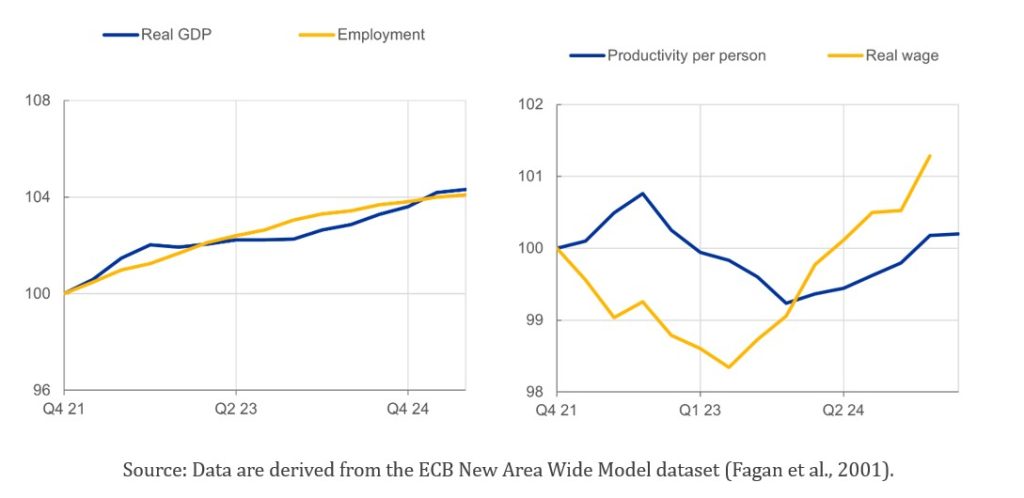
The euro area labour market has shown unusual resilience in the face of a large inflation shock and the sharpest monetary tightening cycle in decades. Employment continued to expand and unemployment declined to historical lows, even as output growth slowed markedly. This decoupling between employment and activity stands in contrast to typical cyclical dynamics: traditionally, the Okun’s law would have indeed suggested employment to grow at roughly half the pace of real GDP. Instead, between the end of 2021 and the mid 2025, the employment elasticity to GDP growth was nearly twice as high, with GDP and employment growing almost at the same rate.
While economic activity weakened in 2022–2024 and financial conditions tightened substantially, firms retained workers. Employment growth remained positive and hours worked declined only modestly. At the same time, labour productivity fell significantly, reversing part of the gains recorded during the pandemic recovery. These developments suggest that labour adjustment occurred primarily through labour productivity rather than employment. While euro area labour productivity remains pro-cyclical, it stands in stark contrast to the US labour market, where productivity tends to be counter-cyclical.
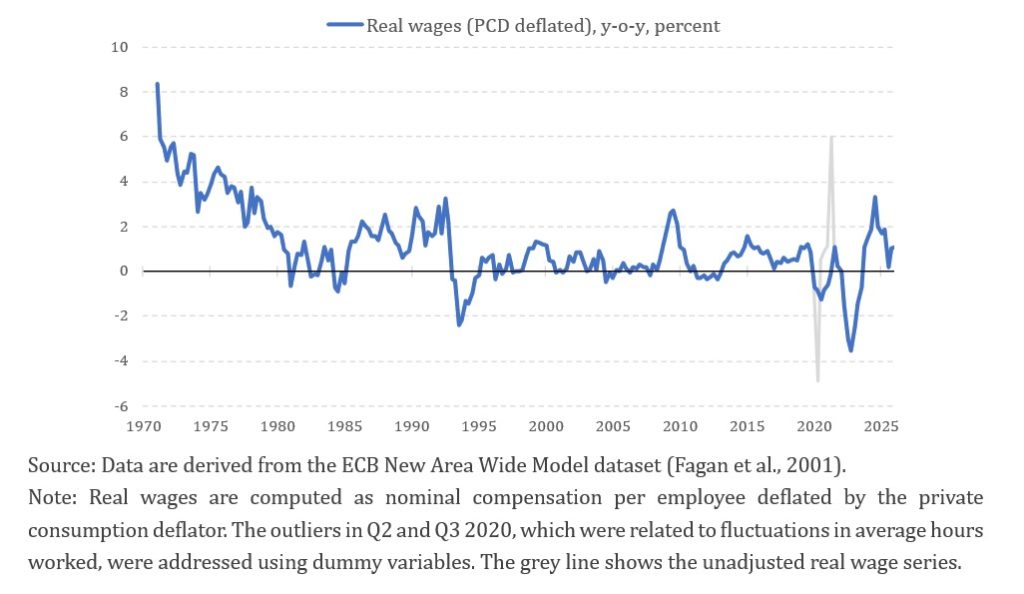
A key mechanism behind labour market resilience was the sharp fall in real wages during the 2022 inflation surge. Nominal wages adjusted only gradually, while consumer prices increased rapidly. As a result, real compensation per employee declined substantially (see Figure 1).
Figure 1. Real wages, 1970 – 2023
This reduction in real labour costs lowered firms’ incentives to cut employment. Firms faced weaker demand but also lower real labour costs, making it less costly to retain workers. Labour hoarding therefore increased, particularly in sectors facing recruitment difficulties or expecting demand to recover (see Figure 2, panel a and b). This behaviour contributed to the persistence of employment growth even as activity slowed. The decline in real wages was therefore accompanied by falling productivity. This procyclical movement in productivity reflects labour hoarding.
Figure 2. Okun’s law, productivity and real wages, in 2020s
(index 2021Q4 = 100)
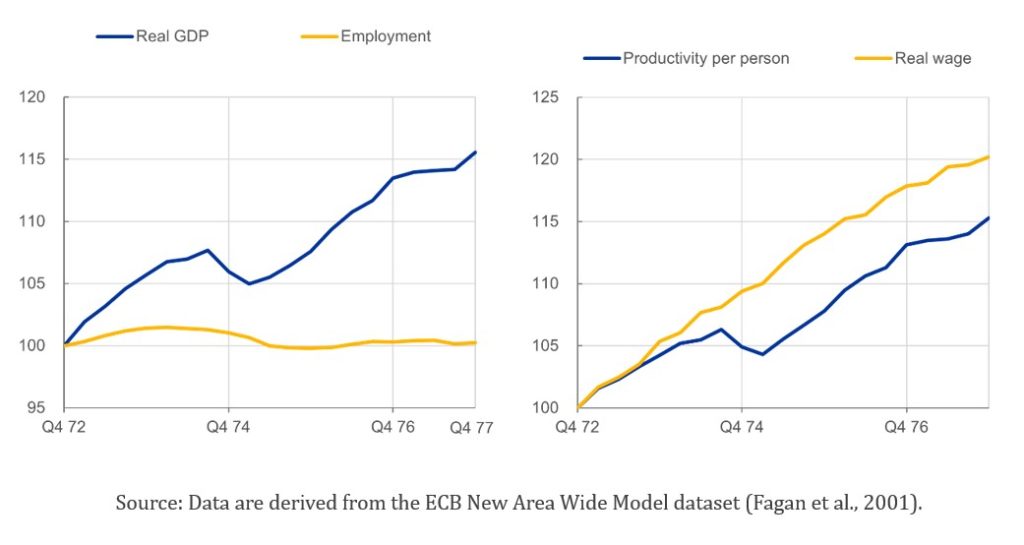
The recent episode contrasts sharply with the inflationary period of the 1970s. During that earlier period, nominal wages reacted strongly to inflation, leading to rising real wages. Higher real labour costs reduced labour demand and resulted in declining employment and rising unemployment. Productivity developments also differed, as employment fell more strongly than output (see Figure 3, panel a and b).
Institutional features may also have contributed to this divergence (see Blanchard and Summers (1986) and Ljungqvist and Sargent (1998)). Wage bargaining arrangements, including the lack of widespread and automatic wage indexation mechanisms played a role in moderating nominal wage growth during the recent 2022 inflation surge. Further, anchored inflation expectations and stronger central bank credibility, with a forceful reaction of the ECB, further helped containing wage responses. These factors allowed real wages to absorb part of the shock, reducing pressure on employment.
Figure 3. Okun’s law, productivity and real wages, in 1970s
To analyse the drivers of recent labour market developments, we use an empirical model that separates movements in output, employment, wages, inflation and interest rates into a small number of economically interpretable shocks (similar to the framework in Foroni and Furlanetto (2025) and through the lenses of a simple search and matching model with skill heterogeneity as in Abbritti and Consolo (2024)).
The model is estimated using quarterly euro area data from 1970 to 2025, allowing us to compare the recent period with earlier inflation episodes. It includes five key variables: real GDP growth, employment growth, inflation, real wage growth and a short-term interest rate.
We distinguish between five types of shocks. First, aggregate demand shocks capture fluctuations in spending, such as those related to fiscal policy, financial conditions or confidence. These shocks typically move output, employment and inflation in the same direction. Second, neutral technology shocks reflect broad productivity improvements that increase output while lowering inflation, and tend to raise both employment and wages. Third, the model identifies factor-substitution shocks, which alter the relative use of labour and capital in production. These shocks are particularly relevant for the recent period. For example, higher energy or financing costs can make capital relatively more expensive, encouraging firms to rely more on labour. In this case, lower real wages support hiring even when output growth is modest, leading to strong employment but weak productivity. This mechanism helps explain the recent decoupling between employment and activity. Fourth, labour market shocks capture developments originating directly in wage-setting or labour supply, such as changes in bargaining conditions or participation. These shocks typically increase employment and output while putting downward pressure on wages and inflation. Finally, monetary policy shocks are identified separately using high-frequency financial market reactions around policy announcements (Altavilla et al. (2019) and Jarocínski and Karadi (2020)). This approach isolates unexpected changes in interest rates and allows us to assess how monetary tightening affects output, employment and wages.
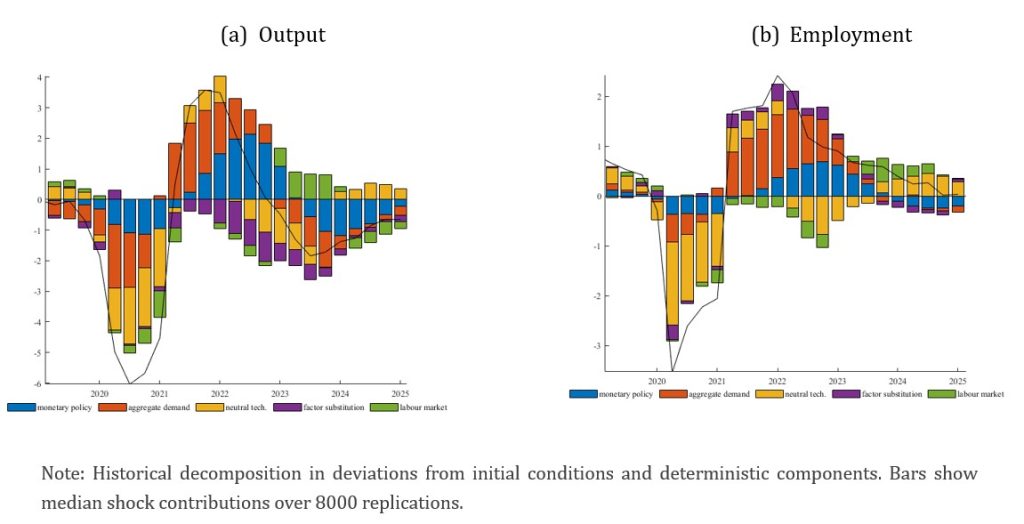
This structural analysis suggests that aggregate demand shocks played a central role in shaping labour market developments (See Figure 4). The post-pandemic recovery was initially driven by strong demand, which supported employment. Subsequent negative shocks, including tighter financial conditions, slowed activity but did not immediately translate into employment losses due to labour hoarding and falling real wages.
Supply shocks contributed primarily to inflation and to the decline in real wages. Energy price increases and supply bottlenecks raised consumer prices, eroding real incomes. This mechanism reduced real labour costs and supported employment, reinforcing labour market resilience.
Monetary policy tightening affected output more strongly than employment. Higher interest rates dampened activity, but firms adjusted mainly through productivity rather than layoffs. This muted employment response reflects both labour hoarding and wage dynamics. As a result, productivity absorbed a significant portion of the adjustment to tighter financial conditions.
These findings imply that the transmission of monetary policy to employment was weaker than in previous cycles. The main channel operated through activity and productivity, while employment remained comparatively stable. This pattern is consistent with the observed decline in productivity (see Figure 5).
Figure 4. Historical decomposition of output and employment (2019–2025)
The resilience of employment has important implications for productivity dynamics. When firms retain workers during slowdowns, productivity tends to decline temporarily. As demand recovers or labour costs rise, firms may subsequently adjust employment, leading to a rebound in productivity. The recent productivity weakness in the euro area may therefore partly reflect a cyclical adjustment via labour hoarding.
Figure 5. Historical decomposition of productivity (2019–2025)
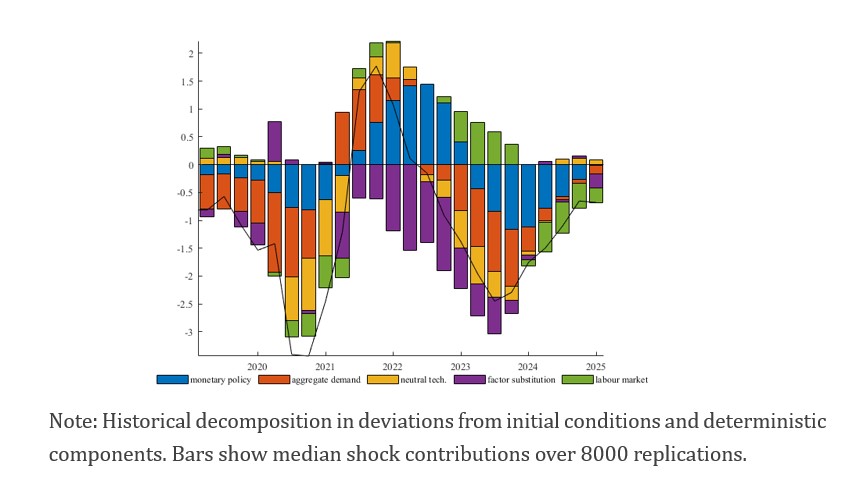
The recent experience suggests that real wage flexibility can stabilise employment during adverse shocks. When real wages adjust downward, firms may retain workers and unemployment increases can be avoided. However, this adjustment comes at the cost of weaker productivity and lower real incomes. For monetary policy, the muted employment response implies that tightening may initially affect productivity rather than employment. Labour hoarding dynamics should be considered when assessing labour market slack. Strong employment growth may coexist with weak productivity and subdued activity. Finally, the recovery in real wages may alter labour market dynamics going forward. As labour costs increase, employment growth may slow and productivity may rebound. Monitoring wage developments is therefore crucial for assessing the outlook for both inflation and labour markets.
The euro area labour market has remained resilient despite a large inflation shock and substantial monetary tightening. The decline in real wages supported labour demand and encouraged firms to hoard labour, leading to strong employment and weak productivity. This adjustment differs markedly from the 1970s, when rising real wages coincided with declining employment. Structural evidence suggests that demand shocks and wage dynamics played a central role, while monetary policy affected output more than employment. As real wages recover, labour market dynamics may shift, potentially leading to slower employment growth and stronger productivity.
Abbritti, M. and Consolo, A. (2024). Labour market skills, endogenous productivity and business cycles. European Economic Review, 170:104873.
Altavilla, C., Brugnolini, L., Gürkaynak, R. S., Motto, R., and Ragusa, G. (2019). Measuring euro area monetary policy. Journal of Monetary Economics, 108:162–179.
Blanchard, O. J. and Summers, L. H. (1986). Hysteresis and the European unemployment problem. NBER Chapters, in: NBER Macroeconomics Annual 1986, Volume 1, pages 15-90, National Bureau of Economic Research, Inc.
Fagan, G., Henry, J., and Mestre, R. (2001). An area-wide model (AWM) for the euro area. ECB Working Paper Series, 42, European Central Bank.
Foroni, C. and Furlanetto, F. (2026), Explaining deviations from Okun’s law, European Economic Review, 182, issue C, number S0014292125002557.
Jarocínski, M. and Karadi, P. (2020). Deconstructing monetary policy surprises—the role of information shocks. American Economic Journal: Macroeconomics, 12(2):1–43.
Ljungqvist, L. and Sargent, T. J. (1998). The European unemployment dilemma. Journal of Political Economy, 106(3):514–550.