

This policy brief is based on Bank of Italy, occasional papers No. 1005. The views expressed are those of the authors and not necessarily those of the institutions the authors are affiliated with.
Abstract
How is artificial intelligence (AI) transforming the corporate landscape? This policy brief examines AI adoption among Italian manufacturing and services firms with at least 50 employees and its effects on performance, labour decisions and expectations. Using new survey data linked to administrative records, the study shows that in 2024 the adoption of AI was still limited – around 11% of firms – but was expected to grow. Adoption is mainly concentrated in larger, knowledge-intensive firms and driven by efficiency motives. In our sample of firms, AI adoption improves corporate profitability and labour productivity. While it does not lead to a decline in total employment, it shifts workforce composition toward high-skilled white-collar roles, at the expense of blue-collar tasks. Furthermore, AI-adopting firms expect more moderate price increases and lower long-term inflation. These findings suggest that AI could become an important driver for productivity growth.
The diffusion of artificial intelligence (AI) is widely seen as one of the most transformative technological developments of recent decades, with the potential to reshape firms’ organization, productivity, and labour demand. A growing body of research shows that AI can reallocate tasks, transform production processes, and alter competitive dynamics across industries (e.g., Acemoglu and Restrepo, 2022; Acemoglu, 2024). While some studies highlight efficiency gains and innovation opportunities (e.g., Czarnitzki et al., 2023), others point to risks such as job displacement, widening inequality, and rising productivity dispersion (e.g., Acemoglu and Restrepo, 2019; Acemoglu, 2021). Despite these contributions, there is still limited evidence on how firms actually adopt AI, what drives this process, and it affects performance, labour and expectations.
This policy brief summarizes key results by Ropele and Tagliabracci (2026), which combines survey and administrative firm-level data to: (i) document AI diffusion across Italian firms, (ii) identify the main determinants of adoption, and (iii) assess the effects of AI adoption on firm performance, labour composition, and expectations, both at the micro level (e.g., own prices) and the macro level (e.g., inflation).
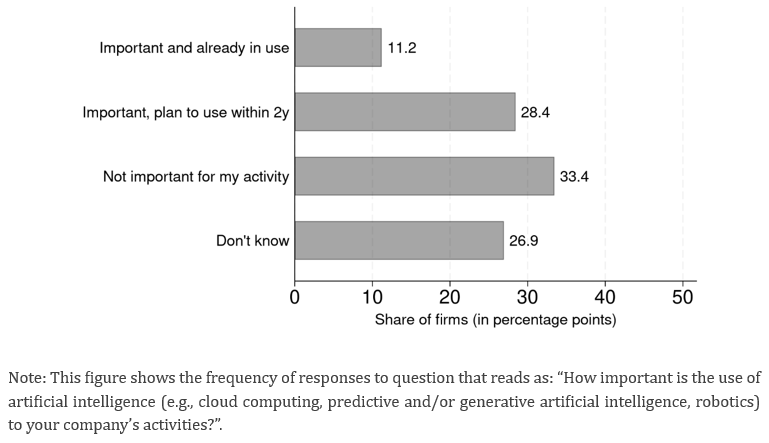
As of the third quarter of 2024, AI adoption among Italian firms remains at an early stage. Only about 11% of firms with at least 50 employees report using AI in their operations (broadly in line with Bencivelli et al., 2025 and Aldasoro et al., 2026). However, the landscape appears poised to change: 28% of firms report plans to adopt AI within the next two years.
At the same time, a large share of firms does not currently see AI as relevant to their business or remains uncertain about its potential. Roughly one-third consider AI irrelevant, while 27% report that they ‘do not know’ or prefer not to answer regarding their adoption plans, pointing to gaps in awareness or perceived applicability.
Figure 1. Importance of AI for business activity
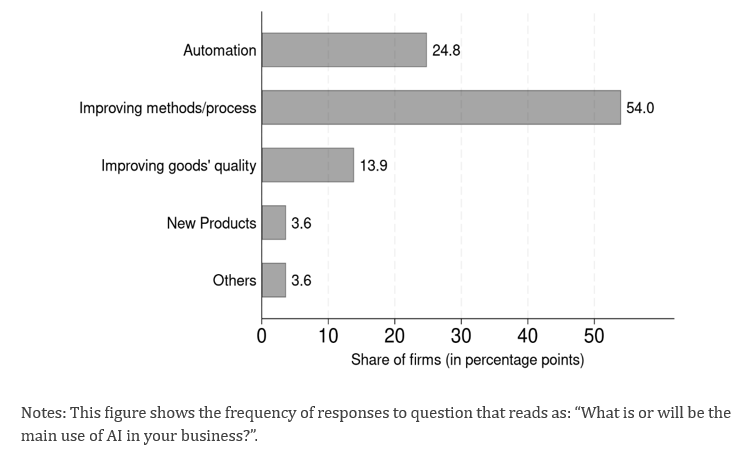
The analysis identifies clear patterns in adoption. First, firm size is the strongest predictor: larger firms have greater capacity to bear the financial and organizational costs of adopting complex advanced technologies. Second, adoption is higher in knowledge-intensive industries and among firms with a larger share of intangible assets. Third, firms with higher labour costs are more likely to adopt AI. When asked about their primary goal for using AI, 54% of firms cite improving production and support processes, while 25% focus on task automation.
Figure 2. Specific use of AI technologies
Empirical results show that AI adoption among industrial and services firms with at least 50 employees has a positive and measurable impact on firm performance. Using a difference-in-differences approach, the study finds that adopters experience higher profitability, both in terms of ROA and EBITDA over sales. AI adoption also improves labour productivity, increasing value added per employee and EBITDA per employee. Importantly, these gains are not driven by wage compression or employment cuts. Unit labour costs remain broadly stable, suggesting that productivity improvements reflect genuine efficiency gains.
The results do not support the view that AI leads to widespread job losses, at least in the short term. Total employment remains broadly unchanged among adopting firms. However, AI leads to a reallocation of tasks within firms: white-collar employment increases, while blue-collar employment declines.
This pattern is consistent with task-based models of technological change, where AI substitutes routine tasks and complements higher-skilled activities. Survey responses confirm this view: about 70% of firms expect no change in total employment, even as skill requirements evolve.
AI adoption also affects firms’ expectations. Adopting firms anticipate smaller increases in their own selling prices, likely reflecting expected efficiency gains. At the macro level, these firms are also more optimistic about economic conditions and expect lower inflation over the medium to long term (24 and 48 months ahead). This suggests that wider AI diffusion could have a disinflationary effect through improved productivity and cost efficiency.
Evidence from Italian firms suggests that AI adoption can be an important driver of productivity and organizational change. However, its impact should be viewed in the broader context of how new technologies diffuse over time. As shown in the literature (Comin and Hobijn, 2010; Kalyani et al., 2025), technological adoption often starts slowly and then accelerates.
The current environment is evolving rapidly. While this study provides a snapshot of 2024, when adoption was still limited, more recent evidence points to a clear acceleration, especially among larger and more advanced firms.
Looking ahead, several aspects require close monitoring. These include the effects on labour markets (see for instance Dalla Zuanna et al., 2024 and Pizzinelli et al., 2023), particularly in terms of skills and wage dynamics, as well as broader macroeconomic implications, such as potential disinflationary effects and changes in equilibrium interest rates (Melina and Villa, 2025). Understanding these dynamics will be key for designing effective policy responses during this technological transition.
Acemoglu, D. (2021). “Harms of AI.” NBER Working Papers No. 29247. National Bureau of Economic Research.
Acemoglu, D. (2024). “The simple macroeconomics of AI.” NBER Working Papers No. 32487. National Bureau of Economic Research.
Acemoglu, D., & Restrepo, P. (2019). “Automation and new tasks: how technology displaces and reinstates labor.” Journal of Economic Perspectives, 33, 3–30.
Acemoglu, D., & Restrepo, P. (2022). “Tasks, automation, and the rise in U.S. wage inequality.” Econometrica, 90, 1973–2016.
Aldasoro, I., Gambacorta, L., Pal, R., Revoltella, D., Weiss, C., & Wolski, M. (2026). “AI adoption, productivity and employment: evidence from European firms.” BIS Working Papers No. 1325.
Bencivelli, L., Formai, S., Mattevi, E., & Padellini, T. (2025). “Embracing the digital transition: the adoption of cloud computing and AI by Italian firms.” Questioni di Economia e Finanza (Occasional Papers) No. 946. Bank of Italy.
Comin, D., & Hobijn, B. (2010). “An exploration of technology diffusion.” American Economic Review, 100, 2031–2059.
Czarnitzki, D., Fernandez, G. P., & Rammer, C. (2023). “Artificial intelligence and firm-level productivity.” Journal of Economic Behavior & Organization, 211, 188–205.
Dalla Zuanna, A., Dottori, D., Gentili, E., & Lattanzio, S. (2024). “An assessment of occupational exposure to artificial intelligence in Italy.” Questioni di Economia e Finanza (Occasional Papers) No. 878. Bank of Italy.
Kalyani, A., Bloom, N., Carvalho, M., Hassan, T., Lerner, J., & Tahoun, A. (2025). “The diffusion of new technologies.” The Quarterly Journal of Economics, 140, 1299–1365.
Melina, G., & Villa, S. (2025). “From servers to rates: AI, ICT capital, and the natural rate.” IMF Working Papers No. 2025/224. International Monetary Fund.
Pizzinelli, C., Panton, A. J., Tavares, M. M. M., Cazzaniga, M., & Li, L. (2023). “Labor market exposure to AI: cross-country differences and distributional implications.” IMF Working Papers No. 2023/216.
Ropele, T., & Tagliabracci, A. (2026). “The economic impact of artificial intelligence: evidence from Italian firms.” Questioni di Economia e Finanza (Occasional Papers) No. 1005. Bank of Italy.