

This policy note is based on Deutsche Bank Research Institute, FX Special Report. The views expressed are those of the author and do not necessarily reflect those of Deutsche Bank.
Abstract
The AI race between the US and China is not just a contest between AI models, but between economic models. The US is leveraging the full power of capitalism – supercharged by blockchain – to try and win the AI race. Enormous US capital expenditure is being supported by unprecedented amounts of foreign equity inflows. The dollar is thus becoming more equity sensitive and leveraged to AI outcomes. The US embrace of asset tokenization which will make US markets more accessible could exaggerate this trend. The US is widening the doors for capital, but keeping AI technology closed to preserve corporate pricing power. Meanwhile, China is pushing out low-cost AI models with open weights. If China’s approach undercuts US profits, this could threaten the US model of shareholder capitalism, and leave the dollar exposed.
The US is sprinting at record speed in its reach for capital. Huge sums of money are being raised to fund the buildout of AI infrastructure and development of frontier AI models, with US companies expected to spend around $800bn in AI capex this year. We argue in this paper that the US is leveraging the full power of capitalism to fund capital investments seen as crucial to winning the AI race.
We simplify the key trends in the US’ capital-raising landscape into a few observations. First, AI labs are turning to private markets to raise large sums of equity capital. Second, hyperscalers are turning to investment grade debt markets to issue meaningful amounts of debt for the first time. And third, public equity markets are back in focus for capital funding with some of the world’s biggest companies returning to issue stock, and major IPOs in the pipeline.
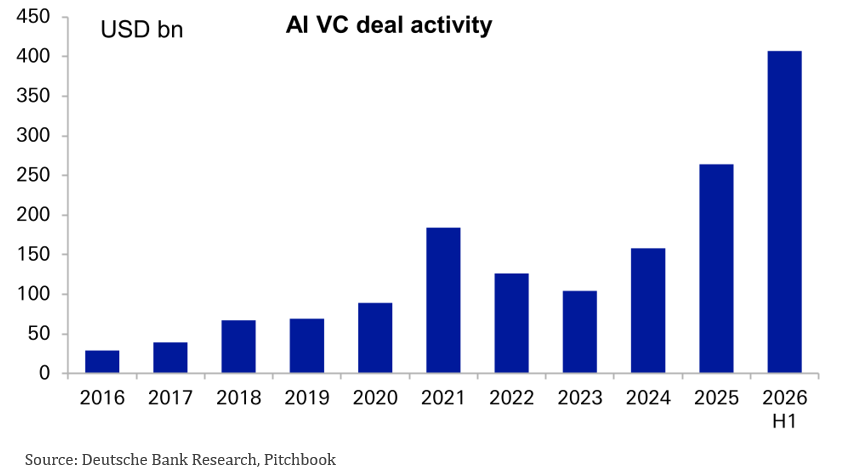
The AI venture capital industry has raised over $400bn this year alone, with over 90% of the biggest deal volumes in the US. The two largest AI labs in the US have raised a combined $217bn this year – valuing each company near $1tn. On an annualized basis, AI VC capital is running at three times last year’s pace.
Figure 1. US AI companies are attracting record amounts of private capital
In debt capital markets, the shift has also been staggering. While free cash flows remain an important source of funding for hyperscalers, the capital intensity of the infrastructure buildout is outrunning cash flows, forcing companies to turn to debt. Hyperscalers like Google, Meta, Oracle and Amazon raised an average of just USD25bn per year between them over 2020-24. In 2026 YTD, they have raised around ten times that amount through IG credit markets. Microsoft has yet to turn to debt markets.
In public equity markets, Google also had its first primary equity raise since its 2004 IPO in June 2026, raising $85bn. Returning to issue is a big reversal from years of buying back stock. This is also setting up to be a historic year for IPOs. SpaceX achieved the largest total market valuation of a newly listed company in history near $2tn in its June 2026 IPO. The largest US AI labs are expected to come to the IPO market soon which could change the AI boom as we have written about here.
On many metrics, Chinese models are closing the gap to the US in terms of performance and capabilities. While the US remains ahead in frontier development, Chinese models account for more than half of US company token usage on Open Router.
But from a capital perspective, China appears to be running a different race – raising much less capital, less from private sources, and less from abroad. While US companies are expected to spend around $800bn in AI capex this year, that number is closer to $100bn in China. While the biggest US AI labs have raised nearly $250bn in private funding rounds this year, Chinese labs have raised far less. China’s National AI fund has participated in a number of capital raisings. Stanford University’s recent AI report made a similar observation: noting that in 2025, US private AI investment was 23 times the $12.4bn invested in China, although Chinese numbers are likely understated given government guided funds.
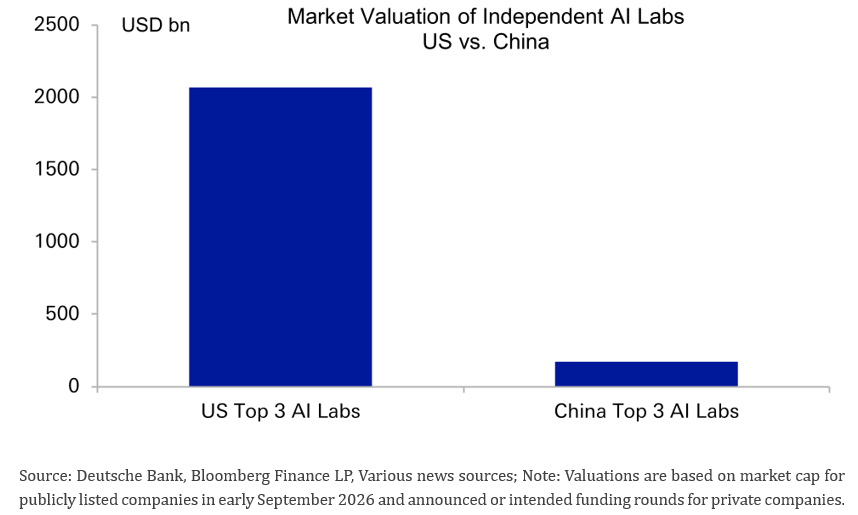
The stark difference in the approach to capital raising is also reflected in markets. With US AI labs raising far more capital for ownership stakes, the market valuations of US AI companies compared with their Chinese peers are many orders of magnitude apart. Furthermore, while Chinese hyperscalers like Tencent, Baidu and Alibaba have been tapping debt markets, they are doing so in smaller size, with a no major uptick compared with earlier years. They are, however, increasingly funding in dim sum bonds, suggestive of a desire to de-dollarize funding.
Figure 2. US labs have much larger implied market valuations than Chinese peers
The dramatic reach for capital in the US is not only reflective of an American economic model that prioritizes open capital markets, but it also reflects the US’ growing need for foreign financing given the US’ large twin deficit position. The US is running a 6%+ fiscal deficit combined with a near 4% of GDP current account deficit. In the absence of fiscal savings, incremental private sector capex will require funding from abroad. At a time when private sector financing requirements for AI capex are rising, it is not a surprise the US is widening its reach for capital from abroad.
The US is in fact enjoying an unprecedented amount of equity capital inflow. In Q2 2026 alone, the US received over USD400bn of foreign equity capital, well above any previous quarter. The amount of capital coming into US equities is also well above what US equity performance alone would imply, and now well above debt flows – the historical mainstay of US capital account financing.
Figure 3. Equity flows have replaced debt flows as the main source of foreign capital financing for the US
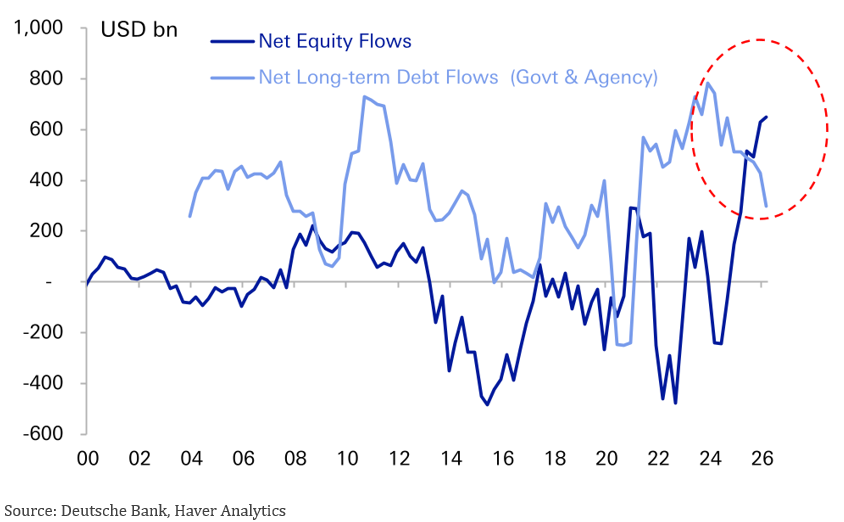
Geopolitical ruptures in long-standing alliances in defence and trade are hurting long-term appetite for USD government debt, particularly by the foreign official sector. But at the same time, technology is pulling enormous equity capital in from other types of foreign investors like retail. The gap between net equity flows to the US (increasing) and debt flows (falling) has never been wider, and the shift from official to private funding sources is becoming more noticeable. With the US on the cusp of a potentially significant IPO cycle, we find it notable that US companies are picking up on the funding shift. SpaceX reportedly initially earmarked 30% of its IPO for retail investors, more than three times as much as a traditional IPO offering.
As we show in this paper, the US will likely remain very focused on attracting foreign private capital to fund both its AI ambitions and its deficits.
The US is taking a very capital-intensive approach to the AI race, raising record amounts of capital, and attracting huge amounts of it from overseas. Foreign capital not only helps support the dollar by providing deficit funding, but it also improves the cost of financing for US companies. It is natural for the US to leverage technology that supports these capital flow trends.
The US has been using the power of blockchain technology and a new form of private money – stablecoins – to democratize access to the dollar. We are now at the second stage of evolution, where the power of blockchain is being used to democratize access to US capital markets. This is called real world asset (RWA) tokenization. While stablecoins aim put the US dollar “on chain” as a digital money token, asset market tokenization could look to put the entirety of US asset markets and their underlying financial architecture on chain.
The two forces of tokenized money and tokenized assets are themselves highly symbiotic. The existence of tokenized assets should widen the appeal of holding tokenized money like stablecoins, that can then be more easily deployed for returns and yields “on chain”, without needing to be moved off-chain back into fiat currency to invest in traditional assets. Both stablecoins and tokenized bank deposits could become important means of payment for tokenized assets, with a meaningful impact on the settlement process.
From a macro perspective, we argue that US tokenization ambitions are deeply linked to supporting capital inflows into the US. Stablecoins arguably have ambitions to support the diversification of dollar debt to private sector holders. Not only did the GENIUS Act introduce 1:1 reserve backing requirements for dollar stablecoin issuance, that helps power demand for front-end US T-bills; more importantly, if stablecoins help keep the world paying in dollars, they help retain the role of the dollar as a private sector savings instrument, which could help demand for assets like longer-dated Treasuries.
If stablecoins are now combined with a wider universe of tokenized assets, this could encourage demand for many more US assets. This should help what we have termed a “geopolitics-to-technology funding swap”. The US is moving away from attracting official, long-term, geopolitically motivated capital flows, towards private sector, shorter-term, technology motivated capital.
America’s full-hearted embrace of asset tokenization – compared with China’s turn away from it – can be understood in the context of both the AI race and the relative external funding position of both states. If the US is taking a capital-focused approach to the AI race, with a starting point of twin deficits, the US will naturally benefit from lowering the hurdles for foreign and private capital as much as possible. That is indeed what it is doing.
We begin with a definition for asset tokenization, borrowing from the DTCC, the custodian for close to $115 trillion in US assets and an organization that finds itself at forefront of this development. Asset tokenization is the “process of converting ownership rights to a financial asset—such as stocks, bonds or real estate—into a digital token recorded on a blockchain. These tokens represent the same legal rights as the original asset but can be transferred, tracked and managed digitally.” They note that tokenization introduces new capabilities, from fractional ownership, faster cross-border transfers, transparent records and smart contracts. In a tokenized world, instead of waiting days for a U.S. Treasury bond to settle through multiple intermediaries, a tokenized version could settle in minutes.
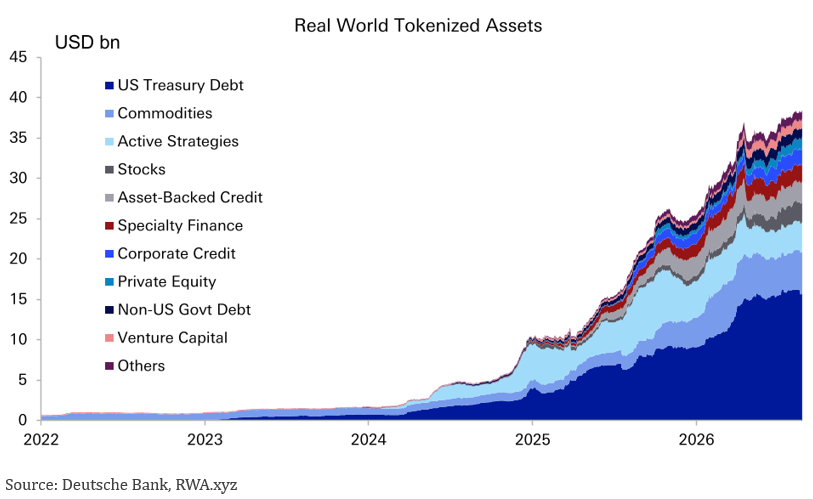
Only around $40bn of real-world assets have been tokenized to date, but the size of the tokenized asset universe is expected to grow much further and faster from here given adoption by traditional finance that is just getting underway.
In Part 1 of this paper, we explored the macro motivations for America’s embrace of tokenization: to reduce the hurdles for foreign capital to flow into the US and fund its AI ambitions in an increasingly competitive and existential AI race.
In this section, we look at some of the more micro motivations for tokenization, and how they come together.
Figure 4. Real world tokenized assets have a lot of scope to grow- they are still a fraction of the over
USD100tn US asset universe – but are now going mainstream
The underlying technology that enables tokenization is distributed ledger technology (DLT) which allows the ownership rights to anything from money, to a stock, to a painting, to be represented as a digital token on a decentralized network like blockchain. But new technology alone cannot drive real world adoption and change, without the financial and economic incentives to use it.
So, why is DLT being used to tokenize real-world assets today and how have incentives aligned across economic agents – from retail investors, asset managers, corporates, financial firms, securities depositories and exchanges – to motivate this adoption? Beyond the macro, state-level motivation for attracting capital to fund the AI race and US deficits, we argue that private agents in the financial system are also likely to be deeply invested for their own reasons.
First, the revolution in overseas retail trading demonstrates the case for widening access to markets. Retail trading has been spurred on in recent years by a number of developments: from Covid lockdowns, the rise of zero-commission platforms, social media, fintech brokerages, improved access to information and charting, and even tax incentives to increase financialization of household savings (i.e., Japan’s NISA program). Korea is arguably the poster child of the retail revolution and offers a potential template for what might become possible at a global scale if technology is used to lower hurdles for entry. Korea represents 2% of global nominal GDP, but accounted for 10% of the $740bn of foreign equity inflows to the US last year, a lot of which were powered by retail investors, or the “seohakaemi” (overseas stock ants). Access arguably played a big role. Korea began allowing for the fractional trading of foreign stocks by certain Korean brokerages as early as 2019, even earlier than for domestic stocks. Korean brokerages also signed up with a number of US alternative trading systems that offered daytime trading of US stocks in Korean hours. The combination of a highly digitized, connected population with lower hurdles for access was a dramatic flow of Korean capital into US equities. To us, the case of Korea demonstrates what is possible if US markets were to become easily accessible 24/7 to everyone.
Second, corporates and institutions still face a number of inefficiencies around cash and capital in traditional off-chain markets. We focus on three examples: trapped cash for settlement, inefficient collateral management, and manual corporate actions. While securities markets in the US have successfully moved from T+2 to T+1, this gap still involves the lock-up of capital to act as a backstop for trade settlement. If securities and payments were to settle atomically and instantly on blockchain, this could free up a huge amount of capital. Collateral markets are also still relatively inflexible today. Today, repo markets allow financial entities to borrow cash in exchange for lending collateral like US Treasuries. Repos are structured around overnight to longer-term financing and are constrained by end-of-day settlement cycles and operational windows. Digital assets held on a blockchain could arguably be posted instantly for much shorter periods, creating intraday repo possibilities and increasing the velocity of collateral. As a final example, NASDAQ highlights that processing corporate actions today alone “carries costs of more than $58 billion across the industry, driven by fragmented systems, manual workflows, and duplicative record-keeping.” The programmability offered by digital assets would help address this as corporate actions could be programmed into smart contracts attached to the asset. In sum, there are clear incentives for agents – from corporate issuers to institutional asset managers – to embrace a tokenized asset environment.
Third, the tokenization train had already left the station but was at risk of being mediated via third-party offerings and fragmenting market liquidity. Fund managers like Blackrock and Templeton had already begun issuing some of their funds like BUIDL and FBOXX on public blockchains. This involved making the funds accessible as digital tokens, but importantly the underlying assets themselves remained off-chain in traditional financial instruments. More importantly, the presence of blockchain technology has allowed for entry and innovation by new private players that have begun offering US assets as digital tokens on blockchain rails. New tokenized equity frameworks offer representations of real US stocks and ETFs, backed 1:1 by underlying traditional equities, held in regulated custody, and issued as on-chain tokens on many different blockchains. They are available to non-US clients in 100+ countries and allow fractional purchases with as little as $1 in select US stocks and ETFs, some of which are available to trade 24/7. They do not, however, confer shareholder rights like voting or dividends in cash – instead, they offer price exposure to the underlying asset in an always-on format, via a third-party token. If tokenization was already underway, the incentive for traditional asset mangers and exchanges to be part of the process was becoming more evident. Rather than simply tokenizing claims on US securities, developments underway to build the infrastructure to allow underlying US securities themselves to be issued, traded, and held as tokens.
Asset tokenization is not a futuristic or frontier concept – it is live and is now happening at the heart of traditional markets, led by core players in the US financial ecosystem.
Tokenization is now being adopted by core, traditional financial players. Securities depositories and exchanges under the aegis of regulatory guidance are building the market infrastructure to tokenize the US asset universe, with participation from asset managers and banks.
The progress at DTC remains crucial to track. DTC is the main central securities depository in the US – it is the venue where trades settle and clear, and the custodian where financial firms hold their assets. DTC has around $115 trillion of US assets under its custody. Tokenization at DTC has now begun. In July 2026, the DTC converted the first asset into tokens that were used for real world trades. 40 different financial firms participated. Amongst many examples, the SPDR S&P500 ETF Trust (SPY) – the world’s first ETF – was tokenized. In another test, JP Morgan successfully posted tokenized assets to satisfy a margin requirement at the CME. DTC intends to launch its tokenization service by October 2026. Assets can then be held traditionally or in tokenized form (as a digital twin) and they will be treated the same, and will refer to the same security. Both architectures will coexist, run side-by-side, and be interoperable, with the trust of DTC custody to back them.
Full-scale tokenization will take time, but the ship has left the harbour. The DTCC CEO has argued it could proceed over many years with markets “crawling, then walking, then running” and the pace to be set by market demand to hold assets as tokens. DTC is beginning by tokenizing the Russell 1000, ETFs, and US Treasuries before widening it out. Market estimates currently range from $2tn to $30tn for the size of the tokenized asset universe by the 2030s, but these estimates may well be revised higher as the infrastructure becomes operational.
Equally important to track are developments at US exchanges – NYSE and NASDAQ – which are shifting to accommodate “always-on” round-the-clock trading. NASDAQ has also announced an intention to offer trading 23/5 trading by December 2025, while NYSE is aiming for 22 hours by later this year. As noted earlier, synthetic equities have already been trading outside market hours on permissionless blockchains and alternative trading systems, so increasing exchange hours will allow that liquidity to come back on exchange.
Exchanges are also building new platforms and tools to enable a tokenized trading experience. The NYSE’s new digital platform aims to not just offer 24/7 operations, but also instant settlement, fractional share trading, and stablecoin based funding. NASDAQ has also announced the launch of an “equity token design” that will allow public companies to leverage tokenization to program shareholder engagement from corporate actions to proxy voting. NASDAQ aims to have full tokenization capabilities by 2027.
With the US moving to provide rapid regulatory clarity and support for the development of tokenized securities, and building the settlement infrastructure to support it, it stands to benefit from a first mover advantage. Not only might the US be setting the standards for what on-chain financial trading and settlement looks like, it could benefit from future network effects. Just as the US benefits from agency over networks like SWIFT and USD correspondent banking, it may exercise them over the future on-chain infrastructure. If the majority of on-chain private money (stablecoins) is dollarized, and the majority of on-chain assets are US listed, this could reinforce USD payments and capital markets dominance. And if access to capital is increasingly concentrated in the US, global companies too may be increasingly interested in listing and issuing in the US to access them.
In this final section, we look at how the AI race and approach to tokenization could impact the dollar, and how it might shape the future of global imbalances and capitalism itself.
US equities already account for more than 50% of global equity market capitalization, and US Treasuries for more than half of OECD sovereign debt. For many investors, this gives US assets “There is No Alternative” status, popularly known as TINA: investors have no alternative but to hold assets which are such a large part of the global market portfolio. The position of US companies in the AI race thus far has further contributed to TINA, with investors compelled to have exposure to technology which could change the world. The ultimate outcome of the AI race will no doubt play an enormous role in whether the US’ share of the global market portfolio grows or shrinks: it is not just how earnings and valuation multiples evolve, but also how terminal values of the corporate sector could change, and how debt sustainability could be impacted.
TINA is already playing a big role in attracting capital to the US, but tokenization could add to this: by making US assets more attractive and more accessible.
First, on attractiveness. The collateral implications of holding US assets on chain could be very attractive for investors. Fed Governor Cook has noted that the most significant benefit of tokenization would be implications for capital and liquidity management for institutions. A tokenized US asset becomes more liquid and deployable, and capital and cash thus becomes more productive. In simple terms, you are more likely to hold a tokenized US equity or bond instead of cash, if you can easily repo your tokenized asset on chain when you need liquidity. If the value of US assets is going up, the cost of capital for US firms is going down. The improved collateral velocity of tokenized assets could be another superpower for US assets, and another arrow in the quiver of US capital attractiveness.
Second, on accessibility. While stablecoins could give anyone with an internet connection access to the dollar on chain, asset tokenization could do the same for US assets. In a world in which US equities and bonds are trading 24/7, with instant settlement and much lower costs and frictions, this could have dramatic knock-on effects on global behaviour, particularly for retail investors that could find access much easier. We find it notable that NASDAQ openly acknowledged that “the investor base of public equities has the potential to expand as markets remain open across multiple time zones, making it increasingly important to have modern tools for public issuers to engage with investors worldwide.” Tokenization need not also be limited to equities and bonds. One can imagine a world in which a person with even $1 in a place 10,000 miles away could own a tiny fraction of a tokenized Times Square on chain.
From an FX perspective, if tokenization succeeds in making US assets more attractive and accessible, this could help attract private capital flows. It is perhaps not surprising that the US is leveraging the power of technology – both AI and blockchain – to attract more foreign private capital at a time when US geopolitical leadership could be under pressure and crucially when US fiscal deficits have been widening. Both increase the need for alternative sources of private sector funding. The US is arguably going “all-in” on private capital to offset public sector vulnerabilities.
Figure 5. The US is increasing reliance on private capital – motivated by technology leadership –
at a time of growing public sector vulnerability
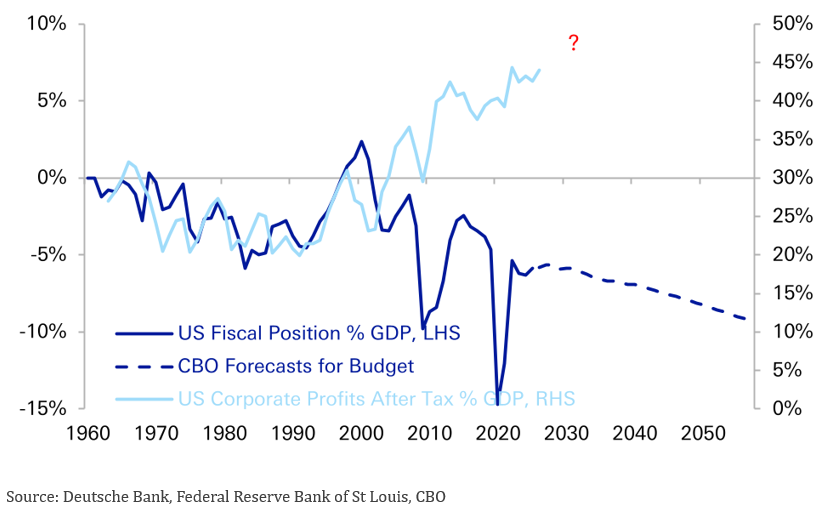
But lowering the hurdles for inbound capital, also exposes the US to capital going out. Tokenization would meaningfully increase capital mobility, in and out of US assets. The shift in US funding towards private sector, potentially shorter-term flows into equities – motivated largely by technology returns – will make the dollar riskier, more equity sensitive, and leveraged to the AI race. The dollar is likely to become more positively correlated to equities, which in turn will reduce the dollar’s historical properties of diversifying equity risk. If AI proves uneconomical or the US starts to fall behind in the AI race, the dollar could be very exposed.
Europe has been receptive to the opportunity presented by tokenization. Europe’s DLT Pilot Regime introduced a regulatory sandbox for institutions to test the trading and settlement of tokenized securities on DLT as early as March 2023, even earlier than the US. ECB Governor Lagarde has noted that tokenization offers the prospect for Europe to “tackle the fragmentation that has held us back for decades.” Note that Europe has over 30 central securities depositories across the union. An integrated market for tokenized assets could allow Europe to “leapfrog the fragmentation of existing legacy systems” (ECB). Europe has also embraced the role of tokenized securities as collateral, with DLT assets held in European CSD’s eligible as collateral at Euroclear from March 2026. This puts digital assets on the same footing as traditional ones in Europe.
Where Europe sits apart from the US is perhaps in the scale of its crypto ambitions, an explicit commitment to retaining a two-tier monetary system with central bank money as the final settlement asset, and the size of the AI economy itself. Europe is alive to the opportunities presented by tokenization for market unification – an important step to increasing Europe’s capital market attractiveness, but the US arguably has more clearly stated ambitions to become “the crypto capital of the world”. Moreover, Europe appears committed to keeping central bank money as the final settlement instrument between financial institutions even in a tokenized world, with initiatives like Pontes and Appia underlying this. In the US, it remains to be seen whether private stablecoins become the primary instrument of settlement, disintermediating central bank money, or whether the existing system of bank deposits and reserves is tokenized. Ultimately, the biggest divide between Europe and the US is in the AI economy itself – Europe has a much smaller footprint in data centres and independent AI labs, and thus may not be where the appetite to raise or deploy capital – even in a tokenized asset world – is most compelling.
Meanwhile, China is taking a very different approach; while the US is embracing stablecoins and RWA tokenization, China is tightly controlling – if not restricting – them. In February 2026, the PBOC and CSRC along with eight other national organization issued a notice that updated China’s 2021 ban on crypto-related activities. The notice defined RWA tokenization and tightened regulation around it – noting that such activity or intermediation of it was prohibited in China, except with regulatory approval on specific financial infrastructure. The notice also banned entities from issuing stablecoins pegged to RMB abroad, without regulatory approval. Chinese regulators prevented Ant Group and JD.Com from proceeding with plans for yuan stablecoins in Hong Kong in October 2025. Instead, in January this year, PBOC began to allow payment of interest on e-CNY, retail CBDC deposits suggesting relative encouragement for controlled forms of central bank digital money. We look further at some of the drivers of this very divergent approach between the US and China.
The US is pursuing a hyper-capitalist approach in the AI race: throwing open the doors for private capital to fund large capex, and using the power of asset tokenization to supercharge it. We call this the open markets approach. Under the US model of shareholder capitalism, US companies prioritize profit maximization, keep AI model weights closed to allow companies to control pricing via subscriptions, and offer the carrot of return participation to shareholders to attract in global capital. The US then uses those huge sums of capital to make large capital investments to innovate and stay ahead of the competition. Importantly, the open markets approach is paired with a closed technology one.
China is taking a very different approach in the AI race, pushing out lower-cost models with open-weights into the world. We call this the open technology approach, and it is paired with a closed markets one. Chinese companies are not only achieving similar model results, and charging clients less for tokens, they are offering their models with open-weights. Open weights allows users to download and customize models on their own servers, promoting global proliferation and usage among corporates. China may be counting on the same penetration of its AI models around the world as it has achieved with manufactured goods. One can perhaps start to look at China’s approach to AI as an extension of China’s broader involution approach to manufacturing where state-based alignment combined with fierce domestic competition achieves low pricing, improving quality, rising market share and ultimately industrial dominance. That China is now trying this in the technology space, where the US has thus far remained a leader, bears close watching. The US’ open markets are meeting China’s open weights.
In sum, the US is taking an “open markets-closed technology” approach to the AI race, while China is taking an “open technology-closed markets” approach. This divergence is not just a reflection of different economic models, but underlying global imbalances, and very different needs for global funding.
The US’ open embrace of tokenization, compared to China’s more closed approach to foreign capital is a reflection of underlying imbalances. The US’ current account deficit combined with a fiscal deficit means the US requires foreign financing to fund incremental private capital expenditure, in the absence of domestic fiscal savings. In comparison, China is running a large and growing current account surplus, reflective of excess savings. China’s trade surplus is in fact growing – with the AI cycle boosting AI-related exports. China does not need to turn to foreign capital because it can fund capital expenditures from abundant current account savings. This affords China the ability to maintain a more managed capital account and explains the relatively restrictive approach to the high-speed blockchain rails that the US is so actively building.
The AI race could further reshape the state of global imbalances. As one potential path, imbalances could become more extreme. If China leverages AI to make industry even more efficient, adopting it for production and industrial automation, this could boost China’s manufacturing dominance and good-driven surplus. One can imagine an alternative scenario in which the US current account improves, narrowing global imbalances. AI revenue streams could potentially help the US current account by around 1% over the coming decade via higher services exports. But this is crucially dependent on US AI labs retaining pricing power with private subscribers and monetizing an international subscriber base. But China’s low-cost, high-proliferation approach could cap the excess profits of US AI companies, and their ability to sell intellectual property for profit. How things evolve may come down to whether US and Chinese models become complements that coexist and serve different market segments, or whether they become substitutes in a winner-takes-all outcome. There is a lot at stake.
Ultimately, the AI race between US and China is more than a battle between AI models. It is a battle between economic models. The US is doubling down on capitalism: operating on the premise that increasing capital market openness will pull in the funding for large AI capital expenditures; in turn, this will help the US remain dominant in AI technology, allow corporates to maintain pricing power, and for the US to pull ahead in the race. Meanwhile, China does not need to leverage open markets to attract capital flows. China’s industrial dominance and record trade surpluses mean it has ample and cheap sources of domestic funding. This allows China to keep a more closed market approach that need not prioritize profits firsthand, and allows it to compete with low-cost, open-weight AI offerings.
If China’s approach starts to undercut US profits, this could threaten the US model of shareholder capitalism, which has become critical not only to attracting funding for AI, but for growing US deficits. China’s challenge is not only about technology, but the central maxim of US power: that free and open capital markets always deliver the winning innovation. The AI race is a big test for capitalism itself.