

The views expressed represent the author’s personal opinions and do not necessarily reflect the views of the Deutsche Bundesbank or the Eurosystem.
Abstract
USD-denominated stablecoins have expanded rapidly since 2020 and are largely backed by short-term U.S. Treasury securities, particularly Treasury bills (T-bills). Despite this growth, stablecoin issuers remain relatively small investors in the U.S. Treasury market compared with other key actors such as money market funds (MMFs). At present, the two largest issuers — Tether and Circle — hold T-bills in volumes comparable to those of medium-sized foreign Treasury holders, but again still far below the largest sovereign investors. While stablecoins have therefore become a measurable new investor group in the T-bill market, their current scale suggests that their macro-financial relevance remains limited. Nevertheless, their continued growth and distinctive institutional structure warrant close monitoring from a market functioning and monetary policy perspective.
Stablecoins are crypto-assets designed to maintain a stable value relative to a reference currency. In recent years, they have emerged as an important component of the digital financial ecosystem. Their rapid growth has attracted increasing attention from policymakers, particularly because most USD-denominated stablecoins are backed by short-term safe assets such as U.S. Treasury bills (T-bills). As a result, stablecoin issuers have become new participants in short-term government debt markets, raising questions about their macro-financial relevance.
Recent policy-oriented work has examined the role of stablecoins within crypto markets, their potential fragility and the regulatory challenges they pose (Assenmacher, 2020; Mai, 2022; Bertsch, 2023; Barthélemy et al., 2026; AlAsadi et al., 2026). Relatedly, the recent literature has turned to analyzing stablecoins in the context of monetary policy transmission. For example, Altavilla et al. (2026) discuss a potential substitution from bank deposits into stablecoins in the euro area, potentially weakening banks’ funding base and thus their credit supply. Cerutti et al. (2026) show that stablecoin demand shocks can influence financial markets more broadly, leading to persistent declines in short-term Treasury yields and potential spillovers to other asset classes. Finally, Barbon et al. (2025) highlight frictions in the transmission of monetary policy to stablecoin-based financial markets, showing that stablecoin lending rates are only partially linked to conventional interest rates and are strongly shaped by crypto-specific factors. Overall, this literature suggests that stablecoins may increasingly interact with monetary policy.
This Policy Brief takes a step back and examines the size and evolution of the largest USD stablecoins relative to key segments of the U.S. short-term government debt market, particularly money market funds (MMFs), to assess their current macro-financial significance.
Approximately 99% of the global stablecoin market is currently linked to the U.S. dollar (e.g., ECB 2025; Bundesbank 2025), underscoring the dominant role of USD-denominated tokens in the crypto ecosystem. The two largest issuers, Tether (USDT) and Circle (USDC), account for a large share of the market, with a combined market capitalization of roughly USD 255 billion. This corresponds to only around 3% compared to the assets under management of U.S. MMFs (Figure 1, top).1
MMFs play a central role in the U.S. short-term government debt market. Since 2020, the volume of outstanding Treasury bills has increased substantially, reaching roughly USD 6.5 trillion (Figure 1, bottom). This expansion reflects a combination of factors, including expansive fiscal policy, higher Treasury issuance, and adjustments in U.S. Treasury cash-management practices. Over the same period, the assets under management of U.S. money market funds have also risen sharply and currently exceed the outstanding T-bill volume. MMFs therefore constitute a structurally dominant investor group in the T-bill market. Their holdings of Treasury bills currently amount to around USD 2.5 trillion, corresponding to roughly 40% of the outstanding T-bill market.
Figure 1. Outstanding U.S. T-Bill Volumes, MMF AUM and Stablecoin market capitalization (top). Outstanding U.S. T-Bill Volumes and Holdings of MMFs (bottom)
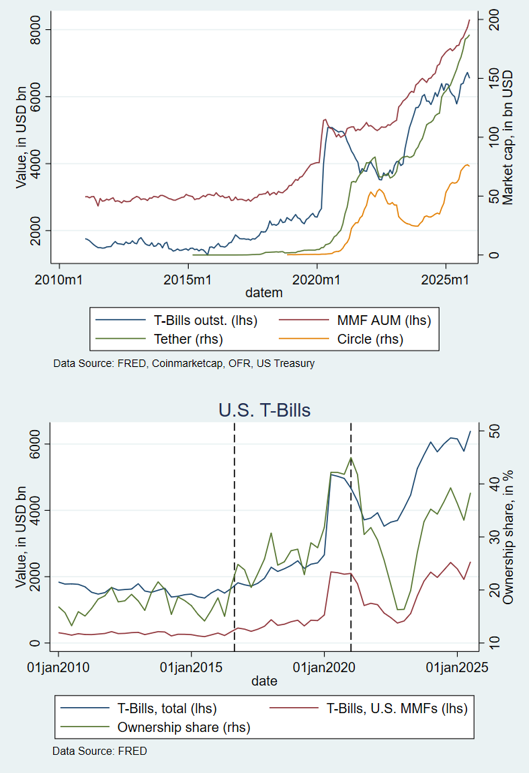
The share of MMFs in the T-bill market has fluctuated over time. Prior to 2016 it was around 20%, but it increased significantly following the U.S. MMF Reform.2 Between 2021 and 2023 the share temporarily declined again to roughly 20%, largely because MMFs made heavy use of the Federal Reserve’s Overnight Reverse Repo Facility (Afonso et al. 2023). More recently, however, the share of T-bills held by MMFs has risen again toward 40%.
Against this background, stablecoin issuers remain small actors in the market. Tether and Circle currently hold approximately USD 122 billion and USD 44 billion in Treasury bills, respectively — significantly less than the holdings of MMFs. Several factors help explain the still limited scale of stablecoins. First, stablecoins are a relatively new phenomenon that has only emerged over the past decade. Second, stablecoins currently offer no direct interest to holders (Bindseil, 2026), making them relatively unattractive under store-of-value considerations. By contrast, MMFs provide returns close to prevailing money market rates. As a result, stablecoins currently serve primarily as transactional instruments, especially for cross-border payments and for trading within the crypto ecosystem.
Figure 2. Treasury-Holdings by investor groups over time (top). Closer look at the geographic distribution of foreign holdings in 2024:Q2 (bottom)
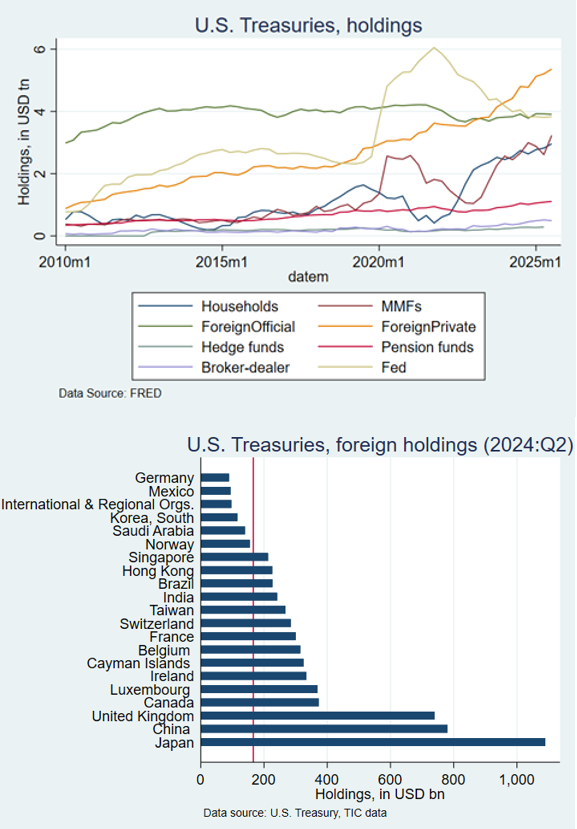
Another useful benchmark for evaluating the significance of stablecoins is the composition of Treasury holders. According to Federal Reserve data, a substantial share of the approximately USD 28 trillion outstanding U.S. Treasury securities is held by foreign investors (Figure 2, top). Historically, official institutions played a particularly important role, but during the last few years private foreign investors -including hedge funds- have become increasingly important (e.g., Barth et al., 2025).
Based on U.S. Treasury International Capital (TIC) data, the geographic breakdown of foreign Treasury holdings (Figure 2, bottom) shows that the largest investors are countries such as Japan, China, and the United Kingdom. Compared with these major holders, the Treasury portfolios of stablecoin issuers (in red) remain small. Nevertheless, when compared with medium-sized foreign holders, the scale of stablecoin investments becomes more visible. The Treasury holdings of Tether and Circle are roughly comparable to those of countries such as Norway. In other words, while stablecoin issuers are far smaller than the largest sovereign investors, they have already reached a scale comparable to some mid-tier foreign Treasury holders.
Taken together, these comparisons help to place the current importance of stablecoins into perspective. Stablecoins remain much smaller than traditional money market intermediaries and therefore do not currently represent a dominant force in the U.S. Treasury market. At the same time, they have grown large enough to constitute a measurable and distinct investor group. This squares with recent work of Ahmed and Aldasoro (2025) who document that stablecoin flows appear to have a small, but measurable effect of short-term Treasury yields.
From a market functioning and monetary policy perspective, stablecoins therefore do not yet appear to be systemically important in the narrow sense. Nonetheless, their rapid growth and their integration into the U.S. short-term government debt market suggest that they may become a more relevant structural factor in the future, also from a monetary policy perspective. For this reason, developments in the stablecoin sector should continue to be closely monitored by policymakers and financial authorities.
Afonso, G., Cipriani, M., & La Spada, G. (2023). Dropping Like a Stone: ON RRP Take-up in the Second Half of 2023. Liberty Street Economics.
Ahmed, R., & Aldasoro, I. (2025). Stablecoins and safe asset prices. BIS Working Papers No. 1270.
AlAsadi, L., Bewaji, O., Gugnani, A., Gupta, T., & Heijmans, R. (2026). An Econometric Investigation on the Stability of Stablecoins. SUERF Policy Brief, No. 1348.
Altavilla, C., Boucinha, M., Burlon, L., Adalid, R., Fortes, R., & Maruhn, F. (2026). Stablecoins and Monetary Policy Transmission. ECB Working Paper, No. 3199.
Assenmacher, K. (2020). Monetary policy implications of digital currencies. SUERF Policy Note, No. 165.
Barbon, A., Barthélemy, J., & Nguyen, B. (2025). DeFi-ying the Fed? Monetary Policy Transmission to Stablecoin Rates. Working Paper.
Barth, D., Beltran, D., Hoops, M., Kahn, J., Lui, E., & Perozek, M. (2025). The Cross-Border Trail of the Treasury Basis Trade. FEDS Notes.
Barthélemy, J., Mengus, E., & Plantin, G. (2026). To What Extent Should “Coins” Be Public to be “Stable”? SUERF Policy Brief, No. 1379.
Bertsch, C. (2023). Adoption, Fragility and Regulation of Stablecoins. SUERF Policy Brief, No. 662.
Bindseil, U. (2026). Stablecoin regulation revisited: Is prohibiting remuneration the solution? SUERF Policy Note, No. 394.
Bundesbank (2025). Financial Stability Report.
Cerutti, E.M., Firat, M., Hengge, M., & Sagawa, T. (2026). Stablecoin Shocks. IMF Working Paper, No. 2026/044.
ECB (2025). Financial Stability Review November 2025.
Fricke, D., Greppmair, S., & Paludkiewicz, K. (2024). You can’t always get what you want (where you want it): Cross-border effects of the U.S. money market fund reform. Journal of International Economics, 147, 103846.
Mai, H. (2022). Stablecoins – DeFi, Libra and Beyond. SUERF Policy Brief, No. 363.
For the sake of reference, at the end of 2025 the market capitalization of EUR-Stablecoins was around 400 million Euros. The aggregate AUM of European MMFs was 2 tn Euros, of which roughly 50% are EUR-denominated MMFs. Hence, the EUR-Stablecoin market cap is only around 0.2% (0.4%) compared to European (EUR-denominated) MMFs.
MMFs can be broadly split into prime and government MMFs. Prime (government) funds invest primarily in private (government) money market securities. The U.S. MMF Reform effectively reshaped the sector into a government-dominated one. See Fricke et al. (2024) for details.