

This policy brief is based on wiiw Working Paper 267. The views expressed are those of the authors and not necessarily those of the institutions the authors are affiliated with. Acknowledgment: Part of the research underpinning this policy brief was supported by European Union’s Horizon 2.2 and 2.2.3 programmes under grant agreement No. 101056793 (‘Twin Seeds’).
Abstract
Robots can replace workers in routine and manual jobs, especially in high-wage countries. At the same time, they boost productivity and help industries grow, which creates new employment opportunities. Our research shows that robotizing industries expand output but do not substantially change their sourcing patterns between domestic and foreign inputs. In other words, robots reinforce existing global production structures rather than “bringing back jobs.” Policy faces a dual challenge: supporting productivity gains from automation while helping displaced workers transition into more sustainable jobs.
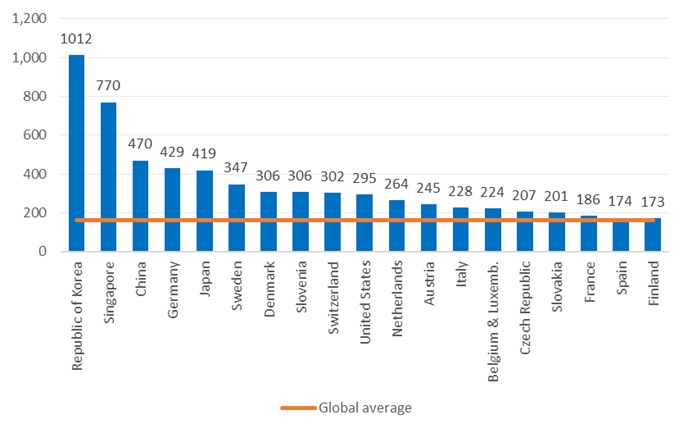
Robotization technologies globally proceed at high pace. Robots per worker in manufacturing have approximately doubled over a decade in many high-income countries. In South Korea, there is already more than one robot for every ten workers in manufacturing. This suggests that many other countries are only at the beginning of their shift toward automated production processes (Figure 1). Such increased automation may simultaneously drive productivity, disrupt traditional job structures, and change the location where goods are produced.
Figure 1. Robot density in the manufacturing industry (per 10,000 workers, 2023)
Source: International Federation of Robotics
Overall labour market effects of robots can be positive or negative. Analysts forecast that by 2030, every fourth job in manufacturing and logistics could be replaced by robots if current trends continue. At the same time, evidence suggests that robot use boosts productivity growth by 0.5 – 1.0 percentage points annually, resulting in booming industries with increased demand for workers.
Empirical estimates of the employment effects of robots hence vary – and several studies find positive effects. In a meta-analysis of 33 studies, Guarascio et al. (2025) document considerable differences across estimates; the average of 644 estimates on the employment effect of robots in those studies is near zero (but marginally negative). A possible explanation for the varying findings across studies is that employment effects of robots are more positive in lower-income countries, because there is less economic need to save labour costs. Conversely, wages in higher-income countries create pressure to automate and replace workers’ tasks (see Muris and Wacker, 2025).
Robots are best at performing routine, manual tasks. Workers in manual routine occupations and in sectors like manufacturing and logistics are hence most likely to be substituted by robots (see de Vries et al., 2020). Conversely, non-routine analytical professions face a lower risk of being replaced by automation (but are possibly affected by more recent technologies like artificial intelligence). There is ongoing debate on whether robotization affects female and male workers differently (e.g., Aksoy et al., 2021; Deng et al., 2023; Lerch, 2024).
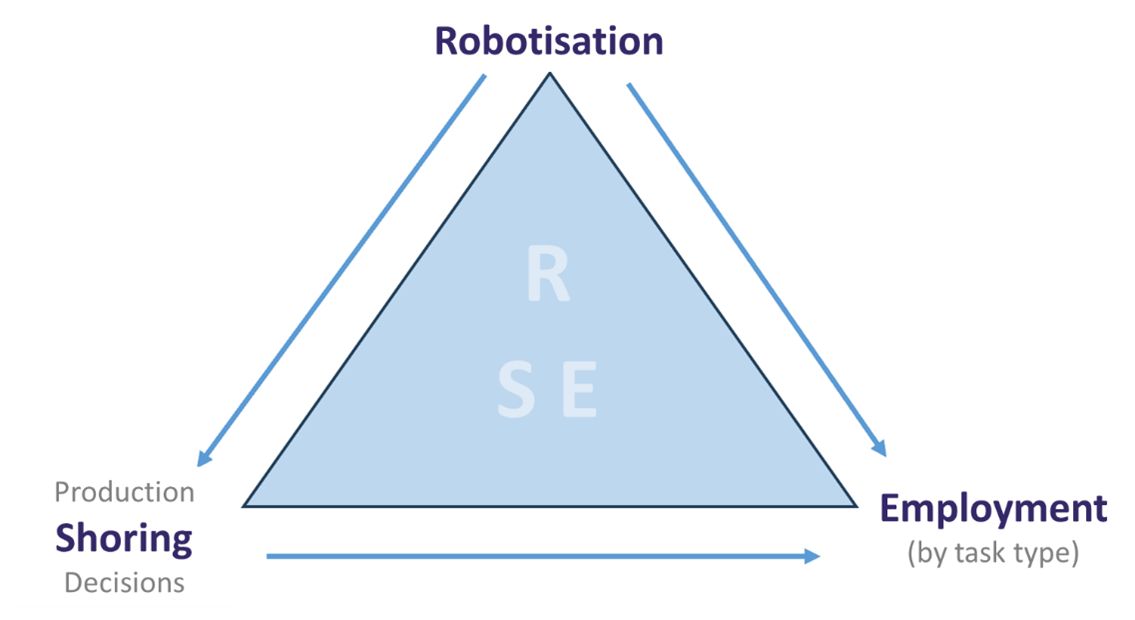
Since robots are highly efficient at performing manual routine tasks, there is less cost incentive to offshore those production steps to other countries. Some policymakers hence have hopes that robotization and automation will lead to a modern manufacturing renaissance in high-income countries that will also “bring back jobs”. In a recent study, we address this robotisation-shoring-employment (RSE) triangle, which is depicted in figure 2.
Figure 2. The RSE triangle
Source: Dijkstra and Wacker (2025)
The key finding of our study is that the use of robots makes the production ‘pie’ bigger, but it does not change how that pie is divided between domestic producers and foreign suppliers. This analysis is based on data for 15 manufacturing industries across 35 countries over a decade up until 2018. We found that industries with faster robotization experienced a faster increase of their output. These robot-related output increases benefitted employment, domestic intermediate input sourcing, and foreign intermediate input sourcing to nearly equal degrees.
In other words, if robot intensity of an industry increases, its employment and demand for domestic input supply go up, but not by a higher degree than its demand for foreign supplies, which also rises. If anything, robotization hence reinforces global sourcing pattern rather than reshoring previously offshored production steps. This association between robot use and global value chain integration is broadly in line with Spanish firm-level results from Stapleton and Webb (2020) and Cilekoglu et al. (2024) and with cross-country patterns documented by Artuc et al. (2023).
Our findings highlight that robotizing industries are those that thrive, and thriving industries are usually internationally well-integrated. Current geopolitical tensions put this international integration at risk. In this situation, the use of robots could possibly be a defensive strategy for firms to cope with supply chain uncertainties: if intermediate input supply from lower-wage countries becomes increasingly uncertain, robotization could be an alternative to produce those intermediate inputs at home (see also Firooz et al., 2025).
In our study, we document that approximately 25% of industries in our sample became more reliant on domestic production inputs (as a share of total industry output) and that those industries experienced rather mediocre output dynamics. For this particular part of our sample, we indeed find that the intensity of domestic input reliance is positively associated with robot intensity. But since those industries are not performing particularly well, such domestic production relocation may not create many jobs in itself. Additionally, most countries have to import robots from a handful of global producers. Installing robots may hence reduce the vulnerability to foreign input suppliers but increases the reliance on a small number of robot producers.
Policy needs to navigate a critical trade-off: on the one hand, firms and industries need novel technologies like robotization for productivity improvements because productive industries generate jobs. On the other hand, robots may replace certain workers, at least over a relevant time horizon: just because overall labour market effects of robots are not negative, this does not mean that no individual worker loses her job due to robotization.
Policies should hence help affected workers move into sustainable jobs that are at lower risk of being automated.
Different policy levers should be combined to promote modern industries and support employment:
If policymakers prefer a more proactive approach, they can use public sector programs that intensively hire routine manual workers; e.g., in infrastructure modernization or jobs related to the green transition. Such programs could combine on-the-job training with financial support through employment continuity.
The fact that the workers who are affected by robotization are often geographically concentrated and clustered suggests strong policy complementarities with place-based policies; that is, policy intervention that focuses on promoting economic development in specific geographic areas.
Aksoy, C.G. Özcan, B. & Philipp, J. (2021): Robots and the gender pay gap in Europe. European Economic Review 134: 103693
Artuc, E., Bastos, P. & Rijkers, B. (2023). Robots, tasks, and trade. Journal of International Economics, 145: 103828.
Cilekoglu, A.A., Moreno, R. & Ramos, R. (2024). The impact of robot adoption on global sourcing. Research Policy, 53(3): 104953
de Vries, G., Gentile, E., Miroudot, S. & Wacker, K.M. (2020). The rise of robots and the fall of routine jobs. Labour Economics, 66. DOI: 10.1016/j.labeco.2020.101885.
Deng, L., Müller, S., Plümpe, V. & Stegmaier, J. (2023): Robots and Female Employment in German Manufacturing. AEA Papers and Proceedings 113: 224–28.
Dijkstra, H. and K.M. Wacker (2025): Robots, shoring patterns, and employment: what are the linkages? wiiw Working paper No. 267.
Firooz, H., Leduc, S. & Liu, Z. (2025). Reshoring, automation, and labor markets under trade uncertainty. Journal of International Economics 156: 104091.
Guarascio, D., Piccirillo, A. & Reljic, J. (2025). Robots vs. Workers: Evidence From a Meta-Analysis. Journal of Economic Surveys: in press. https://doi.org/10.1111/joes.12699
Lerch, B. (2025): From Blue- to Steel-Collar Jobs: The Decline in Employment Gaps?” American Economic Journal: Macroeconomics 17 (1): 126–60.
Muris, C. and K.M. Wacker (2025): Estimating Interaction Effects with Panel Data. GLO Discussion Paper 1583
Stapleton, K. & Webb, M. (2020). Automation, trade and multinational activity: Micro evidence from Spain. CSAE Working Paper Series 2020-16, Centre for the Study of African Economies, University of Oxford.