

I am thankful to Dr. Livio Stracca, Deputy Director General at the European Central Bank, for verifying, reviewing, and providing feedback on the original paper. Errors and oversights are, of course, the sole responsibility of the author.
Abstract
This paper examines the exchange rate implications of a closed-border retail CBDC in the small, open economy of Singapore. Singapore’s case is especially interesting because of its unconventional exchange-rate targeting monetary policy. The study develops a novel aggregated uncovered interest parity (UIP) framework to estimate the effects of the CBDC across various implementations, namely a zero-interest rule, a Markdown rule, and a Taylor Rule. Across CBDC implementations, exchange rates appreciate due to domestic investor reallocation to the CBDC, with the Markdown rule yielding the lowest appreciation and the Taylor Rule the highest. Exchange rate volatility also increased under the zero-interest rule and the Taylor rule. Overall, these findings are economically intuitive and highly relevant to the Monetary Authority of Singapore in its assessment of the implications of a Singaporean CBDC.
A retail central bank digital currency, a digital form of fiat currency that is available to the public to hold and invest in, is a unique asset for its ability to be liquid as a medium of exchange, act as an interest-bearing store of value, and simultaneously be backed by none other than the central bank of the issuing country. Among these characteristics, the “interest-bearing” capability of CBDCs has been widely scrutinized by economists and policymakers. Should CBDCs pay interest rates? If so, how should these interest rates be set, and how do these rates interact with the monetary policy regime of the central bank? The aforementioned policy questions are just some of the concerns surrounding the topic, with other uncertainties, such as bank deposit disintermediation, also widely discussed.
This policy brief examines the effects of different CBDC remuneration designs in small open economies, with a specific focus on Singapore. Singapore, as a case study, is especially interesting among small open economies because of its exchange rate targeting monetary policy regime, unlike the more common interest rate targeting regime followed by most central banks worldwide. The primary reason for this approach is that Singapore is a small, open economy in which gross exports and imports of goods and services are more than 300 percent of GDP, and in which 40 cents of every dollar spent is on imported goods (Monetary Authority of Singapore 2023). As a result, exchange rate fluctuations affect inflation to a greater degree than interest rates, and an exchange rate targeting regime is thus more effective (as empirically shown by Chow, Lim, and McNelis (2014)).
Thus, this brief aims to examine how different retail CBDC implementations (characterized by their remuneration designs) can affect Singapore’s exchange rate. These findings have various implications for the Monetary Authority of Singapore (henceforth MAS), as exchange rate volatility and deviations arising from CBDC implementation can significantly affect MAS’s monetary policy.
Retail CBDC implementations are highly versatile and encompass a wide range of designs, reflecting each central bank’s preferences. For example, a CBDC may be cross-border, allowing foreign investors to hold CBDC and transact internationally, whereas in other cases it may be closed-border and available only to domestic investors. Furthermore, most CBDC implementations offer no remuneration (such as the Bahamas Sand Dollar and the eNaira), while the e-CNY carries interest (the only interest-bearing CBDC in the world). These design decisions, among many others, significantly affect the CBDC’s impact on the economy.
The CBDC implemented in the model is specific to Singapore by following a more realistic closed-border retail CBDC (one that can only be held by domestic residents in Singapore). This assumption is made in light of recent surveys by the Bank for International Settlements (2021), as well as capital-flow volatility concerns outlined by the Monetary Authority of Singapore (2021), which point to a closed-border CBDC as a more plausible implementation (at least in the near future). This assumption follows that foreign individuals can only invest in foreign bonds and Singaporean bonds, while domestic investors (Singaporean residents) can invest in foreign bonds, Singaporean bonds, and Singaporean CBDC. The economy is still considered open as CBDCs are the only Singapore-exclusive asset. It is also important to note that in the pre-CBDC economy, investors could invest only in bonds. The omission of other securities (deposits, stocks, real estate, etc) is made to simplify the model.
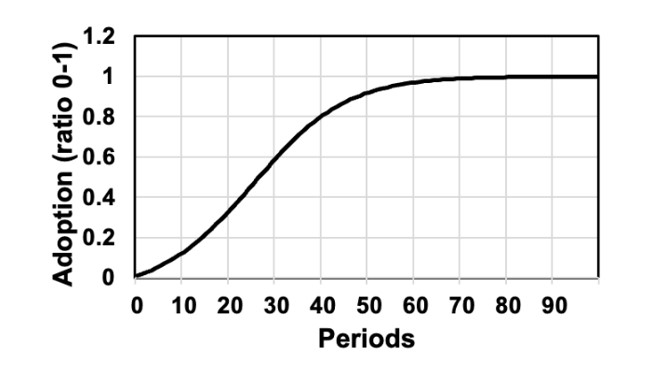
Multiple plausible implementation methods of retail CBDC are also modeled and evaluated, with those being: (i) zero-interest rate, (ii) the markdown rule, and (iii) the Taylor rule. The zero-interest rule is self-explanatory: the retail CBDC provides no remuneration. In the markdown rule, the CBDC has an interest rate that is set 0.5% below the interest rate on bonds, as according to Ferrari Minesso, Mehl, and Stracca (2022) (who derive this assumption from Panetta and Bindseil (2020)). In the markdown regime, the 0.5% markdown serves as a “penalty” in exchange for the liquidity benefits investors receive for holding a CBDC. In the Taylor Rule, the CBDC interest rate is determined by the interest rate in the previous time period, inflation, and the output gap. The model also incorporates a Bass diffusion model for the adoption/dissemination of CBDC over the time period, as seen in Figure 1.
Figure 1. Adoption of CBDC over time in the domestic economy
The mechanism driving exchange rate changes in the model is the uncovered interest parity (UIP) condition. This condition effectively connects the interest rate differential (usually on bonds) between two countries to the exchange rate deviations between those countries. The currency of the country with the higher interest rate will depreciate, and vice versa, under the zero-arbitrage condition. According to the zero-arbitrage condition, even if investors invest in the bond with the higher interest rate, they are no better off (purely from a return perspective) than if they invested in the other bond.
However, when the CBDC is introduced, the UIP condition changes significantly because CBDC remuneration is treated as another security that Singaporeans can hold. It is important to note that, along with remuneration, CBDCs also act as a medium of exchange that can be used for transactions with merchants, thus providing liquidity benefits. The model accounts for both remuneration and liquidity (with bonds being illiquid) when considering how much of the domestic investor’s portfolio is reallocated to CBDCs. Intuitively, the CBDC introduces a domestic asset that competes with foreign bonds in investor portfolios, thus altering domestic investment dynamics and generating exchange rate deviations. By quantifying this reallocation, the model estimates exchange rate deviations under a UIP condition that accounts for investment in the domestic CBDC as well as in foreign and domestic bonds.
The results measure path fidelity (the extent of exchange rate deviation from the original) and exchange rate volatility to understand (i) the common denominator effects of a CBDC across regimes, and (ii) the ideal remuneration regime on the basis of these two factors. According to this framework, there are two key findings: (i) there is an appreciation of the SGD when a CBDC is implemented (across regimes), and (ii) the markdown rule is found to be ideal for preserving both the exchange rate path (i.e., ensuring no significant appreciations/depreciations of the SGD) and maintaining a low exchange rate volatility. The exchange rate paths of each remuneration regime (relative to the original exchange rate series) are shown below in Figure 2.
Figure 2. Exchange rate paths across regimes
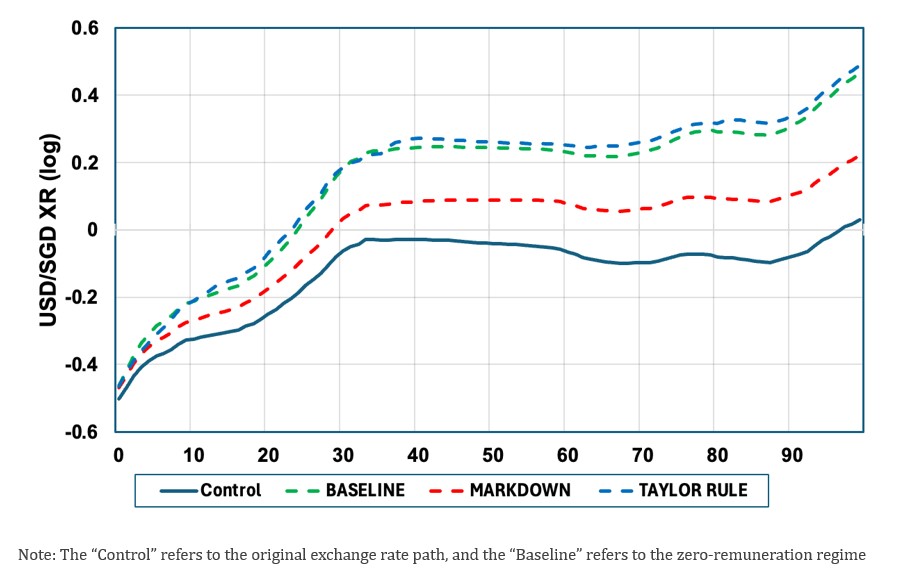
As seen in Figure 2, all CBDC regimes cause an appreciation of the SGD, and the markdown rule outperforms the others in exchange rate path deviation, as it is closest to the original exchange rate path. The Markdown Rule has an appreciation of 35.8%, the Baseline Rule has an appreciation of 79.7%, and the Taylor Rule has an appreciation of 80.4%.
There are two main forces that together explain the more pronounced appreciation of the exchange rate in the CBDC counterfactuals.
Firstly, Singaporean bonds generally have very low interest rates. In this analysis, 1-year Singapore bonds are used, with a mean gross return of 1.014, i.e., an interest rate of 1.41%. Simultaneously, the mean gross return on US 1-year bonds was 1.02, i.e., a 2% interest rate. Thus, there is an appreciation of the Singapore exchange rate across regimes (and in the original/Control path as well), as Singaporean bonds offer lower yields.
However, this appreciation is more pronounced in the CBDC counterfactuals because of the second force: the liquidity benefits of CBDCs. Given the low-interest-rate environment domestic investors face, the liquidity benefits of CBDCs lead investors to reallocate to them, as liquidity provides greater utility relative to the low remuneration on bonds. Thus, this keeps the percentage of investment in CBDCs relatively high even when CBDCs have very low or negative rates. For instance, consider the CBDC investment over time in the Markdown regime (Figure 3), which shows the lowest deviation of the exchange rate path from the original.
Figure 3. CBDC investment as a ratio of total investment in the economy in the Markdown Rule
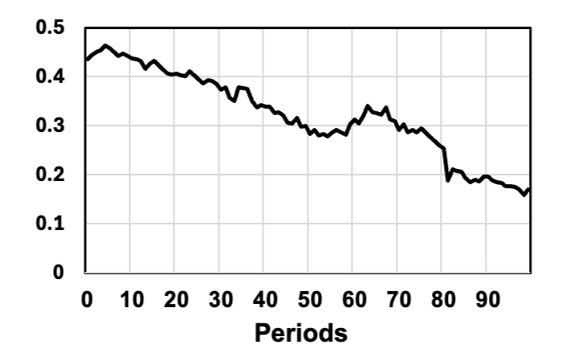
In the Markdown Rule, the average gross return on CBDCs is 1.0091, i.e., an interest rate of 0.91% (while the average Singapore bond rate is 1.41% and the average US bond is 2%), and, in some periods, provides negative interest rates (attributable to the 0.5% penalty on the interest rate on bonds). Despite this, the percentage of domestic investment in CBDCs remains relatively high, at a mean of 32.2% (due to the accompanying liquidity benefits). Thus, the addition of the CBDC raises the opportunity cost of holding a foreign bond, leading to more investment in domestic financial assets than in the pre-CBDC economy. This surge in domestic assets held leads to an appreciation of the Singaporean dollar.
Additionally, another economically intuitive finding is that the Markdown Rule yields the lowest deviation from the status quo. This is intuitive because the Markdown Rule consistently sets the interest rate on CBDCs to 0.5% below the bond rate. The Baseline Rule does not do this: it remains fixed and cannot shift its rates dynamically with bond rates. Similarly, the Taylor Rule, though accommodating for inflation and the output gap, does not change its interest rate in relation to bonds either because of Singapore’s exchange rate targeting monetary policy. Therefore, these results depict that treating the CBDC as having a constant lower remuneration to bonds (acting as a tradeoff for the liquidity benefits of the CBDC) provides the highest exchange rate path fidelity.
The volatility results share a similar story. The volatility was calculated by taking the standard deviation of the exchange rate. Across the full sample period, the Markdown Rule increased exchange rate volatility by just 1.7% relative to the Control (no CBDC), a difference found to be statistically insignificant. By contrast, the Taylor Rule raised volatility by 19.3% and the Baseline Rule by 26.9%, both statistically significant results.
The mechanism by which volatility changes occur is similar: when a CBDC is introduced, domestic investors can shift savings between CBDCs and bonds. Any such rebalancing disturbs the effective return on Singapore dollar assets and, through its impact on the attractiveness of those assets to international investors, moves the exchange rate.
The Markdown Rule minimizes this disruption because the CBDC rate always moves with the bond rate, keeping investor allocations stable. The Taylor and Baseline Rules both break this stability as the growing or shrinking gap between CBDC and bond rates periodically triggers investor rebalancing, generating exchange rate volatility that the Markdown Rule largely avoids.
The findings are up to interpretation and can have various impacts on Singapore’s economy. In all counterfactuals, the Singapore dollar appreciated sharply relative to the Control exchange rate. Even under the Markdown regime, the SGD level is materially higher (35.8%) than the pre-CBDC exchange rate. This appreciation can have advantages and disadvantages, and it is important to note that such appreciation can be limited by monetary policy measures. On the one hand, a higher exchange rate can enable Singapore to import goods at lower prices due to the currency’s increased value. This can increase Singaporeans’ purchasing power. However, the price of Singapore’s exports will also increase due to rising domestic production costs. It is important to note, however, that 43.8% of Singapore’s exports rely directly on imported inputs (OECD 2023), such as value-added components, suggesting that an appreciation could mitigate the adverse effects on export competitiveness. However, this brief does not aim to assess whether a stronger SGD is a boon. Future work on monetary policy measures and CBDC design measures (such as holding limits, sterilized intervention, and CBDC remuneration ceilings), and Singapore’s policy goals is required to provide a substantive conclusion on the future of a retail CBDC in Singapore.
Panetta, Fabio, and Ulrich Bindseil. 2020. “Central Bank Digital Currency Remuneration in a World with Low or Negative Nominal Interest Rates.” CEPR. October 5, 2020. https://cepr.org/voxeu/columns/central-bank-digital-currency-remuneration-world-low-or-negative-nominal-interest.
Bank for International Settlements. 2021. “Central Bank Digital Currencies for Cross-Border Payments Report to the G20.” https://www.bis.org/publ/othp38.pdf.
Chow, Hwee Kwan , G. C. Lim, and Paul D. McNelis . 2014. “Monetary Regime Choice in Singapore: Would a Taylor Rule Outperform Exchange-Rate Management?” Smu.edu.sg. 2014.
https://ink.library.smu.edu.sg/cgi/viewcontent.cgi?article=2523&context=soe_research.
Ferrari Minesso, Massimo, Arnaud Mehl, and Livio Stracca. 2022. “Central Bank Digital Currency in an Open Economy.” Journal of Monetary Economics 127 (February). https://doi.org/10.1016/j.jmoneco.2022.02.001.
Monetary Authority of Singapore. 2021. “Maintenance.” Www.mas.gov.sg. 2021. https://www.mas.gov.sg/-/media/MAS/EPG/Monographs-or-Information-Paper/A-retail-CBDC—Economic-Considerations-in-the-Singapore-Context.pdf.
———. 2023. “What Is MAS’ Monetary Policy Framework and Its Rationale?” Www.mas.gov.sg. April 21, 2023. https://www.mas.gov.sg/monetary-policy/Singapores-Monetary-Policy-Framework/faqs/section-2.
OECD. 2023. “ICIO-TIVA HIGHLIGHTS: GVC INDICATORS for SINGAPORE.”
Panetta, Fabio, and Ulrich Bindseil. 2020. “Central Bank Digital Currency Remuneration in a World with Low or Negative Nominal Interest Rates.” CEPR. October 5, 2020. https://cepr.org/voxeu/columns/central-bank-digital-currency-remuneration-world-low-or-negative-nominal-interest.