

This policy brief is based on “Defining Current and Expected Financial Constraints using AI”. The views expressed are those of the authors and not necessarily those of the institutions the authors are affiliated with.
Abstract
We develop a new firm-level measure of financial constraints using artificial intelligence applied to corporate disclosures, allowing us to distinguish between constraints that are currently binding and those expected in the future. We show that this distinction matters: firms often anticipate constraints but adjust behaviour to prevent them from materialising, while currently constrained firms tend to resolve constraints over time unless they are severe. Financial constraints are therefore dynamic and shaped by expectations. We also revisit the cash flow sensitivity of cash, showing that it primarily identifies firms expecting future constraints but does not capture those that are currently constrained. Instead, currently constrained firms use cash flow to reduce liabilities. Overall, our results highlight the importance of expectations and the need to distinguish between current and anticipated constraints.
Financial constraints play a central role in shaping firms’ decisions. They affect investment, hiring, liquidity management, and ultimately the transmission of macroeconomic policy. Yet, despite their importance, financial constraints remain difficult to identify.
A key limitation of existing approaches is that they rely on ex-post balance sheet information to identify constrained firms. Standard measures — such as the Kaplan–Zingales (1997) or Whited–Wu (2006) indices — classify firms based on realised financial positions, and therefore primarily capture firms that are currently constrained. However, firms’ decisions are shaped not only by current conditions, but also by expected future financing frictions. This creates two important challenges. First, such measures are inherently backward-looking and may identify constraints only once they have already materialised. Second, they miss firms that anticipate future constraints. These firms exhibit significant behavioural changes in anticipation of future financial frictions, for example by accumulating precautionary cash buffers or restructuring liabilities in ways that prevent constraints from binding in the future. These firms do not appear constrained in current data, yet their behaviour is shaped by expected financing conditions. As a result, focusing only on realised constraints risks overlooking an important margin along which expectations influence firm decisions.
In our recent working paper, “Defining Current and Expected Financial Constraints using AI”, we develop a new measure of financial constraints using artificial intelligence applied to firm disclosures. The key advantage of these disclosures is that they contain not only descriptions of firms’ current financial conditions, but also forward-looking assessments of risks, financing conditions, and anticipated challenges. This makes them a natural source for capturing firms’ expectations about future financial constraints.
We use modern natural language processing methods to extract this information systematically at scale. This approach allows us to distinguish between constraints that are currently binding and those that firms expect to bind in the future, and to study how firms transition between these states and how their behaviour differs across them. By directly capturing forward-looking information, our approach provides a measure of financial constraints that incorporates the expectations channel central to firms’ decision-making.
We construct a firm-level measure of financial constraints using the Management Discussion and Analysis (MD&A) sections of firms’ 10-K filings. Our sample covers publicly listed US firms between 1993 and 2024, resulting in a large panel of firm-year observations and corresponding textual disclosures. The MD&A sections provide detailed narrative discussions of firms’ financial conditions, risks, and financing environments, including both current assessments and forward-looking statements about future challenges.
To extract this information, we train modern natural language processing models based on BERT (Bidirectional Encoder Representations from Transformers) on a large set of 23,687 human-labelled text segments. BERT is designed to interpret language in context, meaning that it considers the full sentence and surrounding text when classifying whether a passage reflects financial constraints. This is crucial in our setting, where similar words can convey very different meanings depending on context, for example, whether a firm is currently constrained or discussing potential future risks.
Unlike traditional keyword-based approaches, which rely on predefined dictionaries, this method allows us to capture nuanced and context-dependent discussions of financial constraints. In practice, the model learns to distinguish between statements describing current financing difficulties, anticipated future constraints, and more general discussions of risk, enabling a much richer classification of firms’ financial conditions.
This approach enables us to classify not only whether a firm is financially constrained, but also when constraints bind. Specifically, we distinguish between firms that are unconstrained, those facing constraints today, those expecting constraints to bind in the future, and those facing both current and anticipated constraints. In our data, roughly half of firms are unconstrained, while the majority of constrained firms report constraints that are expected to bind in the future rather than currently. This distinction turns out to be crucial.
Using this new measure, we document several novel facts about the dynamics of financial constraints.
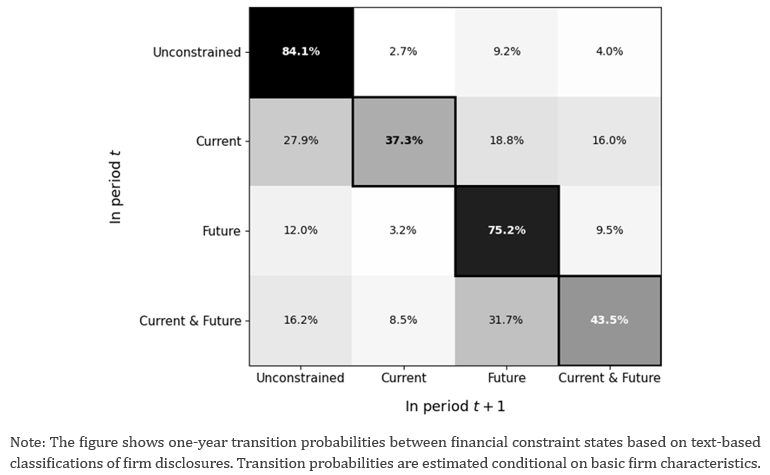
Figure 1 illustrates these transition dynamics. The diagonal elements capture persistence, while the off-diagonal elements show how firms move between states. A key takeaway is that forward-looking constraints frequently do not materialise, consistent with firms taking precautionary action.
Figure 1. Firm transition probabilities across constraint states
Future Constrained Firms (revisiting the cashflow sensitivity of cash): Our results also shed new light on one of the most widely used empirical measures of financial constraints: the cash flow sensitivity of cash (CFSC), introduced by Almeida et al. (2004). The theoretical prediction is straightforward: firms that expect to face financial constraints in the future accumulate cash out of internal cash flows as a precautionary measure, whereas unconstrained firms do not.
A key challenge in testing this prediction empirically is that the theory is inherently forward-looking, while most empirical approaches have abstracted from the timing dimension of financial constraints in this context. In practice, firms are typically classified using balance sheet–based proxies, which reflect realised financial positions and therefore primarily capture whether firms are constrained today. As a result, empirical tests often do not cleanly distinguish between firms that are currently constrained and those that expect constraints to bind in the future.
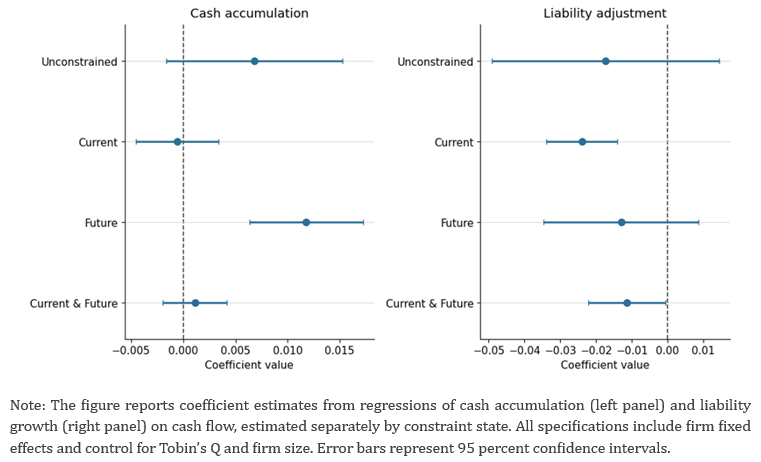
Using our AI-derived classification, we are able to explicitly account for this timing dimension. We find strong support for the theoretical prediction: only firms that anticipate future constraints exhibit a positive cash flow sensitivity of cash. However, we also uncover an important limitation. In standard empirical applications, CFSC is often interpreted as a general measure of financial constraints. Our results show that this interpretation is too broad.
Currently constrained firms (reducing liabilities): Firms that are currently constrained behave differently. Rather than accumulating cash, they use cash flow to reduce liabilities and rebuild financial flexibility. This suggests that the timing of financial constraints is associated with distinct financial strategies.
Figure 2 summarises these results. The left panel shows that cash accumulation is concentrated among firms expecting future constraints. The right panel shows that currently constrained firms instead reduce liabilities, consistent with efforts to restore financial headroom.
Figure 2. Cash-flow sensitivities across financial constraint states
These findings have several implications for policy and empirical work.
Almeida, Heitor, Murillo Campello, and Michael S. Weisbach. “The cash flow sensitivity of cash.” The journal of finance 59, no. 4 (2004): 1777-1804.
Kaplan, Steven N., and Luigi Zingales. “Do investment-cash flow sensitivities provide useful measures of financing constraints?.” The quarterly journal of economics 112, no. 1 (1997): 169-215.
Whited, Toni M., and Guojun Wu. “Financial constraints risk.” The review of financial studies 19, no. 2 (2006): 531-559.