

This policy brief is based on DNB Working Paper No 850/December 2025. The views expressed are those of the author and not necessarily those of the institutions the author is affiliated with.
Abstract
I document that high-frequency euro area monetary policy surprises, measured as changes in risk-free rates around the Eurosystem‘s policy announcements, are not exogenous to information regarding macroeconomic news and financial market developments that pre-date the announcements. More specifically, around 20% of the variation of surprises can be explained by pre-dated information. I show that the violation of the exogeneity of conventional surprise measures introduces a considerable bias into estimates on the effects of monetary policy on euro area macroeconomic outcomes.
Empirical assessments of the effects of monetary policy are key to policy makers seeking to assess the effectiveness of their measures to inform future decisions. Accordingly, they have shaped a large body of research. However, quantifying the effects of monetary policy is a complex endeavor, primarily since it is complicated by endogeneity between observed financial and macroeconomic variables and measures of policy stance.
To overcome these endogeneity issues, many recent empirical studies rely on high-frequency asset price changes in narrow windows around central bank communication events – e.g., the releases of policy statements and subsequent press conferences – to identify exogenous shifts in monetary policy. This identification relies on the assumption of full information, with prices reflecting all available information at each point in time. Consequently, all public information that pre-dates the central bank’s communication event is assumed to be priced in when the announcement begins, and the news about monetary policy are assumed to be the only driver of asset price changes around policy announcements.
In a recent paper, Worms (2025), I test this assumption empirically for the case of the European Central Bank (ECB) by examining the exogeneity of high-frequency changes in risk-free rates around monetary policy communication events with respect to pre-dated information about macroeconomic fundamentals and financial markets. I then examine the extent to which the violation of the exogeneity of surprise measures leads to biased estimates on the effects of monetary policy shocks, if not properly accounted for.
I draw on two main data sources for my analysis. First, I use high-frequency monetary policy surprises, which are assumed to capture instantaneous shifts in markets expectations about the path of monetary policy in response to ECB announcements. In particular, I use the Euro Area Monetary Policy Database (EA-MPD) by Altavilla et al. (2019), the standard reference for event-study analyses on the effects of euro area monetary policy covering high-frequency changes in Overnight Index Swap (OIS) rates with different maturities in narrow windows around ECB monetary policy communication events1.
Second, I collect a set of pre-dated predictors, i.e., public signals and news releases from prior to the announcements, which comprises, first, surprise measures of Bloomberg survey expectations among professional forecasts on euro area industrial production, core CPI and unemployment; second, recent developments in financial markets, covering 3-month changes in the yield curve, the euro area shadow rate, a proxy for risk appetite, the equity performance of euro area banks and the broad stock index; and third, monetary policy surprises of previous ECB announcements2.
To test whether surprises are ex-post predictable based on past information, in a first step, I regress the OIS surprises with different maturities, respectively, on the set of pre-dated public signals. Figure 1 illustrates the share of variation in surprises that is explained by the pre-dated public signals, by maturity of the OIS contract and decomposed by category.
Figure 1. Predictive Power by News Category and Maturity
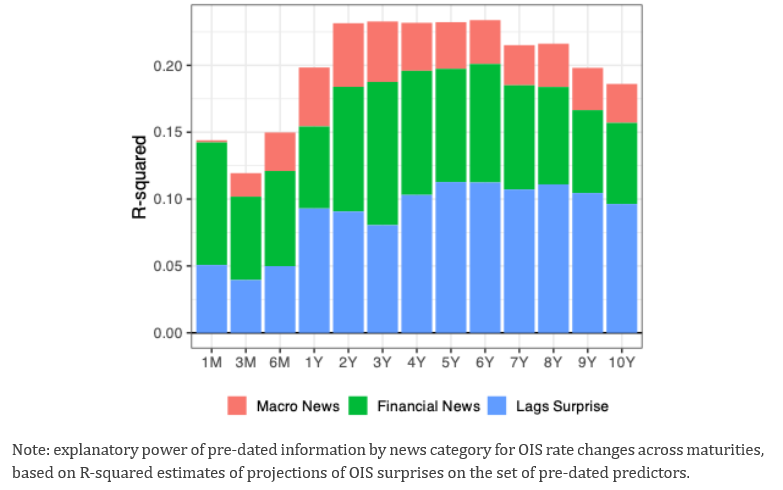
In general, the set of pre-dated signals exhibits strong predictive power, accounting for around 12% to 15% for changes in short-term rates and around 20% and more for longer maturities. Figure 1 also shows that the predictability of medium-term surprises is driven primarily by previous macroeconomic and financial news, while the relative contribution of earlier policy surprises tends to increase for longer maturities. Overall, these findings strongly challenge the implicit assumption of event-study analyses that surprises capture purely exogenous shifts in monetary policy and confirm previous US evidence by Bauer and Swanson (2023a,b) to hold also for the euro area.
To examine the consequences of the violation of the exogeneity of surprises for estimates on the effects of monetary policy on real outcomes, I proceed to orthogonalize the OIS surprises with respect to the pre-dated public signals and then contrast the estimation results based on the adjusted and unadjusted surprise measure3.
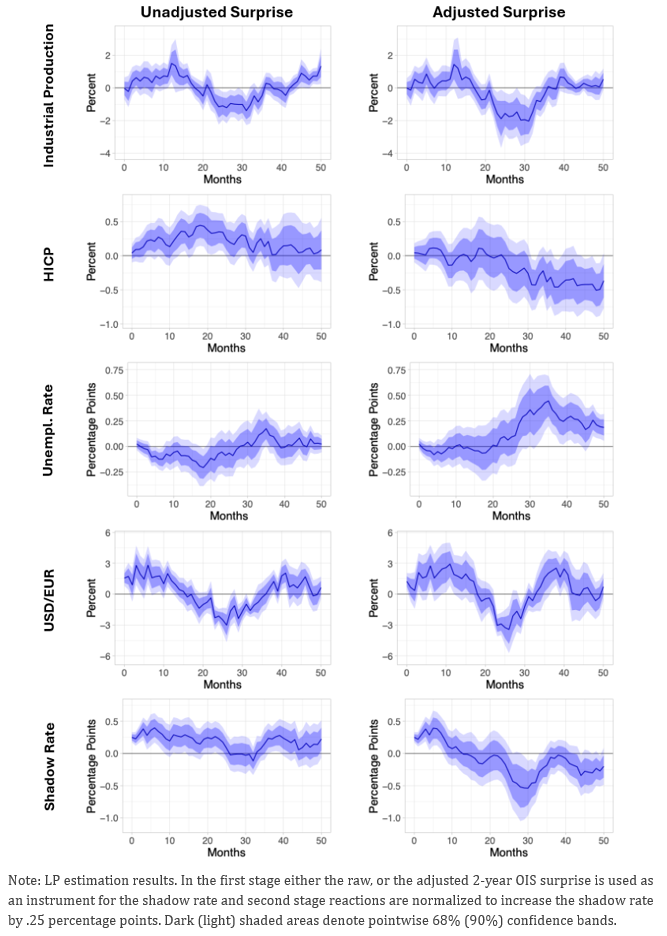
Figure 2 illustrates the estimation results for the effects of monetary policy on macroeconomic outcomes, based on two separate local projection (LP) frameworks on monthly frequency following Jordà (2005) and, e.g., Gertler and Karadi (2015) and Stock and Watson (2018), in which the unadjusted and adjusted surprise in the 2-year OIS rate serve as an instrument for a monetary policy shock, respectively4. The monetary policy shocks are normalized to increase the euro area shadow rate by 25 basis points on impact. The left column of Figure 2 shows the reactions to a monetary policy shock that is based on the unadjusted surprise, while the right column shows estimates based on the adjusted surprise. Overall, the estimated macroeconomic reactions to monetary policy shocks differ considerably: the unadjusted instrument produces puzzling reactions in economic activity, prices and unemployment, whereas the adjusted instrument yields estimates that are more consistent with theoretical predictions. In particular, adjusting the instrument for the correlation of surprise measures with pre-dated information reverses the sign in the reaction of prices and unemployment and mitigates the puzzling initial reaction in economic activity shortly after a tightening monetary policy shock. In Worms (2025), I further decompose the macroeconomic impulse responses to the unadjusted instrument into reactions to the adjusted surprise and to a component capturing the correlation with pre-dated information. Through this decomposition, I demonstrate that the discrepancy in estimated responses stems from a considerable bias in the reactions to the unadjusted surprise, which arises because the violation of the exogeneity of surprises entails that a tightening monetary policy shock is associated with higher economic activity, an increase in prices and lower unemployment.
Figure 2. Macroeconomic Responses to Monetary Policy Shock
I document that the exogeneity assumption of high-frequency changes in risk-free rates around monetary policy announcements does not hold empirically: OIS surprises around ECB communication events are ex-post predictable based on information that pre-dates the announcement. My results reveal that the predictability of monetary policy surprises based on pre-dated information is evident also for the case of the euro area and the ECB, extending earlier evidence by Bauer and Swanson (2023b) for the US. I then show that the violation of the exogeneity of surprises gives rise to puzzling macroeconomic reactions to monetary policy shocks. Overall, my findings highlight the relevance of ensuring the exogeneity of euro area surprise measures for empirical assessments of the macroeconomic effects of monetary policy by orthogonalizing high-frequency asset price changes with respect to pre-dated information.
Altavilla, C., Brugnolini, L., Gürkaynak, R. S., Motto, R., & Ragusa, G. (2019). Measuring euro area monetary policy. Journal of Monetary Economics, 108, 162–179.
Bauer, M. D., & Swanson, E. T. (2023a). An Alternative Explanation for the “Fed Information Effect.” American Economic Review, 664–700.
Bauer, M. D., & Swanson, E. T. (2023b). A reassessment of monetary policy surprises and high-frequency identification. NBER Macroeconomics Annual, 37(1), 87–155.
Gertler, M., & Karadi, P. (2015). Monetary policy surprises, credit costs, and economic activity. American Economic Journal: Macroeconomics, 7(1), 44–76.
Jordà, Ò. (2005). Estimation and inference of impulse responses by local projections. American Economic Review, 95(1), 161–182.
Stock, J. H., & Watson, M. W. (2018). Identification and estimation of dynamic causal effects in macroeconomics using external instruments. The Economic Journal, 128(610), 917–948.
Worms, D. (2025). Predictability of Monetary Policy Surprises and Euro Area Macroeconomic Dynamics.
More specifically, I use the changes in OIS rates over both, the press release and the subsequent press conference.
Due to limited data availability of Bloomberg macro surveys, the sample covers April 2005 to December 2023.
In Worms (2025), I additionally compare the estimation results at earlier stages of the transmission and find that the discrepancy between estimates is not as drastic as for the macroeconomic reactions, which is in line with US evidence in Bauer & Swanson (2023b).
I use the high-frequency OIS surprise with a maturity of two years as a unified measure of monetary policy, which is based on the idea that changes in the 2-year maturity capture both, shifts in monetary policy in terms of conventional as well as unconventional measures over the medium term.