

This SUERF Policy Brief summarizes Imam and Poghosyan (2026). The views expressed are those of the authors and do not necessarily represent the views of the International Monetary Fund, its Executive Board, or IMF management.
Abstract
The post-COVID inflation surge was one of the most synchronized global shocks in decades, yet inflation trajectories diverged markedly across countries. We argue that the key difference lay not in the initial shock itself, but in the extent to which external shocks became embedded in domestic inflation dynamics. Countries with histories of higher inflation and stronger energy-price pass-through experienced significantly more persistent inflation, whereas credible policy frameworks helped contain amplification even when they could not prevent the initial surge. This matters because geopolitical fragmentation, energy insecurity, climate transition pressures, and repeated supply disruptions may increasingly expose economies to recurrent supply shocks. In such an environment, the central policy challenge shifts from preventing every inflationary impulse to limiting the extent to which temporary shocks propagate into broader and more persistent inflation dynamics.
The inflation surge following the pandemic was one of the most synchronized macroeconomic shocks in modern history. Virtually every economy faced the same broad forces at roughly the same time. This included supply-chain disruptions, the sharp rebound in demand following the reopening of economies, labor shortages, and then the energy and food shock following Russia’s invasion of Ukraine.
Inflation rose almost everywhere. Yet the remarkable feature of the episode was not the synchronization of the initial shock itself. It was the divergence that followed.
Some economies experienced inflation that, while painful, remained relatively contained. Others saw inflation rise to levels not experienced in decades, with price increases proving far more persistent. By the end of the episode, cumulative price-level increases differed enormously across countries.
Figure 1 illustrates this divergence. Inflation accelerated globally after the pandemic, but inflation paths increasingly separated over time. The post-COVID period therefore became not only a story of synchronized shocks, but also one of divergent inflation propagation.
Figure 1. Average annual CPI inflation: Pre- and post-COVID
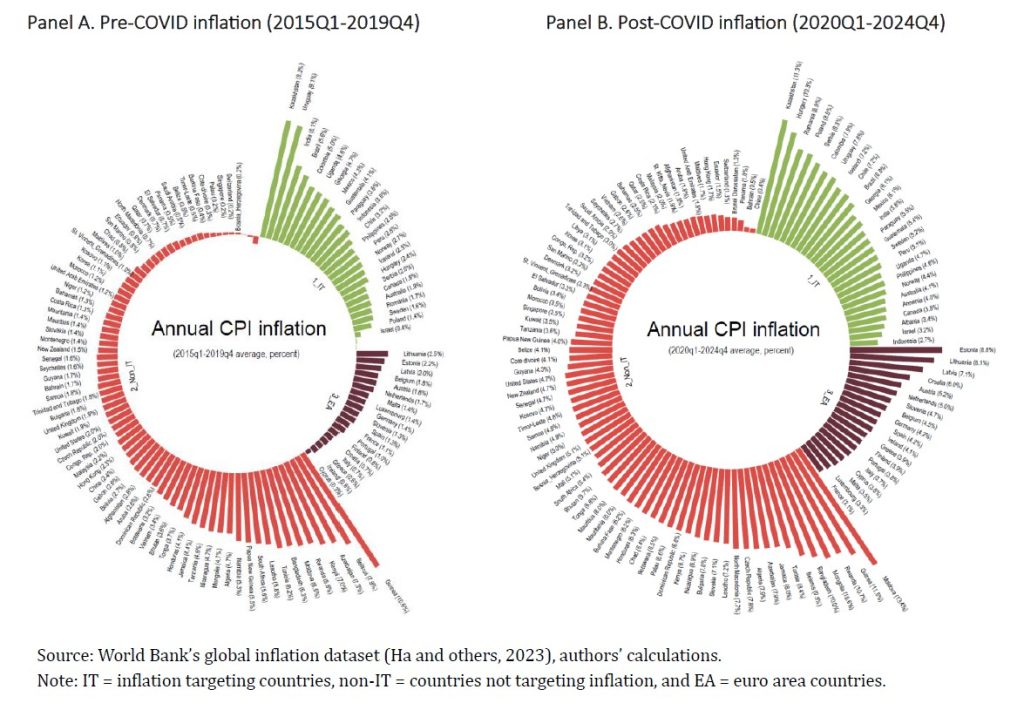
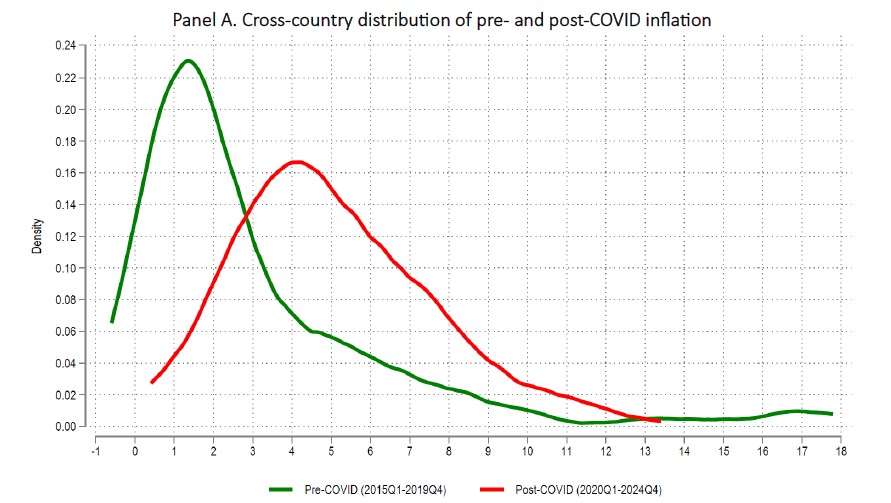
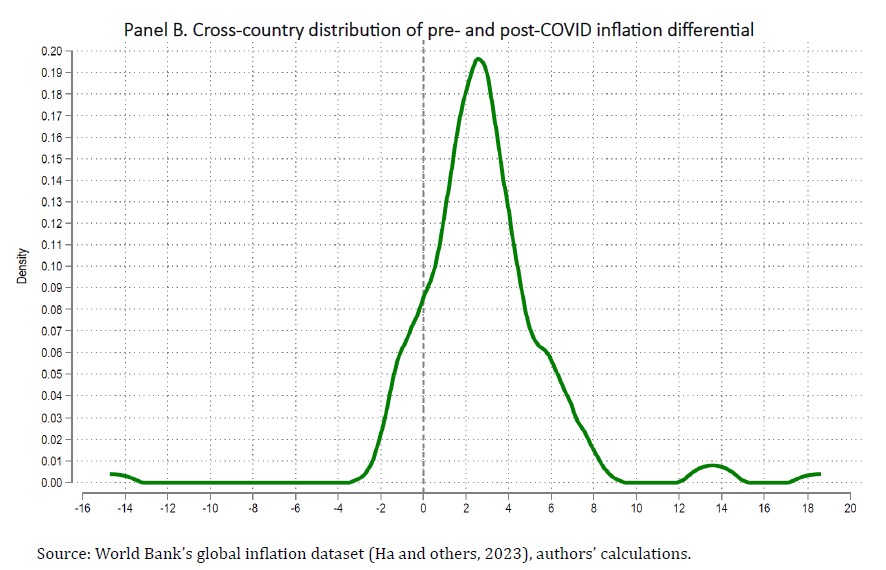
Figure 2 highlights a related and underappreciated point. Although inflation rates eventually declined from their peak, in most economies they did not fully return to their pre-pandemic patterns. The inflation shock therefore left a lasting scar. For households, what mattered was not simply whether inflation was falling, but that inflation did not return to its pre-pandemic level.
Figure 2. Kernel distribution of CPI inflation
Understanding why some countries experienced far more persistent inflation than others is not simply an academic exercise. It goes directly to the question of how economies absorb and internalize large external shocks.
Much of the debate surrounding the inflation surge focused on why inflation rose globally. Reasons included fiscal expansion, accommodative monetary policy, supply bottlenecks, or commodity-price shocks (Bernanke and Blanchard, 2023, 2024). Those factors clearly mattered. But they mainly explain the common inflation impulse. They do not explain why inflation became persistent in some countries but not in others.
Our argument is that the key divergence emerged through inflation propagation. By this we mean the set of domestic mechanisms, such as expectations formation, wage-setting behavior, price adjustment, and policy credibility, through which external shocks become embedded in broader inflation dynamics. The initial shocks were global. The persistence was domestic.
This matters because the post-pandemic episode may not represent a temporary departure from the pre-COVID world. The global economy appears to be entering a more fragmented and shock-prone era, shaped by geopolitical tensions, energy insecurity, climate-related disruptions, and increasingly fragile supply chains. Europe sits particularly close to these pressures because of its dependence on imported energy, the fiscal costs of the green transition, and renewed geopolitical uncertainty.
Perhaps the low-inflation world of the Great Moderation, especially during the 2000s and 2010s, was the exception, not the rule.
Imam and Poghosyan (2026), based on evidence from 130 economies, points to a surprisingly concentrated explanation for post-pandemic inflation divergence. Two variables dominate almost everything else: countries’ prior inflation experience and the scale of domestic energy-price increases. This is one of the central findings of the paper.
Much of the existing literature has focused on identifying the sources of the initial inflation shock (see also Imam and Poghosyan, 2025). Our findings instead shift attention toward the mechanisms that transformed temporary relative price changes into persistent inflation. The key divergence emerged in the second round.
The first-round effects of the shock were largely unavoidable. Central banks could not reopen ports, produce semiconductors, or restore gas flows disrupted by war. Inflation rose sharply almost everywhere, including in economies with highly credible monetary frameworks.
But countries differed markedly in how strongly those shocks became embedded in the broader economy. In economies with histories of higher inflation, firms and households appear to have interpreted the inflation surge differently (see also Gagnon and Kamin, 2025). Temporary increases in energy and food prices were more rapidly incorporated into wage negotiations, pricing decisions, and inflation expectations. Inflation persistence therefore became easier to generate.
By contrast, economies with long histories of low and stable inflation appear to have processed the same shocks differently. Households and firms were more willing to view the inflation surge as temporary, limiting broader propagation. Inflation history matters not because the past mechanically predicts the future, but because it shapes how societies interpret shocks. This interpretation resonates with recent work emphasizing the role of inflation expectations and institutional memory in shaping inflation dynamics (Coibion and Gorodnichenko, 2025).
Inflation, in this sense, is partly behavioral. It depends not only on economic conditions, but also on collective beliefs regarding whether price increases are temporary or lasting. This interpretation also helps explain one of the more intriguing findings of the paper. Many institutional variables commonly emphasized in macroeconomic debates, including broad governance indicators and even formal monetary-policy frameworks, lose explanatory power once inflation history and energy-price shocks are taken into account.
At first glance, this appears counterintuitive. But the result becomes more understandable once one distinguishes between preventing the initial inflation impulse and containing propagation afterward.
Large global shocks can overwhelm even highly credible institutions in the short run. What matters most is whether expectations remain sufficiently anchored to prevent temporary shocks from becoming persistent inflation. Credibility matters not because it prevents the first wave, but because it limits the propagation and the second-round effects.
The paper’s dynamic analysis of energy-price pass-through strongly reinforces this interpretation. We find that the transmission of energy-price increases to headline inflation became materially stronger after COVID than during the pre-pandemic decade. This result suggests that the macroeconomic environment itself may have changed.
For much of the Great Moderation, globalization, integrated trade, and relatively stable geopolitics dampened inflation propagation. Supply shocks occurred, but they rarely generated persistent inflation. Relative price changes tended to remain localized and temporary.
The post-pandemic environment appears fundamentally different. Repeated supply disruptions, energy-market volatility, geopolitical fragmentation, and strategic competition have increased the likelihood that external shocks become persistent inflationary processes. The world has, in some sense, rediscovered the macroeconomics of supply shocks. As Megan Greene (2025) recently argued, the supply side is likely to play a much larger role in shaping macroeconomic outcomes in the years ahead.
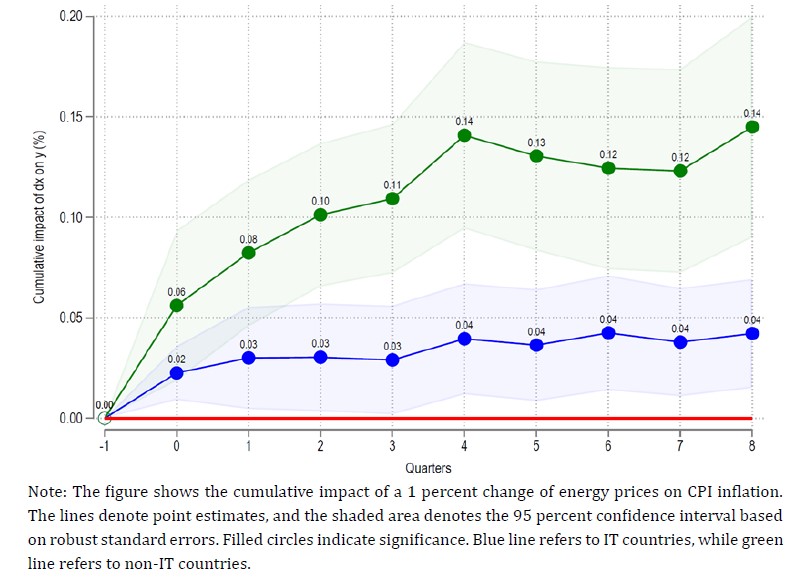
Figure 3 is especially revealing in this regard. Inflation-targeting economies experienced significantly lower and less persistent energy-price pass-through than countries without inflation-targeting frameworks. Yet even among inflation targeters, pass-through remained positive and economically meaningful.
This is an important nuance. Inflation targeting did not immunize economies from the shock. No monetary framework could have fully insulated countries from the scale of the post-pandemic energy disruption. But credible frameworks appear to have moderated propagation. They reduced the extent to which temporary relative price shocks became generalized inflation.
Figure 3. Energy price pass-through: IT versus non-IT countries
The objective of monetary policy in such an environment is therefore not to suppress all relative-price adjustment. Some relative-price changes are inevitable in a world undergoing energy transition and geopolitical restructuring because economies must adapt to scarcer energy, shifting production structures, and higher transition costs. The challenge is to prevent these necessary adjustments from feeding into wage-price spirals and broader inflation expectations, thereby transforming a relative-price shock into generalized inflation (Hofmann, Manea, and Mojon, 2024; Hernández de Cos, 2025).
This distinction increasingly matters for central banking strategy. In a world characterized by repeated supply shocks, central banks may need to focus less on fine-tuning aggregate demand and more on preventing de-anchoring under uncertainty.
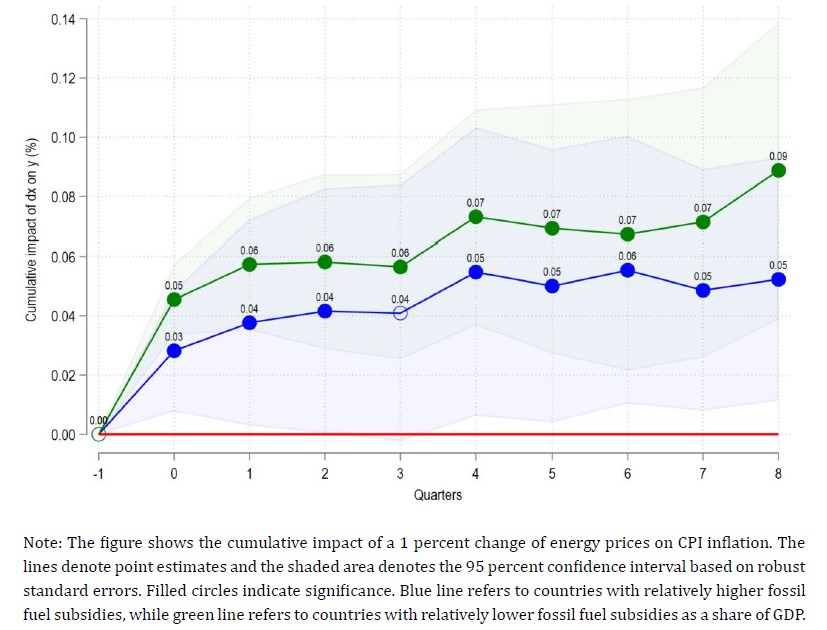
The findings on fossil-fuel subsidies further illuminate these propagation mechanisms. Countries that expanded subsidies generally experienced smaller inflation responses to energy-price increases. Figure 4 shows that economies with larger subsidies experienced materially weaker inflation pass-through following energy-price shocks.
In the short term, such measures dampened pass-through and reduced inflation persistence by limiting the extent to which higher energy costs fed into wages, transportation costs, and broader price-setting behavior. Yet these policies are hardly costless.
Figure 4. Energy price pass-through: The role of fossil fuel subsidies
Subsidies may cushion households and temporarily stabilize inflation, but they can also weaken fiscal positions, distort price signals, and become politically difficult to reverse. If maintained too long, they risk shifting the adjustment burden from consumers to sovereign balance sheets.
The broader lesson is therefore not that subsidies are always desirable or always harmful. It is that inflation management in a world of repeated supply shocks increasingly requires coordination between monetary credibility and fiscal capacity. This is consistent with the broader emphasis on policy coordination between fiscal and monetary authorities.
The post-pandemic inflation episode also exposed the limits of monetary policy acting alone. Monetary policy cannot produce energy, repair supply chains, or eliminate geopolitical fragmentation. What it can do is prevent external shocks from becoming domestically self-reinforcing. In an environment of repeated supply shocks, monetary and fiscal policies may become more interdependent in supporting macroeconomic stabilization.
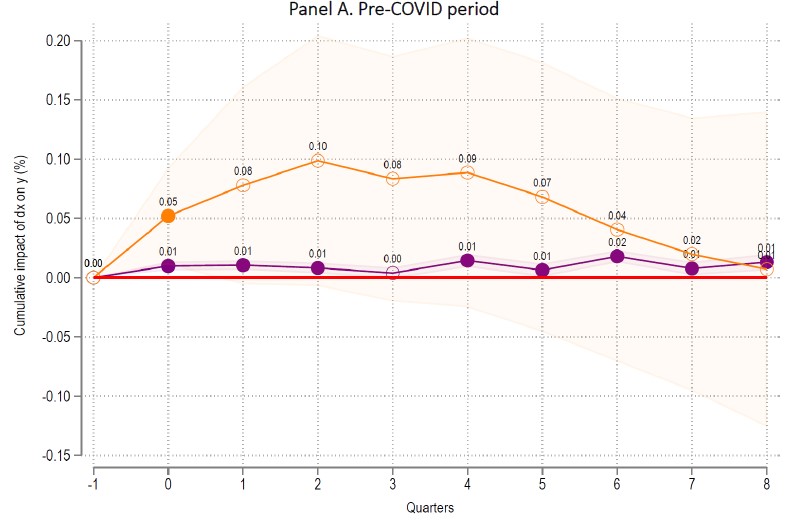
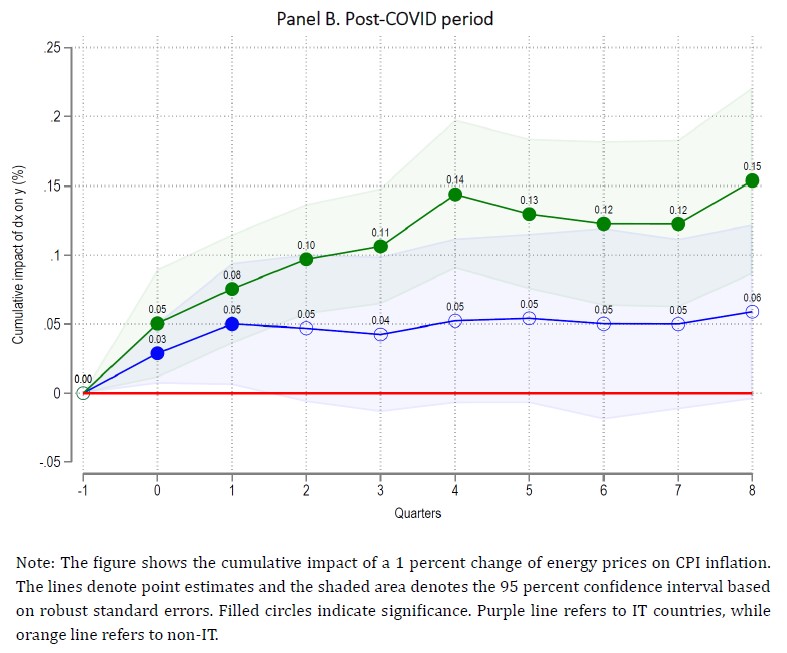
One of the paper’s most striking findings is the clear change in inflation dynamics between the pre- and post-COVID periods. Figure 5 highlights how the transmission of energy-price shocks to inflation became materially stronger and more persistent after the pandemic, particularly in non-inflation-targeting economies.
Panel A shows that before COVID, energy-price shocks generated relatively modest inflation responses that stabilized quickly across most horizons. Inflation-targeting economies experienced especially limited pass-through, suggesting that relative-price shocks remained largely contained and did not diffuse broadly through the economy.
By contrast, Panel B reveals a markedly different post-pandemic pattern. Inflation responses became both larger and more persistent over time, with pass-through continuing to rise several quarters after the initial shock rather than fading quickly. The divergence between inflation-targeting and non-targeting economies also widened considerably, with non-targeters experiencing substantially stronger and more prolonged inflation effects.
Taken together, the figure suggests that the post-pandemic environment became more vulnerable to the propagation of supply shocks through broader domestic inflation dynamics, and inflation proved easier to ignite than to extinguish.
The broader historical shift is striking. For much of the 2000s and 2010s, advanced economies became accustomed to a world in which globalization, technological change, and integrated supply chains continuously dampened inflationary pressures. The dominant concern was not excessive inflation, but persistently weak inflation and secular stagnation. The post-pandemic episode challenged that assumption. It revealed how quickly inflation can become persistent once repeated supply shocks interact with expectations, wages, and credibility.
The post-COVID inflation episode may therefore represent more than a temporary disturbance. It may mark the return of supply-constrained macroeconomics.
Figure 5. Energy price pass-through: IT versus non-IT countries during pre- versus post-COVID period
The post-pandemic inflation episode may ultimately be remembered not simply for the scale of the shocks, but for revealing how quickly inflation regimes can change once repeated supply disturbances begin feeding into expectations, wages, and broader pricing behavior.
During the Great Moderation, advanced economies became accustomed to a world in which inflation shocks faded relatively quickly. That environment now appears less secure. In a more fragmented global economy, repeated supply disruptions may no longer remain temporary relative-price shocks, but increasingly risk becoming embedded in domestic inflation dynamics.
This changes the task facing central banks. The challenge is no longer simply to bring inflation back down after a shock, but to prevent economies from gradually adapting to a world of structurally higher inflation itself.
In the end, the key divide after COVID was not between countries facing shocks and those that did not. It was between economies where shocks remained temporary disturbances and those where they began to reshape expectations, wage formation, and the inflation process itself. The deeper risk for the decade ahead may therefore not be a single inflation surge, but the gradual normalization of a more volatile and persistently inflation-prone macroeconomic environment.
Bernanke, Ben, and Olivier Blanchard. 2023. “What Caused the U.S. Pandemic-Era Inflation?” Peterson Institute for International Economics Working Paper 23-4.
Bernanke, Ben, and Olivier Blanchard. 2024. “An Analysis of Pandemic-Era Inflation in 11 Economies.” NBER Working Paper No. 32532.
Coibion, Olivier, and Yuriy Gorodnichenko. 2025. “Inflation, Expectations and Monetary Policy: What Have We Learned and to What End?” NBER Working Paper No. 33858.
Gagnon, Joseph E., and Steven B. Kamin. 2025. “The Role of Long Histories of ‘Lived Experience’ in the COVID-Era Inflationary Surge.” PIIE Working Paper 25-7, Peterson Institute for International Economics.
Greene, Megan. 2025. “The Supply Side Demands More Attention.” Bank of England speech.
Hernández de Cos, Pablo. 2025. “Delivering on Central Bank Mandates in a Changing World.” BIS speech.
Hofmann, Boris, Cristina Manea, and Benoît Mojon. 2024. “Targeted Taylor Rules: Monetary Policy Responses to Demand- and Supply-Driven Inflation.” BIS Quarterly Review, December.
Imam, Patrick A. and Tigran Poghosyan. 2025. “Navigating the 2022 Inflation Surge: A Comparative Analysis of IT and Non-IT Central Banks” IMF Working Paper No. 25/212. Washington, DC: International Monetary Fund.
Imam, Patrick A. and Tigran Poghosyan, 2026 “One Global Shock, Many Inflation Paths: Explaining Post-COVID Inflation Divergence” IMF Working Paper No.26/103.