

menu
close

Author(s):

Christina Anderl | Bank of England
Alessandro Nava | University of Padova

Keywords:

Inflation , oil shocks , shipping conditions , tanker markets , Baltic Dirty Tanker Index (BDTI) , monetary policy

JEL Codes:

E31 , R41 , Q43 , E52

This brief summarises and interprets findings from the working paper “Oil on the Water: How Shipping Conditions Shape the Inflationary Effects of Oil Shocks” (March 5, 2026). The views expressed are those of the authors of this draft and do not necessarily reflect those of the institutions with which the original paper’s authors are affiliated.

Abstract

Oil-price shocks do not mechanically translate into inflation. A missing part is the cost and availability of transporting crude oil by sea. When tanker markets present high freight rates and constrained capacity, the delivered cost of oil rises more than benchmark crude prices suggest, amplifying the inflationary impact of oil supply and demand shocks. Using evidence from 43 oil-importing and oil-exporting economies over 2000–2024, Anderl & Nava (2026) show that inflation responses to oil shocks are more persistent when shipping conditions are under pressure. Importers typically experience larger consumer-price effects, but under stressed shipping conditions, exporters’ inflation responses become much more similar to those of importers. From a policymaking point of view, the message is straightforward: oil-price monitoring is not enough; shipping indicators should be part of inflation surveillance and scenario analysis.

Why this matters for inflation and monetary policy

Nearly three-quarters of global oil consumption is transported by sea, and oil tankers account for a large share of global shipping capacity. This means that tanker-market conditions can create a wedge between benchmark crude prices and the effective price paid by buyers once transport costs are included. In practice, the same oil-price shock can be mildly inflationary in a low transport price shipping environment, but significantly more inflationary when shipping is in high price conditions. This state dependence matters for:

  • Inflation forecasting and risk assessment (particularly for energy and upstream prices).
  • Distinguishing temporary price spikes from persistent cost-push episodes.
  • Calibrating the policy response to supply shocks (managing second-round effects and expectations).

What the new evidence shows

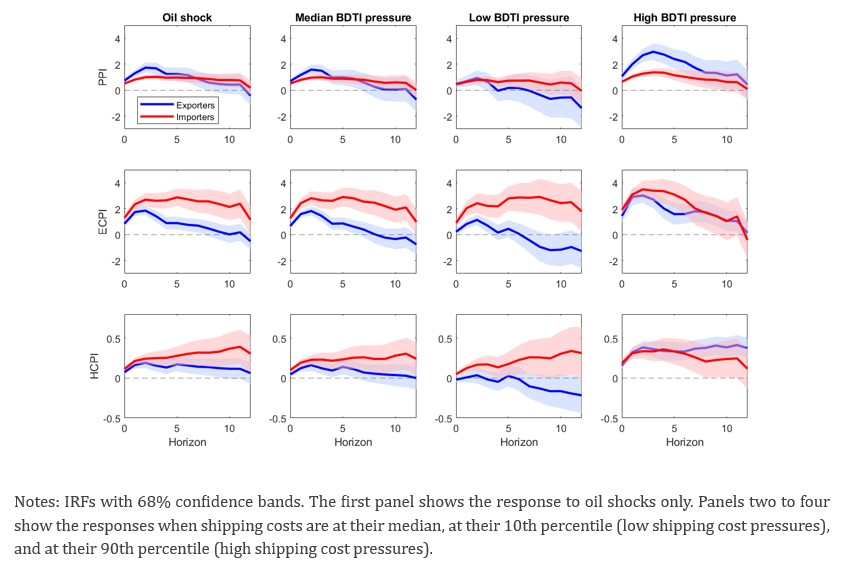
The paper studies how oil supply and demand shocks transmit to inflation under different shipping conditions, measured by the Baltic Dirty Tanker Index (BDTI), a widely used indicator of crude-oil shipping costs. As presented in Figure 1, the analysis compares responses when shipping conditions are low BDTI pressure, median BDTI pressure, and high BDTI pressure.

Figure 1. Results for Producer, Energy, and Headline Price Inflation
Key findings at a glance

  1. Shipping tightness amplifies inflation pass-through.

When shipping markets experience high BDTI pressure, inflation reacts more strongly and for longer to the same oil shock across producer prices, energy prices, and headline inflation. In other words, shipping constraints act as a non-linear amplifier.

  1. Importer/exporter asymmetries shrink when shipping costs are high.

Under median or low BDTI pressure conditions, oil importers tend to experience larger consumer-price effects than exporters. But in high BDTI pressure shipping markets, exporters’ consumer-price responses become much closer to those of importers, turning an oil shock into a broader global cost-push shock.

  1. Energy prices react quickly, and headline inflation becomes more persistent under high BDTI pressure.

Importers show a rapid jump in retail energy inflation immediately after an oil shock. Under high BDTI pressure, exporter energy-price inflation looks much more similar to that of importers, and exporter headline inflation becomes larger and more persistent than under normal conditions.

  1. Oil shocks explain a larger share of inflation volatility with high BDTI pressure.

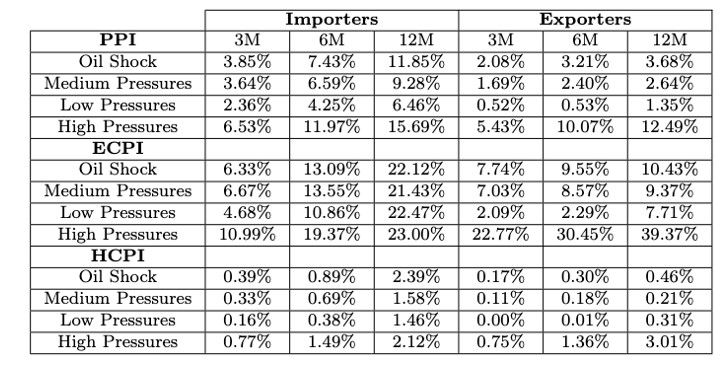
Forecast-error variance decompositions indicate that the contribution of oil shocks to inflation variability increases markedly in tight shipping states, especially for exporters’ producer and energy prices.

Policy implications

Table 1 . Forecast Error Variance Decomposition
The results suggest three practical implications for central banks and other macroeconomic policymakers:

  • Upgrade inflation monitoring: add tanker-market indicators (e.g., BDTI and related freight measures) to standard energy-price dashboards, alongside benchmarks (Brent/WTI) and refined-product spreads.
  • Improve scenario design: in stress tests and forecasting, treat “oil-price shocks with tight shipping” as a distinct scenario with larger and more persistent inflation risks, closer to a broad cost-push shock than a simple energy-price swing.
  • Refine the policy narrative: communicate that the inflationary risk from an oil shock also depends on logistics constraints. When shipping costs are high, second-round effects (wages, core inflation) may warrant closer attention, even if the initial shock is clearly supply-driven.

A policy checklist: what to watch in real time

  • Tanker freight rates and capacity: BDTI (dirty tankers), time-charter rates, fleet utilisation, and orderbook-to-fleet ratios.
  • Chokepoints and rerouting: disruptions that lengthen routes (and effectively reduce capacity), such as conflicts, blockages, or sanction-driven rerouting.
  • Port congestion and turnaround times: delays can tighten shipping even without higher benchmark oil prices.
  • Energy pass-through indicators: refined-product margins, wholesale-to-retail fuel spreads, and inflation expectations (survey and market-based).

Beyond monetary policy: reducing the amplification channel

Shipping tightness is not primarily a monetary phenomenon. It is a real constraint that can amplify energy price shocks. Policy options to reduce this amplification include:

  • Strategic reserves and logistics: when releasing strategic petroleum reserves, ensure logistical capacity to move crude to where it is needed; otherwise, the “delivered price” channel may blunt the stabilizing intent.
  • Resilience and diversification: diversify import routes and supply sources (e.g., pipeline capacity where feasible, storage closer to end-users, diversified shipping arrangements).
  • Regulatory preparedness: in stress periods, streamline operational constraints that slow tanker turnaround (e.g., port operations, customs processes, temporary waivers where appropriate), while maintaining safety and environmental standards.
  • Sanctions and trade measures: when designing energy-related sanctions, consider their indirect effects on shipping capacity and route lengths that can raise freight costs and inflation.

Conclusion

Oil shocks become more inflationary when the oil transport system is under strain. The evidence in Anderl & Nava (2026) suggests that high BDTI pressures can turn what looks like a conventional oil supply shock into a broader and more persistent inflation impulse, including in oil-exporting economies. For policy, the takeaway is straightforward: treat shipping conditions as a crucial part of the energy-inflation nexus. Monitoring and scenario analysis that ignore tanker-market tightness risk misjudging both the magnitude and persistence of inflation pressures.

References

Anderl, C., & Nava, A. (2026). Oil on the Water: How Shipping Conditions Shape the Inflationary Effects of Oil Shocks. Working paper, 22 January 2026.

Känzig, D. R. (2021). The macroeconomic effects of oil supply news: Evidence from OPEC announcements. American Economic Review, 111(4), 1092–1125.

UNCTAD (2024). Review of Maritime Transport 2024.

EIA (2024). Short-Term Energy Outlook.

About the authors

Christina Anderl

Christina Anderl is an international macroeconomist specialising in commodity markets, monetary policy, and inflation dynamics. She holds a PhD in Economics from London South Bank University, and she is currently an Economic Adviser at the Bank of England and previously served as Senior Lecturer in Economics at London South Bank University. Her research focuses on how shocks in global energy, food, and commodity markets affect inflation and inflation expectations. Her recent research examines how shipping costs and supply chain disruptions amplify inflationary pressures, providing policy-relevant insights into the interaction between global markets and inflation.

Alessandro Nava

Alessandro Nava is a PhD student in Economics and Management at the University of Padova. His research lies at the intersection of transport economics and macroeconomics, with a focus on maritime supply chains, energy markets, and inflation dynamics. He has been a visiting researcher at the University of Oxford, where he worked on the macroeconomic implications of shipping disruptions for inflation and global economic activity. He is a research affiliate at the Interuniversity Research Centre of Public Economics (CRIEP), contributing to policy-oriented projects on sustainable logistics and transport systems.

More on these topics

Tags:
Privacy Overview

This website uses cookies so that we can provide you with the best user experience possible. Cookie information is stored in your browser and performs functions such as recognising you when you return to our website and helping our team to understand which sections of the website you find most interesting and useful.