

The views expressed in this brief are those of the authors and do not necessarily reflect the official position of the National Bank of Slovakia or the Eurosystem. All errors and omissions remain the responsibility of the authors. Acknowledgements: We thank Ján Beka, Michal Horváth, Joan Paredes, Milan Vaňko, Ivan Sutóris, and Branislav Reľovský for fruitful discussions and helpful suggestions.
Abstract
We investigate recent wage developments in Slovakia, with a focus on differences between the private and public sectors and their implications for macroeconomic stability. While real wage growth in the private sector has remained subdued, it appears broadly consistent with weak productivity developments and does not constitute a macroeconomic imbalance. By contrast, public sector wages have grown more rapidly and increasingly outpace underlying productivity, leading to a widening divergence between sectors. At the same time, over the last decade economic growth in Slovakia has been driven primarily by increases in labour input rather than productivity gains, limiting the scope for sustained real wage growth. Cross-country comparisons further point to relatively weak performance of the Slovak private sector and rising pressures on cost competitiveness. Overall, the findings suggest that preserving macroeconomic balance over the medium term will require wage growth to remain aligned with productivity developments, while the key policy challenge lies in strengthening productivity growth.
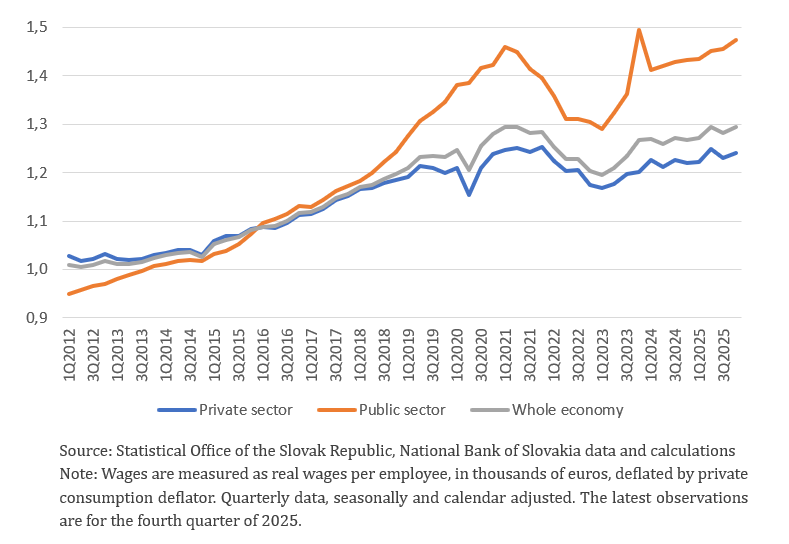
Wage dynamics have taken centre stage in the post-pandemic European economic debate, while Slovakia’s real wage growth has remained subdued by historical standards. Following the sharp inflation surge in 2022–2023, both the pace and distribution of wage adjustments have become central to understanding the persistence of inflation, particularly in the services sector, and the recovery of household purchasing power. Despite relatively tight labour market conditions prior to the pandemic, real wage growth in Slovakia has remained subdued for much of the past five years, especially compared with earlier periods of stronger growth, as shown in Chart 1.
Chart 1. Real wage per employee (thousands of euros)
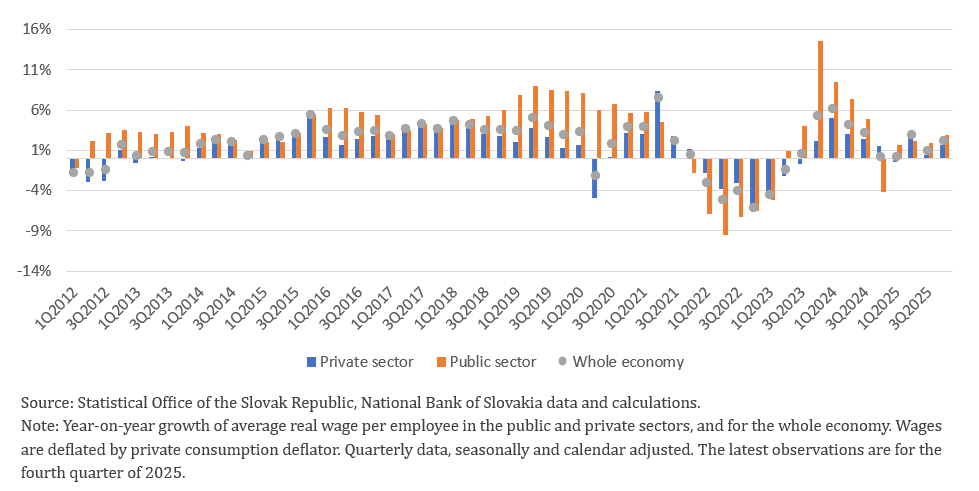
A widening gap between the private and public sectors points to increasingly heterogeneous wage growth dynamics. Chart 2 shows when the divergence in wage growth rates has been visible, with stronger public-sector wage growth gradually widening the gap with the private sector. In the short term, wage developments in the public and private sectors are shaped by markedly different wage-setting mechanisms: the former is mostly policy-driven, while the latter largely reflects market forces.1 However, over the longer term, both must remain aligned with the underlying productivity trends and broader macroeconomic fundamentals, to ensure fiscal sustainability and avoid persistent distortions between sectors, given that public sector wages are ultimately financed through the taxation of private economic activity.
Chart 2. Sectoral real wage growth (year-on-year percentage changes)
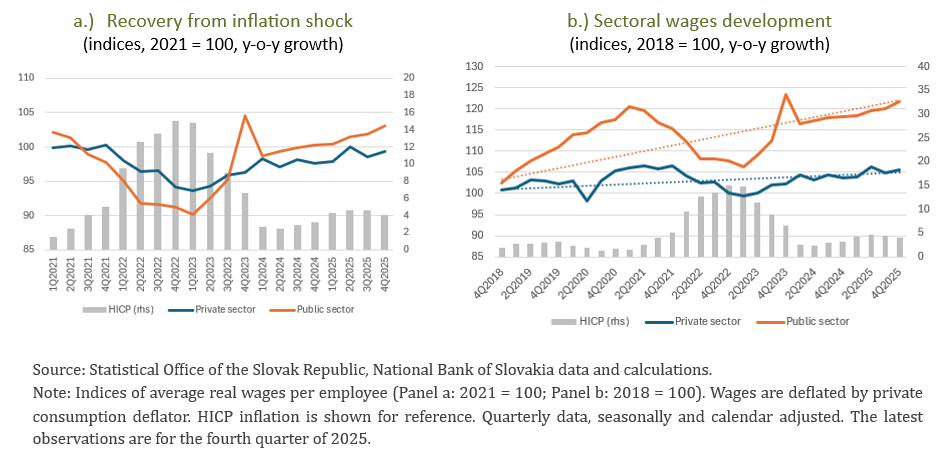
The widening gap between public and private sector wages reflects both the sluggish recovery from the inflation shock and weak private sector wage growth. Chart 3, panel a, shows that by the fourth quarter of 2025, private real wages had only just returned to their pre-inflation shock level in 2021. Panel b, by contrast, highlights a pronounced divergence in wage growth across sectors. Over the past seven years, the average real wage in the private sector has grown cumulatively by 5.5%, compared with 22.7% in the public sector. This difference relative to 2018 levels cannot be explained by a catch-up effect, which would typically imply faster growth from a lower initial wage level. Since the first quarter of 2016, the real wage per employee in the public sector has exceeded that in the private sector.
Chart 3. Sectoral wage recovery and dynamics
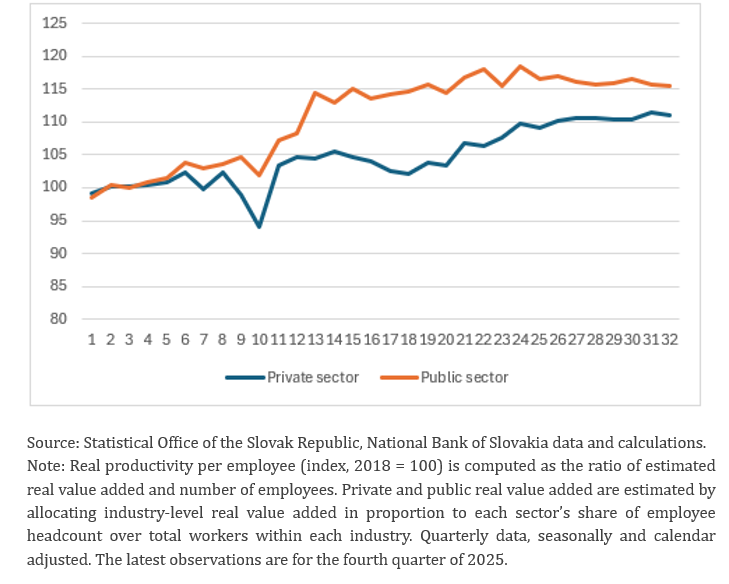
The stagnation of private sector wages appears broadly consistent with weak developments in real productivity per employee. Chart 4 shows that estimated real productivity per employee2 has followed a similarly weak path, suggesting that subdued real wage growth in the private sector does not merely reflect delayed nominal adjustment after the inflation shock, but also the absence of sustained productivity gains capable of supporting stronger real wage growth.
Chart 4. Sectoral real productivity per employee (indices, 2018 = 100)
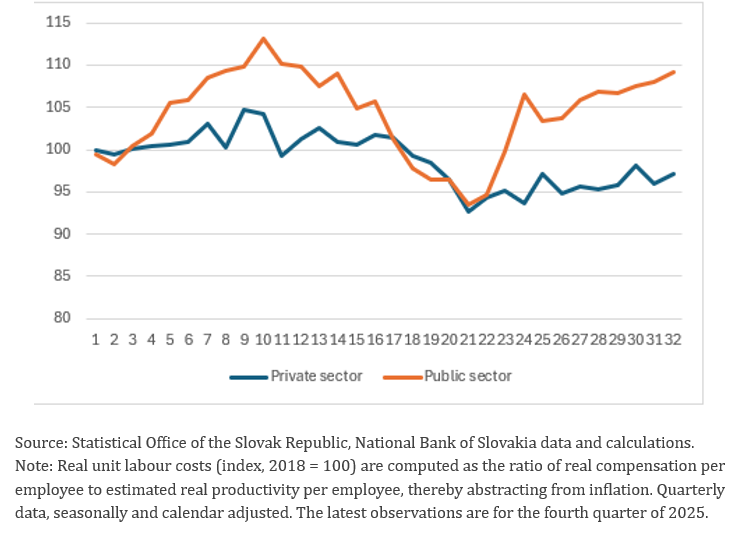
Diverging wage developments are increasingly reflected in different real unit labour cost dynamics across sectors. Private sector real unit labour costs remain below their pre-pandemic levels, reflecting contained real wage growth in a context of weak productivity. In the public sector, by contrast, stronger wage growth amid weak or stagnant productivity has progressively raised real unit labour costs, widening the gap between the two sectors, as shown in Chart 5.3 Part of the observed stagnation in the private sector may also reflect compositional effects related to changes in the structure of employment. However, the concurrent weakness in productivity per employee suggests that a significant share of the subdued wage growth has a real basis and is not merely a statistical artefact.
Chart 5. Real unit labour cost developments in public and private sectors (indices, 2018=100)
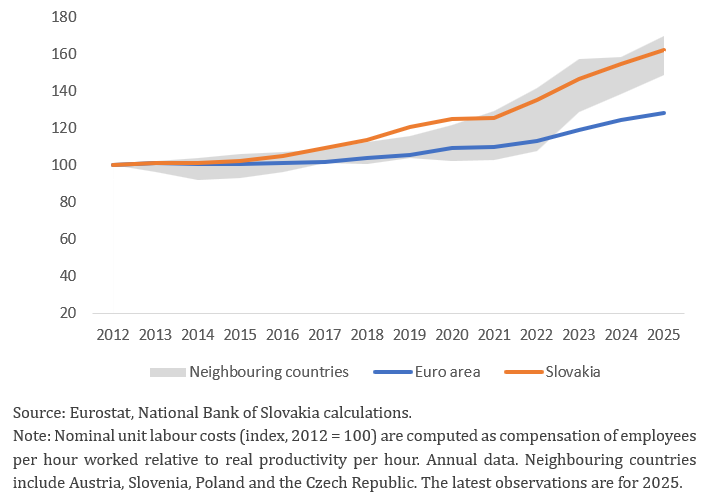
The main concern is the growing disconnect between wages and productivity in the public sector, which may affect wage-setting in the private sector and therefore weigh on wider economy competitiveness. Public sector wage growth has increasingly outpaced weak underlying productivity gains. Since public sector wages are less directly disciplined by market output, sustained divergence from productivity would add pressure to public finances. Empirical evidence (Abdallah et al., 2023; Afonso & Gomes, 2014; Checherita-Westphal et al., 2025; D’Adamo, 2014; Goto & Yamagishi, 2024; Javier, 2010; Lamo et al., 2012) shows that public sector wage increases can spill over into private sector wage-setting, weakening the wage-productivity link. Given Slovakia’s integration into international production chains, persistent wage-productivity gaps may weigh on medium-term cost competitiveness. Chart 6 shows that ULC growth in Slovakia is among the highest in the region and well above the euro area average.
Over the last decade, Slovakia’s economic expansion appears to have relied more on rising labour input than on productivity gains. The combined dynamics of declining unemployment and stagnant productivity point to an economic expansion in Slovakia driven more by the extensive than by the intensive margin. Such a growth model is unlikely to be sustainable over the long term and appears to have reached its limits in recent years, as employment cannot expand indefinitely and demographic trends point to a progressively shrinking working-age population, constraining further expansion of labour input.4 In this environment, a wage growth path that consistently outpaces productivity will prove difficult to reconcile with medium-term macroeconomic balance.
Chart 6. Unit labour cost developments in Slovakia and neighbouring countries (indices, 2012 = 100)
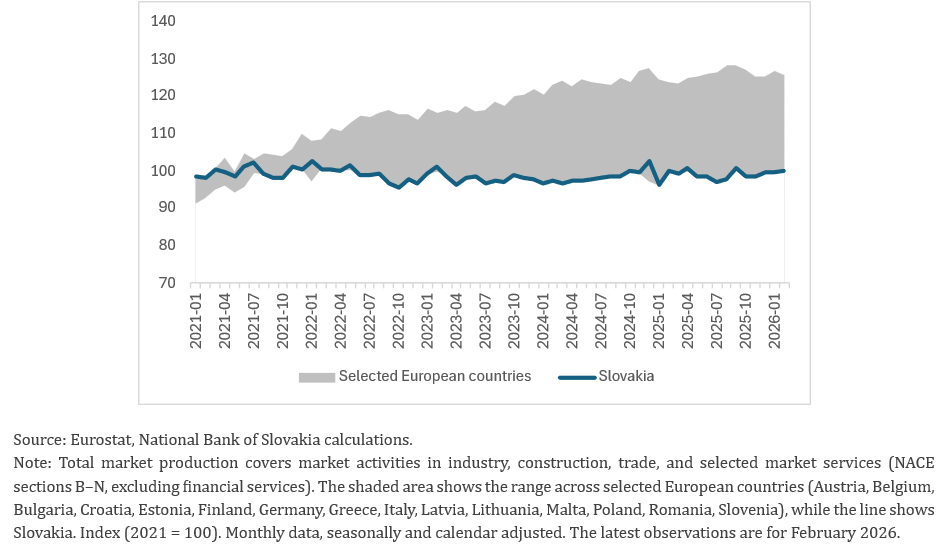
The picture of sluggish productivity is mirrored in Slovakia’s weak overall market production relative to selected European peers, adding to competitiveness concerns. Total market production, covering industry, construction, trade, and selected services excluding financial services, has remained broadly flat since 2021 and is among the weakest in the group, as illustrated in Chart 7. In particular, the industry sector, traditionally a key driver of the Slovak economy, has been constrained by weak external demand, lingering supply-side pressures, and rising labour costs, further weighing on cost competitiveness.
Chart 7. Total market production in Slovakia and selected European countries (indices, 2021 = 100)
Unlike private sector wage developments, which remain broadly aligned with productivity, public sector wage growth has increasingly outpaced underlying productivity gains, creating pressures across several macroeconomic dimensions. If left unaddressed, this divergence could weigh on fiscal sustainability, price stability and cost competitiveness over the medium term. The key policy challenge is therefore twofold: to preserve a closer link between wage dynamics and productivity, particularly in the public sector, and to strengthen productivity growth itself to support sustainable real wage gains. Absent corrective action, continued wage increases in excess of productivity risk becoming a persistent source of macroeconomic imbalance and may increase the likelihood of future harsher stabilisation measures.
Abdallah, C., Coady, D., & Jirasavetakul, L.-B. F. (2023). Public-private wage differentials and interactions across countries and time. IMF Working Papers, 2023(064).
Afonso, A., & Gomes, P. (2014). Interactions between private and public sector wages. Journal of Macroeconomics, 39(PA), 97–112.
Checherita-Westphal, C., Leiner-Killinger, N., & Schildmann, T. (2025). Euro area inflation differentials: the role of fiscal policies revisited. Empirical Economics, 68(2), 803–854.
D’Adamo, G. (2014). Wage spillovers across sectors in Eastern Europe. Empirical Economics, 47(2), 523–552.
Goto, T., & Yamagishi, A. (2024). Wage spillovers across sectors: Evidence from a localized public-sector wage cut. SSRN Electronic Journal.
Javier, J. (2010). Public wages in the euro area – towards securing stability and competitiveness. Occasional Paper Series.
Lamo, A., Pérez, J. J., & Schuknecht, L. (2012). Public or private sector wage leadership? An international perspective: Public or private sector wage leadership? An international perspective. The Scandinavian Journal of Economics, 114(1), 228–244.
See also Box 1 Public sector wages and the minimum wage in the Economic and Monetary Developments – Spring 2026, which discusses the role of public wage policy and the minimum wage in overall wage dynamics https://nbs.sk/dokument/d9205216-2dec-4642-8552-d8a5951f1bb9/stiahnut?force=false
Due to data limitations, we depart from the standard measure of productivity per hour worked and use productivity per employee instead. This choice reflects our focus on comparing private and public sector dynamics, as consistent data on hours worked are not available for the government sector. Industry-level gross value added is allocated to the private and public sectors using the corresponding private and public employment shares within each NACE industry over total employment. The sectoral estimates are then obtained by summing the allocated values across industries. For a sectoral, industry-level, analysis of productivity developments, see the forthcoming Policy Brief, Slovakia’s Productivity Shift: Grounds for Optimism or Cause for Concern?
Chart 5 abstracts from price developments to highlight sectoral differences within Slovakia, while Chart 6 reports standard unit labour costs to assess external cost competitiveness across countries
For a deeper analysis on demographic trends and their impact on the labour market, and the economy at large, see also Section 3, Population ageing and its challenges, of the NBS 2024 Structural Challenges report, available at https://nbs.sk/en/publications/structural-challenges/