

This policy brief is based on Banca d’Italia Occasional Papers No. 1042. The views expressed are those of the author and not necessarily those of the institutions the author is affiliated with.
Abstract
The ongoing debate on unconventional central bank balance sheet (CB-BS) expansions tends to overlook the fact that such expansions are actually nothing new. This column examines the evolution of the Bank of Italy’s BS and shows that, throughout the 20th century, both BS responses and impulses to macroeconomic conditions closely resemble those observed during the recent episodes of unconventional expansions. The results suggest that CB-BS has de facto functioned as a monetary policy instrument well before the global financial crisis. Moreover, the findings provide valuable insights into the current debate.
Central banks’ balance sheet (CB-BS) policies for monetary policy and financial stability purposes have become widespread globally since the global financial crisis, and have given rise to an extensive academic and institutional debate (e.g., Borio and Disyatat, 2010; CGFC, 2019; Bernanke, 2020; Bailey et al., 2020; ECB, 2021). Before the global financial crisis, models abstracted altogether from the CB-BS, only treating the short term nominal interest rate as the instrument. Some of the literature explicitly predicted that CB-BS expansions would have no effects on the macroeconomy. In contrast, the body of literature resulting from the last two decades has put forward several potential transmission channels through which CB-BS may have an impact on financial conditions and the macro-economy. Also the empirical evidence confirms that CB-BS programs have been successful.
However, the literature tends to overlook that CB-BS expansions are actually nothing new, and that significant CB-BS expansions have been going on for as long as we have had CBs (Ferguson et al., 2015; Ferguson et al., 2023; Koike, 2024).
A recent study (Affinito, 2026) investigates whether CB-BS expansions have effectively functioned as a monetary policy tool also in the past. Specifically, it examines the evolution of the Bank of Italy’s balance sheet over a 104-year period, from the Bank’s establishment (at the end of the 19th century) to 1998 (the last year prior to the start of the ECB’s single monetary policy), and analyses the relationship between BS movements and the evolution of key macroeconomic variables of the country. In other terms, the paper applies to historical data the analytical framework and methodologies used by the recent literature on unconventional BS expansions.
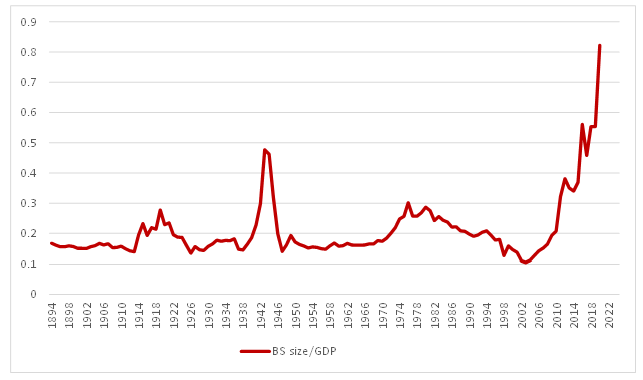
Although the empirical analysis focuses on the history of the Bank of Italy up to 1998, Figure 1 illustrates the evolution of the CB total assets (here scaled by GDP) through the 2020s, and shows that, although the BS has reached much larger dimensions in recent years, episodes of both BS expansion and contraction occurred during the entire century.
Figure 1. The Bank of Italy’s balance sheet size (1894-2024; measured as total assets and scaled by GDP)
To conduct the test on whether the CB-BS has historically functioned as a monetary policy tool, the analysis employs a range of VAR models and investigates both sides of the issue, that is, whether and to what extent the CB-BS responded to macroeconomic developments, and whether it generated macroeconomic effects. VAR techniques have been extensively used over time to analyse the role of conventional and unconventional monetary policy instruments. The paper draws on both the traditional and the recent VAR literature. In line with the traditional literature, the test adopts the standard framework of analysing both sides of the (potential) monetary policy tool, and accordingly interprets the VAR equation describing the CB-BS as part of the monetary authority’s reaction function, which specifies the feedback rule linking the information set monitored by the CB to its policy actions (Christiano et al., 1999). In line with the recent literature employing VARs exactly to investigate the macroeconomic effects of CB-BS expansions (Kapetanios et al., 2012; Gambacorta et al., 2014; Weale and Wieladek, 2016; Garcia Pascual and Wieladek, 2016; Haldane et al 2016, and Boeckx et al., 2017), the analysis examines CB-BS expansions in relation to macroeconomic variables and treat the BS as a unified and comprehensive aggregate, focusing on its overall scale. Since the literature indicates that different types of VAR models can yield different results, the analysis assesses the stability and robustness of findings by employing several types of VAR (both frequentist and Bayesian VARs) and identification schemes. The analysis is divided into three parts. The first examines the full sample of 104 years of data, providing a comprehensive overview of long-run historical averages. The second disaggregates these average results across partially overlapping sub-periods using a rolling VAR approach (Park and Ratti, 2000). The third provides a component-level analysis of the BS.
Four main findings emerge, which may also offer some insights to the ongoing debate.
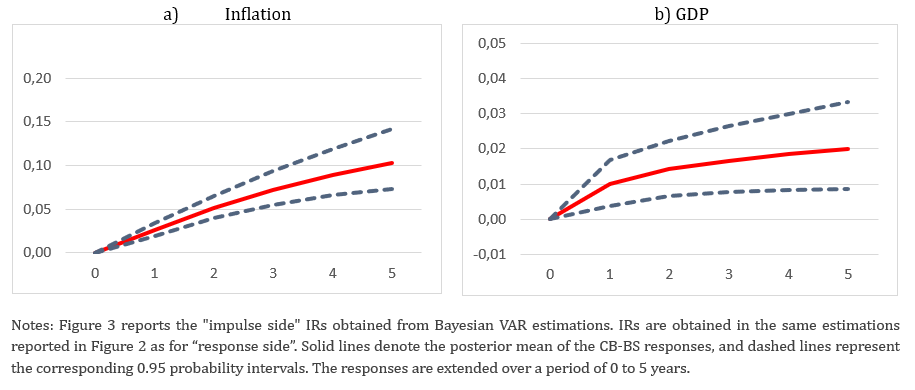
First, during the entire 20th century, both the BS reaction function (CB-BS responses) and effects (CB-BS impulses) were similar to those traditionally attributed to conventional monetary policy instruments, and to those documented in the recent episodes of unconventional BS expansions. Therefore, the evidence suggests that the BS has functioned de facto as an instrument of monetary policy on the average of the century. Specifically, on the reaction side, CB-BS contracted following positive shocks to inflation and exchange rate depreciation (Figure 2), which suggests a reaction to counter the rise of inflation and depreciation. Instead, it expanded following shocks in the real output, government debt, banking system deepening, trade, and contractionary monetary policies implemented by leading CBs abroad. On the impulse side, exogenous BS expansions were followed by significant output growth and rise in inflation (Figure 3), in addition to depreciation of the exchange rate, and increase in international trade.
Figure 2. BS responses to macroeconomic shocks; Bayesian VAR estimations
(1895-1998, excluding World War II years)
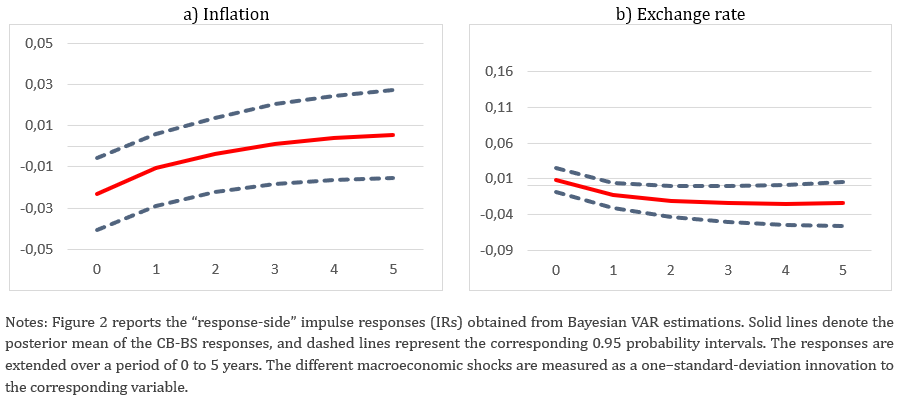
Figure 3. BS impulses to macroeconomic developments; Recursive, structural and Bayesian VAR estimations
(1895-1998, excluding World War II years)
Second, an analysis by sub-periods conducted using rolling VAR results shows that both BS reactions to macroeconomic developments and BS impulses to macroeconomic aggregates have evolved over time, reflecting changes in economic and financial conditions. Nevertheless, the main qualitative findings, with the exception of extreme wartime conditions, remain remarkably consistent across the different phases and cycles of the century. In terms of the current debate, both the century-long average and the year-by-year results suggest that the long-term effectiveness of BS policies did not tend to diminish over time, and that BS policies have functioned both in normal times and during episodes of economic distress. However, it is also to remark that, during the 20th century, many of the standard monetary policy transmission mechanisms that exist today were either largely absent or only beginning to develop. As a result, CB-BS policies may have been more active and effective precisely because they operated under more particular conditions, comparable to those observed during recent crises due to market mechanism dysfunctions.
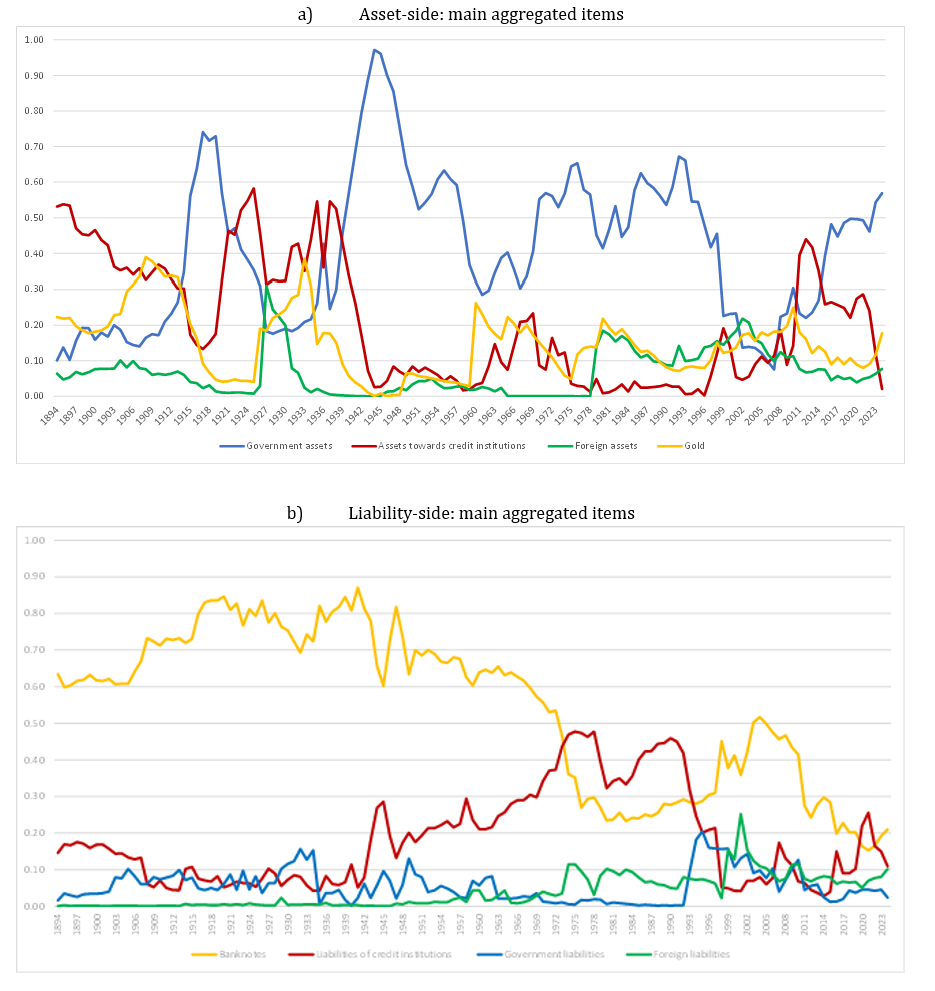
Third, the analysis by BS components (Figure 4, panels a and b) shows that not only BS size but also BS composition has evolved over time in line with prevailing economic needs at each point in time, even though government assets have constituted, on average, the main contributing component and the primary driver of BS dynamics, as was also the case during the recent unconventional policies.
Figure 4. Composition of Bank of Italy’s balance sheet
(shares of total assets)
Fourth, the role of the BS as a monetary policy instrument changed from the early 1980s onward, when all over the world the policy rate became the primary tool of monetary policy and the main instrument for controlling inflation. From that point onward, the interaction between the BS and the policy rate became strongly positive and mutually reinforcing (Figure 5).
Figure 5. Rolling VAR: BS responses and BS impulses with the policy rate
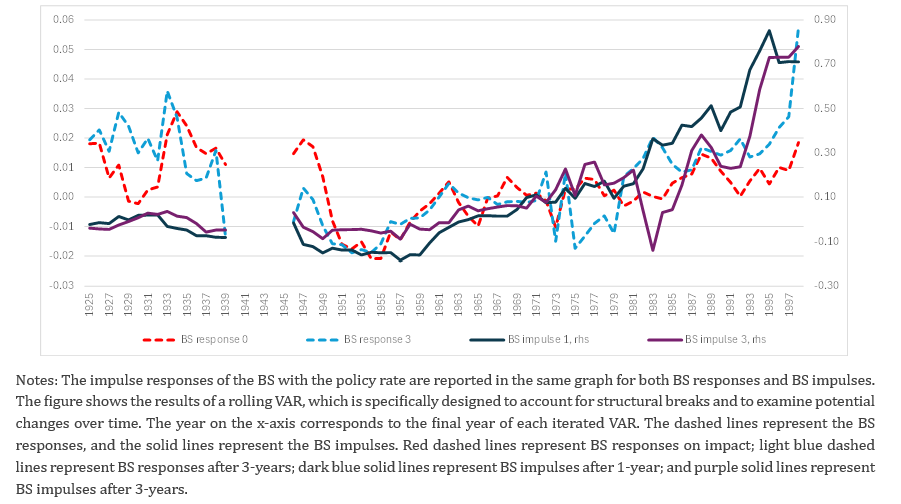
The policy rate appeared to rise in order to mitigate the inflationary implications of BS expansions, while BS expansions appeared to increase in order to offset the contractionary effects of policy rate hikes. Precisely this stronger mutual responsiveness suggests that the BS did not cease to function as a monetary policy tool. Rather, it appeared to operate independently but in conjunction with the policy rate, reflecting their contemporaneous yet opposing effects on inflation, and thereby allowing the BS to pursue additional objectives without undermining the anti-inflationary role of the policy rate. The recent literature on unconventional monetary policies argues that CB–BS expansions are particularly useful during phases of an effective lower bound (given the limited availability of alternative tools), but it also highlights that even in the absence of an effective lower bound, CBs may choose to deploy BS expansions when they judge that this tool can complement conventional instruments. My analysis confirms that BS and interest rate policies have been concretely compatible also in the past, when — despite the absence of a zero lower bound — BS expansions may have functioned as a suitable complement to conventional tools.
Affinito M. (2026), “When did the balance sheet become a monetary policy tool? Evidence from Banca d’Italia across the 20th century,” Banca d’Italia, Questioni di Economia e Finanza (Occasional Papers), Number 1042.
Bailey A., J. Bridges, R. Harrison, J. Jones and A. Mankodi (2020), “The central bank balance sheet as a policy tool: past, present and future,” Bank of England, Staff Working Paper, 899.
Bernanke B.S. (2020), “The New Tools of Monetary Policy,” American Economic Association Presidential Address.
Borio C. and P. Disyatat (2010), “Unconventional Monetary Policies: An Appraisal,” Manchester School, University of Manchester, 78, 53-89.
Boeckx J., M. Dossche, and G. Peersmanc (2017), “Effectiveness and Transmission of the ECB’s Balance Sheet Policies,” International Journal of Central Banking, 13-1.
CGFS – Committee on the Global Financial System (2019), “Unconventional monetary policy tools: a cross-country analysis,” CGFS Papers, 63, October.
Christiano L.J., M. Eichenbaum and C.L. Evans (1999), “Monetary Policy Shocks: What Have We Learned and to What End?,” in J. B. Taylor and M. Woodford (eds), Handbook of Macroeconomics. Amsterdam: Elsevier Science, pp. 65–148.
ECB (2021), “An overview of the ECB’s monetary policy strategy,” Frankfurt am Main.
Ferguson N., A. Schaab and M. Schularick (2015), “Central bank balance sheets: expansion and reduction since 1900,” CESifo Working Paper Series 5379.
Ferguson N., M. Kornejew, P. Schmelzing and M. Schularick (2023), “The safety net: Central bank balance sheets and financial crises,” 1587-2020, CEPR Discussion Paper 17858.
Gambacorta L., B. Hofmann and G. Peersman (2014), “The Effectiveness of Unconventional Monetary Policy at the Zero Lower Bound: A Cross-Country Analysis,” Journal of Money, Credit and Banking, 46-4.
Garcia Pascual A. and T. Wieladek (2016), “The European Central Bank’s QE: A New Hope,” CESIFO Working Paper, 5946.
Haldane A., M. Roberts-Sklar, T. Wieladek and C. Young (2016), “QE: the story so far”, Bank of England Staff Working Paper, 624.
Kapetanios G., H. Mumtaz, I. Stevens and K. Theodoridis (2012). “Assessing the economywide effects of quantitative easing,” Economic Journal, 122-564, 316–47.
Koike R. (2024), “Bank of Japan’s Balance Sheet in 1882–1955: Reassembled Data and Their Developments,” Imes Discussion Paper No. 2024-E-7.
Park K. and R.A. Ratti (2000), “Real activity, inflation, stock returns, and monetary policy,” The Financial Review, 35.
Weale M. and T. Wieladek (2016), “What are the macroeconomic effects of asset purchases?,” Journal of Monetary Economics, 79.