

This SUERF Policy Brief is based on the authors’ IMF Working Paper 25/243, “Elections Matter: Capital Flows and Political Cycles” (Arakelyan and Evdokimova, 2025). The views expressed are those of the authors and not necessarily those of the institutions the authors are affiliated with.
Abstract
National elections are a recurring source of political uncertainty that does not go unnoticed by international investors. Drawing on quarterly data for 38 emerging market economies over 1990-2020, we find that gross private capital inflows decline around election dates, with the sharpest and most persistent effects when elections are marred by violence, held outside their constitutional schedule, or result in leadership change. Countries in the bottom quartile of political stability see inflows fall, on average, by 28 percent in the election quarter relative to pre-election inflows. By contrast, higher levels of overall political stability appear to mitigate these adverse effects. Our findings underscore that it is not elections themselves but the uncertainty they generate that deters capital, and that stronger institutions can act as a buffer against election-related volatility.
Periodic national elections are a defining feature of political life in most countries. They are essential to democratic governance, yet every electoral cycle introduces a degree of political uncertainty, creating the possibility of unforeseen changes in the economic, institutional, and regulatory landscape. Because elections periodically raise uncertainty about future policy direction, they provide a practical proxy for political uncertainty in analyses of investor behaviour. For policymakers in emerging markets who often rely on international capital to finance investment and smooth shocks, this raises an important question: to what extent do elections disrupt capital flows, and under what conditions?
This question connects two strands of research. The first explains international capital flows through the push–pull framework, distinguishing global “push” factors, such as risk appetite or US monetary policy, from domestic “pull” factors, including institutional quality (Koepke 2019). The second examines how political uncertainty affects capital flows. Recent studies show that election-related uncertainty can reduce FDI ahead of competitive contests and weaken portfolio flows when incumbents lose, with particularly pronounced effects in emerging markets with weaker institutions (Julio and Yook 2012; Frot and Santiso 2013; Chen et al. 2019; Honig 2020). However, existing evidence is often limited to a particular flow type, country sample, or short time horizon, leaving open how elections affect capital flows more broadly across emerging markets and how political factors fit into the standard analytical push-pull framework.
Our analysis (Arakelyan and Evdokimova 2025) fills this gap. Drawing on quarterly data for 38 emerging market economies over thirty years (1990-2020), we examine how elections shape the behaviour of international investors. The dataset contains 261 elections, more than half of which resulted in the incumbent losing office. The average distance between elections is close to four years.
We focus on gross private capital inflows: foreign direct investment (FDI), portfolio investment and other investment, including cross-border bank lending. Official flows are removed because their motivations differ from those of private investors and they may move in the opposite direction, for example when official lenders provide support during a period of weaker private capital flows. Gross inflows are also more informative than net flows for this question, since netting residents’ and non-residents’ transactions can conceal large and offsetting movements.
We find that gross private capital inflows decline around elections, especially when elections are contentious, marred by violence, held unexpectedly, or result in leadership changes. Importantly, these effects vary systematically with political stability. Higher levels of political stability appear to mitigate these adverse effects. Elections matter, but not equally everywhere. Where institutions are strong, the impact is muted; where institutions are fragile, the consequences appear to be substantial.
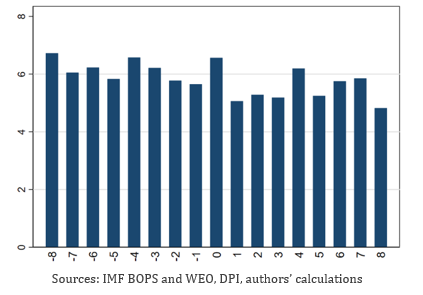
The descriptive pattern is visible before any econometric controls are introduced. On average, private capital inflows begin to soften in the run-up to elections and fall sharply in the quarter immediately after the vote, before recovering gradually thereafter (Figure 1).
To assess how elections affect gross private capital inflows formally, we estimate a standard push–pull model augmented with an election indicator and political and institutional controls. A clear pattern emerges in econometric estimates: gross private capital inflows decline around the time of elections, even after accounting for global and domestic macroeconomic conditions. Moreover, the decline extends into the post-election period, consistent with investors delaying activity until policy uncertainty begins to resolve.
Figure 1. Private capital inflows and the election cycle
(Average gross private inflows, percent of trend GDP, 8 quarters before and after elections)
Crucially, the magnitude of this effect depends on the broader political environment. While elections on average depress inflows, the negative impact is substantially smaller in countries with better scores on the International Country Risk Guide (ICRG) political stability index. Conversely, instability amplifies the response. For countries in the lowest quartile of political stability, the election-quarter decline in inflows averages 1.25 percent of trend GDP, equivalent to a 28% drop relative to pre-election inflows. By contrast, countries with political stability scores above the sample average experience no significant decline around elections.
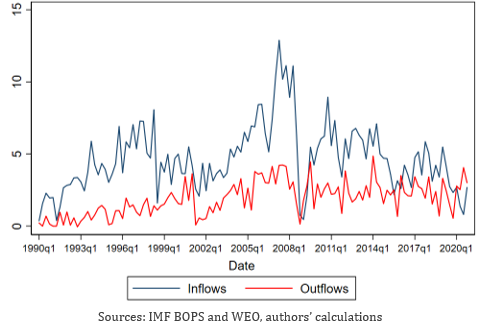
These election-related fluctuations matter because emerging markets have historically been net recipients of capital and often depend on sustained foreign inflows (Figure 2). A temporary interruption can have negative consequences for the stability of their currencies, the continuous supply of credit, their ability to roll over debt obligations, and overall financial stability.
Figure 2. Dynamics of private capital inflows and outflows
(Median private flows in % of trend GDP)
Elections affect capital flows differently across instruments. FDI and other investment inflows decline significantly around elections, while portfolio flows show no comparable response. The effect is also more persistent for FDI, possibly because direct investors delay returning until the post-election policy outlook becomes clearer.
Turning to the direction of flows we notice that gross capital outflows, unlike inflows, do not exhibit a statistically significant relationship with overall political stability, elections, or their interaction. Resident investors may be more familiar with the domestic political risks or better able to interpret them. These results are consistent with other studies suggesting that foreign investors have limited information about the host country and face weaker protection under its legal and political institutions, leaving them more vulnerable to policy uncertainty (e.g., Dixit 2011). Net capital flows broadly mirror the pattern of gross inflows, but the estimates are weaker because changes in outflows dilute the signal. Taken together, the results suggest that the election-related pattern is driven mainly by foreign investors reducing inflows, rather than by domestic residents moving capital abroad.
While elections are useful proxies for political uncertainty, election timing alone does not capture the full range of risks faced by international investors. To distinguish routine elections from those that generate heightened uncertainty, we classify elections by their timing, the presence of political violence, and whether they lead to leadership turnover.
The results show that not all elections generate the same level of investor concern. Elections accompanied by political violence during the campaign, on election day, or in the immediate aftermath, are associated with declines in inflows that persist for up to two quarters after the vote. By contrast, the effect of peaceful elections is largely confined to the election quarter. Violence appears to signal deeper uncertainty about political legitimacy and future policy direction, prompting investors to wait on the sidelines and the impact persisting up to a year after the election.
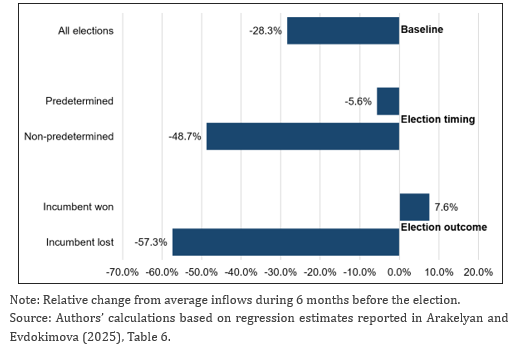
Unscheduled or snap elections tell a similar story. When elections are held earlier or later than constitutionally mandated, typically following political crises or government collapses, the effects are considerably larger. Among countries in the lowest quartile of political stability, capital inflows fall, on average, by close to 50% relative to the pre-election level (see Figure 3). Investors appear to interpret these unexpected contests as signs of institutional weakness and reduce exposure accordingly. Elections held in line with the constitutional schedule are accompanied by a minimal decline in inflows (-5.6%). In politically stable countries, these effects are substantially smaller.
Leadership changes produce a similar pattern. Among countries in the lowest quartile of political stability, inflows fall by close to 60% when incumbents lose (see Figure 3). More broadly, the negative effect remains significant for up to two quarters after the election, suggesting a more pronounced reassessment of policy risk under new leadership. When incumbents win, by contrast, the effects are smaller and short-lived. The quality of institutions and the stability of the political landscape again serve as crucial mitigating factors.
Taken together, these findings underscore a central point: it is not the election itself that deters capital inflows, but the uncertainty surrounding it. High-uncertainty elections, marked by violence, unexpected timing, or leadership turnover, are associated with larger and more persistent declines in inflows. In countries in the bottom quartile of the ICRG political stability index, such events are associated with particularly pronounced declines in gross capital inflows (see Figure 3).
Figure 3. Election-quarter change in gross inflows in the least politically stable countries
(Countries in the lowest quartile of the ICRG political stability index)
While election-related uncertainty is a recurring feature of political life, its economic consequences vary widely across countries. A central finding of our analysis is that institutions play a crucial buffering role, shaping how strongly capital flows respond to elections. In politically stable countries, elections have little measurable effect on capital inflows. Where political stability is weak, by contrast, election-related uncertainty is associated with sharp and economically meaningful contractions in inflows.
These patterns highlight the stabilising role of institutions. Strong governance, predictable policy frameworks, and credible constraints on political power limit the scope for abrupt post-election policy shifts. Even when leadership changes, investors can be confident that the fundamental rules of the game will remain intact. In more fragile institutional environments, elections amplify uncertainty and investor caution.
To identify which institutional features matter most, we examine the underlying pillars of political stability captured by the ICRG index and corroborate the results using alternative governance indicators from the World Bank. Better socioeconomic conditions, lower investment risk, and stronger institutional development, capturing factors such as control of corruption, rule of law, and bureaucratic quality, are consistently associated with higher capital inflows. These same institutional features also mitigate election-related declines in inflows, underscoring their importance during periods of heightened uncertainty.
Overall, the evidence points to a clear conclusion: institutional quality matters most when uncertainty is highest. Elections test the credibility of political and economic frameworks, and stronger institutions help prevent foreign investors from pulling back.
Emerging markets are vulnerable not only to global financial conditions but also to domestic political cycles. Elections matter for capital flows because they raise uncertainty about future policy and governance, making them a useful proxy for political risk. Yet their effects are neither uniform nor inevitable.
The degree of uncertainty surrounding elections varies widely. Routine, orderly contests tend to generate limited market reactions, while elections marked by violence, unexpected timing, or leadership turnover trigger sharper and more persistent declines in capital inflows. In such cases, investor retrenchment often extends beyond the election quarter, reflecting sustained uncertainty about policy direction and institutional continuity.
Crucially, the economic consequences of election-related uncertainty depend on institutional strength. Where governance frameworks are credible and policy constraints well established, capital inflows show little measurable response to electoral cycles. Where institutions are weaker, elections are more likely to be interpreted as risk events, leading to larger and longer-lasting declines in capital inflows. Strengthening institutional quality therefore not only supports long-term investment but also enhances resilience to election-related financial volatility.
Arakelyan, Maria and Tatiana Evdokimova (2025), “Elections Matter: Capital Flows and Political Cycles.” IMF Working Paper WP/25/243.
Chen, Kexin, He Nie, and Zhenyu Ge (2019), “Policy Uncertainty and FDI: Evidence from National Elections.” Journal of International Trade and Economic Development 28 (4): 419–28.
Dixit, Avinash (2011), “International Trade, Foreign Direct Investment, and Security.” Annual Review of Economics 3: 191–213.
Frot, Emmanuel and Javier Santiso (2013), “Portfolio Managers and Elections in Emerging Economies: How Investors Dislike Political Uncertainty.” Review of International Political Economy 20 (1): 26–51.
Honig, Adam (2020), “Elections and Capital Flows.” Journal of Money, Credit and Banking 52 (2–3): 471–503.
Julio, Brandon and Youngsuk Yook (2012), “Political Uncertainty and Corporate Investment Cycle.” The Journal of Finance 67 (1): 45–83.
Koepke, Robin (2019), “What Drives Capital Flows to Emerging Markets? A Survey of the Empirical Literature.” Journal of Economic Surveys 33 (2): 516–540.