

This policy brief is based on Discussion Paper No 10/2026. The views expressed are those of the authors and not necessarily those of the institutions the authors are affiliated with.
Abstract
Culminating in Trump’s so-called “liberation day” in April 2025, punitive tariffs have returned to the forefront of economic policy. Using a dynamic general equilibrium model with a detailed production network, we assess how such import duties affect output, consumption and welfare across four major world regions. Our findings are clear: any short-term gains for the tariff-imposing country fade quickly and disappear altogether once trading partners retaliate, which is likely.
Key policy insights:
Punitive tariffs have re-emerged as a prominent instrument of economic policy. The trade measures introduced by the US against China, the European Union (EU) and other economies in 2025 marked a sharp escalation in global trade tensions. Tariffs and countermeasures have disrupted supply chains, increased uncertainty for firms and raised broader concerns about the macroeconomic consequences of trade conflict. Against this background, two questions arise: what are the aggregate economic effects of punitive tariffs, and can they be justified from the perspective of the countries involved? This policy brief presents the approach to address these questions and the main results of Ernst et al. (2026).
We develop a dynamic general equilibrium model of the global economy based on Hinterlang et al. (2023) and Ernst et al. (2023). The model distinguishes four regions — the US, China, the EU and the rest of the world — and six production sectors, ranging from food to services.1 A central feature is the role of production networks, which are calibrated for each region using FIGAGO input-output data from 2021: firms rely not only on labor and capital, but also on intermediate inputs sourced from other sectors and regions. When tariffs raise the cost of these inputs, production costs increase throughout the supply chain.
We consider five scenarios, each based on a uniform import tariff of 25% on consumption, investment and intermediate input goods. Depending on the scenario, the tariff is either imposed unilaterally or bilaterally (at equalrates):
In each case, the additional tariff revenues are redistributed to domestic households through lump-sum transfers.
When the US alone imposes tariffs on Chinese goods (Scenario 1, Chart 1), domestic demand initially rises. Imported goods become more expensive, domestic products become relatively more attractive, and households benefit from the redistribution of tariff revenue. As a result, US consumption increases, and output rises modestly in the short run.
However, these gains prove temporary. As imported intermediate inputs become more costly, firms face higher production costs, reduce capital accumulation and scale back labor demand. Hence, over time, the initial output gains diminish.
China, by contrast, experiences an immediate decline in exports, output and income. Even regions not directly involved in the trade conflict are negatively affected, as weaker global demand spills over across borders. Thus, global output declines, even in this least distortionary scenario.
Once China retaliates (Scenario 2), the short-lived advantages for the US disappear. As Chinese counter-tariffs primarily target US exports, production, wages and consumption in the US decline. China’s position improves somewhat relative to the unilateral case, but the initial damage is only partially reversed. The global economy performs even worse than under unilateral tariffs.
The broader implication is straightforward: retaliation is highly likely, and once it occurs, all parties suffer larger welfare losses. What may begin as a seemingly advantageous unilateral policy quickly turns into a negative-sum game.
Chart 1. Implications of tariffs for selected key macroeconomic variables
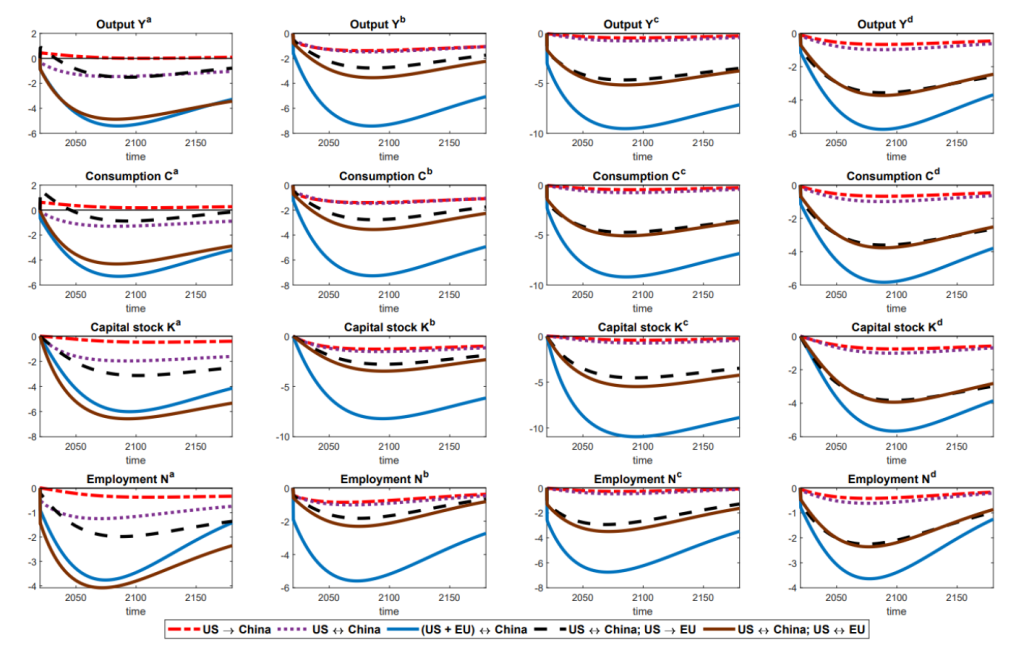
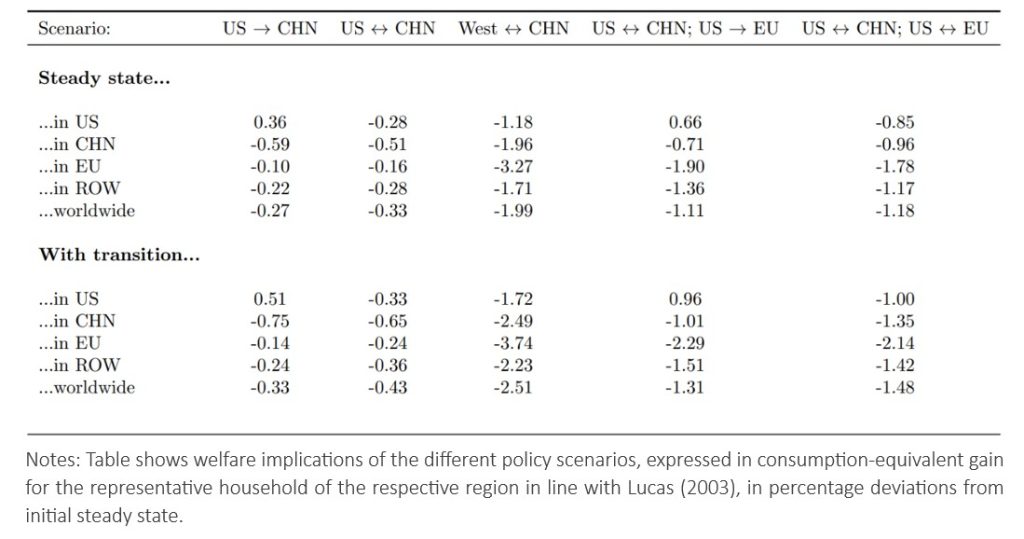
What does this imply for Europe? Our simulations suggest that the EU is best off staying out of a bilateral tariff conflict between the US and China (Scenario 4). If Europe is nevertheless drawn into such a conflict and becomes the target of US tariffs, then responding equivalently can be preferable in terms of welfare (Scenario 5, Table 1), even though this may come at the cost of a somewhat larger decline in GDP.
By contrast, a coordinated Western tariff strategy against China (Scenario 3) proves particularly costly for Europe. The reason is the EU’s strong dependence on Chinese intermediate inputs in the affected sectors: China supplies nearly half of these imports and retaliates forcefully. For Europe, alignment with US tariff policy therefore carries significant economic risks.
Because the model distinguishes between six sectors, it also allows us to examine more targeted tariff measures. The results show that the effects depend heavily on the sector concerned.
Tariffs on electronics, including semiconductors and computers, hurt China most, reflecting its strong export position in these products. In this case, the US may continue to benefit even if China retaliates, because its own dependence on Chinese imports in this segment is comparatively limited.
Tariffs on cars and machinery, by contrast, affect the EU disproportionately. This helps explain why Brussels has reacted particularly sensitively in recent trade disputes involving industrial goods.
Tariffs on food or steel should provoke weaker responses, as they inflict less damage on the trading partner. In such cases, the economic incentive to retaliate is smaller.
Therefore, the choice of sector plays a crucial role in determining both the intensity and the consequences of tariff escalation.
Tariffs operate like a tax on imports. They raise the price not only of consumer goods, but also of intermediate inputs used in production. This pushes up costs throughout supply chains, raises final prices and depresses investment. While one country may benefit temporarily from stronger domestic demand and additional tariff revenue, the global economy suffers from reduced specialization and less efficient allocation of resources.
Our welfare measure — which combines private consumption with the disutility of labor — declines in almost all regions. The losses are particularly large when several countries impose tariffs simultaneously.
Table 1. Welfare effects
Punitive tariffs prove inefficient for economic protection due to a high likelihood of retaliation.. In our model, only the initial unilateral move — if left unanswered — can generate small gains for the country imposing the tariff. But because the targeted trading partner has an incentive to retaliate, tariff conflicts usually end with lower welfare for all sides.
Looking through the lens of production networks also makes clear that tariffs reach deeper into value creation than is often assumed. By raising the cost of intermediate inputs, they disrupt production across sectors and borders. Policymakers resorting to tariffs to bolster their domestic economies therefore risk not only damaging the global economy but ultimately harming their own as well.
Our analysis is based on a model with flexible prices and full pass-through of tariffs into domestic prices. If nominal rigidities were introduced, the short-term costs could be even larger. This would reinforce, rather than weaken, our central result: punitive tariffs are a poor tool for delivering lasting protection or prosperity.
Ernst, A., N. Hinterlang, A. Mahle, and N. Stähler (2023). Carbon pricing, border adjustment and climate clubs: Options for international cooperation. Journal of International Economics 144, 103772.
Ernst, A., N. Hinterlang, M. Jäger, and N. Stähler (2026). America First? The Macroeconomic Implications of Punitive Tariffs in a Production Network Model. International Tax and Public Finance, https://doi.org/10.1007/s10797-026-09955-7.
Hinterlang, N., A. Martin, O. Röhe, N. Stähler, and J. Strobel (2023). The Environmental Multi-Sector DSGE model EMuSe: A Technical Documentation. Technical Paper 03/2023, Deutsche Bundesbank.
Lucas, R. E. (2003). Macroeconomic Priorities. American Economic Review 93 (1), 1–14.
While the regions are modelled structurally alike, calibration is region-specific