

This policy brief is based on “Risky firms and fragile banks: implications for macroprudential policy”. The views expressed herein are solely the authors’ and do not necessarily reflect the views of the Bank of Italy, Deutsche Bundesbank, Banque de France or the Eurosystem.
Abstract
Increases in firm default risk raise the default probability of banks while decreasing output and inflation in US data. To rationalize the empirical evidence, we analyse firm risk shocks in a New Keynesian model where entrepreneurs and banks engage in a loan contract, and both are subject to default risk. In the model, a wave of corporate defaults leads to losses on banks’ balance sheets; banks respond by selling assets and reducing credit provision. A highly leveraged banking sector exacerbates the contractionary effects of firm defaults. We show that high minimum capital requirements jointly implemented with a countercyclical capital buffer are effective in dampening the adverse consequences of firm risk shocks.
As a result of the Covid-19 pandemic and the lockdown measures that followed, many firms were faced with a heightened risk of default. From a policy perspective, there has been an extensive debate on how regulation can stabilize economic activity via a sound financial system (e.g. Mizen et al. 2018; Buch et al. 2021; De Guindos, 2021). In a recent study (Gasparini et al. 2026), we analyze empirically and theoretically the role of the banking sector in the transmission of risk shocks and how macroprudential policy can dampen the adverse effects of these shocks on the real economy.
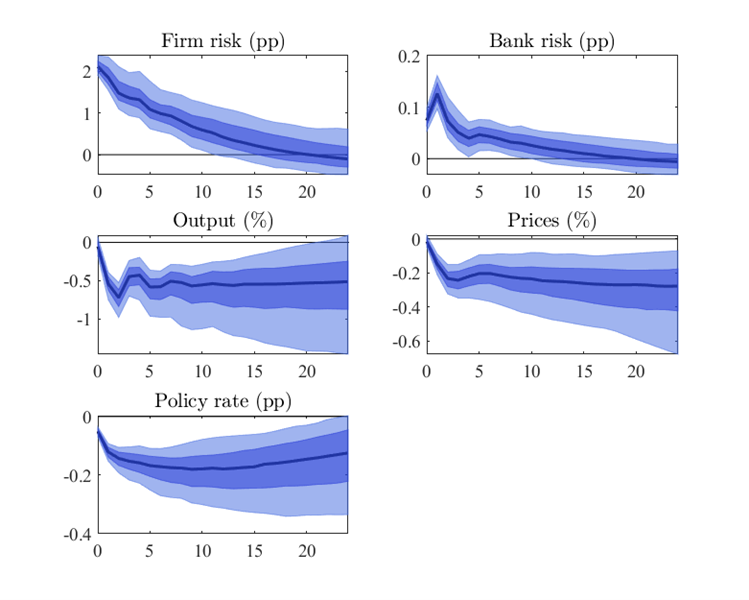
Risk shocks have been identified as an important driver of business cycle fluctuations. We empirically investigate the effects of firm risk shocks on the real economy and banks in the US using a monthly vector autoregression (VAR) with a lag length of 3. The variables used in the VAR model are firm risk, bank risk, the logarithm of real GDP, the logarithm of the price index (measured by the GDP deflator) and the policy rate. We identify firm risk shocks by assuming that firm risk is predetermined and does not respond contemporaneously to output, prices, bank risk and the policy rate.
Chart 1 shows the impulse response functions from the VAR to an exogenous one-standard deviation increase in firm risk. A firm risk shock leads to a significant fall in output, inflation and the policy rate in the US. Moreover, bank risk rises, which indicates that firm risk carries over to the banking sector in the form of a higher implicit bank default probability.
Chart 1. Empirical impulse responses to a firm risk shock
Source: Gasparini et al. 2026
Note: Sample period: January 2005 to June 2020.
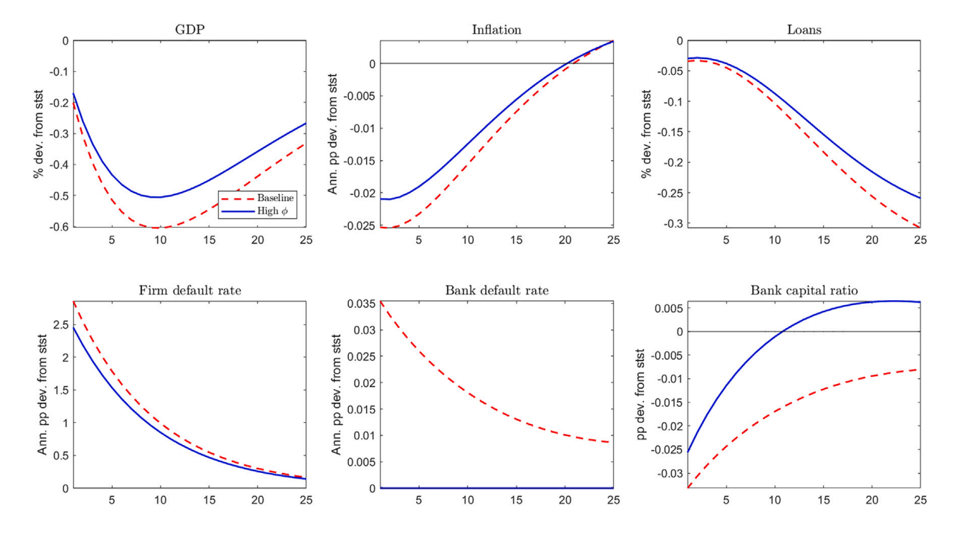
We capture the transmission of firm risk shocks in a model that combines New Keynesian price setting frictions with financial market imperfections. The dashed red lines of Chart 2 show the model impulse responses to a one-standard deviation increase in firm risk. The results are in line with the empirical evidence shown in Chart 1. An exogenous one-standard-deviation increase in firm risk implies that investment projects become riskier and firms are thus more likely to default. The annual default rate of firms rises by about 3 percentage points. Due to higher firm defaults, banks face higher losses, bank equity falls, and the bank default rate rises. The fall in equity is larger than the fall in loans and the bank capital ratio decreases. Entrepreneurs reduce their investment demand, and as investment falls, both output and inflation decrease.
Chart 2. Impulse responses to a firm risk shock: baseline vs. high capital ratio
Source: Gasparini et al. 2026
Note: Responses to a firm risk shock in two scenarios: baseline model and model with high capital re-quirements (high φ).
Chart 2 compares the impulse responses of our baseline economy (dashed red lines) with an economy that essentially eliminates bank default by means of a sufficiently high minimum capital requirement (solid blue lines).
High minimum capital ratios effectively insulate the banking sector from a wave of corporate insolvencies, as the default rate of banks no longer responds to firm risk shocks. The bank capital ratio declines less than in the baseline scenario and even rises above steady state in the medium term before going back to its pre-shock level. Hence, high capital requirements are effective in preserving financial stability.
By avoiding a contraction in loan supply that is due to bank defaults, high capital requirements mitigate the reduction in borrowing following a firm risk shock. Compared to the baseline model, investment falls less, resulting in a smaller decline in GDP, inflation, and the policy rate. However, as Chart 2 demonstrates, high capital requirements alone do not substantially stabilize the business cycle.
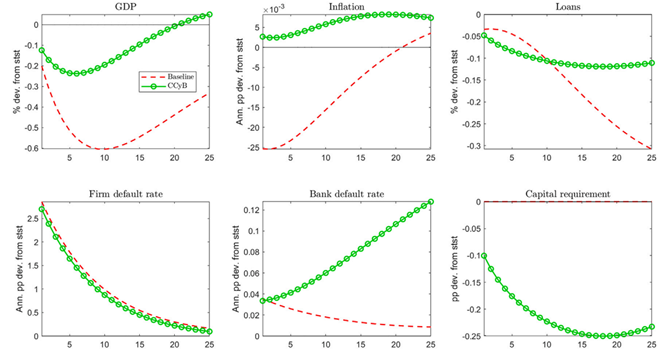
We introduce a countercyclical capital buffer by allowing the bank capital requirement to respond countercyclically to changes in borrowing. Chart 3 compares the impulse responses of our baseline economy (dashed red lines) with an economy with countercyclical capital buffers (solid green lines with circles).
The drop in investment, output and inflation is reduced when the CCyB is activated. This is because the reduction in the capital requirement allows banks to lend more than if the CCyB were not activated. As a result, the drop in loans, investment and GDP is reduced. However, Chart 3 reveals a drawback of the CCyB: an increase in bank fragility. The rise in bank defaults due to a risk shock is stronger when a CCyB is in place because banks increase their leverage to a larger extent to provide loans to entrepreneurs.
Chart 3. Impulse responses to a firm risk shock: baseline vs. CCyB
Source: Gasparini et al. 2026
Note: Responses to a firm risk shock in two scenarios: baseline model and model with countercyclical capital buffers.
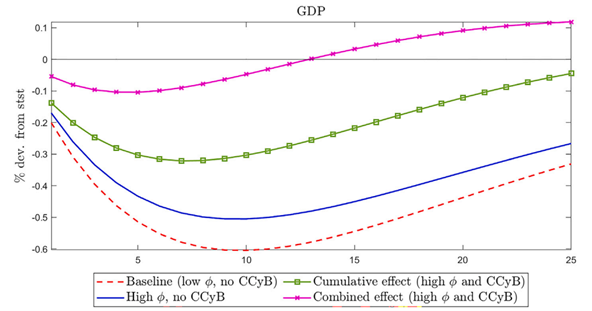
High capital requirements increase bank stability but decrease firms’ access to financial resources in downturns. A countercyclical capital requirement allows firms to have access to financial resources during downturns but increases bank default risk. Chart 4 shows that the two policies are complementary, as their joint implementation mitigates this trade-off.
Chart 4. Response of GDP to a firm risk shock: complementarity of high capital requirements and CCyB
Source: Gasparini et al. 2026
Note: Response of GDP to a risk shock in four scenarios: baseline, high capital requirements, high capi-tal requirements and CCyB without interaction, high capital requirements and CCyB.
Buch, C. M., Bussiere, M., and Goldberg, L. (2021). Macroprudential policy in the wake of the covid-19 crisis: International spillovers and coordination issues. Financial Stability Review, pages 71–81.
De Guindos, L. (2021). Macroprudential policy after the covid-19 pandemic. In Panel contribution at the Banque de France/Sciences Po Financial Stability Review Conference, volume 5.
Gasparini, T., Lewis, V., Moyen, S., Villa, S. (2026). Risky Firms and Fragile Banks: Implications for Macroprudential Policy. Journal of International Money and Finance, Volume 160.
Mizen, P., Rubio, M., and Turner, P. (2018). Macroprudential policy and practice. Cambridge University Press.